
Garrett Hardin Books
Garrett Hardin (1915–2003) was an American ecologist and philosopher known for his work on human population growth, resource scarcity, and environmental ethics. He taught at the University of California, Santa Barbara, and authored influential essays and books on ecological limits and moral responsibility.
Known for: The Tragedy of the Commons
Books by Garrett Hardin
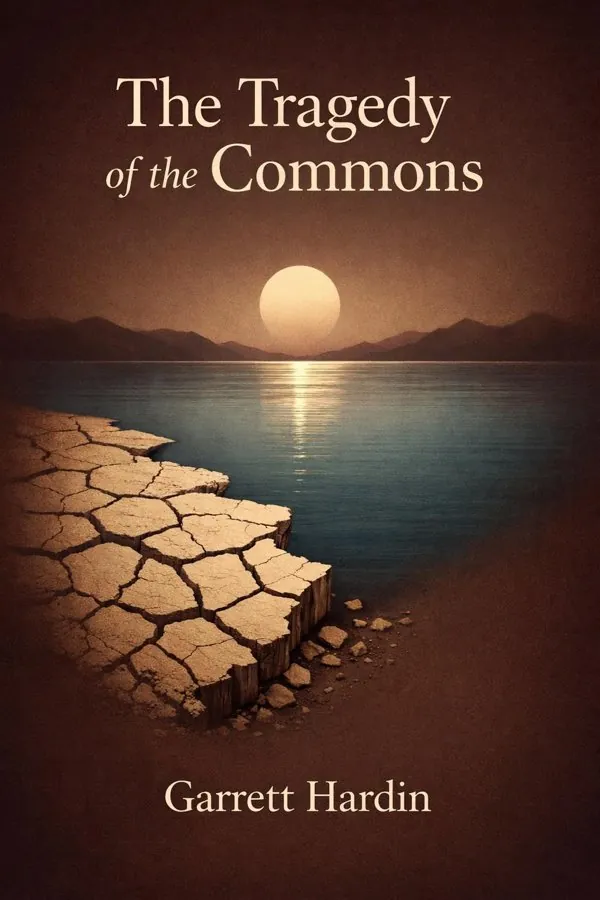
The Tragedy of the Commons
Garrett Hardin’s The Tragedy of the Commons is one of the most influential essays ever written about environmental limits, collective responsibility, and the hidden dangers of unrestricted freedom. First published in 1968, the essay asks a deceptively simple question: what happens when a resource belongs to everyone, but responsibility for protecting it belongs to no one in particular? Hardin’s answer is stark. When individuals rationally pursue their own short-term advantage in a shared system, they can unintentionally destroy the very resource on which everyone depends. Using the famous image of a common pasture open to all herdsmen, Hardin shows how private gain and public loss can become tightly intertwined. His argument reaches far beyond grazing land, extending to pollution, overfishing, population growth, climate pressures, and the governance of shared resources. The essay matters because it forces readers to confront a hard truth: good intentions and technological progress alone cannot solve problems rooted in human incentives. As an ecologist and public thinker, Hardin wrote with unusual clarity about the collision between finite ecosystems and expanding human demands, making this short work foundational in environmental thought, economics, ethics, and public policy.
Read SummaryKey Insights from Garrett Hardin
A Shared Resource Can Invite Ruin
Some of the greatest dangers arise not from malice, but from ordinary people making perfectly understandable choices. That is the unsettling insight at the heart of Hardin’s concept of the commons. A commons is any resource that is open to many users and difficult to exclude people from using: grazi...
From The Tragedy of the Commons
The Pasture Example Reveals the Logic
A simple story can sometimes explain an entire social dilemma more clearly than a complex theory. Hardin’s most famous illustration is the village pasture open to all herdsmen. Each herdsman faces a choice: add one more animal or refrain. From the individual’s perspective, adding an extra cow is rat...
From The Tragedy of the Commons
Individual Rationality Can Produce Collective Disaster
One of Hardin’s most enduring insights is that rational behavior at the personal level does not automatically lead to good outcomes for society. In fact, the opposite can be true. A person can make a choice that is logical, beneficial, and even responsible from their own perspective, yet when many o...
From The Tragedy of the Commons
No Purely Technical Fix Can Save Us
Many public problems tempt us to search for a clever invention that will allow us to avoid difficult social choices. Hardin is deeply skeptical of that hope. He argues that some problems have no purely technical solution, meaning they cannot be solved by science or engineering alone without changing...
From The Tragedy of the Commons
Population Growth Intensifies Commons Pressures
A commons becomes more fragile as the number of users increases and total demand expands. Hardin connects this directly to population growth, arguing that many environmental and social crises cannot be understood without acknowledging the pressure created by rising numbers of people drawing from fin...
From The Tragedy of the Commons
Freedom Without Limits Can Become Destructive
Hardin’s essay becomes especially provocative when he argues that not every form of freedom leads to human flourishing. In commons situations, unrestricted freedom can destroy the conditions that make freedom possible in the first place. His most controversial example is what he calls the “freedom t...
From The Tragedy of the Commons
About Garrett Hardin
Garrett Hardin (1915–2003) was an American ecologist and philosopher known for his work on human population growth, resource scarcity, and environmental ethics. He taught at the University of California, Santa Barbara, and authored influential essays and books on ecological limits and moral responsi...
Read more
Garrett Hardin (1915–2003) was an American ecologist and philosopher known for his work on human population growth, resource scarcity, and environmental ethics. He taught at the University of California, Santa Barbara, and authored influential essays and books on ecological limits and moral responsi...
Garrett Hardin (1915–2003) was an American ecologist and philosopher known for his work on human population growth, resource scarcity, and environmental ethics. He taught at the University of California, Santa Barbara, and authored influential essays and books on ecological limits and moral responsibility.


Frequently Asked Questions
Garrett Hardin (1915–2003) was an American ecologist and philosopher known for his work on human population growth, resource scarcity, and environmental ethics. He taught at the University of California, Santa Barbara, and authored influential essays and books on ecological limits and moral responsibility.
Read Garrett Hardin's books in 15 minutes
Get AI-powered summaries with key insights from 1 book by Garrett Hardin.