
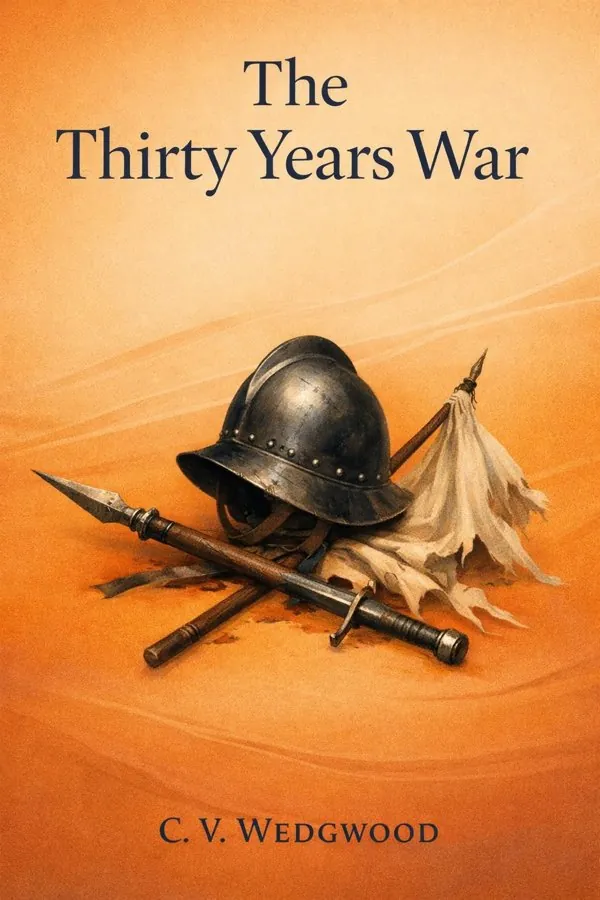
The Thirty Years War: Summary & Key Insights
 10 min9 chaptersAudio available
Key Takeaways from The Thirty Years War
Great wars often begin with a moment that seems local, almost containable, until hidden pressures make compromise impossible.
Idealism without power can become a form of tragedy.
Conflicts widen when outside powers believe intervention will be limited, profitable, or politically manageable.
Victory often plants the seeds of future defeat when it tempts rulers into demanding more than the political system can bear.
History can pivot when a disciplined outsider combines strategic clarity with political timing.
What Is The Thirty Years War About?
The Thirty Years War by C. V. Wedgwood is a world_history book spanning 9 pages. C. V. Wedgwood’s The Thirty Years War is one of the most compelling narrative histories ever written about early modern Europe’s greatest catastrophe. Covering the conflict from the Bohemian Revolt in 1618 to the Peace of Westphalia in 1648, the book shows how a local constitutional crisis inside the Holy Roman Empire expanded into a continent-wide struggle involving religion, dynastic ambition, military entrepreneurship, and state survival. Wedgwood does not treat the war as a simple clash between Catholics and Protestants. Instead, she reveals a world in which faith, fear, pride, opportunism, and political necessity repeatedly reshaped alliances and prolonged suffering. What makes the book endure is its rare blend of scholarship and storytelling. Wedgwood brings emperors, generals, diplomats, and ordinary populations into the same frame, showing how high politics translated into burned villages, famine, plague, and social collapse. Her authority rests not only on deep historical knowledge but on her ability to explain complex events with clarity and moral seriousness. The result is a history that feels both intimate and sweeping. For readers trying to understand how ideological conflict becomes total war, this book remains profoundly relevant.
This FizzRead summary covers all 9 key chapters of The Thirty Years War in approximately 10 minutes, distilling the most important ideas, arguments, and takeaways from C. V. Wedgwood's work. Also available as an audio summary and Key Quotes Podcast.
The Thirty Years War
C. V. Wedgwood’s The Thirty Years War is one of the most compelling narrative histories ever written about early modern Europe’s greatest catastrophe. Covering the conflict from the Bohemian Revolt in 1618 to the Peace of Westphalia in 1648, the book shows how a local constitutional crisis inside the Holy Roman Empire expanded into a continent-wide struggle involving religion, dynastic ambition, military entrepreneurship, and state survival. Wedgwood does not treat the war as a simple clash between Catholics and Protestants. Instead, she reveals a world in which faith, fear, pride, opportunism, and political necessity repeatedly reshaped alliances and prolonged suffering.
What makes the book endure is its rare blend of scholarship and storytelling. Wedgwood brings emperors, generals, diplomats, and ordinary populations into the same frame, showing how high politics translated into burned villages, famine, plague, and social collapse. Her authority rests not only on deep historical knowledge but on her ability to explain complex events with clarity and moral seriousness. The result is a history that feels both intimate and sweeping. For readers trying to understand how ideological conflict becomes total war, this book remains profoundly relevant.
Who Should Read The Thirty Years War?
This book is perfect for anyone interested in world_history and looking to gain actionable insights in a short read. Whether you're a student, professional, or lifelong learner, the key ideas from The Thirty Years War by C. V. Wedgwood will help you think differently.
- ✓Readers who enjoy world_history and want practical takeaways
- ✓Professionals looking to apply new ideas to their work and life
- ✓Anyone who wants the core insights of The Thirty Years War in just 10 minutes
Want the full summary?
Get instant access to this book summary and 100K+ more with Fizz Moment.
Get Free SummaryAvailable on App Store • Free to download
Key Chapters
Great wars often begin with a moment that seems local, almost containable, until hidden pressures make compromise impossible. Wedgwood begins in Bohemia, where Protestant nobles feared that their religious liberties would be crushed by the Habsburg monarchy. The famous Defenestration of Prague in 1618, when imperial officials were thrown from a castle window, was dramatic, but the deeper story lay in years of mistrust between the Bohemian estates and rulers determined to strengthen Catholic authority and dynastic control.
Wedgwood shows that this was not merely a theological dispute. It was also a constitutional struggle over who had the right to govern, appoint officials, and define the political character of the kingdom. When the Bohemians rejected Ferdinand and chose Frederick V of the Palatinate as king, they transformed a domestic rebellion into an international challenge to Habsburg power. The revolt drew in outside sympathizers, alarmed Catholic princes, and exposed the fragility of imperial balance.
A practical lesson emerges here for anyone studying political breakdown: crises become dangerous when identity, legal rights, and state power become fused into one dispute. In modern organizations or nations, a disagreement over rules can escalate quickly if one side sees it as a threat to its existence. Wedgwood’s account reminds us to pay attention not only to dramatic incidents but to the accumulated grievances that make symbolic acts explosive.
Actionable takeaway: When analyzing any conflict, ask what long-term tensions made the triggering event meaningful, not just memorable.
Idealism without power can become a form of tragedy. In Wedgwood’s telling, Frederick V, later mocked as the “Winter King,” was not simply foolish; he was a figure swept up by hope, flattery, and the illusion that a righteous cause would automatically attract decisive support. By accepting the Bohemian crown, he gambled that Protestant solidarity and anti-Habsburg sentiment would offset the military and political strength of his enemies. They did not.
His reign in Bohemia was brief, his coalition weak, and his strategic position disastrous. After defeat at the Battle of White Mountain in 1620, Frederick fled, and his supporters were left to face harsh retribution. Wedgwood uses this episode to illustrate how symbolic victories can conceal practical weakness. Frederick’s acceptance of the crown thrilled allies who wanted a Protestant champion, but many of those same allies hesitated when real sacrifice was required.
The Palatinate phase also reveals how quickly reputations harden in history. Frederick became the emblem of failed defiance, yet Wedgwood encourages readers to see the structural forces behind his collapse: fragmented support, financial instability, and the mismatch between moral aspiration and military preparation. This has modern relevance in politics, business, and activism. Leaders may be praised for bold gestures, but success depends on logistics, coalition discipline, and realistic assessment.
Actionable takeaway: Before committing to a high-stakes cause, test whether your support base is emotional, rhetorical, or truly capable of sustained action.
Conflicts widen when outside powers believe intervention will be limited, profitable, or politically manageable. Wedgwood presents the Danish phase, led by King Christian IV, as a warning against underestimating a conflict already gaining its own momentum. Christian entered the war partly as a Protestant defender and partly as a ruler pursuing influence within northern Germany. His intervention reflected the persistent entanglement of religion and dynastic ambition that defines the whole book.
Yet the Danish campaign exposed how transformed the struggle had become. Imperial and Catholic League forces, especially under commanders like Tilly and Wallenstein, were no longer merely reacting to rebellion. They were developing into powerful military machines capable of enforcing imperial will on a far larger scale. Christian’s defeat showed that Protestant resistance could not rely on prestige alone. Organization, financing, and professional command mattered more than intentions.
Wedgwood also highlights the social cost of escalation. Armies moved through territories not as disciplined national forces in the modern sense but as partly self-sustaining bodies living off occupied land. This meant intervention brought devastation even to areas not central to the original dispute. In modern terms, a conflict that outsiders enter for strategic leverage can rapidly become a humanitarian disaster for civilians trapped in between.
For contemporary readers, the Danish phase offers a framework for understanding mission creep. Limited involvement often expands because each actor believes it can shape outcomes without bearing the full cost. The result is prolonged instability and weakened leverage.
Actionable takeaway: When evaluating intervention, ask not only whether entry is justified, but whether there is a realistic plan for sustaining, controlling, and ending involvement.
Victory often plants the seeds of future defeat when it tempts rulers into demanding more than the political system can bear. Wedgwood treats the Edict of Restitution of 1629 as one of the war’s decisive turning points. Issued by Emperor Ferdinand II after major imperial successes, the edict sought to restore former Catholic properties that had been secularized since the mid-sixteenth century. In theory, it was a legal and religious correction. In practice, it looked like an attempt to remake the empire by force.
The problem was not only the edict’s religious content but its political implications. Many Protestant princes saw it as a direct threat to their autonomy, while even some Catholics feared the growth of centralized imperial power. Wedgwood is especially sharp in showing how overreach can unify otherwise divided opponents. Measures intended to consolidate triumph often expose anxieties that had remained dormant during crisis.
This episode is highly instructive beyond seventeenth-century history. Leaders in any field may mistake a temporary advantage for a mandate to impose maximal change. Yet institutions, communities, and coalitions usually contain hidden thresholds of resistance. Push beyond them, and former allies become skeptics while neutral actors turn hostile.
Wedgwood’s larger argument is that the war could not be reduced to confessional logic alone. Ferdinand’s strongest position became weaker because policy alienated constituencies whose support he needed. The Edict of Restitution therefore demonstrates the danger of treating power as unlimited simply because opposition appears defeated.
Actionable takeaway: After a major win, resist the urge to press every advantage; preserving legitimacy is often more important than enforcing total victory.
History can pivot when a disciplined outsider combines strategic clarity with political timing. Wedgwood’s account of the Swedish intervention centers on Gustavus Adolphus, whose arrival in 1630 altered both the military and psychological balance of the war. Sweden entered as a Protestant power defending co-religionists, but also as a Baltic state pursuing security, influence, and advantage against Habsburg expansion. Wedgwood never lets readers forget this dual motive: ideals and interests moved together.
Gustavus stood out not only for his charisma but for the effectiveness of his army and command style. Wedgwood emphasizes his mobility, tactical innovation, and ability to inspire confidence among allies who had long endured defeat. The Swedish victories, especially at Breitenfeld, broke the sense of inevitable imperial dominance and reopened the political map of Germany. For many Protestant states, Sweden provided what Frederick and Denmark had not: credible military protection.
At the same time, Wedgwood avoids hero worship. Swedish success depended on alliances, financing, and the continued weakness of opponents. Even brilliant leadership could not end the war quickly, and Gustavus’s death at Lützen showed how fragile momentum could be. The intervention demonstrates that strong leadership matters most when connected to institutions capable of carrying strategy beyond the leader’s life.
In practical terms, this phase teaches that reforms or campaigns succeed when message, organization, and execution align. Confidence alone is never enough, but confidence backed by competence can transform what others think is possible.
Actionable takeaway: If you want to change a losing situation, combine moral purpose with superior preparation, not with slogans alone.
One of Wedgwood’s most important insights is that the Thirty Years’ War ceased to be explainable as a purely religious conflict long before it ended. Nothing proves this better than the French intervention. Catholic France, under Cardinal Richelieu and later Mazarin, opposed the Catholic Habsburgs because dynastic encirclement threatened French security and influence. Here Wedgwood shows the emergence of a more modern political logic: raison d’état, or reason of state.
French involvement from 1635 onward made explicit what had been increasingly true all along. Governments pursued survival, power, and strategic balance even when those goals cut across confessional identity. This did not mean religion no longer mattered. Rather, it meant that religion operated within a wider field of state interests. Wedgwood uses this development to explain why the war grew even more destructive. Once preserving equilibrium became the priority, conflict no longer depended on settling doctrine. It continued because no major power wanted another to dominate Europe.
This phase is deeply relevant to modern geopolitics. States often justify action in moral or ideological language while also calculating security, trade, territory, and prestige. Wedgwood’s narrative trains readers to look beyond official slogans and ask what structural interests are truly at stake. That habit is valuable in reading both history and current affairs.
France’s role also marks a turning point in European statecraft. Diplomacy, subsidies, and coalition warfare became as important as battlefield zeal. The war was no longer about who was right before God, but about who could endure, negotiate, and constrain rivals.
Actionable takeaway: In any political conflict, distinguish declared principles from underlying interests; understanding both is essential to predicting outcomes.
Power can hollow itself out when expansion creates burdens greater than any ruler can manage. Wedgwood traces the later years of the war as a period in which the emperor’s authority, despite repeated recoveries, became increasingly difficult to convert into stable control. Ferdinand II and then Ferdinand III presided over an empire exhausted by military campaigning, financial strain, and the centrifugal tendencies of its many territories. The more the war required centralized direction, the more the empire’s fragmented nature limited such direction.
Wedgwood is especially attentive to the role of generals, financiers, and regional princes. Figures like Wallenstein embodied both the strength and danger of wartime improvisation. They could raise armies and deliver victories, but they also accumulated independent influence that made rulers dependent on them. This created a paradox familiar in many institutions: emergency measures solve immediate problems while weakening long-term authority.
By the 1640s, the emperor still mattered enormously, but the dream of imposing a coherent religious and political settlement from the center had faded. Exhaustion, local interests, and foreign involvement made total imperial victory unrealistic. Wedgwood’s analysis suggests that decline is not always dramatic collapse. Sometimes it is the slow recognition that ambition has outrun capacity.
This idea has broad application. Organizations often expand through crisis management, only to discover that ad hoc solutions multiply dependencies and dilute command. Effective leadership requires knowing when to transition from emergency action to sustainable governance.
Actionable takeaway: Measure strength not by how much control you can seize in crisis, but by how much order you can maintain afterward without constant escalation.
Peace matters most when it changes the rules by which enemies can continue living together. Wedgwood presents the Peace of Westphalia in 1648 not as a neat moral triumph but as a hard-earned settlement shaped by fatigue, compromise, and realism. The treaties did not erase religious division or create instant harmony. What they did was acknowledge political plurality inside the empire and establish a framework in which rival powers and confessions could coexist without endless recourse to universal claims.
The settlement confirmed the rights of imperial states, adjusted territorial arrangements, and recognized Calvinism alongside Catholicism and Lutheranism. Just as important, it reduced the possibility that one power could simply dictate Europe’s future under the banner of religious unity. Wedgwood shows that Westphalia emerged because every major actor had learned, through suffering, the cost of insisting on complete victory.
The broader lesson is that durable peace rarely comes from perfect agreement. More often it comes from structured disagreement, accepted limits, and institutions that channel conflict away from annihilation. This insight applies well beyond diplomacy. In workplaces, communities, and politics, coexistence may require arrangements that feel incomplete but prevent destructive absolutism.
Wedgwood also highlights the emotional dimension of settlement. After decades of devastation, peace was not celebrated as glorious fulfillment but accepted as necessary release. That sobriety makes Westphalia significant. It was built not on idealism alone, but on realism disciplined by memory.
Actionable takeaway: In conflict resolution, aim first for workable coexistence and clear rules, rather than waiting for total consensus that may never come.
The deepest cost of war is often paid far from courts and battlefields. Wedgwood’s final achievement is to keep civilian suffering at the center of a story dominated by rulers, treaties, and campaigns. The Thirty Years’ War brought repeated famine, disease, displacement, taxation, plunder, and demographic collapse to large parts of central Europe. Armies consumed the land that fed them, and populations already weakened by scarcity became vulnerable to epidemic disease. Even regions not permanently occupied lived under the shadow of contribution, confiscation, and fear.
Wedgwood refuses to romanticize this devastation. She shows how the war reshaped moral expectations, local economies, and the relationship between subjects and states. Communities learned to survive through bargaining, concealment, flight, and adaptation. In that sense, the war was not only an event but a social condition that lasted a generation. Its memory influenced later understandings of sovereignty, military power, and the dangers of ideological absolutism.
For modern readers, this is the book’s most enduring warning. It is easy to discuss war in terms of strategy, grand principles, or diplomatic results. Wedgwood insists that those abstractions must always be tested against human consequences. Any political order that cannot protect ordinary life eventually undermines its own legitimacy.
This perspective is useful in current debates about security, intervention, and state power. Policies should be judged not just by stated goals but by their effects on civilians, institutions, and social trust over time.
Actionable takeaway: When evaluating any conflict or policy, place human welfare at the center; strategic success without social recovery is a form of failure.
All Chapters in The Thirty Years War
About the Author
Cicely Veronica Wedgwood (1910–1997) was a British historian celebrated for making complex early modern history vivid, readable, and intellectually serious. Educated at Lady Margaret Hall, Oxford, she developed a distinguished career writing narrative history that combined archival rigor with literary grace. Wedgwood became especially known for her works on seventeenth-century Europe and Britain, including studies of the English Civil War, Oliver Cromwell, William the Silent, and the Thirty Years’ War. Her writing stands out for its clear structure, psychological insight, and moral attention to the human cost of political conflict. Though admired by scholars, she also reached a wide general audience because she could explain difficult historical events without sacrificing nuance. She remains one of the twentieth century’s most respected and influential narrative historians.
Get This Summary in Your Preferred Format
Read or listen to the The Thirty Years War summary by C. V. Wedgwood anytime, anywhere. FizzRead offers multiple formats so you can learn on your terms — all free.
Available formats: App · Audio · PDF · EPUB — All included free with FizzRead
Download The Thirty Years War PDF and EPUB Summary
Key Quotes from The Thirty Years War
“Great wars often begin with a moment that seems local, almost containable, until hidden pressures make compromise impossible.”
“Idealism without power can become a form of tragedy.”
“Conflicts widen when outside powers believe intervention will be limited, profitable, or politically manageable.”
“Victory often plants the seeds of future defeat when it tempts rulers into demanding more than the political system can bear.”
“History can pivot when a disciplined outsider combines strategic clarity with political timing.”
Frequently Asked Questions about The Thirty Years War
The Thirty Years War by C. V. Wedgwood is a world_history book that explores key ideas across 9 chapters. C. V. Wedgwood’s The Thirty Years War is one of the most compelling narrative histories ever written about early modern Europe’s greatest catastrophe. Covering the conflict from the Bohemian Revolt in 1618 to the Peace of Westphalia in 1648, the book shows how a local constitutional crisis inside the Holy Roman Empire expanded into a continent-wide struggle involving religion, dynastic ambition, military entrepreneurship, and state survival. Wedgwood does not treat the war as a simple clash between Catholics and Protestants. Instead, she reveals a world in which faith, fear, pride, opportunism, and political necessity repeatedly reshaped alliances and prolonged suffering. What makes the book endure is its rare blend of scholarship and storytelling. Wedgwood brings emperors, generals, diplomats, and ordinary populations into the same frame, showing how high politics translated into burned villages, famine, plague, and social collapse. Her authority rests not only on deep historical knowledge but on her ability to explain complex events with clarity and moral seriousness. The result is a history that feels both intimate and sweeping. For readers trying to understand how ideological conflict becomes total war, this book remains profoundly relevant.
You Might Also Like
The Age of Capital
Eric Hobsbawm
10 min
The Gulag Archipelago
Aleksandr Solzhenitsyn
10 min
Jerusalem: The Biography
Simon Sebag Montefiore
10 min
The Anglo-Saxons
James Campbell
10 min
The Boer War
Thomas Pakenham
10 min
The Industrial Revolutionaries: The Making of the Modern World 1776–1914
Gavin Weightman
10 minBrowse by Category
Ready to read The Thirty Years War?
Get the full summary and 100K+ more books with Fizz Moment.