
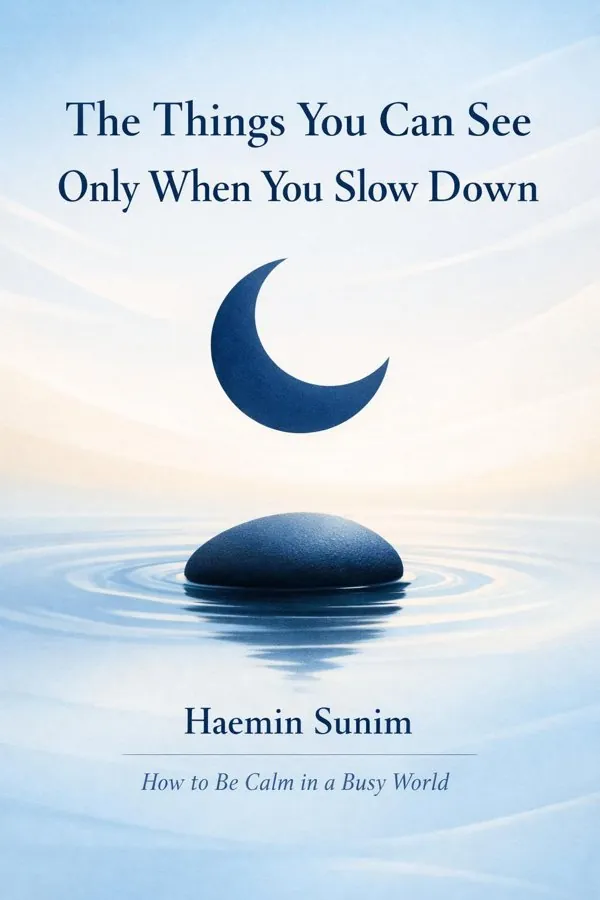
The Things You Can See Only When You Slow Down: How to Be Calm in a Busy World: Summary & Key Insights
by Haemin Sunim
 10 min9 chaptersAudio available
Key Takeaways from The Things You Can See Only When You Slow Down: How to Be Calm in a Busy World
Many people secretly believe that rest is a luxury earned only after everything is done.
The mind rarely stays where the body is.
We are often told to find our passion and pursue it with total intensity.
How we relate to others often reveals how we relate to ourselves.
Love is often imagined as intensity, chemistry, or dramatic feeling.
What Is The Things You Can See Only When You Slow Down: How to Be Calm in a Busy World About?
The Things You Can See Only When You Slow Down: How to Be Calm in a Busy World by Haemin Sunim is a eastern_wisdom book spanning 8 pages. In a culture that rewards speed, productivity, and constant stimulation, Haemin Sunim offers a different path: slow down, look inward, and reconnect with what truly matters. The Things You Can See Only When You Slow Down is a gentle but powerful guide to living with greater peace in the middle of modern life. Rather than demanding dramatic change, the book invites readers to notice how stress, anxiety, and dissatisfaction are often shaped not only by external pressures, but by the restless habits of the mind. Drawing on Zen Buddhism, personal reflection, and compassionate observation, Haemin Sunim explores themes such as rest, mindfulness, relationships, love, work, and spirituality. His writing is simple, warm, and deeply reassuring, making timeless wisdom feel practical and approachable for everyday readers. He writes not as a distant spiritual authority, but as a thoughtful teacher who understands the emotional strain of busy lives. Haemin Sunim is uniquely credible in this role: a Korean Zen monk educated at Berkeley, Harvard, and Princeton, he bridges Eastern contemplative wisdom and contemporary concerns with unusual clarity. This book matters because it reminds us that calm is not found by escaping life, but by learning how to meet it differently.
This FizzRead summary covers all 9 key chapters of The Things You Can See Only When You Slow Down: How to Be Calm in a Busy World in approximately 10 minutes, distilling the most important ideas, arguments, and takeaways from Haemin Sunim's work. Also available as an audio summary and Key Quotes Podcast.
The Things You Can See Only When You Slow Down: How to Be Calm in a Busy World
In a culture that rewards speed, productivity, and constant stimulation, Haemin Sunim offers a different path: slow down, look inward, and reconnect with what truly matters. The Things You Can See Only When You Slow Down is a gentle but powerful guide to living with greater peace in the middle of modern life. Rather than demanding dramatic change, the book invites readers to notice how stress, anxiety, and dissatisfaction are often shaped not only by external pressures, but by the restless habits of the mind.
Drawing on Zen Buddhism, personal reflection, and compassionate observation, Haemin Sunim explores themes such as rest, mindfulness, relationships, love, work, and spirituality. His writing is simple, warm, and deeply reassuring, making timeless wisdom feel practical and approachable for everyday readers. He writes not as a distant spiritual authority, but as a thoughtful teacher who understands the emotional strain of busy lives.
Haemin Sunim is uniquely credible in this role: a Korean Zen monk educated at Berkeley, Harvard, and Princeton, he bridges Eastern contemplative wisdom and contemporary concerns with unusual clarity. This book matters because it reminds us that calm is not found by escaping life, but by learning how to meet it differently.
Who Should Read The Things You Can See Only When You Slow Down: How to Be Calm in a Busy World?
This book is perfect for anyone interested in eastern_wisdom and looking to gain actionable insights in a short read. Whether you're a student, professional, or lifelong learner, the key ideas from The Things You Can See Only When You Slow Down: How to Be Calm in a Busy World by Haemin Sunim will help you think differently.
- ✓Readers who enjoy eastern_wisdom and want practical takeaways
- ✓Professionals looking to apply new ideas to their work and life
- ✓Anyone who wants the core insights of The Things You Can See Only When You Slow Down: How to Be Calm in a Busy World in just 10 minutes
Want the full summary?
Get instant access to this book summary and 100K+ more with Fizz Moment.
Get Free SummaryAvailable on App Store • Free to download
Key Chapters
Many people secretly believe that rest is a luxury earned only after everything is done. But Haemin Sunim challenges this idea by showing that exhaustion clouds judgment, hardens emotions, and disconnects us from the present. When we are depleted, even simple tasks feel heavy. We become impatient with others, overly critical of ourselves, and unable to appreciate what is good in our lives. Rest, then, is not laziness. It is a condition for clarity.
The book argues that a life lived at relentless speed is not necessarily a meaningful one. Constant busyness can become a form of avoidance, keeping us from facing our inner life. We say we are too busy to pause, yet without pausing we lose touch with our deepest values. Rest restores perspective. It allows the nervous system to settle, the mind to soften, and our attention to return to what matters most.
This idea has practical implications. Instead of treating breaks as wasted time, we can see them as essential maintenance. A short walk without your phone, a quiet cup of tea, a few conscious breaths between meetings, or a full evening with no obligation to perform can radically change the quality of your day. Rest is not only sleep or vacation; it is any moment in which you stop forcing yourself forward.
When you feel guilty for slowing down, ask whether fatigue is making your life smaller than it needs to be. Actionable takeaway: schedule rest with the same seriousness you give work, and treat recovery as part of living wisely, not as a reward for overwork.
The mind rarely stays where the body is. It replays yesterday, anticipates tomorrow, and invents problems that do not yet exist. Haemin Sunim reminds us that mindfulness is not about achieving a special state of perfection. It is the simple act of returning to the present moment again and again with kindness.
This matters because much of our suffering comes not from reality itself, but from our constant mental commentary about reality. We become overwhelmed by imagined futures, trapped in old regrets, or distracted by comparison and noise. Mindfulness interrupts this pattern by bringing awareness back to immediate experience: the breath entering the body, the sensation of walking, the sound of rain, the expression on someone’s face. These small acts of noticing ground us in what is real.
The author presents mindfulness as accessible to ordinary life. You do not need a mountain retreat or an hour-long meditation practice to begin. You can wash dishes while actually feeling the water. You can listen to a friend without preparing your response. You can pause before reacting to an upsetting message and notice the emotion rising in your chest. Each moment of awareness weakens the habit of unconscious rushing.
Importantly, mindfulness is not self-judgment. The point is not to scold yourself for drifting, but to gently come back. That gentle return is the practice. Over time, this creates more patience, emotional balance, and presence in relationships.
Actionable takeaway: choose one daily routine, such as eating breakfast or commuting, and turn it into a mindfulness practice by giving it your full attention for at least five minutes each day.
We are often told to find our passion and pursue it with total intensity. Yet Haemin Sunim offers a more humane view: passion is valuable, but when it becomes tangled with ego, fear, or constant comparison, it can turn into another source of suffering. The healthiest passion energizes rather than consumes us.
The book encourages readers to examine why they want what they want. Are you working hard because the work itself matters to you, or because you need recognition? Are you driven by curiosity, or by fear of being left behind? These questions matter because externally impressive goals can leave us internally empty if they are disconnected from our true values.
Balanced passion allows room for rest, reflection, and flexibility. It recognizes that meaningful work unfolds over time and that identity should not depend entirely on performance. A student, artist, entrepreneur, or professional may care deeply about success, but if every setback becomes a verdict on self-worth, then passion has become attachment. In that state, even achievement brings little peace.
A wiser approach is to commit fully while holding outcomes more lightly. You can prepare well, work diligently, and still remember that your dignity does not rise and fall with praise or failure. This creates resilience. It also improves performance, because a calmer mind tends to think more clearly and recover faster.
Actionable takeaway: write down one major goal, then list the deeper reason behind it. If the reason is mostly approval, status, or fear, revise your approach so your effort reflects meaning, growth, and service rather than obsession.
How we relate to others often reveals how we relate to ourselves. Haemin Sunim suggests that many relationship difficulties are intensified not simply by what others do, but by our own unhealed hurts, expectations, and inner tension. When the mind is agitated, we interpret neutral events negatively, react defensively, and struggle to offer generosity.
The book invites readers to bring mindfulness into human connection. This means listening carefully, noticing our emotional triggers, and resisting the urge to win every disagreement. In a busy world, we often interact while distracted, half-listening while checking our phones or mentally rehearsing what we want to say next. True connection requires presence. People feel seen not when we say the perfect thing, but when we are genuinely there.
Haemin Sunim also emphasizes compassion. Everyone is carrying invisible burdens. The rude coworker may be overwhelmed. The distant friend may be afraid. The demanding family member may be lonely. Compassion does not mean tolerating harmful behavior without boundaries, but it does mean refusing to reduce people to the most difficult moment they show us.
In practical terms, healthier relationships often begin with small changes: pausing before replying in anger, asking one sincere question, apologizing without defensiveness, or noticing when your frustration comes from stress unrelated to the person in front of you. The calmer your inner life becomes, the less likely you are to spread pain outward.
Actionable takeaway: in your next important conversation, focus on understanding before being understood. Listen fully, notice your emotional reactions, and respond only after a conscious breath.
Love is often imagined as intensity, chemistry, or dramatic feeling. Haemin Sunim points to something quieter and more enduring: love deepens through attention, kindness, and steady care. To love well is not merely to feel strongly, but to be present enough to notice another person’s reality.
This insight extends beyond romance. Love appears in friendship, family, community, and even in the way we regard strangers. The author shows that genuine love is closely tied to compassion. It listens without immediately fixing. It sees weakness without contempt. It offers warmth without demanding perfection. In contrast, what we sometimes call love is actually attachment, control, or projection. We want others to fit our expectations, and when they do not, disappointment turns into blame.
The book encourages a more spacious understanding of love. If you care for someone, can you allow them to be human? Can you see their struggles without making everything about yourself? Can you express appreciation before crisis forces you to realize their value? Love becomes stronger when it is practiced in ordinary moments: checking in, being patient, remembering small details, speaking honestly but gently.
Haemin Sunim also reminds readers that self-love matters. A person who constantly attacks themselves may seek from others a reassurance that no relationship can permanently provide. Inner kindness creates a more stable foundation for outward love.
Actionable takeaway: each day, show love through one concrete act of attention, such as sending a thoughtful message, offering undivided presence, or speaking to yourself with the same gentleness you would offer someone dear to you.
Much of modern stress comes from excess: too many commitments, too much information, too many comparisons, and too little silence. Haemin Sunim suggests that when life feels confusing, the answer is often not to add more, but to remove what is unnecessary. Clarity grows in simplicity.
This does not mean withdrawing from responsibility or rejecting ambition. It means becoming more intentional about where your energy goes. Many people live by default rather than design. They say yes automatically, consume endlessly, and let external demands shape every hour. Over time, this creates a life that looks full but feels strangely empty.
Simplifying begins with attention. What drains you repeatedly? What matters deeply? Which obligations are real, and which are maintained out of habit, fear, or social pressure? The book encourages readers to become more selective with time, possessions, and mental focus. A simpler life is not smaller; it is more aligned.
Examples are easy to recognize. You may decide to protect your mornings from social media, reduce unnecessary purchases, keep a less crowded schedule, or stop chasing every opportunity that promises status but little meaning. You may choose fewer but deeper friendships, fewer distractions while working, and more moments of quiet. These changes create space for reflection, gratitude, and steadier joy.
Simplicity is a spiritual discipline as much as a practical one. It helps us see that peace is often available when noise subsides.
Actionable takeaway: identify one recurring source of unnecessary complexity in your life this week, then remove, reduce, or restructure it so your time and attention better reflect your true priorities.
Anxiety often disguises itself as preparation. We tell ourselves that worrying about the future is responsible, yet much of the time it only drains our energy and robs the present of its vitality. Haemin Sunim does not suggest ignoring the future, but he does urge us to relate to it differently. The future is best cared for through wise action now, not endless mental rehearsal.
When we become consumed by uncertainty, the mind leaps ahead and imagines worst-case scenarios. This creates tension without solving the problem. We lose sleep over events that may never happen, and in the process we miss the only place where real influence exists: the present moment. The author’s message is calming and practical. Plant good seeds today. The future will grow from them.
This perspective is especially useful in times of career uncertainty, health concerns, financial stress, or major life transition. Rather than asking, “How can I guarantee everything will be okay?” ask, “What is the next wise step available to me now?” That step might be saving money, preparing thoroughly, making a phone call, asking for help, or simply resting so you can think clearly. Peace does not come from certainty. It comes from grounded action combined with acceptance of what cannot be controlled.
This idea also protects against perfectionism. You do not need a complete life plan to move forward. Often, one sincere step is enough.
Actionable takeaway: when future anxiety rises, write down what is within your control today, do one concrete thing from that list, and consciously release the rest for now.
Many people imagine spirituality as something separate from daily life, reserved for temples, meditation halls, or special retreats. Haemin Sunim gently dissolves this division. Spirituality, in his view, is not an escape from ordinary existence. It is the quality of awareness, compassion, and presence we bring to ordinary existence.
This makes the spiritual life far more accessible than many assume. You do not have to withdraw from the world to live wisely within it. A spiritual moment can be found in breathing deeply before speaking, in noticing the sky on your walk home, in forgiving someone who hurt you, or in sitting quietly with your own pain rather than numbing it. These moments seem small, but they transform the texture of life.
The book is rooted in Buddhist wisdom, yet its insights are universal rather than dogmatic. It invites readers of any background to become more awake to impermanence, more compassionate toward suffering, and less attached to the constant demands of ego. Spiritual maturity is measured less by what we profess than by how gently and clearly we live.
Haemin Sunim also emphasizes that inner peace and ethical living are connected. A calmer mind is more able to act with generosity, patience, and humility. Spirituality is not just self-soothing. It is a way of becoming less harmful and more loving in the world.
Actionable takeaway: create a brief daily ritual, such as two minutes of silence in the morning or gratitude before sleep, and use it to reconnect with awareness beyond productivity and distraction.
One of the most painful forms of stress is the voice inside us that is never satisfied. Haemin Sunim recognizes that many people live under constant inner criticism, measuring themselves against impossible standards and interpreting every weakness as personal failure. He offers a softer alternative: treat yourself with the same compassion you would offer a struggling friend.
Self-compassion is not self-indulgence or denial. It is honest, but not cruel. It allows you to acknowledge mistakes without turning them into identity. Instead of saying, “I failed, so I am worthless,” you learn to say, “This is hard, and I am still worthy of care.” That shift matters because shame tends to paralyze, while kindness makes growth possible.
The author’s approach is especially important for high achievers, perfectionists, and people carrying old emotional wounds. If your worth depends on constant success, life becomes exhausting. Every setback feels existential. Self-compassion loosens that pressure. It creates room to rest, learn, and begin again.
Practically, this may mean noticing harsh self-talk and replacing it with truthful but supportive language. It may mean giving yourself permission to recover after disappointment instead of immediately demanding more output. It may also mean recognizing when emotional pain needs support from friends, community, or professional help.
A peaceful life is not built only through discipline. It is also built through tenderness toward your own humanity.
Actionable takeaway: the next time you make a mistake, pause and write three sentences you would say to a loved one in the same situation, then read those sentences back to yourself.
All Chapters in The Things You Can See Only When You Slow Down: How to Be Calm in a Busy World
About the Author
Haemin Sunim is a Korean Zen Buddhist teacher and bestselling author known for bringing mindfulness and compassion into everyday life. Ordained as a monk in the Korean Buddhist tradition, he has studied extensively in both Asia and the United States, with academic experience including Berkeley, Harvard, and Princeton. This cross-cultural background helps him translate Eastern contemplative wisdom into language that feels relevant to modern readers facing stress, distraction, and emotional fatigue. Haemin Sunim’s teachings often focus on inner peace, relationships, self-compassion, and the value of slowing down in a fast-moving world. Through his books, lectures, and public outreach, he has become one of the most widely recognized contemporary voices in accessible Buddhist-inspired well-being.
Get This Summary in Your Preferred Format
Read or listen to the The Things You Can See Only When You Slow Down: How to Be Calm in a Busy World summary by Haemin Sunim anytime, anywhere. FizzRead offers multiple formats so you can learn on your terms — all free.
Available formats: App · Audio · PDF · EPUB — All included free with FizzRead
Download The Things You Can See Only When You Slow Down: How to Be Calm in a Busy World PDF and EPUB Summary
Key Quotes from The Things You Can See Only When You Slow Down: How to Be Calm in a Busy World
“Many people secretly believe that rest is a luxury earned only after everything is done.”
“The mind rarely stays where the body is.”
“We are often told to find our passion and pursue it with total intensity.”
“How we relate to others often reveals how we relate to ourselves.”
“Love is often imagined as intensity, chemistry, or dramatic feeling.”
Frequently Asked Questions about The Things You Can See Only When You Slow Down: How to Be Calm in a Busy World
The Things You Can See Only When You Slow Down: How to Be Calm in a Busy World by Haemin Sunim is a eastern_wisdom book that explores key ideas across 9 chapters. In a culture that rewards speed, productivity, and constant stimulation, Haemin Sunim offers a different path: slow down, look inward, and reconnect with what truly matters. The Things You Can See Only When You Slow Down is a gentle but powerful guide to living with greater peace in the middle of modern life. Rather than demanding dramatic change, the book invites readers to notice how stress, anxiety, and dissatisfaction are often shaped not only by external pressures, but by the restless habits of the mind. Drawing on Zen Buddhism, personal reflection, and compassionate observation, Haemin Sunim explores themes such as rest, mindfulness, relationships, love, work, and spirituality. His writing is simple, warm, and deeply reassuring, making timeless wisdom feel practical and approachable for everyday readers. He writes not as a distant spiritual authority, but as a thoughtful teacher who understands the emotional strain of busy lives. Haemin Sunim is uniquely credible in this role: a Korean Zen monk educated at Berkeley, Harvard, and Princeton, he bridges Eastern contemplative wisdom and contemporary concerns with unusual clarity. This book matters because it reminds us that calm is not found by escaping life, but by learning how to meet it differently.
More by Haemin Sunim
You Might Also Like
A New Earth
Eckhart Tolle
10 min
The Daily Stoic
Ryan Holiday, Stephen Hanselman
10 min
Buddhism: Plain and Simple
Steve Hagen
10 min
Enchiridion
Epictetus
10 min
The Book of Tea
Kakuzō Okakura
10 min
The Light We Give: How Sikh Wisdom Can Transform Your Life
Simran Jeet Singh
10 minBrowse by Category
Ready to read The Things You Can See Only When You Slow Down: How to Be Calm in a Busy World?
Get the full summary and 100K+ more books with Fizz Moment.