
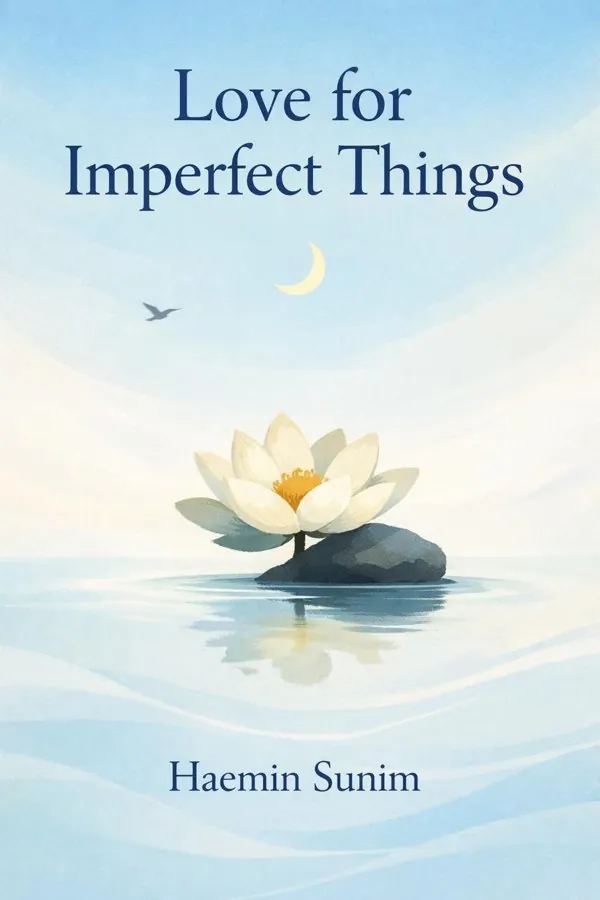
Love for Imperfect Things: How to Accept Yourself in a World Striving for Perfection: Summary & Key Insights
by Haemin Sunim
 10 min8 chaptersAudio available
What Is Love for Imperfect Things: How to Accept Yourself in a World Striving for Perfection About?
Love for Imperfect Things: How to Accept Yourself in a World Striving for Perfection by Haemin Sunim is a eastern_wisdom book spanning 8 pages. In this inspiring follow-up to the international bestseller 'The Things You Can See Only When You Slow Down,' Zen Buddhist teacher Haemin Sunim offers gentle wisdom on embracing imperfection and finding peace in an often demanding world. Through short essays and beautiful illustrations, he guides readers toward self-compassion, acceptance, and emotional balance.
This FizzRead summary covers all 8 key chapters of Love for Imperfect Things: How to Accept Yourself in a World Striving for Perfection in approximately 10 minutes, distilling the most important ideas, arguments, and takeaways from Haemin Sunim's work. Also available as an audio summary and Key Quotes Podcast.
Love for Imperfect Things: How to Accept Yourself in a World Striving for Perfection
In this inspiring follow-up to the international bestseller 'The Things You Can See Only When You Slow Down,' Zen Buddhist teacher Haemin Sunim offers gentle wisdom on embracing imperfection and finding peace in an often demanding world. Through short essays and beautiful illustrations, he guides readers toward self-compassion, acceptance, and emotional balance.
Who Should Read Love for Imperfect Things: How to Accept Yourself in a World Striving for Perfection?
This book is perfect for anyone interested in eastern_wisdom and looking to gain actionable insights in a short read. Whether you're a student, professional, or lifelong learner, the key ideas from Love for Imperfect Things: How to Accept Yourself in a World Striving for Perfection by Haemin Sunim will help you think differently.
- ✓Readers who enjoy eastern_wisdom and want practical takeaways
- ✓Professionals looking to apply new ideas to their work and life
- ✓Anyone who wants the core insights of Love for Imperfect Things: How to Accept Yourself in a World Striving for Perfection in just 10 minutes
Want the full summary?
Get instant access to this book summary and 100K+ more with Fizz Moment.
Get Free SummaryAvailable on App Store • Free to download
Key Chapters
Our journey begins with ourselves. In modern life, we are so busy caring for others—families, careers, communities—that we often neglect the one person who needs our kindness most: ourselves. When we are tired, we label it laziness. When we feel sad, we call it weakness. Yet these judgments create more suffering. I invite you to see your emotions as natural movements of the heart, not as flaws to be fixed.
Imagine a young tree in a storm. If we expect it to stand straight through gusts and rain, we will be disappointed. But if we recognize that bending is its way of surviving, we appreciate its resilience. Likewise, your exhaustion, your restlessness, your sadness—they are all signs of being alive. To care for yourself is not indulgence; it is wisdom.
In Buddhist practice, self-compassion begins with awareness. When you notice anxiety rising or fatigue weighing down your spirit, pause. Breathe with the feeling rather than against it. The breath is a bridge between body and mind; it tells you that you are safe to rest. I often remind my students that rest is not wasteful—it restores the quiet where insight grows. Only when we treat ourselves gently can we extend genuine care to others.
This simple act of turning inward with warmth rather than criticism is the foundation of inner peace. No perfect morning routine, diet, or productivity hack can substitute for that fundamental kindness. You do not have to prove your worth. You are enough simply because you exist. As the sun does not demand permission to shine, you, too, can radiate calm presence by allowing yourself to be.
Family often mirrors our deepest struggles with love and forgiveness. We may care for our parents yet feel frustrated by old wounds, or cherish our children yet fear failing them. Families are made of imperfect people who are learning how to love. When we accept that truth, frustration softens into understanding.
I remember counseling a student who felt trapped by resentment toward his father. He spoke of harsh words and unmet expectations that haunted their relationship. Rather than urging him to forget the past, I asked him to imagine his father as a young man—someone who once carried his own fears and dreams. As he reflected, tears came, not from pain but recognition. Compassion blooms when we look beyond the roles—parent, child, sibling—and see the shared humanity inside each.
To love family deeply does not mean to agree with everything they say or do. It means holding space for imperfection. It means recognizing that misunderstandings are natural, that reconciliation may unfold slowly. In Zen, we talk of polishing the mirror of the heart: when we clear away judgment, love reflects more clearly. Families grow stronger not by perfection but through honest communication and forgiveness.
You do not have to fix every broken bond immediately. Sometimes healing begins when you simply stop blaming yourself or another. Send quiet blessings instead—just as sunlight warms a seed without demanding it to sprout instantly. In time, love will find its own way.
+ 6 more chapters — available in the FizzRead app
All Chapters in Love for Imperfect Things: How to Accept Yourself in a World Striving for Perfection
About the Author
Haemin Sunim is a Zen Buddhist teacher and author born in South Korea. Educated at UC Berkeley, Harvard, and Princeton, he has become one of the most influential spiritual voices in Asia and beyond. His books on mindfulness and compassion have sold millions of copies worldwide and have been translated into numerous languages.
Get This Summary in Your Preferred Format
Read or listen to the Love for Imperfect Things: How to Accept Yourself in a World Striving for Perfection summary by Haemin Sunim anytime, anywhere. FizzRead offers multiple formats so you can learn on your terms — all free.
Available formats: App · Audio · PDF · EPUB — All included free with FizzRead
Download Love for Imperfect Things: How to Accept Yourself in a World Striving for Perfection PDF and EPUB Summary
Key Quotes from Love for Imperfect Things: How to Accept Yourself in a World Striving for Perfection
“In modern life, we are so busy caring for others—families, careers, communities—that we often neglect the one person who needs our kindness most: ourselves.”
“Family often mirrors our deepest struggles with love and forgiveness.”
Frequently Asked Questions about Love for Imperfect Things: How to Accept Yourself in a World Striving for Perfection
Love for Imperfect Things: How to Accept Yourself in a World Striving for Perfection by Haemin Sunim is a eastern_wisdom book that explores key ideas across 8 chapters. In this inspiring follow-up to the international bestseller 'The Things You Can See Only When You Slow Down,' Zen Buddhist teacher Haemin Sunim offers gentle wisdom on embracing imperfection and finding peace in an often demanding world. Through short essays and beautiful illustrations, he guides readers toward self-compassion, acceptance, and emotional balance.
More by Haemin Sunim
You Might Also Like

A New Earth
Eckhart Tolle
10 min
The Daily Stoic
Ryan Holiday, Stephen Hanselman
10 min
Buddhism: Plain and Simple
Steve Hagen
10 min
Enchiridion
Epictetus
10 min
The Book of Tea
Kakuzō Okakura
10 min
The Light We Give: How Sikh Wisdom Can Transform Your Life
Simran Jeet Singh
10 minBrowse by Category
Ready to read Love for Imperfect Things: How to Accept Yourself in a World Striving for Perfection?
Get the full summary and 100K+ more books with Fizz Moment.