
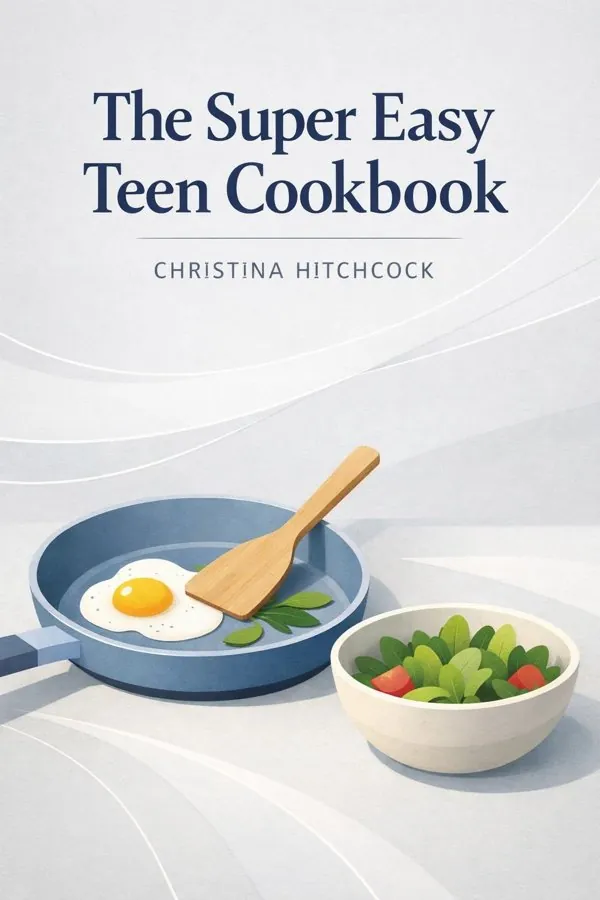
The Super Easy Teen Cookbook: 75 Simple Step-by-Step Recipes for Young Cooks: Summary & Key Insights
 10 min9 chaptersAudio available
Key Takeaways from The Super Easy Teen Cookbook: 75 Simple Step-by-Step Recipes for Young Cooks
Confidence in the kitchen does not begin with a recipe; it begins with knowing how to move safely and calmly through the space.
Mastery rarely begins with complexity; it begins with small wins repeated often.
People often think learning to cook is mainly about dinner, but some of the most important lessons come from snacks and desserts.
The most practical education often happens outside the classroom, and cooking is one of the clearest examples.
Healthy eating becomes far more meaningful when teens help create the food themselves.
What Is The Super Easy Teen Cookbook: 75 Simple Step-by-Step Recipes for Young Cooks About?
The Super Easy Teen Cookbook: 75 Simple Step-by-Step Recipes for Young Cooks by Christina Hitchcock is a education book spanning 5 pages. Cooking can feel intimidating when you are just starting out, but The Super Easy Teen Cookbook turns the kitchen into a place of discovery instead of stress. Christina Hitchcock creates a beginner-friendly guide for teens who want to make real food for themselves and their families without needing advanced skills, expensive tools, or complicated ingredients. With 75 approachable recipes, the book teaches young cooks how to prepare breakfasts, lunches, dinners, snacks, desserts, and drinks through clear, step-by-step instructions that are easy to follow. What makes this book especially valuable is that it goes beyond recipes. It introduces kitchen safety, basic techniques, meal planning, ingredient prep, and healthy food choices in a way that feels practical rather than preachy. The result is a cookbook that builds both competence and confidence. Hitchcock’s authority comes from her work as a food blogger and recipe developer known for simplifying home cooking for busy families. Her style is warm, direct, and encouraging, making this book a strong starting point for any teen who wants to become more independent, eat better, and feel capable in the kitchen.
This FizzRead summary covers all 9 key chapters of The Super Easy Teen Cookbook: 75 Simple Step-by-Step Recipes for Young Cooks in approximately 10 minutes, distilling the most important ideas, arguments, and takeaways from Christina Hitchcock's work. Also available as an audio summary and Key Quotes Podcast.
The Super Easy Teen Cookbook: 75 Simple Step-by-Step Recipes for Young Cooks
Cooking can feel intimidating when you are just starting out, but The Super Easy Teen Cookbook turns the kitchen into a place of discovery instead of stress. Christina Hitchcock creates a beginner-friendly guide for teens who want to make real food for themselves and their families without needing advanced skills, expensive tools, or complicated ingredients. With 75 approachable recipes, the book teaches young cooks how to prepare breakfasts, lunches, dinners, snacks, desserts, and drinks through clear, step-by-step instructions that are easy to follow.
What makes this book especially valuable is that it goes beyond recipes. It introduces kitchen safety, basic techniques, meal planning, ingredient prep, and healthy food choices in a way that feels practical rather than preachy. The result is a cookbook that builds both competence and confidence. Hitchcock’s authority comes from her work as a food blogger and recipe developer known for simplifying home cooking for busy families. Her style is warm, direct, and encouraging, making this book a strong starting point for any teen who wants to become more independent, eat better, and feel capable in the kitchen.
Who Should Read The Super Easy Teen Cookbook: 75 Simple Step-by-Step Recipes for Young Cooks?
This book is perfect for anyone interested in education and looking to gain actionable insights in a short read. Whether you're a student, professional, or lifelong learner, the key ideas from The Super Easy Teen Cookbook: 75 Simple Step-by-Step Recipes for Young Cooks by Christina Hitchcock will help you think differently.
- ✓Readers who enjoy education and want practical takeaways
- ✓Professionals looking to apply new ideas to their work and life
- ✓Anyone who wants the core insights of The Super Easy Teen Cookbook: 75 Simple Step-by-Step Recipes for Young Cooks in just 10 minutes
Want the full summary?
Get instant access to this book summary and 100K+ more with Fizz Moment.
Get Free SummaryAvailable on App Store • Free to download
Key Chapters
Confidence in the kitchen does not begin with a recipe; it begins with knowing how to move safely and calmly through the space. One of the book’s most useful lessons is that good cooking habits are built before the stove is even turned on. For teens, this matters because uncertainty often comes less from the food itself and more from fear of sharp knives, hot pans, or getting something wrong.
Christina Hitchcock addresses this by introducing the kitchen as a practical workspace. She emphasizes washing hands, tying back long hair, using oven mitts, cleaning as you go, and understanding how to handle basic tools. These lessons may sound simple, but they are what transform cooking from a messy guessing game into a manageable routine. A teen who knows where the measuring cups are, how to read a recipe first, and how to keep raw ingredients separate from ready-to-eat foods is already far more prepared than someone who jumps straight in.
The book also teaches organization. Gathering ingredients before starting, checking cooking times, and preparing tools in advance reduce panic and mistakes. This habit, often called mise en place, helps beginners stay focused. For example, if you measure pancake batter ingredients ahead of time or chop vegetables before heating a skillet, the entire process becomes smoother and less stressful.
By starting with safety and setup, the book sends a powerful message: cooking is not about talent, but about systems. Once teens understand the rules of the kitchen, they can experiment with much greater ease.
Actionable takeaway: Before making any recipe, spend five minutes reading it fully, gathering ingredients, and setting out every tool you will need.
Mastery rarely begins with complexity; it begins with small wins repeated often. A major strength of The Super Easy Teen Cookbook is its recognition that beginners gain confidence not by attempting impressive restaurant-style dishes, but by successfully making simple food that tastes good. Hitchcock structures the cooking journey so that teens can progress from basic breakfasts and snacks to fuller meals without feeling overwhelmed.
Breakfast recipes are especially effective training tools because they often rely on familiar ingredients and repeatable methods. Smoothies teach measuring and balancing flavors. Scrambled eggs teach heat control. Pancakes teach mixing, timing, and flipping. Sandwiches and wraps introduce assembly, texture, and ingredient pairing. As teens practice these recipes, they learn that cooking is less mysterious than it first appears.
The psychological impact is important. When a young cook makes a decent breakfast or prepares lunch without help, cooking becomes associated with capability rather than pressure. That shift matters because confidence encourages consistency. A teen who succeeds with French toast may be willing to try grilled chicken next. Someone who can make a quesadilla may feel ready to prepare a full dinner.
Hitchcock’s step-by-step style supports this progression. The recipes are written clearly enough that teens can work independently, but they also leave room for growth. Once the basics feel comfortable, readers can swap ingredients, adjust toppings, or combine techniques.
The book’s broader lesson is that confidence is earned through repetition. Every completed dish, even a very simple one, strengthens kitchen instincts and reduces hesitation.
Actionable takeaway: Choose three easy recipes you like, make each one more than once, and focus on becoming comfortable with the process before trying harder dishes.
People often think learning to cook is mainly about dinner, but some of the most important lessons come from snacks and desserts. These recipes are where young cooks begin to see food as something they can personalize, enjoy, and share. In Hitchcock’s cookbook, snacks and sweets are not filler; they are confidence-building opportunities that make the kitchen feel inviting.
Snacks usually involve quick preparation, fewer ingredients, and lower pressure. That makes them ideal for practicing techniques such as slicing fruit, layering ingredients, melting cheese, mixing dips, or assembling no-bake treats. A teen making a yogurt parfait, trail mix, or simple pizza toast learns balance, presentation, and flavor contrast without needing long cooking times or multiple pans.
Desserts offer a different kind of education. They teach precision. Baking often requires accurate measuring, attention to order, and patience with timing. Even basic cookies or brownies help beginners understand why instructions matter. At the same time, desserts are fun. They carry an immediate reward, which keeps motivation high. A teen who proudly shares homemade cookies with friends or family starts to connect cooking with generosity and self-expression.
This part of the book also encourages creativity. Once a reader understands a simple formula, such as combining yogurt, fruit, and granola or topping a dessert with different mix-ins, customization becomes natural. Teens learn they can adapt food to their preferences instead of depending entirely on packaged options.
In that way, snacks and desserts do more than satisfy cravings. They help beginners experiment safely, enjoy the process, and discover that cooking can be both useful and playful.
Actionable takeaway: Pick one snack and one dessert recipe, then make them again with one small variation, such as a different fruit, topping, or seasoning.
The most practical education often happens outside the classroom, and cooking is one of the clearest examples. The Super Easy Teen Cookbook frames cooking not as a hobby for special occasions, but as an everyday life skill that supports independence. This idea is central to the book’s value. When teens learn to feed themselves, they are not just making meals; they are developing responsibility, planning ability, and self-reliance.
Hitchcock shows that practical cooking includes much more than following instructions. It involves reading labels, understanding portions, managing time, and using what is already in the kitchen. A teen who can boil pasta, heat leftovers properly, make a sandwich, roast simple vegetables, or prepare a basic protein is already better equipped for busy school days, future college life, and adulthood in general.
The book also teaches efficiency. Young cooks begin to notice that one prepared ingredient can serve many meals. Cooked chicken might become a wrap at lunch and part of a rice bowl at dinner. Chopped vegetables can be used in omelets, salads, and snacks. This is how cooking becomes sustainable rather than exhausting.
Another key point is that everyday mastery reduces dependence on fast food and convenience meals. Teens who know how to prepare simple dishes gain more control over cost, nutrition, and taste. They also become more helpful at home. Being able to contribute dinner once or twice a week changes cooking from an individual skill into a family asset.
The deeper message is empowering: cooking is not about perfection but usefulness. If a teen can make ordinary meals with confidence, that skill pays off for years.
Actionable takeaway: Learn five “go-to” meals you can make without assistance, and keep the ingredients for at least two of them available at home.
Healthy eating becomes far more meaningful when teens help create the food themselves. One of the book’s smartest insights is that nutrition is easier to understand and practice when it is tied to action rather than lectures. Instead of presenting healthy food as a restriction, Hitchcock makes it part of a practical cooking routine built on balance, freshness, and accessible ingredients.
When teens prepare smoothies with fruit and yogurt, sandwiches with protein and vegetables, or dinners that include grains and simple sides, they begin to see what a balanced meal looks like. This matters because food choices often feel abstract until someone shops, measures, cooks, and tastes the result. Through cooking, healthy eating becomes visible and manageable.
The book also gives young readers more control. Teens often depend on what adults buy or what is available quickly, but learning to cook creates options. If you know how to make eggs instead of skipping breakfast, or how to prepare a basic salad and pasta dish instead of ordering takeout, you gain ownership over your routine. That sense of independence can have a lasting effect on habits.
Importantly, the book does not treat health as perfection. It allows room for enjoyment, treats, and personal preference. This balanced approach makes healthy eating more realistic. Young cooks are encouraged to make better choices more often, not to follow rigid rules.
In the end, participation changes perspective. Once teens see how meals are assembled and how ingredients work together, they become more thoughtful eaters. They are not just consuming food; they are making decisions.
Actionable takeaway: For your next meal, aim to include three elements you chose yourself, such as a protein, a fruit or vegetable, and a simple whole-food side.
A recipe can either invite a beginner in or push them away. One reason this cookbook works so well for teens is that its instructions are designed to reduce uncertainty. For new cooks, anxiety often comes from unclear wording, assumed knowledge, or too many moving parts at once. Hitchcock responds by breaking cooking into manageable steps, which makes the entire process feel more achievable.
This structure matters because beginners do not yet have a mental library of cooking terms and routines. If a recipe casually says to sauté, fold, or simmer without explanation, a teen may feel stuck before even beginning. In contrast, step-by-step guidance creates momentum. It answers the small questions that often stop new cooks: What should I do first? How hot should the pan be? When do I add the next ingredient? How do I know it is done?
Clear sequencing also teaches how cooking works. Teens start to understand that recipes are built logically: prep first, heat second, combine in order, monitor texture, and finish with timing. Over time, they rely less on strict instructions because they have absorbed the pattern. That is how beginners become intuitive cooks.
Practical examples make this especially effective. A grilled cheese recipe teaches pan control and flipping. A smoothie teaches ingredient order and blending. A simple baked dish teaches preheating, assembly, and timing. These lessons are transferable. Once a teen learns one process clearly, many others become easier.
The book’s underlying message is reassuring: confusion is not failure, and a well-written recipe can act like a teacher beside you. For many teens, that support is what makes independent cooking possible.
Actionable takeaway: When trying a new recipe, follow the steps exactly the first time, and note any words or techniques you want to learn better afterward.
Good meals are often the result of decisions made before hunger kicks in. One of the quieter but more important lessons in The Super Easy Teen Cookbook is that cooking teaches planning. Teens who cook begin to think ahead: what ingredients are available, how long a recipe will take, what tools are needed, and what should be cleaned up afterward. These are not just cooking skills; they are life management skills.
Planning starts with reading recipes in advance and checking whether the kitchen has what is needed. That habit helps teens understand preparation, budgeting, and substitution. If there is no milk for pancakes, can yogurt or water work? If fresh fruit is unavailable, can frozen fruit be used in a smoothie? These small decisions build resourcefulness.
Responsibility grows from ownership. When a teen chooses a recipe, prepares it, and serves it, they experience the full cycle of a task from start to finish. They also learn consequences. Forgetting to preheat the oven affects dinner time. Not cleaning up as they go creates a bigger mess. Leaving ingredients out too long can affect food quality or safety. These are useful lessons because they connect actions to outcomes in a direct, memorable way.
Cooking for others deepens this responsibility. Making breakfast for siblings or helping with dinner encourages reliability and care. Food becomes a way of contributing to the household, not just consuming what someone else has prepared.
Seen this way, the kitchen becomes training ground for adulthood. Planning, adapting, finishing tasks, and cleaning up are all part of becoming capable.
Actionable takeaway: Once a week, choose one meal to plan completely yourself, including ingredients, timing, preparation, and cleanup.
Many beginners assume good cooks are naturally talented, but most kitchen skill comes from repetition. This cookbook quietly teaches that cooking is learned the same way other practical abilities are learned: by doing familiar tasks again and again until they feel normal. For teens, this is an important mindset shift, because it removes the pressure to be impressive right away.
Repeating simple recipes creates pattern recognition. A teen who makes scrambled eggs several times learns how heat changes texture. Someone who bakes muffins more than once begins to notice how batter should look before going into the oven. Preparing tacos, pasta, or grilled sandwiches repeatedly develops timing, coordination, and taste judgment. These are the foundations of real cooking ability.
Repetition also helps beginners troubleshoot. If pancakes turn out too dark the first time, the next attempt might use lower heat. If a smoothie is too thick, more liquid can be added next time. These adjustments teach that mistakes are feedback, not proof of failure. Over time, young cooks become less afraid of getting something wrong because they know they can improve through practice.
The recipes in Hitchcock’s book support this learning style because they are accessible enough to make often. They do not depend on rare ingredients or advanced equipment, so teens can revisit favorites and build skill naturally. That consistency matters more than occasional ambitious cooking projects.
Ultimately, repetition builds confidence that lasts. When basic kitchen actions become familiar, teens gain the freedom to branch out, experiment, and trust themselves.
Actionable takeaway: Keep a short list of recipes you have made successfully, and revisit them regularly until you can prepare them with minimal guidance.
Food is rarely just fuel; it is also one of the easiest ways to connect with other people. Although The Super Easy Teen Cookbook focuses on helping teens cook independently, it also highlights a social truth: learning to cook can strengthen relationships at home. The kitchen becomes a place where young people can contribute, collaborate, and share something meaningful with others.
For many families, meals are one of the few consistent parts of a busy week. When a teen helps prepare breakfast, packs their own lunch, or takes charge of one dinner recipe, they become an active participant in family life rather than a passive recipient of care. That shift can be powerful. Cooking for others communicates maturity, effort, and generosity.
The book’s approachable recipes make shared cooking realistic. A parent and teen can make pancakes together on a weekend, siblings can assemble snacks, or a teen can prepare a side dish while someone else handles the main meal. These moments create informal learning opportunities. Skills are passed down through conversation, and confidence grows through encouragement.
Even when teens cook alone, the results often lead to connection. Sharing cookies, making smoothies for a friend, or serving a simple dinner to family members turns cooking into a form of communication. Food says, “I made this for you,” and that matters.
This social dimension also increases motivation. Teens are often more willing to practice cooking when the outcome feels useful and appreciated. Preparing food becomes not only a personal achievement, but also a contribution to the people around them.
Actionable takeaway: Use one recipe from the book this week to make something specifically for another person, and pay attention to how sharing food changes the experience.
All Chapters in The Super Easy Teen Cookbook: 75 Simple Step-by-Step Recipes for Young Cooks
About the Author
Christina Hitchcock is a food blogger, recipe developer, and cookbook author known for making home cooking approachable for everyday readers. She is the creator of the popular blog It Is a Keeper, where she shares easy recipes, kitchen tips, and family-friendly meal ideas designed for busy households. Her work focuses on simplifying the cooking process so that even beginners can make satisfying meals with confidence. That practical, encouraging style carries directly into The Super Easy Teen Cookbook, where she helps young cooks build foundational kitchen skills without intimidation. Hitchcock’s strength lies in turning cooking into something clear, realistic, and enjoyable. Through her writing and recipe development, she has become a trusted guide for readers who want simple instructions, reliable meals, and a more confident relationship with food.
Get This Summary in Your Preferred Format
Read or listen to the The Super Easy Teen Cookbook: 75 Simple Step-by-Step Recipes for Young Cooks summary by Christina Hitchcock anytime, anywhere. FizzRead offers multiple formats so you can learn on your terms — all free.
Available formats: App · Audio · PDF · EPUB — All included free with FizzRead
Download The Super Easy Teen Cookbook: 75 Simple Step-by-Step Recipes for Young Cooks PDF and EPUB Summary
Key Quotes from The Super Easy Teen Cookbook: 75 Simple Step-by-Step Recipes for Young Cooks
“Confidence in the kitchen does not begin with a recipe; it begins with knowing how to move safely and calmly through the space.”
“Mastery rarely begins with complexity; it begins with small wins repeated often.”
“People often think learning to cook is mainly about dinner, but some of the most important lessons come from snacks and desserts.”
“The most practical education often happens outside the classroom, and cooking is one of the clearest examples.”
“Healthy eating becomes far more meaningful when teens help create the food themselves.”
Frequently Asked Questions about The Super Easy Teen Cookbook: 75 Simple Step-by-Step Recipes for Young Cooks
The Super Easy Teen Cookbook: 75 Simple Step-by-Step Recipes for Young Cooks by Christina Hitchcock is a education book that explores key ideas across 9 chapters. Cooking can feel intimidating when you are just starting out, but The Super Easy Teen Cookbook turns the kitchen into a place of discovery instead of stress. Christina Hitchcock creates a beginner-friendly guide for teens who want to make real food for themselves and their families without needing advanced skills, expensive tools, or complicated ingredients. With 75 approachable recipes, the book teaches young cooks how to prepare breakfasts, lunches, dinners, snacks, desserts, and drinks through clear, step-by-step instructions that are easy to follow. What makes this book especially valuable is that it goes beyond recipes. It introduces kitchen safety, basic techniques, meal planning, ingredient prep, and healthy food choices in a way that feels practical rather than preachy. The result is a cookbook that builds both competence and confidence. Hitchcock’s authority comes from her work as a food blogger and recipe developer known for simplifying home cooking for busy families. Her style is warm, direct, and encouraging, making this book a strong starting point for any teen who wants to become more independent, eat better, and feel capable in the kitchen.
You Might Also Like

Bedtime Biography: Florence Nightingale
Isabel Thomas
10 min
Introduction To Museum Studies
Howard H. Hoyt
10 min
A Mind for Numbers: How to Excel at Math and Science (Even If You Flunked Algebra)
Barbara Oakley
10 min
AI for Educators: Learning Strategies, Teacher Empowerment, and the Future of Education
Matt Miller
10 min
Animation For Beginners
Morr Meroz
10 min
Artificial Intelligence for Learning
Donald Clark
10 minBrowse by Category
Ready to read The Super Easy Teen Cookbook: 75 Simple Step-by-Step Recipes for Young Cooks?
Get the full summary and 100K+ more books with Fizz Moment.