
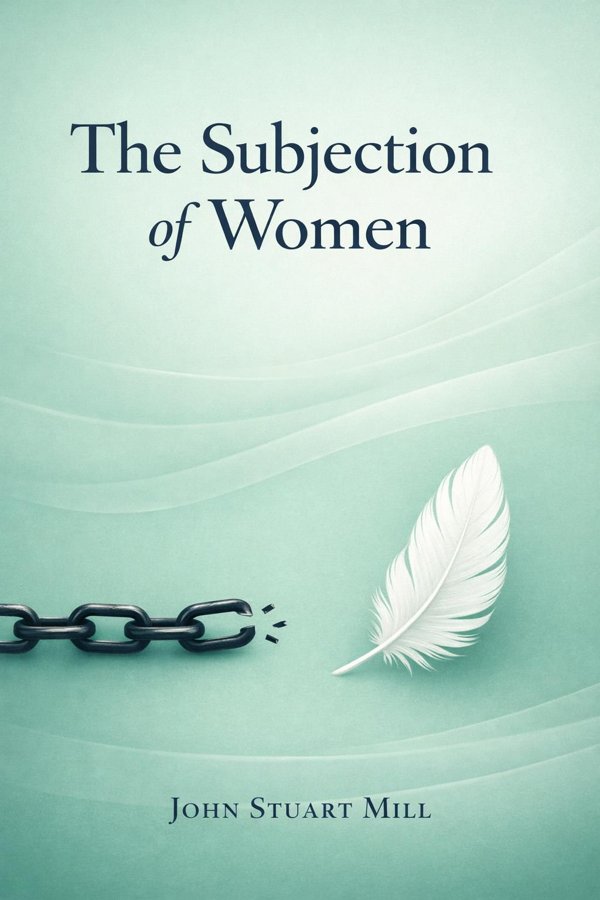
The Subjection of Women: Summary & Key Insights
 10 min9 chaptersAudio available
Key Takeaways from The Subjection of Women
What if one of society’s oldest institutions survives not because it is just, but because it is ancient?
No human being grows fully under compulsion.
People often call something natural when they have never allowed alternatives to exist.
A society wastes its talent when it confines half its members.
The private home can be the most political place in society.
What Is The Subjection of Women About?
The Subjection of Women by John Stuart Mill is a western_phil book spanning 6 pages. Published in 1869, The Subjection of Women is John Stuart Mill’s bold and systematic case for the full legal, social, and moral equality of women. At a time when women were denied political rights, excluded from many professions, and legally constrained within marriage, Mill argued that these arrangements were not natural at all—they were inherited forms of domination. His essay challenges the idea that female inferiority is a fact of nature and insists that no one can know what women are truly capable of until they are free to develop their abilities on equal terms with men. What makes the book enduring is that Mill does not treat women’s equality as a narrow special interest. He presents it as a test of justice, liberty, and social progress itself. A major philosopher of liberalism and the author of On Liberty and Utilitarianism, Mill brings moral clarity, political analysis, and practical reasoning to the subject. The result is a foundational work of feminist philosophy that still speaks powerfully to debates about equality, opportunity, and human flourishing.
This FizzRead summary covers all 9 key chapters of The Subjection of Women in approximately 10 minutes, distilling the most important ideas, arguments, and takeaways from John Stuart Mill's work. Also available as an audio summary and Key Quotes Podcast.
The Subjection of Women
Published in 1869, The Subjection of Women is John Stuart Mill’s bold and systematic case for the full legal, social, and moral equality of women. At a time when women were denied political rights, excluded from many professions, and legally constrained within marriage, Mill argued that these arrangements were not natural at all—they were inherited forms of domination. His essay challenges the idea that female inferiority is a fact of nature and insists that no one can know what women are truly capable of until they are free to develop their abilities on equal terms with men. What makes the book enduring is that Mill does not treat women’s equality as a narrow special interest. He presents it as a test of justice, liberty, and social progress itself. A major philosopher of liberalism and the author of On Liberty and Utilitarianism, Mill brings moral clarity, political analysis, and practical reasoning to the subject. The result is a foundational work of feminist philosophy that still speaks powerfully to debates about equality, opportunity, and human flourishing.
Who Should Read The Subjection of Women?
This book is perfect for anyone interested in western_phil and looking to gain actionable insights in a short read. Whether you're a student, professional, or lifelong learner, the key ideas from The Subjection of Women by John Stuart Mill will help you think differently.
- ✓Readers who enjoy western_phil and want practical takeaways
- ✓Professionals looking to apply new ideas to their work and life
- ✓Anyone who wants the core insights of The Subjection of Women in just 10 minutes
Want the full summary?
Get instant access to this book summary and 100K+ more with Fizz Moment.
Get Free SummaryAvailable on App Store • Free to download
Key Chapters
What if one of society’s oldest institutions survives not because it is just, but because it is ancient? Mill begins from this unsettling thought. The subordination of women, he argues, did not emerge from reasoned judgment or mutual agreement. It began in physical force. In earlier stages of society, the stronger sex secured power over the weaker, and law later preserved what strength had first imposed. Once customs hardened into institutions, people came to mistake inherited dominance for moral order.
Mill’s point is crucial: many social arrangements are treated as if they were naturally ordained simply because they have existed for a long time. The history of patriarchy resembles the history of monarchy, slavery, and aristocratic privilege. Each was once defended as necessary, normal, and rooted in nature. Yet later generations recognized that these systems were products of power, not justice. The same scrutiny, Mill insists, must be applied to relations between men and women.
This idea has practical force even today. Whenever a workplace assumes leadership qualities are masculine, or a family automatically expects caregiving to belong primarily to women, custom may be doing the work that reason should do. A tradition can feel normal while still being unfair. Mill invites readers to ask whether a rule survives because it serves human flourishing or because it benefits those already in control.
The takeaway is simple: when a social hierarchy appears timeless, examine its origins before accepting its legitimacy.
No human being grows fully under compulsion. Mill argues that the subjection of women is not only unjust because it limits rights; it is harmful because it distorts the character of everyone involved. When one group is forced into dependence, obedience becomes a survival skill rather than a virtue. At the same time, those who rule become accustomed to command, flattery, and emotional domination. Inequality therefore damages both the oppressed and the powerful.
Mill compares the condition of women to other forms of subordination in one important respect: all systems of domination require the silencing of independent judgment. Women were expected to shape their personalities around male approval, often learning to please rather than to think or act freely. This pressure could make sincerity dangerous. A woman might conceal her true convictions, ambitions, or frustrations because her security depended on submission.
The implications go beyond law. A household in which one partner’s desires automatically override the other’s cannot be a school of mutual respect. A workplace where women feel they must soften every opinion to avoid being labeled difficult reproduces the same pattern. Mill’s insight is that unequal power reaches into habits of speech, confidence, and moral development.
In modern life, this means freedom should be measured not only by formal rights but by whether people can disagree, choose, and aspire without fear of punishment or ridicule. The healthiest relationships and institutions are those that invite honest agency rather than enforced dependence.
Actionable takeaway: look for places where compliance is rewarded more than truth, and work to create conditions where equal voices can genuinely be heard.
People often call something natural when they have never allowed alternatives to exist. Mill attacks the claim that women are naturally less rational, less ambitious, or less suited to public life than men. His central argument is devastatingly simple: you cannot infer natural capacity from a condition shaped by artificial restraint. If women have been denied education, excluded from professions, and trained from childhood to be submissive, their observed behavior proves almost nothing about their innate abilities.
Mill insists that genuine knowledge of human nature requires freedom. If a society wants to know what women can do, it must stop prescribing in advance what they are supposed to be. Any conclusion drawn from a controlled and unequal experiment is unreliable. A person educated only for ornament cannot then be cited as evidence against women’s intellectual seriousness.
This argument remains highly relevant. If girls are subtly steered away from mathematics, leadership, or technical fields, later gender imbalances cannot honestly be treated as pure preference. If women are interrupted more often in meetings or judged more harshly for assertiveness, differences in outcomes may reflect environment, not essence. Mill asks us to distinguish between choice and conditioning.
His view does not deny individual differences between people. Rather, it rejects the leap from average observation to fixed destiny. Institutions should be organized around open opportunity, not assumptions about what entire groups are fit for.
Actionable takeaway: when you see unequal outcomes, ask first whether opportunities, expectations, and incentives have truly been equal before attributing the difference to nature.
A society wastes its talent when it confines half its members. Mill defends women’s equality not only as a demand of justice but also as a practical necessity for collective well-being. This dual argument is one reason the book remains so persuasive. From a moral standpoint, no person should be denied liberty merely because of sex. From a social standpoint, every barrier placed before women deprives families, institutions, and nations of intelligence, creativity, and labor.
Mill’s utilitarian background shapes this claim. He asks what arrangement best promotes human happiness and development. A system that excludes women from education, professions, and civic life cannot possibly maximize social good, because it artificially narrows the pool of ability from which society draws. It also burdens men with roles they need not bear alone and deprives children of the example of equal partnership.
We can see this logic in modern settings. Organizations that promote fairly based on merit gain access to a wider range of skills and perspectives. Families in which both partners can pursue meaningful work and shared caregiving often become more resilient. Public life improves when laws and institutions are shaped by the experience of all citizens, not only one sex.
Mill’s insight is that equality is not a charitable concession to women. It is an upgrade in how society organizes human potential. The strongest communities are those that remove arbitrary obstacles and allow competence to emerge wherever it exists.
Actionable takeaway: support systems that widen access by merit—education, hiring, leadership, and political participation—because fairness and social benefit are not competing goals.
The private home can be the most political place in society. Mill treats marriage as one of the central sites of women’s subordination because, in his time, the law gave husbands sweeping authority over wives. A married woman’s property, legal identity, and practical freedom could be absorbed into her husband’s power. Mill saw this not as a personal misfortune affecting some women, but as a structural injustice embedded in ordinary life.
His alternative is radical for its time: marriage should be a voluntary union between equals, not a legal hierarchy. Affection is corrupted when one party rules and the other obeys. A true marriage should be based on companionship, mutual respect, and shared decision-making. Mill believed such equality would improve not just women’s lives but men’s character as well. Instead of learning domination, men would learn reciprocity; instead of dependence, women would develop responsibility and independence.
The relevance is immediate. Even where the law now recognizes equal spouses, habits of inequality can persist in finances, domestic labor, childcare, and career sacrifice. If one partner’s work is always prioritized, or if emotional and household responsibilities fall silently on the other, the old hierarchy survives in softer form. Mill challenges couples to ask whether their arrangements are chosen freely or inherited unconsciously.
A modern application might include transparent financial planning, explicit discussion of domestic responsibilities, and mutual support for both partners’ ambitions. Equality in marriage is not sameness in every task; it is the refusal to assume one partner exists to serve the other.
Actionable takeaway: audit your closest relationships for hidden hierarchies and replace default roles with deliberate, mutual agreements.
Dependence is often praised as femininity when it is really enforced powerlessness. Mill argues that women cannot be free in any meaningful sense if they are denied serious education and access to remunerative work. Without the ability to support themselves or cultivate their minds, women remain vulnerable to coercion, whether from husbands, fathers, or social expectation. Education and economic opportunity are therefore not secondary reforms; they are the foundation of independence.
Mill objects to an education designed merely to make women agreeable, decorative, or marriageable. Such training may produce social polish, but it suppresses judgment and ambition. He insists that women should have the same chance as men to study, compete, and pursue professions according to talent. If some choose domestic life, that choice is valid—but it must be a real choice, not the only respectable path available.
This remains a live issue in many forms. When girls receive less encouragement in science or leadership, when women are channeled into lower-paid work, or when career breaks are treated as solely their responsibility, dependence is reproduced. Financial literacy, access to training, and fair hiring practices all matter because they expand the range of genuine options.
Mill also highlights a deeper point: people develop through exercise. To deny women opportunities is not merely to block rewards; it is to prevent capacities from maturing. Human powers grow when they are used.
Actionable takeaway: treat education and earning power as instruments of freedom—invest in skills, demand fair access, and avoid any arrangement that leaves one person without meaningful economic choice.
The most powerful social rules are often the ones people stop noticing. Mill repeatedly warns that custom disguises itself as common sense. Once a pattern becomes familiar, people begin to experience it not as one possible arrangement among many, but as the obvious and proper order of things. This is why unjust systems can persist even after their original justifications weaken: they sink into habit.
For Mill, the subordination of women is sustained not only by laws but by deeply internalized expectations. Women are taught to desire approval, self-sacrifice, and dependence; men are taught to expect deference and service. Over time, these trained preferences are mistaken for spontaneous traits. Society then points to women’s adaptation as proof that they naturally fit subordinate roles.
This mechanism still operates today. A company may claim women are less interested in leadership when the culture rewards aggressive styles that punish female assertiveness. A family may say daughters are naturally more caring when sons were never given equal domestic responsibilities. In both cases, social design creates behavior and then labels it innate.
Mill’s method is therefore diagnostic. To understand any norm, ask who benefits from it, how early it is taught, and what penalties accompany nonconformity. If deviation is costly, conformity tells us little about genuine preference. Progress requires making the familiar strange enough to inspect.
Actionable takeaway: whenever a role or expectation seems simply “how things are,” pause and ask what training, incentives, and sanctions made it look natural in the first place.
No group should be governed permanently by another in its supposed best interest. Although The Subjection of Women focuses broadly on legal and social equality, Mill’s political logic also supports women’s full participation in public life. If laws affect women’s property, work, marriage, education, and bodily security, then women must have a voice in shaping those laws. Rule without representation, however benevolent it claims to be, remains domination.
Mill distrusts paternalism. Men may sincerely believe they understand women’s needs, but sincerity does not substitute for experience. A legislature composed only of men will inevitably overlook or minimize problems that women know directly. The issue is not that women think identically as a group, but that excluding them removes vital perspectives from public reasoning. Equal citizenship means equal standing as a source of knowledge and judgment.
The practical lesson extends beyond voting rights. Boards, leadership teams, academic institutions, and community organizations all make decisions that affect others. When women are absent from these forums, blind spots persist. Policies around parental leave, workplace safety, healthcare, and compensation are often shaped differently when those most affected are present in the room.
Mill’s broader principle is democratic: institutions work better when those subject to power can participate in it. Inclusion is not symbolic decoration; it improves deliberation and legitimacy. A society that claims to value liberty must allow women not merely to be protected, but to govern alongside men.
Actionable takeaway: wherever decisions are made, ask who is missing from the table and treat representation as a requirement of justice, not public relations.
A civilization can be measured by how much human potential it permits to unfold. Mill ends on an expansive vision: women’s equality is not one reform among many, but part of humanity’s broader movement away from rule by force and toward rule by reason. Progress means replacing inherited domination with voluntary cooperation. The family, the workplace, and the state should all reflect this moral development.
Mill believes society becomes more intelligent and humane when individuals are free to cultivate their capacities. Equality between men and women would enrich emotional life, strengthen moral character, improve childrearing, and expand the supply of talent available to every field. It would also alter the spirit of social relations. Instead of command and obedience, people would learn partnership. Instead of fixed ranks, they would learn reciprocity.
This is why the essay still matters. Gender equality is not only about correcting specific injustices, though it certainly does that. It is also about the kind of society we want: one that trusts people with freedom, evaluates them as individuals, and refuses to convert old prejudice into destiny. Modern debates about pay equity, parental leave, leadership, reproductive autonomy, and domestic labor all fit within Mill’s larger question: will society organize itself around custom or around justice?
His optimism is disciplined rather than naive. Reform is difficult because habits are old, but old habits are not sacred. Institutions can be redesigned.
Actionable takeaway: treat every gain in equal freedom as part of a larger civilizational project—build norms and policies that replace inherited hierarchy with shared opportunity.
All Chapters in The Subjection of Women
About the Author
John Stuart Mill (1806–1873) was an English philosopher, political economist, and civil servant whose work helped shape modern liberal thought. Educated intensively from childhood by his father, James Mill, he became one of the nineteenth century’s leading public intellectuals. Mill wrote influential works on liberty, ethics, representative government, and social reform, including On Liberty, Utilitarianism, and Considerations on Representative Government. He was also an early and forceful advocate of women’s equality, a position strongly informed by his intellectual partnership with Harriet Taylor Mill. Combining philosophical rigor with practical political concern, Mill argued for individual freedom, open debate, and institutions that promote human development. His writings continue to influence political theory, feminist philosophy, and democratic thought.
Get This Summary in Your Preferred Format
Read or listen to the The Subjection of Women summary by John Stuart Mill anytime, anywhere. FizzRead offers multiple formats so you can learn on your terms — all free.
Available formats: App · Audio · PDF · EPUB — All included free with FizzRead
Download The Subjection of Women PDF and EPUB Summary
Key Quotes from The Subjection of Women
“What if one of society’s oldest institutions survives not because it is just, but because it is ancient?”
“No human being grows fully under compulsion.”
“People often call something natural when they have never allowed alternatives to exist.”
“A society wastes its talent when it confines half its members.”
“The private home can be the most political place in society.”
Frequently Asked Questions about The Subjection of Women
The Subjection of Women by John Stuart Mill is a western_phil book that explores key ideas across 9 chapters. Published in 1869, The Subjection of Women is John Stuart Mill’s bold and systematic case for the full legal, social, and moral equality of women. At a time when women were denied political rights, excluded from many professions, and legally constrained within marriage, Mill argued that these arrangements were not natural at all—they were inherited forms of domination. His essay challenges the idea that female inferiority is a fact of nature and insists that no one can know what women are truly capable of until they are free to develop their abilities on equal terms with men. What makes the book enduring is that Mill does not treat women’s equality as a narrow special interest. He presents it as a test of justice, liberty, and social progress itself. A major philosopher of liberalism and the author of On Liberty and Utilitarianism, Mill brings moral clarity, political analysis, and practical reasoning to the subject. The result is a foundational work of feminist philosophy that still speaks powerfully to debates about equality, opportunity, and human flourishing.
More by John Stuart Mill
You Might Also Like
A Little History of Philosophy
Nigel Warburton
10 min
Areopagitica
John Milton
10 min
How To Think Like A Philosopher: Essential Principles For Clear Thinking
Peter Cave
10 min
Language, Truth and Logic
A. J. Ayer
10 min
The Age of Reason
Thomas Paine
10 min
The Essays
Michel De Montaigne
10 minBrowse by Category
Ready to read The Subjection of Women?
Get the full summary and 100K+ more books with Fizz Moment.