
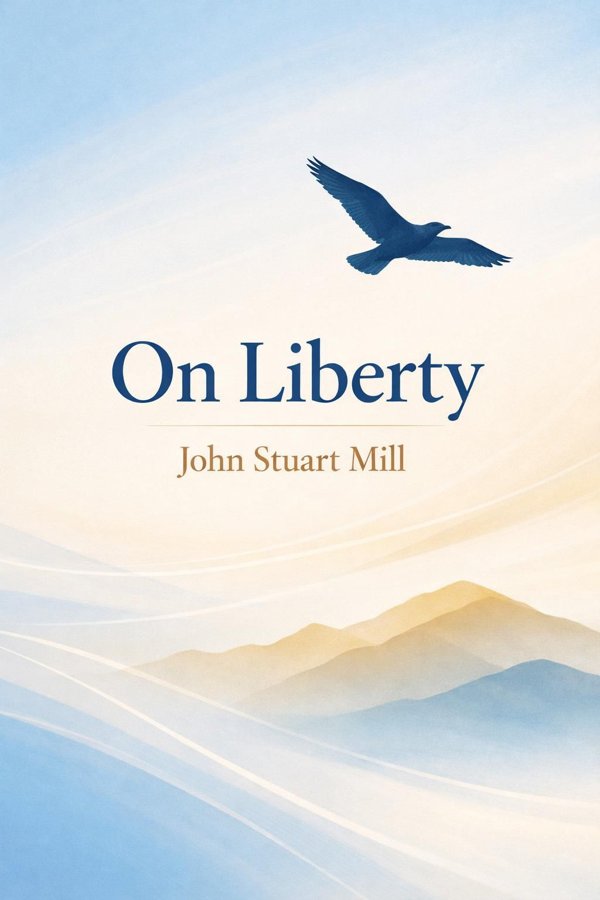
On Liberty: Summary & Key Insights
 10 min9 chaptersAudio available
Key Takeaways from On Liberty
The most famous idea in On Liberty is also its simplest: power should only be exercised over someone against their will to prevent harm to others.
To silence an opinion is to assume infallibility.
A society that fears difference eventually fears growth.
Political oppression is obvious; social oppression is often invisible.
Even true beliefs decay when they are inherited without thought.
What Is On Liberty About?
On Liberty by John Stuart Mill is a general book. What happens when society, not just government, begins to dictate how people should think, speak, and live? In On Liberty, John Stuart Mill tackles that question with extraordinary clarity and urgency. First published in 1859, this classic work of political philosophy argues that individual freedom is essential not only for personal happiness, but for truth, progress, and a healthy society. Mill explores the limits of social and political power, asking when authority may rightly interfere with personal conduct and when it must step back. His answer became one of the most influential defenses of free speech, individuality, and moral independence ever written. The book matters because its central concerns remain strikingly modern: censorship, public outrage, conformity, personal autonomy, and the pressure to fit accepted norms. Mill writes not as a detached theorist, but as one of the 19th century’s most important philosophers and public intellectuals, shaped by deep study, political engagement, and a lifelong commitment to reform. On Liberty is a foundational text for anyone who wants to understand why freedom matters and how easily it can be lost.
This FizzRead summary covers all 9 key chapters of On Liberty in approximately 10 minutes, distilling the most important ideas, arguments, and takeaways from John Stuart Mill's work. Also available as an audio summary and Key Quotes Podcast.
On Liberty
What happens when society, not just government, begins to dictate how people should think, speak, and live? In On Liberty, John Stuart Mill tackles that question with extraordinary clarity and urgency. First published in 1859, this classic work of political philosophy argues that individual freedom is essential not only for personal happiness, but for truth, progress, and a healthy society. Mill explores the limits of social and political power, asking when authority may rightly interfere with personal conduct and when it must step back. His answer became one of the most influential defenses of free speech, individuality, and moral independence ever written. The book matters because its central concerns remain strikingly modern: censorship, public outrage, conformity, personal autonomy, and the pressure to fit accepted norms. Mill writes not as a detached theorist, but as one of the 19th century’s most important philosophers and public intellectuals, shaped by deep study, political engagement, and a lifelong commitment to reform. On Liberty is a foundational text for anyone who wants to understand why freedom matters and how easily it can be lost.
Who Should Read On Liberty?
This book is perfect for anyone interested in general and looking to gain actionable insights in a short read. Whether you're a student, professional, or lifelong learner, the key ideas from On Liberty by John Stuart Mill will help you think differently.
- ✓Readers who enjoy general and want practical takeaways
- ✓Professionals looking to apply new ideas to their work and life
- ✓Anyone who wants the core insights of On Liberty in just 10 minutes
Want the full summary?
Get instant access to this book summary and 100K+ more with Fizz Moment.
Get Free SummaryAvailable on App Store • Free to download
Key Chapters
The most famous idea in On Liberty is also its simplest: power should only be exercised over someone against their will to prevent harm to others. Mill calls this the central principle of liberty, and it remains one of the clearest tests for judging when interference is justified. He argues that neither the government nor society has the right to control a person merely for that person’s own good, whether moral or physical. People may advise, persuade, warn, or criticize, but coercion requires a stronger reason: preventing real harm to others.
This distinction matters because many forms of control are justified in the language of protection. A community might want to ban unhealthy habits, censor offensive opinions, or shame unconventional lifestyles. Mill warns that such paternalism often masks a desire to dominate rather than help. If an adult makes a foolish decision that primarily affects themselves, that is part of the cost of freedom. Human beings develop judgment by choosing, erring, learning, and taking responsibility.
Modern examples make Mill’s point vivid. A person’s diet, religion, hobbies, reading choices, or personal relationships may strike others as misguided, but that alone does not justify coercion. By contrast, fraud, violence, reckless driving, or spreading dangerous falsehoods in a context where they can directly incite harm do affect others and may rightly be restricted.
Mill is not saying that all behavior is equally wise. He is saying that the threshold for compulsion must be high. A free society does not eliminate bad choices; it protects the space in which moral agency becomes possible.
Actionable takeaway: Before supporting a restriction on someone’s behavior, ask one disciplined question: does this prevent actual harm to others, or am I simply trying to enforce my preferences?
To silence an opinion is to assume infallibility. Mill’s defense of free speech rests on that bold insight. He argues that suppressing an opinion is always dangerous because the silenced view may be true, partly true, or even false in a way that still benefits society by forcing truth to defend itself. In every case, censorship costs us something valuable.
If the opinion is true, suppression robs humanity of correction. If it is partly true, it may contain the missing piece needed to complete prevailing understanding. And if it is false, confronting it strengthens people’s grasp of truth by preventing belief from hardening into empty repetition. Mill is especially concerned about opinions held only because they are socially accepted. A belief that is never challenged becomes a dead dogma rather than a living conviction.
This argument applies far beyond formal censorship. Social penalties can be just as powerful as laws. People may avoid speaking honestly because they fear ridicule, professional consequences, or collective outrage. Mill sees this as a subtler but equally serious threat. A society can appear free while crushing dissent through informal intimidation.
Consider public debate today. When controversial views are immediately dismissed rather than examined, both sides lose. Errors go uncorrected, truths become slogans, and intellectual laziness spreads. Mill does not claim every opinion is wise or equally valid. He claims that open contest is the best process for discovering what is wise.
The deeper lesson is humility. Human beings are fallible, and our institutions should reflect that fact. The answer to bad ideas is usually not silence, but better reasoning, evidence, and argument.
Actionable takeaway: When you encounter a view you dislike, resist the urge to shut it down first. Ask what can be learned by testing it openly against evidence and principle.
A society that fears difference eventually fears growth. Mill treats individuality not as a private luxury, but as a public good. He argues that people need freedom to shape their own lives, tastes, habits, and character, because originality expands what is possible for everyone. Independent lives become experiments in living, showing others new ways to pursue meaning, happiness, and virtue.
For Mill, conformity is one of the greatest threats to civilization. Even without harsh laws, social pressure can push people into uniformity. Customs become unquestioned. Respectability replaces thought. People stop asking whether a practice is right and instead ask whether it is accepted. Mill believes this weakens both individuals and societies. A person who never chooses for themselves does not fully develop judgment, courage, or character.
This idea has practical implications in family life, education, work, and culture. A student pressured into a safe career they do not want, a worker who hides unconventional ideas to fit office norms, or a citizen who suppresses beliefs to avoid social exclusion all illustrate Mill’s concern. Innovation in science, art, politics, and morality often begins with a person willing to differ from the crowd.
Mill does not praise eccentricity for its own sake. He values individuality because living thoughtfully according to one’s own convictions is essential to human flourishing. Diverse ways of life reveal strengths and weaknesses that no single social model can capture.
Healthy societies therefore leave wide room for voluntary difference, so long as others are not harmed. Uniformity may look orderly, but it often conceals stagnation.
Actionable takeaway: Identify one area of your life where habit or social expectation is deciding for you, and deliberately choose based on reflection rather than conformity.
Even true beliefs decay when they are inherited without thought. Mill insists that the value of free discussion is not only that it helps us find truth, but that it helps us understand truth. When beliefs are repeated as formulas rather than examined as reasons, they lose force, depth, and practical meaning. People may recite principles they no longer genuinely comprehend.
This is why Mill resists the idea that settled truths no longer need debate. He argues that unless important beliefs are regularly contested, most people will hold them mechanically. They may know the words, but not the grounds. Their convictions will be vulnerable because they have never learned to answer objections or appreciate complexity.
This applies to religion, politics, ethics, and even professional expertise. A teacher who presents conclusions without inviting challenge may produce obedient students, not thoughtful ones. An organization that treats values as slogans may discover that employees cannot apply them in difficult cases. A democracy in which citizens inherit opinions from their tribe without reflection becomes brittle and polarized.
Mill is not glorifying endless skepticism for its own sake. He believes some claims are better justified than others. But confidence should emerge from engagement, not insulation. A belief tested through criticism becomes more intelligent, more resilient, and more humane.
In practice, this means seeking out serious disagreement, not caricatures. It means understanding opposing arguments in their strongest form. It also means revisiting one’s own assumptions, especially when they feel most obvious.
Mill’s broader point is educational as much as political: discussion is not merely a contest for victory, but a method of intellectual and moral development.
Actionable takeaway: Take one belief you strongly hold and write the best argument against it. If you cannot do that fairly, your understanding is weaker than you think.
Character cannot be manufactured through obedience alone. Mill argues that human beings become fully developed only when they are free to make meaningful choices. This is why he opposes excessive control, even when authorities claim to know what is best. A person whose life is directed entirely by external rules may be orderly, but they are not fully alive as a moral agent.
For Mill, choosing is not merely a means to getting what we want. It is part of becoming the kind of person who can judge, care, and act responsibly. When individuals decide for themselves, they exercise discernment, strengthen judgment, and learn from consequences. These capacities are central to dignity. A life lived by imitation may be safer, but it is also shallower.
Think about how this applies in everyday settings. Parents who make every decision for their children can unintentionally hinder the growth of independence. Managers who overcontrol employees reduce initiative. Schools that reward memorization over inquiry may produce compliance without wisdom. In each case, external order can come at the cost of internal development.
Mill does recognize limits. Children and those not yet capable of self-government may properly receive guidance and protection. His defense of liberty is aimed at mature individuals able to bear responsibility for their actions. But once that threshold is met, freedom becomes necessary for growth.
This idea also reshapes how we think about mistakes. Errors are not always evidence that freedom failed. They are often the process by which competence and judgment are built. Shielding people from every bad outcome can also shield them from becoming strong.
Actionable takeaway: In your work or personal life, replace one unnecessary rule or dependency with a real choice that requires judgment and accountability.
No single way of life can capture the full range of human flourishing. Mill sees social diversity as a source of learning. When individuals are free to pursue different values, routines, and ambitions, society gains a broader field of moral and practical experiments. Some fail, some succeed, and many teach lessons impossible to discover under enforced uniformity.
This idea is central to Mill’s defense of liberty. He believes that progress often comes from variation. New social arrangements, artistic forms, educational methods, and moral insights emerge when people are not trapped by custom. If everyone is compelled to live the same way, society loses the ability to compare alternatives and improve.
You can see this in entrepreneurship, science, family structure, creative work, and civic life. One person invents a new work model, another rethinks education, another lives according to an unconventional moral discipline. Not all innovations deserve praise, but liberty allows them to be tested in practice. A rigid culture, by contrast, confuses familiarity with truth.
Mill also recognizes that diversity benefits observers, not just participants. Seeing how others live broadens imagination and weakens dogmatism. It reminds us that our own habits are not inevitable. This is especially important in pluralistic societies, where peace depends partly on learning to coexist with unfamiliar choices.
The challenge is to preserve this diversity without abandoning standards altogether. Mill’s answer is that the key boundary remains harm. Beyond that, people should have broad space to pursue their own good in their own way.
Actionable takeaway: Expose yourself to one serious alternative way of living or thinking this month, not to copy it blindly, but to expand your sense of what a good life can be.
Liberty is not license. Mill defends broad personal freedom, but he does not treat individuals as isolated beings free from accountability. His principle allows people to act as they choose in self-regarding matters, yet once their actions affect the rights, safety, or legitimate interests of others, society may respond. This balance prevents liberty from collapsing into selfishness.
Mill therefore distinguishes between actions that concern mainly the self and actions that create social obligations. A person may choose risky habits, offensive beliefs, or unconventional priorities, but they may still be judged if they neglect duties to family, violate contracts, deceive others, or impose costs through reckless conduct. The point is not that all criticism is wrong, but that coercion must track actual harm and responsibility.
This framework is useful because many debates about freedom become confused. Some people treat any consequence as oppression; others treat any disapproval as justification for control. Mill offers a sharper view. You are free to live differently, but not free to escape responsibility for the effects your choices have on others in roles you have voluntarily assumed or harms you directly cause.
In modern life, this applies to speech, business, health, digital conduct, and public trust. A person may hold controversial views, but if they use a position of power to deceive or endanger others, accountability is appropriate. Freedom requires room for difference, but social cooperation requires reliability.
Mill’s mature liberalism therefore joins autonomy with answerability. The goal is not a society without standards, but one in which standards are properly directed.
Actionable takeaway: Defend your freedom vigorously, but pair it with one honest question: what obligations to others are attached to the choices I am making?
All Chapters in On Liberty
About the Author
John Stuart Mill was an English philosopher, economist, and political theorist born in 1806. Educated rigorously by his father, James Mill, he became one of the leading intellectual voices of the 19th century. Mill worked for the East India Company and later served as a Member of Parliament, where he supported causes such as women’s rights, free expression, and political reform. His major works include On Liberty, Utilitarianism, The Subjection of Women, and Principles of Political Economy. Mill is especially remembered for shaping modern liberal thought through his defense of individuality, free speech, and limited government. His writing remains influential in philosophy, law, politics, and ethics because it combines logical clarity with a deep concern for human freedom and moral development.
Get This Summary in Your Preferred Format
Read or listen to the On Liberty summary by John Stuart Mill anytime, anywhere. FizzRead offers multiple formats so you can learn on your terms — all free.
Available formats: App · Audio · PDF · EPUB — All included free with FizzRead
Download On Liberty PDF and EPUB Summary
Key Quotes from On Liberty
“The most famous idea in On Liberty is also its simplest: power should only be exercised over someone against their will to prevent harm to others.”
“To silence an opinion is to assume infallibility.”
“A society that fears difference eventually fears growth.”
“Political oppression is obvious; social oppression is often invisible.”
“Even true beliefs decay when they are inherited without thought.”
Frequently Asked Questions about On Liberty
On Liberty by John Stuart Mill is a general book that explores key ideas across 9 chapters. What happens when society, not just government, begins to dictate how people should think, speak, and live? In On Liberty, John Stuart Mill tackles that question with extraordinary clarity and urgency. First published in 1859, this classic work of political philosophy argues that individual freedom is essential not only for personal happiness, but for truth, progress, and a healthy society. Mill explores the limits of social and political power, asking when authority may rightly interfere with personal conduct and when it must step back. His answer became one of the most influential defenses of free speech, individuality, and moral independence ever written. The book matters because its central concerns remain strikingly modern: censorship, public outrage, conformity, personal autonomy, and the pressure to fit accepted norms. Mill writes not as a detached theorist, but as one of the 19th century’s most important philosophers and public intellectuals, shaped by deep study, political engagement, and a lifelong commitment to reform. On Liberty is a foundational text for anyone who wants to understand why freedom matters and how easily it can be lost.
More by John Stuart Mill

You Might Also Like
Duct Tape Marketing: The World's Most Practical Small Business Marketing Guide
John Jantsch
10 minDusk, Night, Dawn: On Revival and Courage
Anne Lamott
10 minFinish Big: How Great Entrepreneurs Exit Their Companies on Top
Bo Burlingham
10 minFirst As Tragedy, Then As Farce
Slavoj Zizek
10 minFirst Principles: What America's Founders Learned from the Greeks and Romans and How That Shaped Our Country
Thomas E. Ricks
10 minGood Habits, Bad Habits: The Science of Making Positive Changes That Stick
Wendy Wood
10 minBrowse by Category
Ready to read On Liberty?
Get the full summary and 100K+ more books with Fizz Moment.