
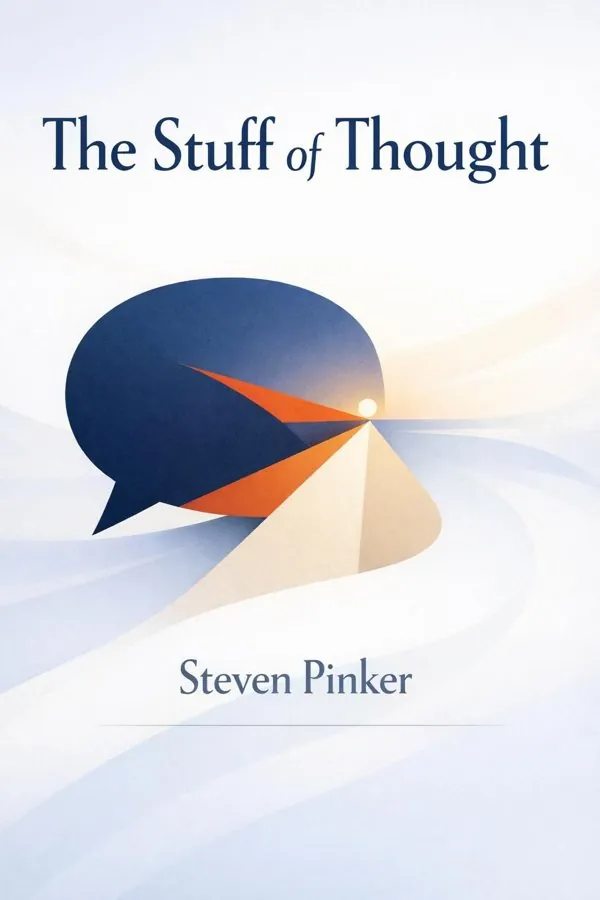
The Stuff of Thought: Language as a Window into Human Nature: Summary & Key Insights
 10 min10 chaptersAudio available
Key Takeaways from The Stuff of Thought: Language as a Window into Human Nature
One of the most enduring intellectual debates asks whether language determines thought or whether thought exists independently and language merely expresses it.
Every word is a miniature theory about how the world is carved up.
Human beings do not think about abstract ideas in a vacuum.
Grammar can seem like a dry set of schoolroom rules, but Pinker treats it as evidence about how the mind organizes experience.
Much of what people say is aimed not just at transferring information but at managing relationships.
What Is The Stuff of Thought: Language as a Window into Human Nature About?
The Stuff of Thought: Language as a Window into Human Nature by Steven Pinker is a popular_sci book spanning 10 pages. What if ordinary conversation could reveal how the human mind is built? In The Stuff of Thought, Steven Pinker argues that language is not just a social tool for exchanging information. It is also a rich record of how people perceive reality, organize concepts, judge causes, negotiate relationships, and express emotion. By examining verbs, metaphors, swearing, indirect requests, and even small grammatical choices, Pinker shows that everyday speech offers clues to the architecture of thought itself. The book matters because it tackles one of the biggest questions in psychology and philosophy: does language shape thought, or does thought come first? Pinker resists simplistic answers. Instead, he uses findings from linguistics, cognitive science, neuroscience, and philosophy to show that language both reflects and interacts with deeper mental structures. His approach is wide-ranging yet concrete, moving from abstract theory to vivid examples drawn from real life. Pinker is uniquely qualified to guide this inquiry. A Harvard cognitive psychologist and one of the world’s best-known writers on language and the mind, he combines scholarly rigor with unusual clarity, making complex ideas accessible without reducing their depth.
This FizzRead summary covers all 10 key chapters of The Stuff of Thought: Language as a Window into Human Nature in approximately 10 minutes, distilling the most important ideas, arguments, and takeaways from Steven Pinker's work. Also available as an audio summary and Key Quotes Podcast.
The Stuff of Thought: Language as a Window into Human Nature
What if ordinary conversation could reveal how the human mind is built? In The Stuff of Thought, Steven Pinker argues that language is not just a social tool for exchanging information. It is also a rich record of how people perceive reality, organize concepts, judge causes, negotiate relationships, and express emotion. By examining verbs, metaphors, swearing, indirect requests, and even small grammatical choices, Pinker shows that everyday speech offers clues to the architecture of thought itself.
The book matters because it tackles one of the biggest questions in psychology and philosophy: does language shape thought, or does thought come first? Pinker resists simplistic answers. Instead, he uses findings from linguistics, cognitive science, neuroscience, and philosophy to show that language both reflects and interacts with deeper mental structures. His approach is wide-ranging yet concrete, moving from abstract theory to vivid examples drawn from real life.
Pinker is uniquely qualified to guide this inquiry. A Harvard cognitive psychologist and one of the world’s best-known writers on language and the mind, he combines scholarly rigor with unusual clarity, making complex ideas accessible without reducing their depth.
Who Should Read The Stuff of Thought: Language as a Window into Human Nature?
This book is perfect for anyone interested in popular_sci and looking to gain actionable insights in a short read. Whether you're a student, professional, or lifelong learner, the key ideas from The Stuff of Thought: Language as a Window into Human Nature by Steven Pinker will help you think differently.
- ✓Readers who enjoy popular_sci and want practical takeaways
- ✓Professionals looking to apply new ideas to their work and life
- ✓Anyone who wants the core insights of The Stuff of Thought: Language as a Window into Human Nature in just 10 minutes
Want the full summary?
Get instant access to this book summary and 100K+ more with Fizz Moment.
Get Free SummaryAvailable on App Store • Free to download
Key Chapters
One of the most enduring intellectual debates asks whether language determines thought or whether thought exists independently and language merely expresses it. Pinker’s central insight is that this is a false choice when stated too absolutely. Language does not imprison the mind, but neither is it a transparent, neutral channel. Instead, it provides evidence of the concepts, distinctions, and priorities that human minds are already prepared to make.
Pinker challenges strong versions of linguistic determinism, the idea that people can only think what their language allows them to say. He points out that humans routinely create new expressions, paraphrase unfamiliar ideas, and understand thoughts that exceed ready-made labels. At the same time, recurring patterns in language are not random. They reveal stable structures in human cognition: how we understand objects, agents, actions, intentions, and relationships. If many languages distinguish who did what to whom, that suggests the mind is deeply tuned to tracking agency and causation.
This perspective has practical importance. In education, it reminds us that teaching vocabulary can sharpen thinking without assuming words create concepts from nothing. In cross-cultural communication, it warns against imagining that speakers of different languages live in sealed conceptual worlds. And in everyday conversation, it suggests that wording matters because it highlights certain aspects of a thought, even if it does not wholly invent them.
The actionable takeaway is simple: pay attention to how people phrase things. Their words may not fully determine what they think, but they reliably expose what distinctions their minds find important.
Every word is a miniature theory about how the world is carved up. Pinker shows that vocabulary is not just a list of labels attached to things; it reflects the conceptual categories people use to make reality manageable. When a language distinguishes between cup, bowl, mug, and glass, it is revealing the features speakers care about—shape, function, material, and use.
This matters because concepts do not come to us as neat packages from the outside world. The world is continuous and messy, but the mind must organize it into meaningful chunks. Language records those chunks. Nouns often reveal what we take to be stable objects, while verbs reveal how we classify events and changes. The fact that we have different words for walking, running, strolling, and marching shows that human minds track fine distinctions in movement, purpose, and style.
Pinker also highlights how naming affects communication. A person who can distinguish between annoyance, frustration, resentment, and rage can describe inner life with greater precision than someone who relies on a single vague word like upset. In work settings, the same principle applies: teams that differentiate between a mistake, a risk, a failure, and an uncertainty usually make better decisions because their language reflects clearer thinking.
The practical lesson is to expand and refine your vocabulary in domains that matter to you. Better words do not magically create intelligence, but they give you more precise handles on the concepts you already use and help you communicate them with greater accuracy.
Human beings do not think about abstract ideas in a vacuum. Pinker shows that much of abstract reasoning is scaffolded by metaphor, especially metaphors rooted in bodily experience. We speak of time as if it were space, ideas as if they were objects, and arguments as if they were battles. These are not merely decorative expressions. They reveal how the mind imports familiar physical frameworks into less tangible domains.
Consider how often people talk about the future as being ahead and the past behind, or describe emotional burden as carrying weight. Such expressions are powerful because the underlying mappings are intuitive. Physical movement, force, containment, and balance provide mental templates for understanding love, morality, politics, and identity. Pinker does not claim that all thought is metaphor, but he does show that metaphor is one of the mind’s most efficient tools for making the abstract graspable.
This idea has everyday applications. Leaders who frame change as a journey rather than a disruption shape how people emotionally process uncertainty. Therapists who help clients move from seeing anxiety as an enemy to seeing it as a signal may change how they cope. Teachers who explain electric current as water flowing through pipes are using metaphor to translate complexity into familiarity.
The actionable takeaway is to examine the metaphors you use most often. They influence what you notice, what solutions seem plausible, and how others respond. Choosing better metaphors can improve persuasion, learning, and self-understanding.
Grammar can seem like a dry set of schoolroom rules, but Pinker treats it as evidence about how the mind organizes experience. Sentence structure reveals which relationships humans find cognitively fundamental: actor and action, cause and effect, possession, location, time, and intention. Grammar is therefore not just a style guide for correctness. It is a window into the hidden machinery that converts thoughts into communicable form.
For example, the difference between “John broke the vase” and “The vase broke” is not trivial. The first sentence highlights agency and responsibility; the second presents the event with the cause left vague or omitted. Grammatical alternatives allow speakers to frame the same reality in different ways, depending on what matters socially or cognitively. Passive constructions, ditransitive verbs, tense markers, and pronouns all help speakers manage attention, blame, perspective, and certainty.
Pinker also argues that grammar reflects the combinatorial nature of human thought. We do not memorize every sentence we might ever say. Instead, we generate limitless expressions using underlying patterns. That creative flexibility suggests that the mind contains abstract rules and expectations that operate beneath conscious awareness.
In practical terms, grammar matters whenever accountability, clarity, or nuance matters. Journalists, lawyers, managers, and parents all shape interpretation through syntax. “Mistakes were made” sounds very different from “I made a mistake.”
The actionable takeaway is to listen for grammatical framing, especially around responsibility and intention. Small structural choices often reveal more than the visible facts alone.
Swearing, euphemism, and emotionally charged words may seem like the least rational parts of language, but Pinker shows that they are among the most revealing. Taboo terms expose what a culture fears, reveres, or treats as morally contaminated. Emotional language reveals that words are not processed as neutral signals alone; they can trigger visceral reactions, memories, and social alarms.
A profanity uttered in pain is different from the same word used as an insult, a joke, or a marker of solidarity. That flexibility shows how language carries layers of emotional and social coding. Pinker explores why some words remain shocking even when their literal referents are familiar, and why euphemisms tend to become contaminated over time. Once a polite substitute becomes associated with the same unpleasant reality, speakers invent another. This “euphemism treadmill” reflects the fact that emotional meaning is not fixed in the dictionary; it evolves through use and social context.
Understanding this can improve communication in sensitive settings. Doctors, teachers, managers, and public officials must choose words carefully because language can either reduce stigma or intensify it. On a personal level, being aware of emotionally loaded language helps people recognize when conversations are escalating because of social signals rather than substance alone.
The actionable takeaway is to treat emotionally charged words as diagnostic tools. Ask what fear, value, or relationship they are signaling. If you want better outcomes, choose language that communicates truth without needlessly triggering defensiveness or shame.
People often imagine morality as a matter of explicit principles, but Pinker shows that moral intuitions are embedded in ordinary language. The way we describe an act can shift how blame, permission, intention, and harm are understood. Compare “She lied” with “She protected someone’s feelings,” or “He killed” with “He let die.” These phrasing differences do not simply decorate a moral judgment; they help construct it.
Language gives people tools to distinguish accidental from intentional harm, action from omission, and justified force from cruelty. These distinctions matter in law, politics, and everyday ethics because moral reasoning depends heavily on how events are mentally represented. A policy described as “tax relief” carries a different moral flavor than one described as “public investment,” even when the underlying facts overlap. The words activate different assumptions about what counts as burden, fairness, and responsibility.
Pinker’s discussion suggests that moral argument is often a contest over framing before it is a contest over evidence. If two people use different conceptual labels for the same event, they may appear to disagree about facts when they actually disagree about categories and values. This insight is crucial for civic discourse, where emotionally saturated labels can harden division.
The practical takeaway is to slow down when moral language appears obvious. Ask what assumptions are built into the chosen terms. Reframing an issue in more neutral or precise language can open the door to clearer thinking and less polarized discussion.
Human beings rely heavily on spatial thinking to understand both the physical world and more abstract experiences. Pinker examines how language about location, movement, direction, and duration reveals the mind’s tendency to use spatial frameworks as a basic mode of cognition. We say deadlines are approaching, the weekend is behind us, and a project is moving forward. Such expressions suggest that the mind organizes time by borrowing from space.
This is not a superficial quirk. Spatial language helps people build mental models for navigation, planning, and memory. Calendars, timelines, maps, diagrams, and even user interfaces depend on the same principle: abstract relations become easier to grasp when placed into structured spatial form. Pinker’s broader point is that these linguistic habits tell us something about the design of cognition. Minds evolved to move through environments, track objects, and orient bodies; abstract thought often reuses those older capacities.
In practical life, this explains why visual organization is so effective. People often understand a strategy faster when it is laid out as a roadmap, a funnel, a ladder, or a flow. Students remember history better when they see sequences arranged on a timeline. Teams coordinate better when goals, bottlenecks, and dependencies are represented spatially.
The actionable takeaway is to externalize complex thinking with spatial tools. When an issue feels vague, draw it. Use timelines, matrices, maps, and diagrams. You are not simplifying thought artificially; you are working with one of the mind’s natural organizing systems.
To understand human thought, Pinker argues, we must pay close attention to how language represents cause. People are constantly distinguishing between doing and allowing, forcing and persuading, making and enabling, accident and intention. These distinctions are built into verbs and grammatical constructions, and they reveal how finely tuned the mind is to causal structure.
A sentence like “She shattered the glass” implies direct agency, while “The glass shattered” leaves cause unspecified. “He made her leave” differs from “He convinced her to leave,” because the verbs encode different models of influence, responsibility, and autonomy. Such contrasts matter because social life depends on them. Courts need them to assign liability, parents use them to evaluate behavior, and organizations rely on them to diagnose problems accurately.
Pinker’s analysis suggests that language does not merely report causation after the fact. It packages events into causal interpretations that guide emotion and action. An employee who says “The deadline slipped” may be obscuring agency, while one who says “We underestimated the work” is making a causal model explicit. Better causal language leads to better learning because it reveals where intervention is possible.
The practical takeaway is to audit your explanations for hidden vagueness. When something goes right or wrong, ask: what exactly caused it, who acted, what conditions enabled it, and what wording best captures that chain? Precise causal language improves accountability and problem-solving.
Pinker’s deepest claim is that language is a product of human nature and therefore a source of evidence about what human nature contains. The complexity of grammar, the universality of symbolic communication, and the ease with which children acquire language all suggest that the human mind is equipped with powerful, evolved capacities for representing and sharing thought. Language is not a cultural ornament added to an otherwise complete mind; it is bound up with what kind of creatures humans are.
At the same time, Pinker avoids romantic mystification. Language evolved because it served practical functions: coordinating action, transmitting knowledge, negotiating relationships, and making social life possible at scale. Its design reflects these pressures. We are a species that tracks intentions, forms coalitions, detects cheaters, teaches offspring, and plans together. Language bears the imprint of those needs.
This idea broadens the book beyond linguistics. It implies that by studying speech patterns, metaphors, grammatical distinctions, and social conventions, we can infer recurring features of human psychology. We learn not only how people talk, but what they care about, what they fear, and how they organize experience.
The actionable takeaway is to treat language as evidence, not background noise. Whether you are studying culture, leadership, relationships, or your own habits of mind, the words people choose can reveal enduring truths about human motives and mental design.
All Chapters in The Stuff of Thought: Language as a Window into Human Nature
About the Author
Steven Pinker is a Canadian-American cognitive psychologist, linguist, and public intellectual best known for his work on language, human nature, and the mind. Educated at McGill University and Harvard, he has taught at institutions including MIT and Harvard University, where he became one of the most prominent scholars in cognitive science. Pinker’s research has focused on language acquisition, visual cognition, and the relationship between language and thought. He is also widely admired for making complex academic ideas accessible to general readers. His major books include The Language Instinct, How the Mind Works, The Blank Slate, The Better Angels of Our Nature, and Enlightenment Now. Across his work, Pinker combines scientific evidence, philosophical debate, and clear prose to explore what makes humans think, speak, and behave the way they do.
Get This Summary in Your Preferred Format
Read or listen to the The Stuff of Thought: Language as a Window into Human Nature summary by Steven Pinker anytime, anywhere. FizzRead offers multiple formats so you can learn on your terms — all free.
Available formats: App · Audio · PDF · EPUB — All included free with FizzRead
Download The Stuff of Thought: Language as a Window into Human Nature PDF and EPUB Summary
Key Quotes from The Stuff of Thought: Language as a Window into Human Nature
“One of the most enduring intellectual debates asks whether language determines thought or whether thought exists independently and language merely expresses it.”
“Every word is a miniature theory about how the world is carved up.”
“Human beings do not think about abstract ideas in a vacuum.”
“Grammar can seem like a dry set of schoolroom rules, but Pinker treats it as evidence about how the mind organizes experience.”
“Much of what people say is aimed not just at transferring information but at managing relationships.”
Frequently Asked Questions about The Stuff of Thought: Language as a Window into Human Nature
The Stuff of Thought: Language as a Window into Human Nature by Steven Pinker is a popular_sci book that explores key ideas across 10 chapters. What if ordinary conversation could reveal how the human mind is built? In The Stuff of Thought, Steven Pinker argues that language is not just a social tool for exchanging information. It is also a rich record of how people perceive reality, organize concepts, judge causes, negotiate relationships, and express emotion. By examining verbs, metaphors, swearing, indirect requests, and even small grammatical choices, Pinker shows that everyday speech offers clues to the architecture of thought itself. The book matters because it tackles one of the biggest questions in psychology and philosophy: does language shape thought, or does thought come first? Pinker resists simplistic answers. Instead, he uses findings from linguistics, cognitive science, neuroscience, and philosophy to show that language both reflects and interacts with deeper mental structures. His approach is wide-ranging yet concrete, moving from abstract theory to vivid examples drawn from real life. Pinker is uniquely qualified to guide this inquiry. A Harvard cognitive psychologist and one of the world’s best-known writers on language and the mind, he combines scholarly rigor with unusual clarity, making complex ideas accessible without reducing their depth.
More by Steven Pinker



You Might Also Like

Structures: Or Why Things Don"t Fall Down
J.E. Gordon
10 min
The Road to Wigan Pier
George Orwell
10 min
Bonk: The Curious Coupling of Science and Sex
Mary Roach
10 min
First Bite: How We Learn to Eat
Bee Wilson
10 min
In Pursuit Of The Unknown: 17 Equations That Changed The World
Ian Stewart
10 min
Napoleon's Buttons: 17 Molecules That Changed History
Penny Le Couteur and Jay Burreson
10 minBrowse by Category
Ready to read The Stuff of Thought: Language as a Window into Human Nature?
Get the full summary and 100K+ more books with Fizz Moment.