
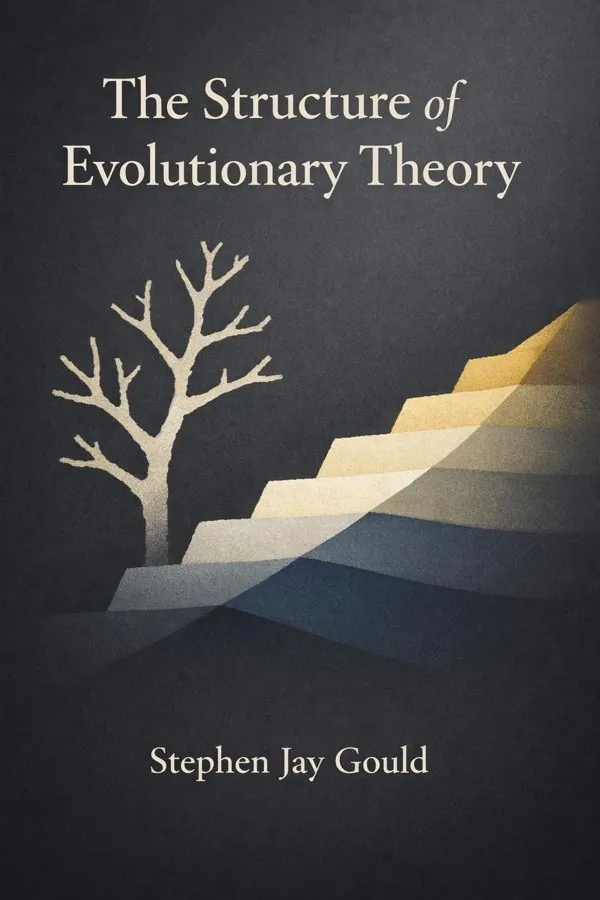
The Structure of Evolutionary Theory: Summary & Key Insights
 10 min9 chaptersAudio available
Key Takeaways from The Structure of Evolutionary Theory
Gould treats this chain of reasoning as the indispensable core of evolutionary theory.
Theories do not emerge in a vacuum; they are built, revised, defended, and sometimes distorted by the historical worlds that produce them.
A powerful explanation can become misleading when treated as the only explanation.
He believed this habit can produce elegant stories that sound scientific but outrun the evidence.
The insight is striking because it challenges the expectation that evolution must always proceed as smooth, continuous transformation.
What Is The Structure of Evolutionary Theory About?
The Structure of Evolutionary Theory by Stephen Jay Gould is a life_science book spanning 11 pages. Stephen Jay Gould’s The Structure of Evolutionary Theory is one of the most ambitious works ever written about how evolution operates, how scientific ideas change, and why Darwin’s legacy remains both foundational and unfinished. Rather than offering a simple restatement of natural selection, Gould reexamines the architecture of evolutionary thought itself. He argues that Darwin established a brilliant core logic, but that modern biology reveals a richer, more layered picture involving developmental constraints, historical contingency, punctuated patterns of change, and selection acting at multiple levels of life. The book matters because it challenges readers to move beyond simplified versions of evolution often presented in textbooks and public debate. Gould shows that evolutionary theory is strongest not when treated as a rigid doctrine, but when expanded to accommodate complexity, hierarchy, and deep time. As a leading paleontologist, historian of science, and one of the twentieth century’s most influential scientific writers, Gould was uniquely equipped to undertake this synthesis. The result is a monumental, intellectually demanding, and deeply rewarding exploration of how life changes—and how science learns to explain that change.
This FizzRead summary covers all 9 key chapters of The Structure of Evolutionary Theory in approximately 10 minutes, distilling the most important ideas, arguments, and takeaways from Stephen Jay Gould's work. Also available as an audio summary and Key Quotes Podcast.
The Structure of Evolutionary Theory
Stephen Jay Gould’s The Structure of Evolutionary Theory is one of the most ambitious works ever written about how evolution operates, how scientific ideas change, and why Darwin’s legacy remains both foundational and unfinished. Rather than offering a simple restatement of natural selection, Gould reexamines the architecture of evolutionary thought itself. He argues that Darwin established a brilliant core logic, but that modern biology reveals a richer, more layered picture involving developmental constraints, historical contingency, punctuated patterns of change, and selection acting at multiple levels of life. The book matters because it challenges readers to move beyond simplified versions of evolution often presented in textbooks and public debate. Gould shows that evolutionary theory is strongest not when treated as a rigid doctrine, but when expanded to accommodate complexity, hierarchy, and deep time. As a leading paleontologist, historian of science, and one of the twentieth century’s most influential scientific writers, Gould was uniquely equipped to undertake this synthesis. The result is a monumental, intellectually demanding, and deeply rewarding exploration of how life changes—and how science learns to explain that change.
Who Should Read The Structure of Evolutionary Theory?
This book is perfect for anyone interested in life_science and looking to gain actionable insights in a short read. Whether you're a student, professional, or lifelong learner, the key ideas from The Structure of Evolutionary Theory by Stephen Jay Gould will help you think differently.
- ✓Readers who enjoy life_science and want practical takeaways
- ✓Professionals looking to apply new ideas to their work and life
- ✓Anyone who wants the core insights of The Structure of Evolutionary Theory in just 10 minutes
Want the full summary?
Get instant access to this book summary and 100K+ more with Fizz Moment.
Get Free SummaryAvailable on App Store • Free to download
Key Chapters
Big scientific revolutions often begin with a deceptively simple idea, and Darwin’s was this: if organisms vary, if some variations are heritable, and if more individuals are born than can survive, then nature will sort those differences over time. Gould treats this chain of reasoning as the indispensable core of evolutionary theory. He insists that any serious revision of Darwinism must preserve this explanatory backbone, because it remains one of the most powerful insights in science.
But Gould also reminds us that Darwin worked in a specific historical context. He was fighting essentialist views that treated species as fixed types and confronting a culture still searching for lawful explanations of nature. Darwin’s genius was not merely proposing evolution, but identifying a mechanism—natural selection—that could explain adaptation without invoking design. This gave biology a historical and causal structure.
At the same time, Gould argues that many popular accounts reduce Darwinism to a slogan like “survival of the fittest,” stripping away its nuance. Darwin was not saying that the strongest always win, nor that evolution marches toward perfection. He was describing how differential reproduction shapes populations in specific environments.
A practical way to use Gould’s insight is to apply Darwin’s logic carefully whenever you encounter evolutionary claims. Ask: what varies, what is inherited, what environmental pressures exist, and how does reproduction differ? This keeps the theory grounded in evidence rather than metaphor.
Actionable takeaway: When evaluating any explanation of biological change, start with Darwin’s core logic—but do not assume that core alone explains the full complexity of evolution.
Theories do not emerge in a vacuum; they are built, revised, defended, and sometimes distorted by the historical worlds that produce them. One of Gould’s most important contributions is showing that evolutionary theory itself has evolved. To understand modern debates, we must first understand how Darwin’s ideas were interpreted, narrowed, challenged, and expanded over the next century.
Gould traces how Darwinism survived periods of skepticism, merged with genetics in the modern synthesis, and then hardened into a more gene-centered and adaptationist orthodoxy than Darwin himself would likely have recognized. This history matters because scientific frameworks often become simplified as they gain authority. What begins as a flexible research program can turn into a rigid set of assumptions.
For example, twentieth-century evolutionary biology often emphasized gradual change, organism-level selection, and adaptation as the default explanation for traits. Gould does not reject these principles outright, but he argues that they became overextended. Fossil evidence, developmental biology, and hierarchical models of selection all suggest that the standard view left important phenomena underexplained.
In practical terms, Gould’s historical approach teaches intellectual humility. Whenever a scientific consensus seems complete, it is worth asking which questions it solved well and which questions it pushed to the margins. This applies not only to biology, but also to economics, psychology, medicine, and technology.
Actionable takeaway: Study the history of an idea before accepting its current form as final; often the most fruitful insights come from recovering what earlier versions overlooked.
A powerful explanation can become misleading when treated as the only explanation. Gould argues that natural selection remains central to evolution, but it should not be inflated into a universal answer for every feature of life. Selection explains why some traits spread because they improve reproductive success, yet not all biological patterns arise primarily from adaptive fine-tuning.
This is where Gould’s revisionary project begins. He accepts selection as real and vital, but he resists the habit of treating every trait as an optimization crafted by competition. Some features persist because of developmental constraints, inherited structural patterns, or historical accidents. Others may be byproducts of changes selected for entirely different reasons. A chin, for example, need not have evolved because chins were directly favored; it might result from broader changes in jaw and facial structure.
Gould’s point is not to weaken evolutionary theory, but to strengthen it by making it more realistic. A richer theory asks multiple questions: Is this trait adaptive? Could it be a side effect? Is it constrained by body plan or developmental pathway? Did it arise at one biological level and persist at another?
In everyday reasoning, this matters because people often default to single-cause stories. In health, behavior, or social systems, we search for one driver when multiple interacting causes are at work. Gould’s pluralism cautions against that reflex.
Actionable takeaway: When faced with an evolutionary explanation, ask not only “How might selection favor this?” but also “What constraints, byproducts, or historical pathways might have shaped it?”
One of Gould’s most famous intellectual interventions is his critique of strict adaptationism—the tendency to assume that every trait exists because it was directly designed by natural selection for its current function. He believed this habit can produce elegant stories that sound scientific but outrun the evidence.
Gould does not deny adaptation. Birds’ wings are adaptive for flight, camouflage can improve survival, and antibiotic resistance in bacteria is a textbook case of selection. His concern is with overreach. Traits can emerge for one reason and later be co-opted for another. Some structures are developmental byproducts, like architectural spaces that arise from building constraints rather than deliberate design. In evolution, these “spandrels” remind us that form is not always a direct answer to an adaptive problem.
Consider human cognition. It is tempting to assign a direct adaptive purpose to every feature of thought, emotion, or behavior. Gould would advise caution. Some capacities may be emergent consequences of larger evolutionary changes in brain complexity, not isolated products of separate adaptive pressures. The same logic applies across biology: not every detail of a shell, flower, or skeleton must be individually optimized.
Practically, this perspective sharpens critical thinking. It trains us to distinguish evidence-based explanation from storytelling. In research, policy, and everyday conversation, plausible narratives are not enough; we need comparative evidence, developmental analysis, and historical context.
Actionable takeaway: Treat adaptive explanations as hypotheses to test, not as default conclusions to accept simply because they sound convincing.
One of Gould’s signature ideas, developed with Niles Eldredge, is punctuated equilibrium: the proposal that species often remain relatively stable for long periods and that major evolutionary change tends to occur in geologically rapid bursts associated with speciation. The insight is striking because it challenges the expectation that evolution must always proceed as smooth, continuous transformation.
Gould developed this idea partly from paleontology. Fossil records frequently show long stretches of morphological stability, interrupted by comparatively abrupt appearances of new forms. Rather than treating this pattern as mere incompleteness in the fossil record, punctuated equilibrium interprets stasis itself as a meaningful biological phenomenon. Stability is not the absence of evolution; it may reflect the persistence of successful developmental and ecological configurations.
This concept does not reject Darwinian evolution. Instead, it changes our expectations about tempo and mode. Evolution can still proceed through natural selection, but the visible pattern across deep time may be episodic rather than gradual. Small isolated populations, ecological disruption, and speciation events can produce bursts of change that later appear sudden in the geological record.
The broader application is clear: important change in complex systems is often uneven. Businesses, cultures, and technologies may remain stable for years, then shift dramatically when conditions cross a threshold. Gould’s model encourages us to stop assuming that all meaningful change must be constant and incremental.
Actionable takeaway: Look for periods of stability as seriously as periods of transformation; understanding why systems resist change is often as important as explaining why they change.
Life is organized in layers, and Gould argues that evolutionary theory must respect that hierarchy. Genes exist within cells, cells within organisms, organisms within populations, and species within larger ecological and historical lineages. A major theme of the book is that selection may operate at more than one of these levels, and that confining explanation to the individual organism can miss crucial dynamics.
Traditional Darwinism often focused on organismal selection: individuals with favorable traits leave more offspring. Gould accepts this as important but incomplete. Species may also differ in rates of speciation and extinction, producing species selection. Traits that increase the survival or proliferation of whole lineages may shape large-scale patterns in the history of life, even if they are not reducible to organism-level advantages.
For example, a geographic range broad enough to buffer environmental disruption may not make every individual fitter in a direct sense, yet species possessing such properties may persist longer than others. Over millions of years, this can influence which forms dominate the fossil record.
This hierarchical view has implications beyond biology. In organizations, what benefits an individual may not benefit the team; what helps a team may not benefit the institution. Causes and consequences differ across levels. Confusion arises when we collapse them into one scale.
Actionable takeaway: When analyzing any complex system, identify the relevant levels at which selection, competition, or persistence may occur instead of assuming one level explains everything.
A central argument in Gould’s work is that large-scale evolutionary patterns cannot always be explained simply by extending small-scale population changes over longer periods. Macroevolution—the origin of major forms, broad trends, differential diversification, and mass extinction patterns—deserves analytical status in its own right.
This does not mean microevolution and macroevolution are disconnected. Changes in gene frequencies within populations remain real and fundamental. But Gould argues that the history of life includes phenomena visible only at larger scales. Mass extinctions, for instance, can reset evolutionary possibilities in ways that local adaptation cannot predict. The rise of mammals after the dinosaur extinction was not merely the cumulative result of tiny adaptive improvements; it depended on a catastrophic historical event that restructured opportunity.
Gould also stresses that trends in the fossil record may emerge from sorting among species rather than directional improvement within lineages. Complexity, diversity, and disparity do not necessarily reflect progress. They may result from branching experiments, differential survivorship, and constraints on what life can become.
This perspective guards against simplistic narratives of inevitability. In career paths, social systems, and technological development, outcomes often reflect system-level events, path dependence, and selective retention of lineages, not just the steady optimization of individual units.
Actionable takeaway: Do not assume that large-scale outcomes are merely scaled-up versions of small-scale processes; ask what new patterns appear at broader levels and what mechanisms are needed to explain them.
If evolution teaches one humbling lesson, it is that history could have gone differently. Gould emphasizes contingency: the idea that chance events, prior pathways, and irreversible historical sequences profoundly shape life’s outcomes. Evolution is lawful in process, but not fully predictable in result.
This means that natural selection works on available variation within inherited constraints and changing environments, not on an open field of infinite possibilities. A meteor impact, a climate shift, a developmental innovation, or a migration event can redirect the future in ways no general law could have forecast in detail. Gould famously resisted triumphalist stories that portray human beings as the inevitable goal of evolution. We are one contingent outcome among many.
Historical constraint is the companion idea. Organisms evolve from what already exists. Evolution is an improviser, not an engineer designing from scratch. The vertebrate eye, the panda’s thumb, and the recurrent quirks of body plans show that solutions are often workable rather than optimal because they inherit previous structures.
This has broad practical relevance. In institutions, personal lives, and societies, current possibilities are shaped by prior commitments and accidental turns. Better decisions come from recognizing the force of path dependence instead of pretending every situation begins anew.
Actionable takeaway: Replace narratives of inevitability with questions about sequence, prior constraint, and chance; understanding how something became possible is often more revealing than assuming it had to happen.
Evolution does not act on abstract possibilities; it acts on bodies built through development. Gould argues that any adequate evolutionary theory must integrate developmental biology and structural constraints, because the forms available to selection are limited and channeled by how organisms grow.
This insight pushes against a purely external view of evolution in which environments simply sculpt passive variation. Variation itself has structure. Some changes are easier for developmental systems to produce than others. Certain body plans open paths; others close them. As a result, the direction of evolutionary change depends not only on selective pressure, but also on the internal architecture of organisms.
Think of the repeated emergence of similar forms in different lineages, or the persistence of conserved developmental pathways across vast timescales. These patterns suggest that evolution is not only about competitive filtering, but also about the generative rules of life. A mutation may be theoretically possible yet developmentally inaccessible, while another may recur because the organismal system readily produces it.
This perspective matters outside biology too. In any creative or organizational process, outcomes are constrained by the structure of the system generating options. Strategy depends not just on choosing among possibilities, but on understanding why certain possibilities arise in the first place.
Actionable takeaway: When thinking about change, examine the system that produces variation, not only the environment that selects among outcomes.
All Chapters in The Structure of Evolutionary Theory
About the Author
Stephen Jay Gould (1941–2002) was an American paleontologist, evolutionary biologist, historian of science, and one of the most influential public intellectuals in modern science. He spent most of his career at Harvard University, where he taught biology and worked as a curator at the Museum of Comparative Zoology. Gould became widely known not only for his technical scholarship, but also for his extraordinary ability to communicate complex ideas to general readers through essays, lectures, and bestselling books. He co-developed the theory of punctuated equilibrium with Niles Eldredge and challenged overly rigid forms of adaptationism in evolutionary thought. Across his work, Gould combined scientific rigor with deep historical awareness and philosophical reflection. The Structure of Evolutionary Theory stands as his monumental final synthesis of a lifetime spent studying evolution and the history of ideas.
Get This Summary in Your Preferred Format
Read or listen to the The Structure of Evolutionary Theory summary by Stephen Jay Gould anytime, anywhere. FizzRead offers multiple formats so you can learn on your terms — all free.
Available formats: App · Audio · PDF · EPUB — All included free with FizzRead
Download The Structure of Evolutionary Theory PDF and EPUB Summary
Key Quotes from The Structure of Evolutionary Theory
“Gould treats this chain of reasoning as the indispensable core of evolutionary theory.”
“Theories do not emerge in a vacuum; they are built, revised, defended, and sometimes distorted by the historical worlds that produce them.”
“A powerful explanation can become misleading when treated as the only explanation.”
“He believed this habit can produce elegant stories that sound scientific but outrun the evidence.”
“The insight is striking because it challenges the expectation that evolution must always proceed as smooth, continuous transformation.”
Frequently Asked Questions about The Structure of Evolutionary Theory
The Structure of Evolutionary Theory by Stephen Jay Gould is a life_science book that explores key ideas across 9 chapters. Stephen Jay Gould’s The Structure of Evolutionary Theory is one of the most ambitious works ever written about how evolution operates, how scientific ideas change, and why Darwin’s legacy remains both foundational and unfinished. Rather than offering a simple restatement of natural selection, Gould reexamines the architecture of evolutionary thought itself. He argues that Darwin established a brilliant core logic, but that modern biology reveals a richer, more layered picture involving developmental constraints, historical contingency, punctuated patterns of change, and selection acting at multiple levels of life. The book matters because it challenges readers to move beyond simplified versions of evolution often presented in textbooks and public debate. Gould shows that evolutionary theory is strongest not when treated as a rigid doctrine, but when expanded to accommodate complexity, hierarchy, and deep time. As a leading paleontologist, historian of science, and one of the twentieth century’s most influential scientific writers, Gould was uniquely equipped to undertake this synthesis. The result is a monumental, intellectually demanding, and deeply rewarding exploration of how life changes—and how science learns to explain that change.
More by Stephen Jay Gould
The Desert Evolution
Stephen Jay Gould
10 min
Ever Since Darwin: Reflections in Natural History
Stephen Jay Gould
10 min
The Panda’s Thumb: More Reflections in Natural History
Stephen Jay Gould
10 min
Full House: The Spread of Excellence from Plato to Darwin
Stephen Jay Gould
10 minYou Might Also Like
The Selfish Gene
Richard Dawkins
10 min
Awakenings
Oliver Sacks
10 min
Parasite Rex: Inside the Bizarre World of Nature's Most Dangerous Creatures
Carl Zimmer
10 min
The Atlas of Life on Earth
Various
10 min
The Book of Humans: The Story of How We Became Us
Adam Rutherford
10 min
The Horse
Wendy Williams
10 minBrowse by Category
Ready to read The Structure of Evolutionary Theory?
Get the full summary and 100K+ more books with Fizz Moment.