
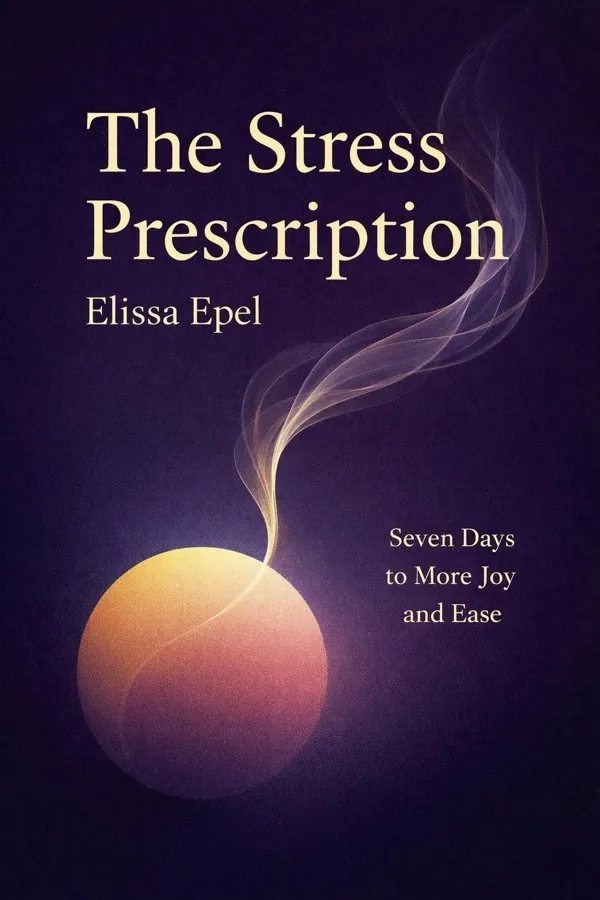
The Stress Prescription: Seven Days to More Joy and Ease: Summary & Key Insights
by Elissa Epel
 10 min9 chaptersAudio available
Key Takeaways from The Stress Prescription: Seven Days to More Joy and Ease
One of the book’s most surprising insights is that stress is not automatically harmful.
Much of what we call stress is not caused by the present moment, but by the mind’s habit of leaving it.
A stressed mind is easier to calm when the body is given a chance to downshift.
Stress narrows our focus and often convinces us to pull away from others, yet one of the most effective antidotes to stress is human connection.
When life feels pressured, gratitude can sound naive and joy can feel like a distraction.
What Is The Stress Prescription: Seven Days to More Joy and Ease About?
The Stress Prescription: Seven Days to More Joy and Ease by Elissa Epel is a mental_health book spanning 9 pages. Stress is often treated like a modern poison: something to eliminate, suppress, or outrun. In The Stress Prescription, psychologist and stress researcher Elissa Epel argues for a more powerful approach. Instead of waging war against stress, she shows readers how to change their relationship to it. Through a practical seven-day program, Epel translates cutting-edge findings from psychology, neuroscience, and mind-body medicine into small daily practices that help people feel calmer, more resilient, and more alive. What makes this book especially valuable is its balance of science and accessibility. Epel does not offer vague encouragement or unrealistic promises. She draws on decades of research into stress biology, emotional regulation, mindfulness, aging, and cellular health to explain why certain habits help us recover faster and suffer less. Her message is both hopeful and grounded: stress is inevitable, but spiraling, depletion, and disconnection do not have to be. By focusing on mindset shifts, body-based resets, connection, gratitude, release, and meaning, Epel gives readers a concise blueprint for cultivating more joy and ease in daily life. It is a short book with surprisingly lasting impact.
This FizzRead summary covers all 9 key chapters of The Stress Prescription: Seven Days to More Joy and Ease in approximately 10 minutes, distilling the most important ideas, arguments, and takeaways from Elissa Epel's work. Also available as an audio summary and Key Quotes Podcast.
The Stress Prescription: Seven Days to More Joy and Ease
Stress is often treated like a modern poison: something to eliminate, suppress, or outrun. In The Stress Prescription, psychologist and stress researcher Elissa Epel argues for a more powerful approach. Instead of waging war against stress, she shows readers how to change their relationship to it. Through a practical seven-day program, Epel translates cutting-edge findings from psychology, neuroscience, and mind-body medicine into small daily practices that help people feel calmer, more resilient, and more alive.
What makes this book especially valuable is its balance of science and accessibility. Epel does not offer vague encouragement or unrealistic promises. She draws on decades of research into stress biology, emotional regulation, mindfulness, aging, and cellular health to explain why certain habits help us recover faster and suffer less. Her message is both hopeful and grounded: stress is inevitable, but spiraling, depletion, and disconnection do not have to be. By focusing on mindset shifts, body-based resets, connection, gratitude, release, and meaning, Epel gives readers a concise blueprint for cultivating more joy and ease in daily life. It is a short book with surprisingly lasting impact.
Who Should Read The Stress Prescription: Seven Days to More Joy and Ease?
This book is perfect for anyone interested in mental_health and looking to gain actionable insights in a short read. Whether you're a student, professional, or lifelong learner, the key ideas from The Stress Prescription: Seven Days to More Joy and Ease by Elissa Epel will help you think differently.
- ✓Readers who enjoy mental_health and want practical takeaways
- ✓Professionals looking to apply new ideas to their work and life
- ✓Anyone who wants the core insights of The Stress Prescription: Seven Days to More Joy and Ease in just 10 minutes
Want the full summary?
Get instant access to this book summary and 100K+ more with Fizz Moment.
Get Free SummaryAvailable on App Store • Free to download
Key Chapters
One of the book’s most surprising insights is that stress is not automatically harmful. What often damages us more than stress itself is the belief that every sign of tension means something is wrong. A racing heart, sweaty palms, and sharpened attention can feel unpleasant, but they are also signals that the body is mobilizing energy to meet a challenge. Epel invites readers to reinterpret the stress response not as proof of failure, but as evidence that the body is trying to help.
This shift matters because mindset influences physiology. Research suggests that when people view stress as enhancing rather than debilitating, they often cope better, recover faster, and perform more effectively. Reframing stress does not mean pretending overwhelm is enjoyable. It means recognizing that activation can be useful. Before a presentation, difficult conversation, exam, or medical appointment, instead of saying, “I’m falling apart,” you might say, “My body is preparing me to respond.”
This is a subtle but powerful psychological pivot. It reduces the extra layer of fear we often add to stressful moments. Rather than resisting what is happening internally, we become less reactive and more capable. Epel’s approach helps readers move from threat to challenge, from panic to participation.
A practical application is to pause whenever stress arises and name its purpose. Ask: What is this stress trying to help me do? Speak to yourself in supportive language. Actionable takeaway: the next time your body activates, replace “This is bad for me” with “This is energy I can use.”
Much of what we call stress is not caused by the present moment, but by the mind’s habit of leaving it. We replay old conflicts, imagine future disasters, and turn uncertainty into a full internal crisis. Epel argues that one of the fastest ways to reduce unnecessary stress is to return attention to what is actually happening right now. Presence does not solve every problem, but it prevents the mind from multiplying pain.
Being present is more than a relaxation technique. It is a resilience skill. When attention comes back to the body, the breath, or the immediate environment, the nervous system often receives a signal that it is safe enough to stop escalating. This can be as simple as noticing your feet on the floor while waiting for difficult news, or taking three slow breaths before reacting to an upsetting email.
Epel emphasizes that presence is trainable. You do not need a perfect meditation practice or a quiet life. In fact, daily interruptions are ideal training opportunities. Standing in line, washing dishes, walking to the car, or listening to a child can become moments of mindful return. By anchoring attention in the senses, you step out of mental spirals and into direct experience.
Presence also improves judgment. When we are less lost in imagined scenarios, we can better assess what needs to be done now and what can wait. Actionable takeaway: choose one daily cue, such as hearing a phone notification or opening a door, and use it as a reminder to pause, breathe, and notice the present moment.
A stressed mind is easier to calm when the body is given a chance to downshift. Epel highlights a simple but often ignored truth: psychological stress is not only a story in the head; it is also a physical state. Muscles tighten, breathing becomes shallow, the heart works harder, and the nervous system prepares for danger. Trying to think your way out of stress without helping the body can feel like arguing with an alarm while it is still blaring.
That is why body-based practices are central to Epel’s seven-day prescription. Small physical interventions can shift the body toward regulation and, in turn, make emotional steadiness more accessible. Examples include slow exhalations, stretching, brief walks, shaking out tension, resting a hand on the chest, or stepping outside for fresh air and natural light. These are not luxuries reserved for retreats; they are micro-resets available in everyday life.
The key is consistency, not intensity. A 60-second breathing practice before a meeting may be more useful than waiting for a perfect 30-minute wellness routine. Likewise, a quick movement break during a draining workday can interrupt accumulated stress before it hardens into irritability or exhaustion.
Epel’s broader point is empowering: you can influence your stress state through your physiology. By learning to regulate the body, you create better conditions for clearer thinking, kinder responses, and faster recovery.
Actionable takeaway: build a personal reset ritual lasting one to three minutes, such as inhale for four counts, exhale for six, roll your shoulders, and relax your jaw, then use it at least twice a day.
Stress narrows our focus and often convinces us to pull away from others, yet one of the most effective antidotes to stress is human connection. Epel shows that support is not merely comforting at an emotional level; it is biologically regulating. Warm, trustworthy relationships can calm the nervous system, reduce feelings of threat, and restore a sense of safety. In other words, we do not just think our way to resilience. We co-regulate through relationships.
This idea is especially important because modern stress often drives isolation. When overwhelmed, people frequently become curt, withdrawn, or self-protective. They may assume no one will understand, or they may feel too depleted to reach out. Epel encourages readers to challenge that instinct. A short conversation, a shared laugh, a hug, or even a sincere text can soften stress responses more than many solitary coping strategies.
Connection also includes the way we show up for others. Helping someone else can reduce our own stress by moving us out of rumination and into meaning, perspective, and mutual care. This does not mean overextending yourself or becoming everyone’s emotional caretaker. It means remembering that stress is easier to bear when we feel woven into a social fabric.
Practical examples include calling a friend instead of scrolling alone, asking a colleague for help, eating one meal with full attention to another person, or creating a family ritual of checking in each evening. Actionable takeaway: identify one person who reliably helps you feel grounded and make one intentional point of contact with them this week.
When life feels pressured, gratitude can sound naive and joy can feel like a distraction. Epel argues the opposite. Positive emotions are not a denial of difficulty; they are a resource that broadens perspective, replenishes energy, and helps the body recover from stress. Even brief moments of appreciation, delight, awe, or amusement can interrupt threat mode and remind us that life is larger than the problem of the moment.
Gratitude is especially effective because it shifts attention from scarcity to sufficiency. Under stress, the mind fixates on what is missing, uncertain, or going wrong. A gratitude practice gently trains attention toward what is still supportive, meaningful, or beautiful. This could be a capable body, a caring friend, sunlight through a window, a good meal, or a small success after a hard day.
Joy works similarly, but with an added sense of aliveness. It may come from music, play, humor, creativity, time in nature, or a shared moment of affection. Epel does not suggest chasing forced positivity. Instead, she encourages readers to become more available to genuine uplifting experiences that are already possible in ordinary life.
Importantly, gratitude and joy increase resilience not by erasing pain, but by giving us more emotional range. A person who can access appreciation amid difficulty is less likely to be consumed by stress alone.
Actionable takeaway: at the end of each day, write down three specific moments that brought relief, beauty, connection, or gratitude, and spend ten seconds fully feeling each one before moving on.
Stress becomes especially toxic when it fuses with control. We grip, monitor, predict, and rehearse, hoping that enough mental effort will secure a better outcome. Epel’s sixth-day lesson is that peace often begins not with solving everything, but with releasing the struggle against what cannot be managed. Letting go is not passivity. It is the disciplined act of separating what is yours to influence from what is not.
Many people waste enormous energy trying to control other people’s reactions, uncertain futures, or irreversible past events. This creates a cycle of vigilance and frustration. Epel invites readers to notice where they are investing emotional effort without actual leverage. The goal is not indifference, but wise allocation of attention.
Acceptance can coexist with action. For example, you cannot control whether a job application is accepted, but you can control the quality of your preparation. You cannot control a loved one’s mood, but you can choose whether to respond with patience or defensiveness. You cannot erase a mistake, but you can repair, learn, and move forward.
Practices of letting go may include journaling worries into two columns, one for what you can act on and one for what you must release; using a phrase like “This is here right now”; or visualizing yourself setting down a heavy bag. Over time, this reduces the exhausting illusion that constant mental engagement equals safety.
Actionable takeaway: when a worry loops in your mind, ask, “Can I act on this today?” If yes, take one concrete step. If no, name it clearly and practice releasing it for now.
People can tolerate a great deal of strain when they understand why it matters. Epel’s final day focuses on meaning, because purpose changes the emotional texture of stress. The same effort that feels crushing when disconnected from values can feel energizing when linked to something deeply important. Meaning does not remove difficulty, but it gives difficulty a container.
This is why stress often feels different depending on context. Caring for a child, building a business, healing from illness, studying for a calling, or supporting a community can all be demanding. Yet when these actions reflect who we are and what we care about, stress may become more bearable and even growth-promoting. Meaning helps answer the question, “What is this effort in service of?”
Epel encourages readers to move beyond survival mode and reconnect with larger values. This can be done through reflection on moments of pride, contribution, love, or moral clarity. You might ask: When do I feel most like myself? What kind of person do I want to be under pressure? What am I willing to endure because it aligns with my purpose?
Meaning also guards against emptiness. Without it, people may manage stress efficiently yet still feel drained and directionless. With it, everyday challenges become part of a larger narrative.
Actionable takeaway: write a short personal purpose statement for your current season of life, such as “I am working hard to create stability for my family” or “I am learning to use my challenges in service of growth,” and revisit it when stress rises.
The deepest lesson of The Stress Prescription is that resilience is not a personality trait you either have or lack. It is a set of practices that can be strengthened over time. Epel’s seven-day structure is helpful not because transformation happens in a week, but because it gives readers a manageable entry point into habits that become more powerful with repetition. Lasting change comes from integration.
This matters because many people approach stress management as an emergency intervention. They wait until they are overwhelmed, exhausted, or emotionally flooded, then scramble for relief. Epel instead promotes a preventive model. Small actions taken regularly create a more flexible nervous system and a more compassionate inner life. Reframing stress, returning to presence, calming the body, seeking connection, savoring gratitude, letting go, and reconnecting to meaning work best as an ecosystem rather than isolated tricks.
Integration also requires realism. You will not remember every practice every day. Some days will feel calm; others will feel chaotic. The goal is not perfect self-regulation. The goal is to recover more quickly, react less harshly, and build trust in your ability to meet hard moments with skill.
A useful way to integrate the book is to create a personal resilience menu: a short list of practices that work for you in different situations. For example, breathing for acute anxiety, texting a friend for loneliness, gratitude journaling for negativity, and purpose reflection for burnout.
Actionable takeaway: choose one practice from the book to use in the morning, one during stressful moments, and one before bed, turning the seven-day plan into a sustainable routine.
What gives Epel’s advice unusual credibility is that it rests on a strong scientific foundation. She is not simply offering lifestyle tips; she is translating decades of research on stress physiology, emotion regulation, mindfulness, and cellular aging into practical guidance. Her work has explored how chronic stress affects the body over time, including its links to inflammation, accelerated aging, and changes at the cellular level. Yet just as important, her research also points to the body’s capacity for repair and resilience.
A central theme is that the stress response is adaptive in the short term but costly when it becomes chronic, unrelenting, and unsupported by recovery. This is why the book emphasizes not just reducing stress exposure, which is often impossible, but improving stress recovery. Mindset, social support, breathing, mindful attention, positive emotions, and meaning all help shape how long the body stays activated and how quickly it returns to balance.
Epel’s scientific lens helps readers avoid simplistic thinking. Stress is neither wholly good nor wholly bad. It is a complex biological and psychological process that can either sharpen us or wear us down depending on context, interpretation, and recovery habits. That nuance is one of the book’s greatest strengths.
For readers who are skeptical of self-help, this evidence-based framing is especially reassuring. The practices are simple, but they are not trivial.
Actionable takeaway: treat stress management less as mood repair and more as nervous-system training, and commit to one evidence-based recovery practice you can repeat often enough to make it biologically meaningful.
All Chapters in The Stress Prescription: Seven Days to More Joy and Ease
About the Author
Elissa Epel, Ph.D., is a professor in the Department of Psychiatry at the University of California, San Francisco, and one of the leading researchers in the science of stress. Her work focuses on how chronic psychological stress influences health, aging, emotional well-being, and cellular function. She is especially known for studying the links between stress, resilience, mindfulness, and biological aging, helping to show how daily habits and mental states affect long-term health. Epel is also the co-author of the bestselling book The Telomere Effect, which brought complex longevity research to a general audience. Across her career, she has combined rigorous science with practical application, making her an unusually credible and accessible voice on stress. In The Stress Prescription, she distills years of research into clear tools for living with greater calm, resilience, and joy.
Get This Summary in Your Preferred Format
Read or listen to the The Stress Prescription: Seven Days to More Joy and Ease summary by Elissa Epel anytime, anywhere. FizzRead offers multiple formats so you can learn on your terms — all free.
Available formats: App · Audio · PDF · EPUB — All included free with FizzRead
Download The Stress Prescription: Seven Days to More Joy and Ease PDF and EPUB Summary
Key Quotes from The Stress Prescription: Seven Days to More Joy and Ease
“One of the book’s most surprising insights is that stress is not automatically harmful.”
“Much of what we call stress is not caused by the present moment, but by the mind’s habit of leaving it.”
“A stressed mind is easier to calm when the body is given a chance to downshift.”
“Stress narrows our focus and often convinces us to pull away from others, yet one of the most effective antidotes to stress is human connection.”
“When life feels pressured, gratitude can sound naive and joy can feel like a distraction.”
Frequently Asked Questions about The Stress Prescription: Seven Days to More Joy and Ease
The Stress Prescription: Seven Days to More Joy and Ease by Elissa Epel is a mental_health book that explores key ideas across 9 chapters. Stress is often treated like a modern poison: something to eliminate, suppress, or outrun. In The Stress Prescription, psychologist and stress researcher Elissa Epel argues for a more powerful approach. Instead of waging war against stress, she shows readers how to change their relationship to it. Through a practical seven-day program, Epel translates cutting-edge findings from psychology, neuroscience, and mind-body medicine into small daily practices that help people feel calmer, more resilient, and more alive. What makes this book especially valuable is its balance of science and accessibility. Epel does not offer vague encouragement or unrealistic promises. She draws on decades of research into stress biology, emotional regulation, mindfulness, aging, and cellular health to explain why certain habits help us recover faster and suffer less. Her message is both hopeful and grounded: stress is inevitable, but spiraling, depletion, and disconnection do not have to be. By focusing on mindset shifts, body-based resets, connection, gratitude, release, and meaning, Epel gives readers a concise blueprint for cultivating more joy and ease in daily life. It is a short book with surprisingly lasting impact.
More by Elissa Epel

You Might Also Like
Big Feelings: How to Be Okay When Things Are Not Okay
Liz Fosslien, Mollie West Duffy
10 min
Creative Arts Therapies Handbook: Art, Music and Dance Therapy Practices for Wellbeing
Susan I. Buchalter
10 min
Emotional First Aid: Healing Rejection, Guilt, Failure, and Other Everyday Hurts
Guy Winch
10 min
Lost Connections: Why You're Depressed and How to Find Hope
Johann Hari
10 min
No Time to Panic: How to Stop Worrying and Embrace Life
Matt Gutman
10 min
Overcoming Mobbing: A Recovery Guide for Workplace Aggression and Bullying
Maureen Duffy, Len Sperry
10 minBrowse by Category
Ready to read The Stress Prescription: Seven Days to More Joy and Ease?
Get the full summary and 100K+ more books with Fizz Moment.