
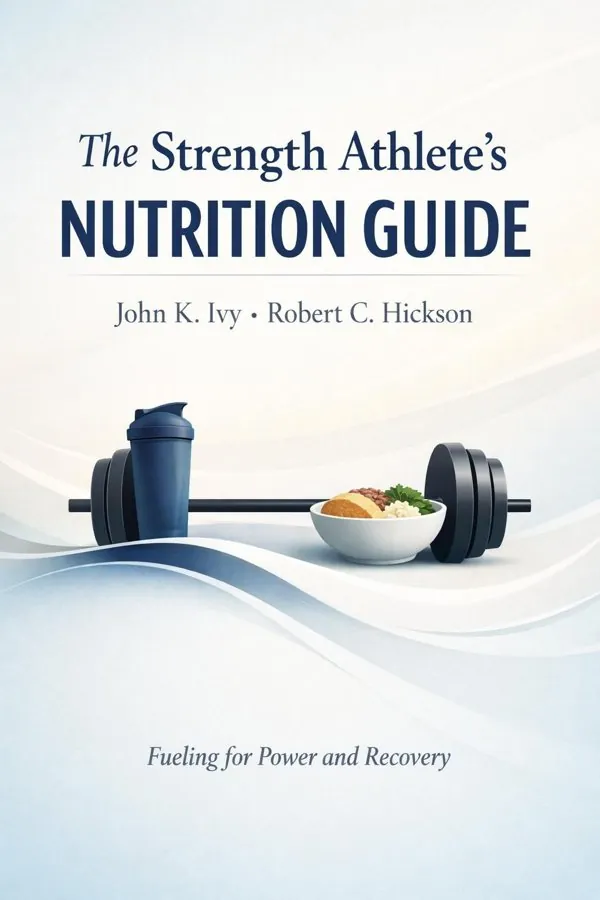
The Strength Athlete’s Nutrition Guide: Fueling for Power and Recovery: Summary & Key Insights
by John K. Ivy, Robert C. Hickson
 10 min9 chaptersAudio available
Key Takeaways from The Strength Athlete’s Nutrition Guide: Fueling for Power and Recovery
Most athletes think of lifting as a matter of effort, but underneath every set is a precise energy problem the body must solve.
Muscle glycogen is the storage form of carbohydrate, and when it runs low, output often falls before the athlete fully recognizes what is happening.
Many athletes know they need protein, but fewer understand that the body responds to protein as a repeated signal, not just a daily total.
What you eat matters, but when you eat can determine whether a hard workout becomes a stepping stone or a setback.
A slight drop in hydration can quietly undermine performance long before an athlete feels truly thirsty.
What Is The Strength Athlete’s Nutrition Guide: Fueling for Power and Recovery About?
The Strength Athlete’s Nutrition Guide: Fueling for Power and Recovery by John K. Ivy, Robert C. Hickson is a nutrition book spanning 4 pages. Strength training is often discussed in terms of programming, intensity, and technique, yet nutrition is the invisible factor that determines how well those efforts translate into muscle, power, and recovery. The Strength Athlete’s Nutrition Guide: Fueling for Power and Recovery focuses on that missing link. John K. Ivy and Robert C. Hickson explain how strength athletes can eat not just to support training, but to improve force production, accelerate adaptation, and recover more effectively between demanding sessions. Rather than offering generic sports nutrition advice, the book addresses the specific physiological demands of powerlifting, Olympic lifting, bodybuilding, sprint-based power sports, and resistance training in general. It shows how energy systems work during lifting, why carbohydrate and protein timing matter, how hydration affects strength output, and how to structure food intake for both performance and body composition goals. Ivy and Hickson bring unusual authority to the topic: both are highly respected exercise physiologists whose research helped shape modern understanding of glycogen metabolism, recovery, and nutrient timing. The result is a practical, evidence-based guide for athletes and coaches who want stronger results from smarter fueling.
This FizzRead summary covers all 9 key chapters of The Strength Athlete’s Nutrition Guide: Fueling for Power and Recovery in approximately 10 minutes, distilling the most important ideas, arguments, and takeaways from John K. Ivy, Robert C. Hickson's work. Also available as an audio summary and Key Quotes Podcast.
The Strength Athlete’s Nutrition Guide: Fueling for Power and Recovery
Strength training is often discussed in terms of programming, intensity, and technique, yet nutrition is the invisible factor that determines how well those efforts translate into muscle, power, and recovery. The Strength Athlete’s Nutrition Guide: Fueling for Power and Recovery focuses on that missing link. John K. Ivy and Robert C. Hickson explain how strength athletes can eat not just to support training, but to improve force production, accelerate adaptation, and recover more effectively between demanding sessions. Rather than offering generic sports nutrition advice, the book addresses the specific physiological demands of powerlifting, Olympic lifting, bodybuilding, sprint-based power sports, and resistance training in general. It shows how energy systems work during lifting, why carbohydrate and protein timing matter, how hydration affects strength output, and how to structure food intake for both performance and body composition goals. Ivy and Hickson bring unusual authority to the topic: both are highly respected exercise physiologists whose research helped shape modern understanding of glycogen metabolism, recovery, and nutrient timing. The result is a practical, evidence-based guide for athletes and coaches who want stronger results from smarter fueling.
Who Should Read The Strength Athlete’s Nutrition Guide: Fueling for Power and Recovery?
This book is perfect for anyone interested in nutrition and looking to gain actionable insights in a short read. Whether you're a student, professional, or lifelong learner, the key ideas from The Strength Athlete’s Nutrition Guide: Fueling for Power and Recovery by John K. Ivy, Robert C. Hickson will help you think differently.
- ✓Readers who enjoy nutrition and want practical takeaways
- ✓Professionals looking to apply new ideas to their work and life
- ✓Anyone who wants the core insights of The Strength Athlete’s Nutrition Guide: Fueling for Power and Recovery in just 10 minutes
Want the full summary?
Get instant access to this book summary and 100K+ more with Fizz Moment.
Get Free SummaryAvailable on App Store • Free to download
Key Chapters
Most athletes think of lifting as a matter of effort, but underneath every set is a precise energy problem the body must solve. Strength performance depends heavily on the phosphagen system, which provides immediate energy for short, explosive efforts such as a heavy squat, clean, or bench press. As sets last longer or rest periods shorten, anaerobic glycolysis contributes more, increasing the need for stored carbohydrate in the form of muscle glycogen. This is why strength athletes cannot dismiss nutrition as secondary to training. The energy system used in training determines which fuels matter most, when fatigue appears, and how quickly an athlete can recover for the next set or session.
Ivy and Hickson emphasize that although resistance training is not identical to endurance sport, it still creates significant metabolic demands. Multiple sets, high training volume, repeated explosive efforts, and intense assistance work all deplete energy reserves. Athletes who train several times per week, or even twice per day, often underestimate how much glycogen they use. Low glycogen does not only reduce endurance; it can impair training quality, work capacity, and output in later sets. That means the athlete may complete the workout, but at a lower quality than planned.
A practical application is to match fuel intake to training demands. A lifter doing low-volume neural work may need less carbohydrate than one performing high-volume hypertrophy sessions, strongman circuits, or repeated speed work. Similarly, athletes in hard training blocks need more total energy than those in maintenance periods.
Actionable takeaway: assess your training style honestly, then eat according to the energy systems you stress most, especially by supporting explosive efforts with sufficient daily carbohydrate and overall calorie intake.
Carbohydrates are often treated as optional in strength sports, but for athletes who want consistent training quality, they are performance nutrition rather than dietary decoration. The book makes clear that while ATP and phosphocreatine fuel the first moments of maximal lifting, carbohydrate becomes essential when sessions involve repeated sets, moderate rep ranges, short rest intervals, or large training volume. Muscle glycogen is the storage form of carbohydrate, and when it runs low, output often falls before the athlete fully recognizes what is happening.
This has direct implications for lifters who train hard several days per week. A powerlifter in peaking season, a weightlifter performing multiple technical sessions, or a bodybuilder doing intense volume work all need glycogen replenishment to sustain quality. Low-carbohydrate approaches may reduce body weight temporarily, but they can also reduce training capacity, especially in athletes who need to repeat powerful contractions over and over. Carbohydrates help preserve performance, support recovery, and may lower the stress burden of hard training.
The authors encourage athletes to think in terms of timing as well as quantity. A pre-workout meal with carbohydrate can improve available energy, while post-workout intake helps replenish glycogen stores. For example, rice and lean meat two to three hours before training, followed by a shake and fruit after lifting, can support both immediate output and next-day recovery. During especially long sessions, some athletes may also benefit from liquid carbohydrate intake.
Actionable takeaway: if your lifting includes volume, repeated efforts, or multiple weekly sessions, make carbohydrate a strategic tool by placing a meaningful portion before and after training.
Many athletes know they need protein, but fewer understand that the body responds to protein as a repeated signal, not just a daily total. Ivy and Hickson show that protein supports the repair and remodeling of muscle tissue after resistance exercise, but the timing and distribution of intake influence how effectively that process occurs. Strength training creates the stimulus; protein provides the raw material and biochemical trigger for adaptation.
The authors’ discussion moves beyond the simplistic idea of “eat more protein.” Muscle protein synthesis rises after resistance exercise, especially when high-quality protein containing essential amino acids is consumed. This is one reason post-workout feeding matters. However, the book also implies that athletes should spread protein across the day rather than loading most of it into one dinner. Regular servings at breakfast, lunch, post-workout, and evening meals provide multiple opportunities to support recovery and growth.
Practical application is straightforward. A strength athlete might consume eggs or Greek yogurt in the morning, chicken and rice at lunch, a whey shake after training, and fish or beef at dinner. The exact foods matter less than consistency, quality, and total adequacy. Athletes cutting weight often make the mistake of reducing calories without protecting protein intake, which can increase the risk of losing lean mass.
Protein also works best in context. Without enough calories or carbohydrate, the body may use some amino acids for energy instead of tissue repair. So while protein is crucial, it is not a standalone fix for poor overall nutrition.
Actionable takeaway: aim for high-quality protein at multiple points throughout the day, with special attention to the meal or shake after training, so recovery and muscle growth are supported continuously rather than accidentally.
What you eat matters, but when you eat can determine whether a hard workout becomes a stepping stone or a setback. One of Ivy’s major contributions to sports nutrition is the concept of nutrient timing, and this book applies that concept directly to strength athletes. Resistance exercise creates a temporary state in which muscles are especially receptive to nutrients. Supplying carbohydrate and protein around training can improve glycogen restoration, stimulate muscle protein synthesis, and accelerate recovery processes that prepare the athlete for the next session.
The pre-workout period helps establish readiness. A meal containing carbohydrate and protein one to three hours before training can improve available energy, reduce excessive hunger, and support better quality work. The post-workout period is especially important because training increases the body’s demand for repair and replenishment. Carbohydrate helps restore glycogen, while protein provides amino acids needed for recovery and adaptation. The combination is often more effective than either alone.
This principle becomes even more important for athletes with frequent sessions, demanding weekly volumes, or tournaments requiring repeated performances. For example, an Olympic lifter training in the morning and again in the afternoon cannot rely on casual eating. Immediate post-session nutrition can make the difference between entering the second workout prepared or depleted.
Nutrient timing does not mean obsessing over minutes, nor does it mean every athlete needs expensive supplements. A turkey sandwich and fruit, chocolate milk, or a whey shake with oats can all serve the purpose. The key is intentionality.
Actionable takeaway: create a repeatable pre- and post-workout nutrition routine that combines carbohydrate and protein, and treat it as part of training rather than an optional extra.
A slight drop in hydration can quietly undermine performance long before an athlete feels truly thirsty. Strength athletes sometimes ignore hydration because their events do not resemble marathon running, yet fluid balance affects blood volume, temperature regulation, mental focus, muscle function, and the ability to sustain performance across a training session. Ivy and Hickson stress that hydration is not just a health issue; it is a performance variable.
In resistance training, dehydration can reduce work capacity, increase perceived exertion, and interfere with training quality, especially in hot environments or long sessions. Athletes who sweat heavily, train in multiple layers, or manipulate body weight are particularly vulnerable. The common habit of dramatically cutting water before weigh-ins may produce a lower scale number, but it can also compromise strength, coordination, and recovery if not managed carefully. Weight-class athletes often face the greatest tension between appearance or weigh-in demands and actual performance readiness.
Practical hydration starts with consistency. Drinking fluids regularly through the day is more effective than trying to “catch up” right before training. Athletes can monitor body weight changes across sessions to estimate sweat losses. If a lifter finishes practice two pounds lighter, much of that difference is likely fluid and should be replaced. In some cases, especially after heavy sweating, electrolytes matter too.
The broader lesson is that hydration should be planned with the same seriousness as meals. A lifter who tracks sets and reps but ignores fluid intake is managing only part of the performance equation.
Actionable takeaway: begin training well hydrated, monitor weight loss during hard sessions, and replace fluids systematically after exercise instead of relying on thirst alone.
The supplement market thrives on the promise of shortcuts, but most real performance gains still come from disciplined eating, hard training, and adequate recovery. This book takes an evidence-based view of supplementation, distinguishing between products with plausible value and those driven mostly by marketing. For strength athletes, the right supplements may be useful, but only after the nutritional foundation is solid.
Protein powders are one of the clearest examples of practical supplementation. They are not magical, but they offer a convenient way to consume high-quality protein after training or when whole-food meals are impractical. Sports drinks or carbohydrate-protein recovery beverages may also help during periods of high training volume or when quick refueling is needed. Creatine, though not always emphasized equally in every popular nutrition text, is a logical fit for strength athletes because it supports phosphocreatine availability and repeated high-intensity efforts.
At the same time, the authors’ framework discourages dependency on products that promise anabolic effects without strong scientific support. Many athletes spend heavily on pills and powders while neglecting sleep, total calorie intake, or post-workout nutrition. That is backwards. A supplement can fill a gap, improve convenience, or offer a modest edge, but it cannot rescue a poor diet.
A practical example is choosing whey protein because you train early and cannot eat a full meal immediately after lifting. That is a smart use of supplementation. Buying five pre-workout formulas while skipping breakfast and under-eating all day is not.
Actionable takeaway: use supplements selectively for convenience or evidence-backed support, but build your program on whole foods, adequate calories, and smart nutrient timing first.
Changing body composition is not simply a matter of eating less or eating more; for strength athletes, it is a matter of changing tissue while preserving performance. Ivy and Hickson show that nutrition must be adjusted according to the athlete’s objective: gaining muscle, maintaining weight class readiness, reducing body fat, or peaking for competition. The challenge is that aggressive dieting can impair training quality and lean mass retention, while careless bulking can add unnecessary fat that hurts movement efficiency and competitive classification.
For muscle gain, the authors support a modest calorie surplus paired with consistent strength training and adequate protein. This creates the conditions for hypertrophy without excessive spillover into fat gain. For fat loss, the process must be slower and more deliberate. Reducing calories too sharply often leads to lower energy, poorer training output, and muscle loss. Strength athletes should protect protein intake, maintain resistance training intensity where possible, and place carbohydrates strategically around training to preserve performance.
Weight-class athletes require even more precision. A wrestler, powerlifter, or weightlifter trying to make a class should not wait until the final week and attempt a severe cut. Gradual body composition planning allows the athlete to arrive close to target weight while preserving strength and minimizing dehydration tactics.
The practical message is to align food intake with the season. Off-season growth, pre-competition tightening, and in-season maintenance are different nutritional problems and should be treated differently.
Actionable takeaway: set body composition goals early, adjust calories gradually, and preserve training performance by keeping protein high and concentrating key carbohydrates around your hardest sessions.
Nutrition knowledge is useless if it never survives the realities of work schedules, travel, family life, and gym timing. One of the most valuable themes in the book is that successful athletes operationalize nutrition. They do not merely understand macronutrients; they build systems that make good eating predictable. Meal planning transforms sports nutrition from a set of ideals into a daily performance habit.
This begins with structure. Strength athletes often benefit from planning their day around key feeding opportunities: breakfast, pre-workout meal, post-workout recovery, dinner, and one or two additional snacks depending on calorie needs. When these anchor points are in place, total intake and nutrient timing become far easier to manage. Without a plan, athletes often miss meals, under-eat protein, and arrive at training under-fueled.
Examples are highly practical. A busy lifter might prepare chicken, potatoes, rice, fruit, and yogurt in bulk on Sunday. Another may keep whey protein, oats, bananas, and trail mix available for quick options. Travel days may require portable foods such as protein bars, sandwiches, jerky, or shelf-stable shakes. The best plan is not the most elegant one; it is the one an athlete can actually repeat.
Meal planning also reduces decision fatigue. Instead of wondering what to eat after every workout, the athlete already knows. This consistency is especially useful during heavy training phases when appetite, time, and motivation fluctuate.
Actionable takeaway: build a simple weekly food system with repeatable meals, portable backup options, and scheduled pre- and post-workout nutrition so your eating supports your goals even on busy days.
Progress in strength sports is rarely limited by one workout; it is limited by how well the body recovers from many workouts over time. Recovery nutrition is therefore not a separate concern from performance but the mechanism that allows performance to improve across weeks and months. Ivy and Hickson argue that hard training creates opportunity only if the athlete replaces what was used, repairs what was damaged, and restores readiness for future work.
This broader view of recovery includes glycogen restoration, muscle repair, fluid replacement, and adequate total energy intake. Athletes often focus on the visible moment of training and ignore the invisible hours afterward, where adaptation largely takes place. Skipping meals, under-eating after sessions, or failing to rehydrate can turn productive stress into accumulated fatigue. Over time, this may show up as stalled lifts, reduced motivation, lingering soreness, or greater risk of illness and injury.
A practical example is the athlete who trains hard in the evening and then eats very little before bed. Even if total weekly training is well designed, poor post-session recovery nutrition can limit adaptation. By contrast, an athlete who consumes carbohydrate, protein, fluids, and a balanced dinner after training is more likely to recover fully and perform better in the next session.
The book’s deeper message is that recovery should be treated as a training effect you can influence. Nutrition is one of the most powerful tools for doing so because it acts every day.
Actionable takeaway: judge your nutrition not only by body weight or appearance, but by whether it helps you come back stronger, fresher, and more capable for the next workout.
All Chapters in The Strength Athlete’s Nutrition Guide: Fueling for Power and Recovery
About the Authors
John K. Ivy, Ph.D., is a prominent exercise physiologist and sports nutrition researcher best known for his work on carbohydrate metabolism, glycogen restoration, and nutrient timing. His research has helped shape modern thinking about how athletes should eat before and after training to maximize recovery and adaptation. Robert C. Hickson, Ph.D., is a professor emeritus of exercise physiology whose academic work has examined the effects of endurance and strength training on muscle metabolism and performance. Together, Ivy and Hickson bring deep scientific expertise to the practical challenges athletes face. Their collaboration reflects a rare combination of laboratory research and real-world application, making their guidance especially valuable for coaches, lifters, and performance-minded athletes.
Get This Summary in Your Preferred Format
Read or listen to the The Strength Athlete’s Nutrition Guide: Fueling for Power and Recovery summary by John K. Ivy, Robert C. Hickson anytime, anywhere. FizzRead offers multiple formats so you can learn on your terms — all free.
Available formats: App · Audio · PDF · EPUB — All included free with FizzRead
Download The Strength Athlete’s Nutrition Guide: Fueling for Power and Recovery PDF and EPUB Summary
Key Quotes from The Strength Athlete’s Nutrition Guide: Fueling for Power and Recovery
“Most athletes think of lifting as a matter of effort, but underneath every set is a precise energy problem the body must solve.”
“Carbohydrates are often treated as optional in strength sports, but for athletes who want consistent training quality, they are performance nutrition rather than dietary decoration.”
“Many athletes know they need protein, but fewer understand that the body responds to protein as a repeated signal, not just a daily total.”
“What you eat matters, but when you eat can determine whether a hard workout becomes a stepping stone or a setback.”
“A slight drop in hydration can quietly undermine performance long before an athlete feels truly thirsty.”
Frequently Asked Questions about The Strength Athlete’s Nutrition Guide: Fueling for Power and Recovery
The Strength Athlete’s Nutrition Guide: Fueling for Power and Recovery by John K. Ivy, Robert C. Hickson is a nutrition book that explores key ideas across 9 chapters. Strength training is often discussed in terms of programming, intensity, and technique, yet nutrition is the invisible factor that determines how well those efforts translate into muscle, power, and recovery. The Strength Athlete’s Nutrition Guide: Fueling for Power and Recovery focuses on that missing link. John K. Ivy and Robert C. Hickson explain how strength athletes can eat not just to support training, but to improve force production, accelerate adaptation, and recover more effectively between demanding sessions. Rather than offering generic sports nutrition advice, the book addresses the specific physiological demands of powerlifting, Olympic lifting, bodybuilding, sprint-based power sports, and resistance training in general. It shows how energy systems work during lifting, why carbohydrate and protein timing matter, how hydration affects strength output, and how to structure food intake for both performance and body composition goals. Ivy and Hickson bring unusual authority to the topic: both are highly respected exercise physiologists whose research helped shape modern understanding of glycogen metabolism, recovery, and nutrient timing. The result is a practical, evidence-based guide for athletes and coaches who want stronger results from smarter fueling.
You Might Also Like

Eating by the Seasons Cookbook: Seasonal Produce-Focused Recipes
Clare Foster
10 min
From Crook to Cook: Platinum Recipes from Tha Boss Dogg's Kitchen
Snoop Dogg with Ryan Ford
10 min
Juicing for Beginners: The Essential Guide to Juicing Recipes and Juicing for Weight Loss
Rockridge Press
10 min
The Food Therapist: Break Bad Habits, Eat with Intention, and Indulge Without Worry
Shira Lenchewski
10 min
The Mediterranean Diet Meal Plan: A 4-Week Meal Plan for Optimal Health and Weight Loss
Various Contributors
10 min
The Well Plated Cookbook: Simple, Wholesome Recipes for Everyday Meals
Erin Clarke
10 minBrowse by Category
Ready to read The Strength Athlete’s Nutrition Guide: Fueling for Power and Recovery?
Get the full summary and 100K+ more books with Fizz Moment.