
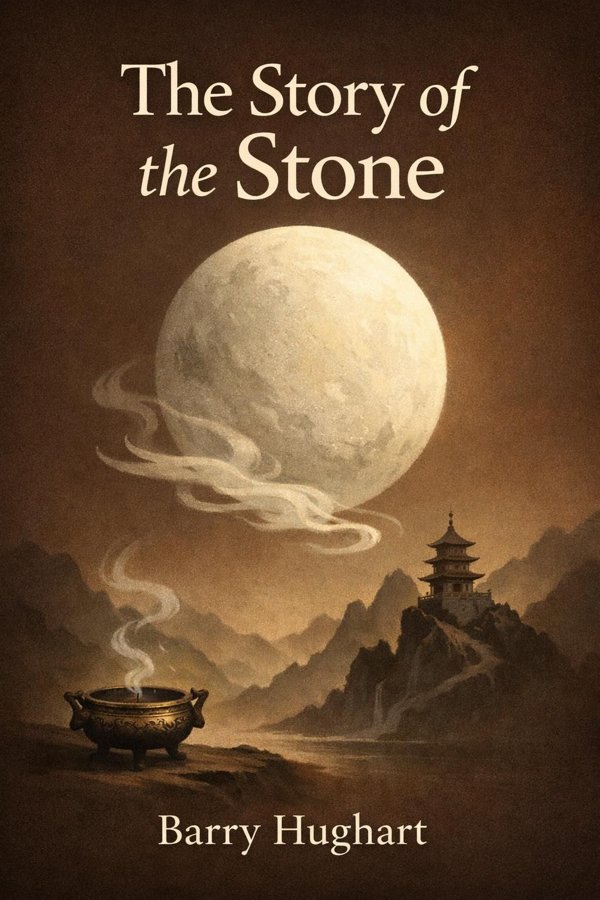
The Story of the Stone: Summary & Key Insights
 10 min8 chaptersAudio available
Key Takeaways from The Story of the Stone
Great stories often begin with a place that seems cursed, and in The Story of the Stone, the Valley of Sorrows is more than a setting: it is a moral landscape.
Religious and moral systems become dangerous when they stop pursuing truth and start pursuing control.
Fantasy is most powerful when magic exposes truths that realism might soften.
Some investigations lead to facts; others lead to the buried foundations of a world.
One of the novel’s quiet achievements is its insistence that wisdom is relational.
What Is The Story of the Stone About?
The Story of the Stone by Barry Hughart is a scifi_fantasy book spanning 5 pages. The Story of the Stone is Barry Hughart’s third and final novel featuring the unforgettable pairing of Master Li Kao and Number Ten Ox, and it brings their strange, comic, and deeply humane adventures to a fitting close. Set in “an ancient China that never was,” the novel begins as a murder mystery in a remote monastic valley but quickly opens into something much larger: a tale of spiritual rivalry, alchemical obsession, ghosts, corruption, and the painful search for meaning. Hughart blends fantasy, folklore, detective fiction, and philosophical reflection with remarkable ease, creating a world that feels playful on the surface yet emotionally serious underneath. What makes this novel matter is not only its inventive plot, but its understanding of how people misuse belief, power, and knowledge in the name of salvation. Through the contrast between the brilliant but morally compromised Master Li and the loyal, plainspoken Ox, Hughart explores wisdom, deception, grief, and compassion. Already celebrated for Bridge of Birds, Hughart had established himself as one of fantasy’s most original voices, and this final entry shows his full command of mythic storytelling, dark humor, and moral complexity.
This FizzRead summary covers all 8 key chapters of The Story of the Stone in approximately 10 minutes, distilling the most important ideas, arguments, and takeaways from Barry Hughart's work. Also available as an audio summary and Key Quotes Podcast.
The Story of the Stone
The Story of the Stone is Barry Hughart’s third and final novel featuring the unforgettable pairing of Master Li Kao and Number Ten Ox, and it brings their strange, comic, and deeply humane adventures to a fitting close. Set in “an ancient China that never was,” the novel begins as a murder mystery in a remote monastic valley but quickly opens into something much larger: a tale of spiritual rivalry, alchemical obsession, ghosts, corruption, and the painful search for meaning. Hughart blends fantasy, folklore, detective fiction, and philosophical reflection with remarkable ease, creating a world that feels playful on the surface yet emotionally serious underneath.
What makes this novel matter is not only its inventive plot, but its understanding of how people misuse belief, power, and knowledge in the name of salvation. Through the contrast between the brilliant but morally compromised Master Li and the loyal, plainspoken Ox, Hughart explores wisdom, deception, grief, and compassion. Already celebrated for Bridge of Birds, Hughart had established himself as one of fantasy’s most original voices, and this final entry shows his full command of mythic storytelling, dark humor, and moral complexity.
Who Should Read The Story of the Stone?
This book is perfect for anyone interested in scifi_fantasy and looking to gain actionable insights in a short read. Whether you're a student, professional, or lifelong learner, the key ideas from The Story of the Stone by Barry Hughart will help you think differently.
- ✓Readers who enjoy scifi_fantasy and want practical takeaways
- ✓Professionals looking to apply new ideas to their work and life
- ✓Anyone who wants the core insights of The Story of the Stone in just 10 minutes
Want the full summary?
Get instant access to this book summary and 100K+ more with Fizz Moment.
Get Free SummaryAvailable on App Store • Free to download
Key Chapters
Great stories often begin with a place that seems cursed, and in The Story of the Stone, the Valley of Sorrows is more than a setting: it is a moral landscape. Master Li Kao and Number Ten Ox enter a remote monastery under the shadow of grief, secrecy, and murder. At first, the assignment appears familiar—a mystery to solve, a crime to untangle—but Hughart immediately makes clear that this is not a simple detective puzzle. The valley itself seems saturated with old suffering, and the murder reflects a larger spiritual disease.
This opening matters because it teaches us how environments shape human behavior. The monastery is meant to be a place of discipline, peace, and transcendence, yet its isolation has allowed rivalries, obsessions, and distortions of faith to deepen unnoticed. In modern life, institutions can function the same way. A company, school, family, or religious community may outwardly present order while privately harboring unresolved tension. Hughart uses the valley to show that hidden sorrow eventually becomes visible through conflict.
Master Li’s method is not merely to inspect clues but to read atmosphere, motive, vanity, and fear. Number Ten Ox, by contrast, provides strength, sincerity, and emotional grounding. Together they remind us that understanding a crisis requires more than intelligence alone; it also requires patience and human perception.
A practical lesson emerges here: when a situation seems chaotic, do not focus only on the immediate incident. Ask what deeper conditions made it possible. Whether dealing with workplace breakdown, family conflict, or personal burnout, look beyond the surface event to the emotional landscape beneath it.
Actionable takeaway: When facing a troubling problem, identify not just what happened, but the hidden environment—beliefs, habits, and resentments—that allowed it to happen.
Religious and moral systems become dangerous when they stop pursuing truth and start pursuing control. One of the novel’s richest themes is the division within the monastery, where spiritual ideals have been contaminated by ambition, fear, and the seductive promise of alchemical transformation. What should be a search for enlightenment becomes tangled with competing doctrines and secret practices.
Hughart is not attacking faith itself. Instead, he examines what happens when institutions built for wisdom begin serving ego. The monks are not simply believers versus nonbelievers; they are fractured by different interpretations of salvation, power, purity, and transcendence. Some seek spiritual discipline, while others are drawn toward formulas, hidden arts, and promises of mastery over mortality. The “stone” of the title becomes symbolic not only of material mystery but of the human desire to make the divine concrete, possessable, and useful.
This idea has broad relevance. In modern settings, people can turn any noble goal—health, success, ethics, even self-improvement—into a system of competition and superiority. A meditation practice becomes branding. A moral code becomes tribal identity. A scientific breakthrough becomes a tool for prestige. Hughart’s monastery reminds us that corruption often enters through good intentions linked to vanity.
Master Li is especially effective in this world because he understands hypocrisy. He is flawed enough to recognize how others rationalize their sins. Number Ten Ox, with his straightforward decency, acts as a counterbalance, showing what integrity looks like without intellectual performance.
The practical application is simple but difficult: whenever you belong to a cause, community, or discipline, ask whether it is still serving its original purpose—or your desire for status within it. Honest self-audits prevent noble pursuits from becoming hollow rituals.
Actionable takeaway: Examine one belief system or group you value and ask whether your participation is driven more by truth, service, or belonging than by pride and control.
Fantasy is most powerful when magic exposes truths that realism might soften. In The Story of the Stone, demons, spirits, and uncanny forces are not decorative additions to the plot; they are pressure points that reveal what each character is made of. The supernatural realm intensifies temptation, fear, and longing, forcing hidden motives into the open.
Hughart draws deeply from folklore, but he uses mythic beings in psychologically intelligent ways. Encounters with spirits are never just spectacles. They test whether characters are ruled by greed, terror, compassion, or delusion. The strange events surrounding the monastery and the valley suggest that the boundary between spiritual and material life is thinner than people assume. Yet the real danger does not come simply from monsters. It comes from how human beings respond to mystery. Some become humble. Others become manipulative. Others lose themselves entirely.
This theme carries an everyday lesson. Most people do not meet demons in a haunted valley, but everyone faces moments that feel larger than ordinary reason: grief, sudden success, betrayal, obsession, illness, or encounters with beauty and mortality. Such experiences can either deepen character or destabilize it. Hughart suggests that what looks like an external trial is often an internal revelation.
Master Li meets the supernatural with cunning, wit, and skepticism, but also with respect for forces beyond simple logic. Number Ten Ox brings courage and loyalty rather than sophistication. Their partnership shows that surviving the unknown requires both clear thinking and moral steadiness.
In practical terms, when life becomes strange or frightening, notice what your first impulse reveals about you. Do you cling, deny, control, panic, or listen? The novel urges readers to see extraordinary situations as opportunities for self-knowledge.
Actionable takeaway: In your next moment of uncertainty, ask not only “What is happening?” but “What is this situation revealing about my character?”
Some investigations lead to facts; others lead to the buried foundations of a world. As Master Li and Number Ten Ox push beyond the surface crime, their search becomes a descent—literal, symbolic, and spiritual—into hidden chambers of history, conspiracy, and death. Hughart transforms the familiar detective structure into a mythic underworld journey, where solving the case means confronting what a community has tried to bury.
This descent matters because it reframes truth as costly. Many stories treat revelation as victory, but Hughart understands that discovering the truth often destroys comforting illusions. Beneath the monastery’s sacred facade lie old schemes, denied sins, and systems of exploitation. The underworld is not just a physical place; it is the accumulation of everything institutions and individuals refuse to face.
The idea is highly practical. In organizations, families, and personal histories, the unresolved does not disappear. It goes underground. Hidden financial misconduct, unspoken resentment, untreated trauma, and long-protected lies can remain invisible for years until one triggering event forces exposure. When that happens, the “investigation” becomes emotionally exhausting because it reaches into identity, not just evidence.
Master Li excels in descent because he is willing to follow logic into uncomfortable territory. Number Ten Ox gives him the strength to continue when truth becomes dangerous. Their journey suggests that courage is not the absence of dread, but the refusal to turn away from complexity.
Readers can apply this lesson by reconsidering the problems they avoid. If an issue keeps recurring, chances are it is rooted in something deeper than the latest symptom. Superficial fixes may restore calm temporarily, but only excavation brings lasting change.
Actionable takeaway: Pick one recurring problem in your life and ask what “underground” cause—old assumptions, unresolved pain, or concealed fear—might be sustaining it.
One of the novel’s quiet achievements is its insistence that wisdom is relational. Master Li may be brilliant, inventive, and experienced, but his insight would become brittle without Number Ten Ox. Likewise, Ox’s strength and goodness might remain limited without Li’s cunning guidance. Their partnership is not a side feature of the story; it is the moral center that gives the novel warmth amid darkness.
Hughart uses their bond to challenge the fantasy of solitary mastery. Too often, intelligence is imagined as self-sufficient and virtue as passive. Here, however, wisdom emerges through conversation, trust, correction, and shared endurance. Li’s flaws—vanity, deceit, appetites, and manipulative tendencies—are balanced by Ox’s loyalty and straightforward heart. Ox’s innocence, in turn, is protected and sharpened by Li’s understanding of human corruption. Each man makes the other more effective and, in a sense, more complete.
This has obvious real-world application. Many people overvalue independence and undervalue the right companion. The best work, hardest recovery, and deepest moral growth often happen in partnership: a mentor and student, friends under strain, spouses solving hardship together, or colleagues whose strengths are complementary rather than identical. Hughart shows that companionship is not sentimental support; it is a practical structure of survival and judgment.
The novel’s final movements, filled with restoration and reflection, make this especially clear. After violence, deception, and spiritual confusion, what endures is not doctrine or prestige but the bond between people who have chosen loyalty.
For readers, the lesson is to look closely at who helps you think more clearly and act more honorably. The right companion may not flatter you, but they make you harder to corrupt and easier to restore.
Actionable takeaway: Identify one relationship that genuinely strengthens your judgment and invest in it intentionally through gratitude, honesty, and time.
A story can confront death, corruption, and metaphysical dread without becoming heavy-handed, and Hughart achieves this through humor. The Story of the Stone is filled with wit, irony, absurdity, and verbal play, especially through Master Li’s voice and the contrast between Li and Number Ten Ox. This humor does not cheapen the stakes. Instead, it allows the novel to move through darkness without losing vitality.
Why is this important? Because laughter can be a mode of wisdom. Hughart understands that solemnity is not the same as seriousness. In fact, excessive solemnity often hides insecurity or dogmatism. By placing comic exchanges alongside murder, spiritual conflict, and supernatural terror, he reminds readers that human beings remain ridiculous even when confronting ultimate questions. Humor becomes a way to preserve perspective.
In real life, this principle is invaluable. Families in crisis often survive through shared jokes. Medical professionals and emergency workers use humor to endure difficult realities. Leaders who can laugh without becoming cynical tend to inspire more trust than those who perform constant gravity. The key is that the humor must illuminate, not evade. Hughart’s comedy exposes pretension, punctures self-importance, and keeps readers emotionally flexible.
Master Li’s jokes often disguise intelligence and defense at the same time. Number Ten Ox’s earnestness makes the humor land even more effectively, because he anchors the story in sincerity. Together they model a healthy balance: never trivialize suffering, but never let darkness convince you it is the whole truth.
The practical lesson is to cultivate forms of humor that restore perspective rather than deny pain. Good humor helps people endure and connect; bad humor distances and hardens.
Actionable takeaway: In your next stressful situation, use humor carefully to reduce fear and restore perspective—but make sure it serves compassion, not avoidance.
The novel repeatedly asks a disturbing question: what happens when knowledge grows faster than wisdom? Alchemy, hidden teachings, sacred texts, and esoteric practices all promise insight or power, yet Hughart shows that knowledge alone is morally unstable. In the wrong hands—or in hands corrupted by fear and ambition—it becomes a means of domination rather than liberation.
This is one of the book’s most enduring contributions. The search for secret knowledge appears noble, especially in fantasy, where forbidden arts and ancient mysteries often signal greatness. But The Story of the Stone strips away that glamour. It presents learning as something inseparable from motive. A formula, ritual, or revelation does not improve the user automatically. It magnifies what is already there. If the seeker is vain, knowledge serves vanity. If the seeker is wounded, it may serve obsession. If the seeker is compassionate, it may become healing.
Modern readers can easily recognize this dynamic. Technology, financial expertise, psychological insight, and social influence all function like forms of alchemy. None are inherently virtuous. A brilliant manager can manipulate employees. A skilled therapist can abuse trust. A powerful platform can spread truth or poison. Hughart’s world may be mythical, but its moral logic is contemporary.
Master Li himself is an ideal vehicle for this theme because he is deeply learned yet morally imperfect. He is not a saint dispensing clean lessons from above. He knows too well how intelligence can be bent. Number Ten Ox represents the necessary counterweight: decency that does not depend on technical mastery.
The practical application is to ask not merely whether you can learn or achieve something, but what kind of person that knowledge is making you. Skill without character is risk.
Actionable takeaway: Pair any pursuit of expertise with an equal examination of motive, asking how your knowledge will serve others rather than merely enlarge your power.
Some truths are too large, too ancient, or too emotionally complex to be expressed through straightforward realism. Hughart’s genius lies in his use of myth, folklore, and fabulist exaggeration to tell the truth slant. In The Story of the Stone, impossible events, enchanted settings, and legendary references do not distance us from reality; they bring us closer to its moral and emotional structure.
The valley, the monastery, the spirits, and the underworld elements all operate symbolically as well as narratively. They make visible what ordinary language often conceals: grief as landscape, corruption as haunting, desire as sorcery, institutional rot as a literal descent underground. By externalizing inner and social realities, myth allows readers to feel ideas rather than merely understand them.
This technique matters beyond literature. People naturally use stories, metaphors, rituals, and symbols to process experience. We speak of carrying burdens, hitting walls, feeling haunted, or searching for light because metaphor captures dimensions of life that raw data misses. Hughart reminds us that fantasy is not an escape from truth but one of its oldest vehicles.
For practical application, consider how you explain difficult experiences to yourself. If you rely only on literal description, you may miss emotional meaning. A season of burnout might feel like wandering in a wasteland. A family conflict might resemble a house with locked rooms. Such images can clarify what needs attention.
The novel therefore rewards readers who treat fantasy seriously. Its inventions are not random; they are disciplined imaginative tools for seeing human reality with sharper edges.
Actionable takeaway: When facing a difficult emotional situation, try describing it as an image or story; the metaphor may reveal truths that plain analysis has overlooked.
All Chapters in The Story of the Stone
About the Author
Barry Hughart (1934–2019) was an American novelist best known for his inventive fantasy series featuring Master Li Kao and Number Ten Ox. Though his published output was relatively small, his impact on fantasy literature was significant. Hughart’s work stood apart for its unusual blend of Chinese folklore, mystery plotting, comic storytelling, and philosophical depth, all set in what he famously called “an ancient China that never was.” His best-known novel, Bridge of Birds, won the World Fantasy Award and established him as one of the genre’s most original voices. Readers and critics admired his ability to combine whimsy with moral seriousness and mythic imagination with human warmth. The Story of the Stone, the final book in his acclaimed trilogy, remains a fitting example of his singular literary style.
Get This Summary in Your Preferred Format
Read or listen to the The Story of the Stone summary by Barry Hughart anytime, anywhere. FizzRead offers multiple formats so you can learn on your terms — all free.
Available formats: App · Audio · PDF · EPUB — All included free with FizzRead
Download The Story of the Stone PDF and EPUB Summary
Key Quotes from The Story of the Stone
“Great stories often begin with a place that seems cursed, and in The Story of the Stone, the Valley of Sorrows is more than a setting: it is a moral landscape.”
“Religious and moral systems become dangerous when they stop pursuing truth and start pursuing control.”
“Fantasy is most powerful when magic exposes truths that realism might soften.”
“Some investigations lead to facts; others lead to the buried foundations of a world.”
“One of the novel’s quiet achievements is its insistence that wisdom is relational.”
Frequently Asked Questions about The Story of the Stone
The Story of the Stone by Barry Hughart is a scifi_fantasy book that explores key ideas across 8 chapters. The Story of the Stone is Barry Hughart’s third and final novel featuring the unforgettable pairing of Master Li Kao and Number Ten Ox, and it brings their strange, comic, and deeply humane adventures to a fitting close. Set in “an ancient China that never was,” the novel begins as a murder mystery in a remote monastic valley but quickly opens into something much larger: a tale of spiritual rivalry, alchemical obsession, ghosts, corruption, and the painful search for meaning. Hughart blends fantasy, folklore, detective fiction, and philosophical reflection with remarkable ease, creating a world that feels playful on the surface yet emotionally serious underneath. What makes this novel matter is not only its inventive plot, but its understanding of how people misuse belief, power, and knowledge in the name of salvation. Through the contrast between the brilliant but morally compromised Master Li and the loyal, plainspoken Ox, Hughart explores wisdom, deception, grief, and compassion. Already celebrated for Bridge of Birds, Hughart had established himself as one of fantasy’s most original voices, and this final entry shows his full command of mythic storytelling, dark humor, and moral complexity.
More by Barry Hughart
You Might Also Like
Red Rising
Pierce Brown
10 min
Stranger in a Strange Land
Robert A. Heinlein
10 min
AI Valley
Chen Qiufan
10 min
Bloodchild
Octavia E. Butler
10 min
Do Androids Dream of Electric Sheep?
Philip K. Dick
10 min
Jujutsu Kaisen, Vol. 24
Gege Akutami
10 minBrowse by Category
Ready to read The Story of the Stone?
Get the full summary and 100K+ more books with Fizz Moment.