
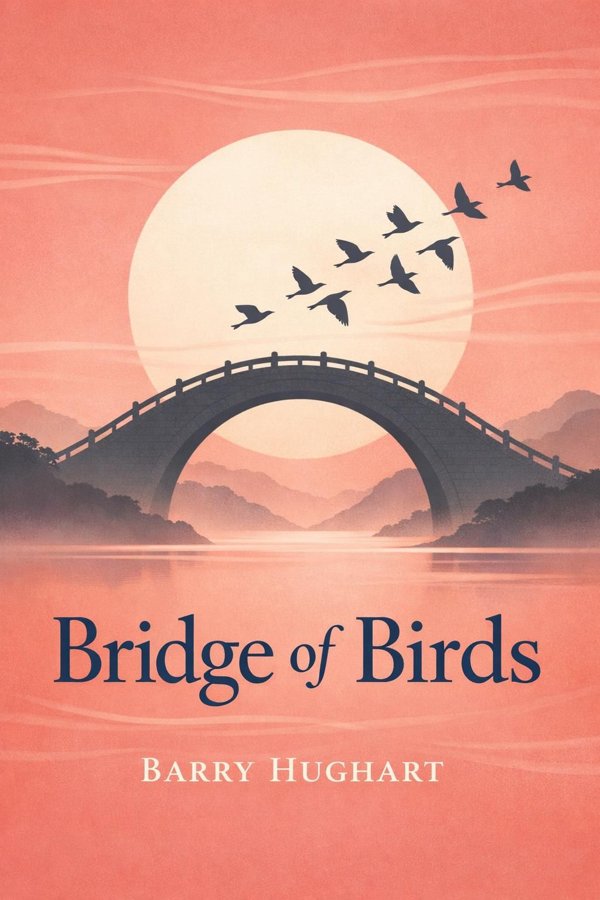
Bridge of Birds: A Novel of an Ancient China That Never Was: Summary & Key Insights
 10 min9 chaptersAudio available
Key Takeaways from Bridge of Birds: A Novel of an Ancient China That Never Was
A great adventure often begins with a simple act of love.
The most useful guide is not always the purest person.
Fantasy feels most alive when wonder and absurdity exist side by side.
Evil is rarely just one villain doing one bad thing.
Most crises do not begin where they seem to begin.
What Is Bridge of Birds: A Novel of an Ancient China That Never Was About?
Bridge of Birds: A Novel of an Ancient China That Never Was by Barry Hughart is a scifi_fantasy book spanning 4 pages. Barry Hughart’s Bridge of Birds is a fantasy novel unlike almost anything else in the genre: part quest tale, part mystery, part comedy, and part mythic fable. Set in “an ancient China that never was,” it follows the enormous, honest peasant Number Ten Ox and the elderly sage Master Li Kao, a scholar with dazzling intelligence and “a slight flaw in his character,” as they search for a cure after the children of Ox’s village fall into a mysterious sleep. What begins as a desperate mission soon expands into a dazzling journey through haunted cities, imperial secrets, folk legends, courtly corruption, and heartbreaking love. What makes the novel matter is not only its inventive plot, but the way Hughart blends wonder with humanity. He uses folklore, humor, detective logic, and moral paradox to explore loyalty, greed, innocence, and the cost of power. The result is both delightfully entertaining and emotionally resonant. Hughart, best known for the Master Li and Number Ten Ox stories, earned major critical acclaim for this book, including the World Fantasy Award. Bridge of Birds remains a beloved classic because it offers adventure with soul: clever, compassionate, and full of unforgettable magic.
This FizzRead summary covers all 9 key chapters of Bridge of Birds: A Novel of an Ancient China That Never Was in approximately 10 minutes, distilling the most important ideas, arguments, and takeaways from Barry Hughart's work. Also available as an audio summary and Key Quotes Podcast.
Bridge of Birds: A Novel of an Ancient China That Never Was
Barry Hughart’s Bridge of Birds is a fantasy novel unlike almost anything else in the genre: part quest tale, part mystery, part comedy, and part mythic fable. Set in “an ancient China that never was,” it follows the enormous, honest peasant Number Ten Ox and the elderly sage Master Li Kao, a scholar with dazzling intelligence and “a slight flaw in his character,” as they search for a cure after the children of Ox’s village fall into a mysterious sleep. What begins as a desperate mission soon expands into a dazzling journey through haunted cities, imperial secrets, folk legends, courtly corruption, and heartbreaking love.
What makes the novel matter is not only its inventive plot, but the way Hughart blends wonder with humanity. He uses folklore, humor, detective logic, and moral paradox to explore loyalty, greed, innocence, and the cost of power. The result is both delightfully entertaining and emotionally resonant. Hughart, best known for the Master Li and Number Ten Ox stories, earned major critical acclaim for this book, including the World Fantasy Award. Bridge of Birds remains a beloved classic because it offers adventure with soul: clever, compassionate, and full of unforgettable magic.
Who Should Read Bridge of Birds: A Novel of an Ancient China That Never Was?
This book is perfect for anyone interested in scifi_fantasy and looking to gain actionable insights in a short read. Whether you're a student, professional, or lifelong learner, the key ideas from Bridge of Birds: A Novel of an Ancient China That Never Was by Barry Hughart will help you think differently.
- ✓Readers who enjoy scifi_fantasy and want practical takeaways
- ✓Professionals looking to apply new ideas to their work and life
- ✓Anyone who wants the core insights of Bridge of Birds: A Novel of an Ancient China That Never Was in just 10 minutes
Want the full summary?
Get instant access to this book summary and 100K+ more with Fizz Moment.
Get Free SummaryAvailable on App Store • Free to download
Key Chapters
A great adventure often begins with a simple act of love. In Bridge of Birds, the story opens in the humble village of Ku-fu, where Number Ten Ox lives a straightforward life defined by physical strength, honesty, and duty. That simplicity is shattered when the village children, including those dearest to the community, collapse into a strange, deathlike sleep. The illness is not merely a plot device; it immediately establishes what is at stake. This is not a quest for glory, treasure, or abstract destiny. It is a mission born of communal suffering and personal responsibility.
Number Ten Ox becomes the ideal hero precisely because he is not polished, noble, or ambitious in the usual epic sense. He acts because no one else can bear the burden as he can, and because he cares. His devotion to the children gives the novel its emotional grounding. In fantasy, readers often encounter chosen ones marked by prophecy. Hughart offers something more human: a man chosen by circumstance and conscience.
The search for a cure also introduces one of the book’s central patterns: solutions cannot be found through strength alone. Ox can carry impossible loads and defeat enemies, but brute force is powerless against mystery, poison, and ancient injustice. To save the children, he must seek wisdom beyond the boundaries of the village, which leads him to Master Li.
In practical terms, the opening reminds us that meaningful action usually begins close to home. Most people do not set out to change the world in grand terms; they respond to the suffering directly in front of them. Whether helping a family member through illness, solving a workplace crisis, or supporting a struggling community, responsibility often starts with seeing clearly and refusing to look away.
Actionable takeaway: When faced with a hard problem, begin with the people most affected, let care define your priorities, and take the first step before you feel fully prepared.
The most useful guide is not always the purest person. Master Li Kao enters the novel as one of fantasy’s most memorable mentors: brilliant, disreputable, funny, manipulative, perceptive, and morally slippery. He is introduced as a sage with a “slight flaw” in his character, which proves to be a comic understatement. He drinks heavily, deceives freely, and has little patience for respectable appearances. Yet he also sees connections others miss, understands human weakness, and possesses the intellectual daring necessary to confront the impossible.
This combination of wisdom and defect is essential to the novel’s power. Hughart rejects the cliché of the flawless old master dispensing serene truths from a mountain. Master Li is worldly rather than pure. He knows that evil often hides beneath etiquette, that institutions can be more dangerous than bandits, and that solving deep problems requires cunning as well as virtue. His methods are often questionable, but his insight is indispensable.
The partnership between Master Li and Number Ten Ox works because each compensates for the other’s limits. Ox offers loyalty, strength, and moral steadiness. Li brings strategy, knowledge, and skepticism. Their relationship suggests that effective collaboration rarely comes from finding identical people. It comes from pairing integrity with expertise, instinct with analysis, and innocence with experience.
There is also a practical lesson here about leadership and mentors. In real life, the people who teach us most may be imperfect. A demanding teacher, eccentric manager, or unconventional friend can offer transformative insight without being a model in every respect. The challenge is to learn selectively: absorb wisdom, remain alert to flaws, and keep your own moral compass intact.
Actionable takeaway: Seek out people who expand your understanding, but do not surrender your judgment; learn from brilliance without excusing harmful behavior or abandoning your values.
Fantasy feels most alive when wonder and absurdity exist side by side. One of Bridge of Birds’ greatest achievements is its setting: an “ancient China that never was,” assembled from folklore, legend, storytelling rhythms, and playful invention rather than strict historical realism. Hughart creates a world where magistrates, ghosts, tricksters, monks, nobles, and peasants all belong to the same moral theater. The tone can shift from farce to terror to melancholy within a few pages, and that instability becomes part of the novel’s charm.
Humor is not decorative here; it is structural. The jokes, exaggerations, and comic encounters keep the book buoyant even when it deals with cruelty, corruption, and loss. A lesser novel might treat mythic material with ponderous reverence. Hughart instead understands that traditional storytelling often contains slapstick, riddles, reversals, and irony. The result is a world that feels old, strange, and deeply inhabited.
This blend matters because it mirrors real life more accurately than solemn fantasy often does. People tell jokes in crises. Beauty and foolishness coexist. Bureaucracy can be absurd even when its consequences are deadly. By allowing laughter into the fabric of the story, Hughart makes sorrow more piercing and heroism more human.
Readers can apply this idea beyond fiction. In communication, teaching, and leadership, seriousness is not always strengthened by solemnity. A well-placed humorous observation can make difficult truths easier to face. Teams often process stress better when wit is allowed alongside discipline. Even personal resilience depends partly on the ability to hold pain and absurdity together.
Actionable takeaway: When confronting heavy subjects, make room for humor and imagination; they do not weaken seriousness, but often make endurance, honesty, and connection possible.
Evil is rarely just one villain doing one bad thing. As Number Ten Ox and Master Li move toward Peking and beyond, they discover that the mystery of the children’s illness is entangled with old crimes, concealed greed, and structures of influence that protect the powerful. Markets, temples, courts, and hidden networks all reveal a world where appearances are carefully managed and truth is expensive. Hughart’s imagined China is whimsical, but it is not naive. The novel understands that corruption often survives because it becomes ordinary.
This is one reason the book feels more sophisticated than a simple fairy tale. The protagonists are not merely hunting a magical herb. They are navigating systems built on secrecy, status, and self-interest. Every lead opens onto another layer of exploitation. The city becomes a labyrinth not only in a literal sense, but morally. People trade in stories, lies, favors, and bodies. Justice is obscured by spectacle.
Master Li’s investigative style makes this theme especially sharp. He listens for contradictions, follows motives, and studies who benefits from confusion. The method resembles detective fiction: to solve the mystery, he must identify not just what happened, but what institutions are invested in burying it. The book therefore suggests that power is often most dangerous when it dresses itself as order, tradition, or refinement.
In practical life, this insight applies to workplaces, politics, and communities. If a problem persists despite repeated promises to fix it, the useful question is not only “Who caused this?” but “Who gains from letting it continue?” Whether dealing with dysfunctional processes, unfair rules, or manipulated narratives, clarity comes from tracing incentives rather than accepting official explanations.
Actionable takeaway: When a situation feels confusing or unjust, examine the system around it, identify who benefits from silence or disorder, and base your decisions on patterns rather than appearances.
Most crises do not begin where they seem to begin. One of the novel’s deepest pleasures is the gradual revelation that the plague afflicting the children is tied to a much older story: the legend of the Princess of Birds, a tale of beauty, love, loss, and wrongdoing whose echoes still govern the present. Hughart uses this structure to show that mysteries are often historical before they are personal. What appears random may actually be the delayed consequence of betrayal left unresolved.
The legend itself gives the novel emotional and symbolic depth. It transforms the quest from a race for medicine into an act of restoration. Master Li and Number Ten Ox are not simply collecting ingredients or defeating obstacles; they are uncovering a broken narrative that must be understood before healing can occur. In that sense, the cure is inseparable from truth. To mend the present, they must recover what power, time, and distortion have buried.
This idea resonates beyond fantasy. Families inherit silences. Organizations inherit bad incentives. Nations inherit myths that conceal older wounds. People often try to solve immediate symptoms without asking what earlier injuries created them. Hughart suggests that genuine resolution requires memory. Not nostalgia, not romanticizing the past, but honest excavation.
The legend also reminds readers that stories themselves are repositories of moral knowledge. Folktales, rumors, songs, and half-forgotten histories may preserve truths that formal authority ignores. Master Li’s intelligence works because he takes old tales seriously without accepting them uncritically. He asks what emotional fact survives beneath the ornament.
Actionable takeaway: When facing a recurring problem, investigate its history, listen for old patterns and neglected stories, and remember that lasting solutions often require understanding causes that predate the current crisis.
Civilizations reveal themselves by what they sacrifice and what they defend. In Bridge of Birds, the sleeping children are more than victims in need of rescue. They symbolize innocence, continuity, and the vulnerable future of a community. Their condition gives the quest a moral focus that never disappears, even when the story becomes comic, romantic, or bizarre. The book repeatedly contrasts the purity of what is endangered with the appetites of those who exploit, deceive, or dominate.
This contrast is especially powerful because Hughart refuses to make innocence simplistic. The children are not abstract ideals; they are beloved individuals whose suffering tears open the everyday life of the village. That specificity matters. We care because Number Ten Ox cares, and because the novel keeps returning us to the human cost of delay. Even the most dazzling episodes along the journey are shadowed by urgency.
The theme broadens into a meditation on love itself. The older legend at the heart of the story shows that innocence can be harmed not only by obvious cruelty, but by selfishness, vanity, and the misuse of privilege. Love in the novel is precious because it is fragile in a world structured by appetite and ambition. To love well is to protect what cannot protect itself.
This applies in contemporary life in direct ways. Children, new ideas, trust within relationships, and fragile communities all require stewardship. Neglect is rarely neutral. If the most vulnerable people in a family or institution are ignored while those with power protect only themselves, corruption has already begun. Care must be organized, not merely felt.
Actionable takeaway: Measure your choices by how they affect the most vulnerable people around you, and turn affection into concrete protection through time, attention, and responsible action.
Intelligence is impressive, but without moral direction it can become another instrument of harm. Bridge of Birds delights in puzzles, schemes, disguises, and verbal dexterity. Master Li in particular embodies extraordinary cleverness. He sees through trickery, devises improbable plans, and manipulates situations with theatrical flair. Yet the novel never treats cleverness as automatically admirable. Again and again, it shows that wit can expose evil, but can also resemble it if detached from compassion.
This tension gives Master Li depth. He is not merely smart; he is dangerous in ways both useful and unsettling. What makes him ultimately compelling is not his talent alone, but the gradual evidence that he chooses, despite cynicism, to place that talent in the service of suffering people. Number Ten Ox anchors this choice. Ox’s plain decency acts as a moral counterweight to Li’s opportunism, reminding both Li and the reader that solving a puzzle is not the same as doing good.
The book therefore distinguishes between strategic intelligence and ethical wisdom. Strategic intelligence asks, “What works?” Ethical wisdom asks, “What is this for, and what kind of person does it make me?” The best moments in the novel occur when the two are united. The worst crimes in its backstory occur when intelligence serves vanity, possession, or domination.
This is highly relevant today. In business, politics, technology, and everyday relationships, people often praise efficiency, optimization, and persuasion without asking whether the goal deserves such tools. A persuasive argument can still be manipulative. A successful plan can still be corrosive. Cleverness earns trust only when bounded by principle.
Actionable takeaway: Before using your skill, strategy, or influence, ask not just whether it will succeed, but whether it serves a humane purpose and aligns with the kind of person you want to become.
No one survives a long trial on competence alone. At the heart of Bridge of Birds is one of fantasy’s most rewarding friendships: the bond between Number Ten Ox and Master Li. Their differences are extreme. Ox is young, literal, physically mighty, and emotionally transparent. Li is old, elusive, intellectually dazzling, and morally improvisational. Yet their partnership becomes believable because each begins to trust what the other sees.
This friendship matters because the journey they undertake would break either one alone. Ox without Li would lack the knowledge and cunning to navigate the layered mystery. Li without Ox would lack physical protection, emotional grounding, and perhaps the courage to remain loyal to something better than his own amusement. Together they become more than a comic pairing. They become a model of interdependence.
Hughart also shows that friendship is built through shared ordeal, not merely compatibility. The two argue, misunderstand each other, and repeatedly face danger, but the very act of continuing together creates commitment. Their alliance grows because each has evidence that the other will return, endure, and act. Trust becomes practical before it becomes sentimental.
In real life, people often search for ideal collaborators who think similarly or make interaction easy. But some of the strongest partnerships come from complementary differences united by a common mission. A disciplined operator and a visionary thinker, an empathetic caregiver and a skeptical analyst, or a mentor and novice may accomplish far more together than apart if mutual respect develops.
Actionable takeaway: Build relationships with people whose strengths differ from yours, invest in trust through shared work and reliability, and remember that enduring friendship often grows from commitment before comfort.
The deepest triumphs are not acts of conquest but acts of repair. As Bridge of Birds moves toward its resolution, the goal becomes clearer: not simply to defeat enemies, expose secrets, or outwit rivals, but to restore what has been broken. The image of the bridge in the title captures this beautifully. A bridge connects what has been separated—past and present, innocence and justice, grief and healing, one person and another. The novel’s ending carries emotional force because it is concerned with mending relationships, narratives, and moral balance.
This distinguishes Hughart’s story from many quest fantasies built around domination or escape. The protagonists do not seek to rule the world or seize ultimate power. Their task is humbler and therefore more profound: to put right an old wrong so life can continue. The return home is essential to this meaning. Adventures matter because they change what home can become. The cure for the children is not only a magical solution; it is the restoration of communal possibility.
The title also suggests that repair is difficult, delicate work. Building or rebuilding a bridge requires understanding both sides of a divide. In moral terms, this means acknowledging pain without becoming trapped in it, and recognizing guilt without abandoning the possibility of renewal. Hughart never implies that restoration erases tragedy. Rather, he suggests that meaning can emerge when truth, sacrifice, and compassion finally meet.
In everyday life, many people define success too narrowly as winning arguments, gaining status, or defeating opposition. Yet families, teams, and communities often need restoration more than victory. Rebuilding trust after conflict, correcting an injustice, or reconnecting estranged groups may matter more than proving oneself right.
Actionable takeaway: In conflict or crisis, ask what needs to be repaired, not just who needs to be beaten, and let your efforts aim toward reconnection, healing, and a more livable future.
All Chapters in Bridge of Birds: A Novel of an Ancient China That Never Was
About the Author
Barry Hughart (1934–2019) was an American novelist best known for Bridge of Birds and the larger series featuring Master Li Kao and Number Ten Ox. His fiction is distinctive for its fusion of fantasy, Chinese-inspired folklore, detective storytelling, sharp humor, and genuine emotional depth. Though he published relatively few novels, Hughart earned lasting admiration for the originality of his voice and the richness of his imaginative worlds. Bridge of Birds won the World Fantasy Award for Best Novel and established him as a singular talent within modern fantasy. Readers and critics alike have praised his ability to balance whimsy with tragedy, mystery with myth, and comedy with moral seriousness. Hughart’s work continues to stand out as inventive, humane, and difficult to imitate.
Get This Summary in Your Preferred Format
Read or listen to the Bridge of Birds: A Novel of an Ancient China That Never Was summary by Barry Hughart anytime, anywhere. FizzRead offers multiple formats so you can learn on your terms — all free.
Available formats: App · Audio · PDF · EPUB — All included free with FizzRead
Download Bridge of Birds: A Novel of an Ancient China That Never Was PDF and EPUB Summary
Key Quotes from Bridge of Birds: A Novel of an Ancient China That Never Was
“A great adventure often begins with a simple act of love.”
“The most useful guide is not always the purest person.”
“Fantasy feels most alive when wonder and absurdity exist side by side.”
“Evil is rarely just one villain doing one bad thing.”
“Most crises do not begin where they seem to begin.”
Frequently Asked Questions about Bridge of Birds: A Novel of an Ancient China That Never Was
Bridge of Birds: A Novel of an Ancient China That Never Was by Barry Hughart is a scifi_fantasy book that explores key ideas across 9 chapters. Barry Hughart’s Bridge of Birds is a fantasy novel unlike almost anything else in the genre: part quest tale, part mystery, part comedy, and part mythic fable. Set in “an ancient China that never was,” it follows the enormous, honest peasant Number Ten Ox and the elderly sage Master Li Kao, a scholar with dazzling intelligence and “a slight flaw in his character,” as they search for a cure after the children of Ox’s village fall into a mysterious sleep. What begins as a desperate mission soon expands into a dazzling journey through haunted cities, imperial secrets, folk legends, courtly corruption, and heartbreaking love. What makes the novel matter is not only its inventive plot, but the way Hughart blends wonder with humanity. He uses folklore, humor, detective logic, and moral paradox to explore loyalty, greed, innocence, and the cost of power. The result is both delightfully entertaining and emotionally resonant. Hughart, best known for the Master Li and Number Ten Ox stories, earned major critical acclaim for this book, including the World Fantasy Award. Bridge of Birds remains a beloved classic because it offers adventure with soul: clever, compassionate, and full of unforgettable magic.
More by Barry Hughart
You Might Also Like
Red Rising
Pierce Brown
10 min
Stranger in a Strange Land
Robert A. Heinlein
10 min
AI Valley
Chen Qiufan
10 min
Bloodchild
Octavia E. Butler
10 min
Do Androids Dream of Electric Sheep?
Philip K. Dick
10 min
Jujutsu Kaisen, Vol. 24
Gege Akutami
10 minBrowse by Category
Ready to read Bridge of Birds: A Novel of an Ancient China That Never Was?
Get the full summary and 100K+ more books with Fizz Moment.