
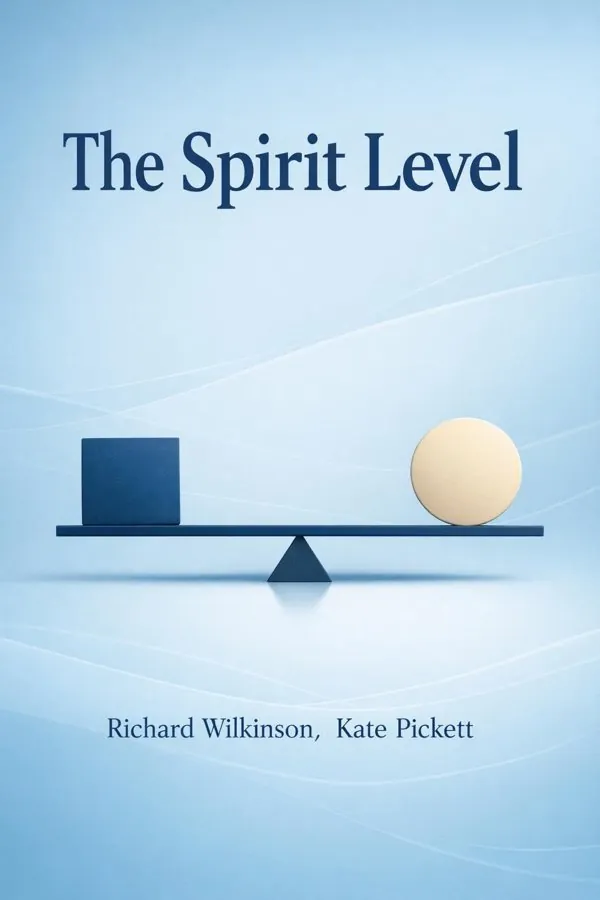
The Spirit Level: Why More Equal Societies Almost Always Do Better: Summary & Key Insights
by Richard Wilkinson, Kate Pickett
 10 min5 chaptersAudio available
What Is The Spirit Level: Why More Equal Societies Almost Always Do Better About?
The Spirit Level: Why More Equal Societies Almost Always Do Better by Richard Wilkinson, Kate Pickett is a sociology book spanning 5 pages. This book argues that societies with greater equality among citizens tend to have better health, lower crime rates, and higher levels of trust and happiness. Drawing on extensive data from around the world, the authors demonstrate how inequality harms social cohesion and individual well-being, and they advocate for policies that promote fairness and social justice.
This FizzRead summary covers all 5 key chapters of The Spirit Level: Why More Equal Societies Almost Always Do Better in approximately 10 minutes, distilling the most important ideas, arguments, and takeaways from Richard Wilkinson, Kate Pickett's work. Also available as an audio summary and Key Quotes Podcast.
The Spirit Level: Why More Equal Societies Almost Always Do Better
This book argues that societies with greater equality among citizens tend to have better health, lower crime rates, and higher levels of trust and happiness. Drawing on extensive data from around the world, the authors demonstrate how inequality harms social cohesion and individual well-being, and they advocate for policies that promote fairness and social justice.
Who Should Read The Spirit Level: Why More Equal Societies Almost Always Do Better?
This book is perfect for anyone interested in sociology and looking to gain actionable insights in a short read. Whether you're a student, professional, or lifelong learner, the key ideas from The Spirit Level: Why More Equal Societies Almost Always Do Better by Richard Wilkinson, Kate Pickett will help you think differently.
- ✓Readers who enjoy sociology and want practical takeaways
- ✓Professionals looking to apply new ideas to their work and life
- ✓Anyone who wants the core insights of The Spirit Level: Why More Equal Societies Almost Always Do Better in just 10 minutes
Want the full summary?
Get instant access to this book summary and 100K+ more with Fizz Moment.
Get Free SummaryAvailable on App Store • Free to download
Key Chapters
Our argument rests on careful empirical foundations. The Spirit Level draws on decades of comparative data from rich countries, showing that income inequality correlates strongly with a vast range of social problems—from health outcomes to crime, from educational achievement to trust. This is not casual correlation born from selective anecdotes but a pattern robust across multiple datasets and measures. We deliberately focus on rich, developed nations to control for the effects of poverty itself. The question is not whether poor countries suffer more—it’s whether, among the rich, those who are less equal suffer unnecessarily.
Japan and the Scandinavian countries consistently emerge as the most equal among developed nations. These societies enjoy better health, lower crime, fewer teenage births, and higher levels of trust. In contrast, countries like the United States, the United Kingdom, and Portugal, characterized by higher income inequality, experience higher levels of social dysfunction despite their comparable wealth. We show this visually through graphs where each country’s performance on measures like life expectancy or homicide rates aligns closely with its level of inequality, forming unmistakable patterns. The takeaway is powerful: as inequality rises, social well-being declines.
These findings resist simple economic explanations. It’s not that unequal countries are poorer—they’re often wealthy—but their citizens suffer in ways not explained by material scarcity. The mechanism is psychosocial: inequality intensifies stress, promotes status competition, and undermines social trust. The more unequal a society, the more its members feel judged and insecure about their place in the social hierarchy. This insecurity becomes chronic, influencing mental health, social cohesion, and even physical health.
By grounding our argument in observable data, we aim to move the debate beyond ideology. The evidence demonstrates that inequality distorts the social environment for everyone—even the well-off. Societies that foster equality cultivate stability, mutual respect, and greater overall happiness. This is not redistribution for its own sake; it’s an investment in collective well-being.
One of the most striking patterns that emerged from our analyses is how inequality directly impacts health outcomes. When income disparities widen, life expectancy shortens—not just for the poor but across all social strata. In The Spirit Level, we explore the mechanisms behind this phenomenon. Human health is not solely determined by access to medical care or nutrition; it is deeply influenced by psychosocial factors, such as stress, social cohesion, and perceived status.
In unequal societies, the psychological burden of social comparison becomes pervasive. People constantly evaluate their worth relative to others, leading to chronic stress responses known to undermine immune function and cardiovascular health. We draw evidence from epidemiological studies showing that individuals living in more unequal societies have higher rates of mental illness, heart disease, and mortality—irrespective of their personal income level. In contrast, countries with narrower income gaps exhibit longer life expectancies and lower incidences of preventable disease.
Examples from Japan and Sweden illustrate how equality translates into better public health. These societies not only provide robust healthcare systems but, more importantly, foster environments where people feel trust and social security. The resulting sense of belonging and shared destiny reduces the chronic stress that fuels illness. Thus, equality operates as a form of preventive medicine—strengthening the fabric of social life and improving collective health.
This insight redefines health policy. It is not enough to invest in hospitals or medical technology without addressing the social determinants of health. By reducing inequality, we enhance the well-being of nations holistically, ensuring that longevity and vitality are shared benefits rather than privileges confined to the affluent few.
+ 3 more chapters — available in the FizzRead app
All Chapters in The Spirit Level: Why More Equal Societies Almost Always Do Better
About the Authors
Richard Wilkinson is a British social epidemiologist known for his research on income inequality and public health. Kate Pickett is a British epidemiologist and professor of epidemiology at the University of York. Together, they co-founded The Equality Trust, an organization promoting social equality.
Get This Summary in Your Preferred Format
Read or listen to the The Spirit Level: Why More Equal Societies Almost Always Do Better summary by Richard Wilkinson, Kate Pickett anytime, anywhere. FizzRead offers multiple formats so you can learn on your terms — all free.
Available formats: App · Audio · PDF · EPUB — All included free with FizzRead
Download The Spirit Level: Why More Equal Societies Almost Always Do Better PDF and EPUB Summary
Key Quotes from The Spirit Level: Why More Equal Societies Almost Always Do Better
“Our argument rests on careful empirical foundations.”
“One of the most striking patterns that emerged from our analyses is how inequality directly impacts health outcomes.”
Frequently Asked Questions about The Spirit Level: Why More Equal Societies Almost Always Do Better
The Spirit Level: Why More Equal Societies Almost Always Do Better by Richard Wilkinson, Kate Pickett is a sociology book that explores key ideas across 5 chapters. This book argues that societies with greater equality among citizens tend to have better health, lower crime rates, and higher levels of trust and happiness. Drawing on extensive data from around the world, the authors demonstrate how inequality harms social cohesion and individual well-being, and they advocate for policies that promote fairness and social justice.
More by Richard Wilkinson, Kate Pickett
You Might Also Like

Between the World and Me
Ta-Nehisi Coates
10 min
Half the Sky
Nicholas D. Kristof, Sheryl WuDunn
10 min
Men Explain Things To Me
Rebecca Solnit
10 min
Rational Ritual
Michael Suk-Young Chwe
10 min
The New Jim Crow
Michelle Alexander
10 min
Beyond Culture
Edward T. Hall
10 minBrowse by Category
Ready to read The Spirit Level: Why More Equal Societies Almost Always Do Better?
Get the full summary and 100K+ more books with Fizz Moment.