
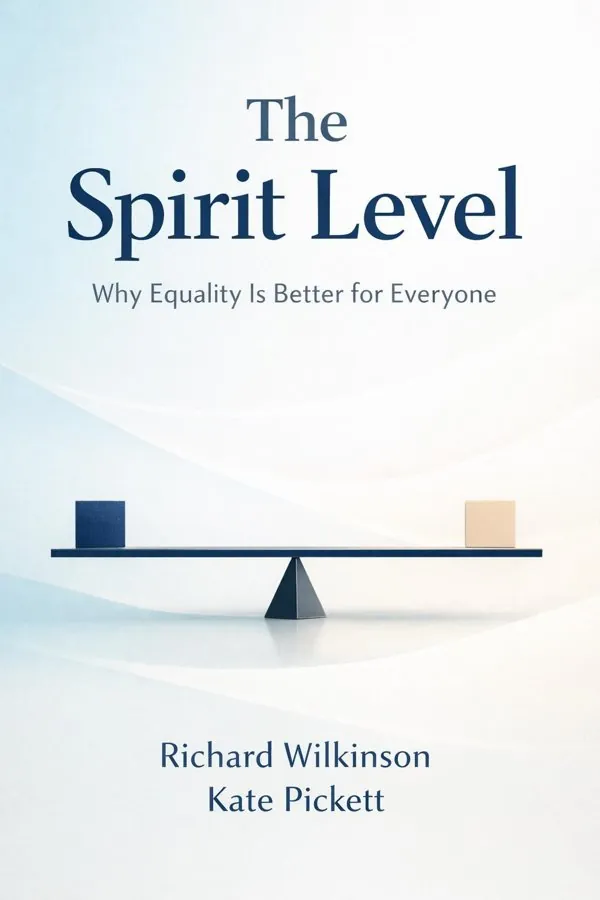
The Spirit Level: Why Equality Is Better for Everyone: Summary & Key Insights
by Richard Wilkinson, Kate Pickett
 10 min8 chaptersAudio available
What Is The Spirit Level: Why Equality Is Better for Everyone About?
The Spirit Level: Why Equality Is Better for Everyone by Richard Wilkinson, Kate Pickett is a sociology book spanning 8 pages. This influential work argues that societies with smaller income differences between rich and poor are healthier, happier, and more successful. Drawing on extensive data, the authors show that inequality harms everyone, not just the disadvantaged, and that greater equality benefits social trust, mental health, and community well-being.
This FizzRead summary covers all 8 key chapters of The Spirit Level: Why Equality Is Better for Everyone in approximately 10 minutes, distilling the most important ideas, arguments, and takeaways from Richard Wilkinson, Kate Pickett's work. Also available as an audio summary and Key Quotes Podcast.
The Spirit Level: Why Equality Is Better for Everyone
This influential work argues that societies with smaller income differences between rich and poor are healthier, happier, and more successful. Drawing on extensive data, the authors show that inequality harms everyone, not just the disadvantaged, and that greater equality benefits social trust, mental health, and community well-being.
Who Should Read The Spirit Level: Why Equality Is Better for Everyone?
This book is perfect for anyone interested in sociology and looking to gain actionable insights in a short read. Whether you're a student, professional, or lifelong learner, the key ideas from The Spirit Level: Why Equality Is Better for Everyone by Richard Wilkinson, Kate Pickett will help you think differently.
- ✓Readers who enjoy sociology and want practical takeaways
- ✓Professionals looking to apply new ideas to their work and life
- ✓Anyone who wants the core insights of The Spirit Level: Why Equality Is Better for Everyone in just 10 minutes
Want the full summary?
Get instant access to this book summary and 100K+ more with Fizz Moment.
Get Free SummaryAvailable on App Store • Free to download
Key Chapters
At the heart of *The Spirit Level* lies an extraordinary body of data. We compared rich countries—places that all enjoy high material living standards—and asked why some perform dramatically better on measures of health, crime, education, and social trust. What emerged was not random noise but a precise and consistent pattern: nations with greater income equality do better across the board.
We found this correlation not just once, but repeatedly. Whether examining outcomes like imprisonment rates, mental illness prevalence, child mortality, or obesity, the same line appeared—the more unequal the country, the worse the problem. Nations like Japan and the Nordic countries, which keep income gaps relatively narrow, tend to enjoy long life expectancy, low crime, and high levels of civic engagement. Conversely, countries like the United States and the United Kingdom show persistent social distress alongside wide inequality.
This evidence forces a rethink of the traditional assumption that market wealth alone guarantees well-being. Once a society achieves a level of prosperity sufficient for basic needs, further enrichment adds little to happiness or health unless distributed equally. It is not poverty but inequality that corrodes the collective spirit.
Consider, for instance, the United States—a country rich beyond historical precedent, yet plagued by anxious individualism, vast incarceration, and fragile social trust. When we overlay these realities with income data, the pattern becomes unmistakable: people’s sense of status insecurity is magnified in unequal settings. The constant measurement of one’s position on the social ladder generates a low-grade stress that affects all strata.
Through international comparisons, we saw equality’s impact operate much like environmental pollution—pervasive, systemic, and invisible until measured. The takeaway is profound: inequality is not simply a matter of fairness; it is a determinant of societal health.
Our work as epidemiologists made us acutely aware that the gradient of health—the steady decline in well-being from the top of the social hierarchy downward—is stubbornly universal. What inequality does is steepen that gradient. In more equal societies, health outcomes improve across all classes. The rich live longer, the middle class enjoy fewer stress-related diseases, and the poor gain the greatest benefits of all.
The physiological mechanisms are increasingly clear: inequality raises chronic stress hormones, undermines immune systems, and sustains environments where social support is weak. A population living under high inequality becomes one where anxiety and defensiveness are woven into daily life. This psychological burden translates directly into biological harm.
Japan illustrates the inverse. Despite modest average incomes compared to some Western nations, its tight social fabric and egalitarian wage structure coincide with the highest life expectancy in the developed world. Health there is a communal achievement, not an individual one.
What matters most is not absolute income, but relative position—the feeling of being more or less valued. The human body is exquisitely sensitive to perceived inferiority. As inequality rises, so too does the sense of marginalization, and with it diseases of despair such as addiction, cardiovascular illness, and depression.
Health inequalities, then, are not biological accidents but social constructions. The data reveal an encouraging truth: when societies reduce income gaps, they heal themselves holistically.
+ 6 more chapters — available in the FizzRead app
All Chapters in The Spirit Level: Why Equality Is Better for Everyone
About the Authors
Richard Wilkinson is a British social epidemiologist known for his research on health inequalities and social determinants of health. Kate Pickett is a British epidemiologist and professor of epidemiology at the University of York. Together, they co-founded The Equality Trust to promote awareness of the social impacts of inequality.
Get This Summary in Your Preferred Format
Read or listen to the The Spirit Level: Why Equality Is Better for Everyone summary by Richard Wilkinson, Kate Pickett anytime, anywhere. FizzRead offers multiple formats so you can learn on your terms — all free.
Available formats: App · Audio · PDF · EPUB — All included free with FizzRead
Download The Spirit Level: Why Equality Is Better for Everyone PDF and EPUB Summary
Key Quotes from The Spirit Level: Why Equality Is Better for Everyone
“At the heart of *The Spirit Level* lies an extraordinary body of data.”
“Our work as epidemiologists made us acutely aware that the gradient of health—the steady decline in well-being from the top of the social hierarchy downward—is stubbornly universal.”
Frequently Asked Questions about The Spirit Level: Why Equality Is Better for Everyone
The Spirit Level: Why Equality Is Better for Everyone by Richard Wilkinson, Kate Pickett is a sociology book that explores key ideas across 8 chapters. This influential work argues that societies with smaller income differences between rich and poor are healthier, happier, and more successful. Drawing on extensive data, the authors show that inequality harms everyone, not just the disadvantaged, and that greater equality benefits social trust, mental health, and community well-being.
More by Richard Wilkinson, Kate Pickett

You Might Also Like

Between the World and Me
Ta-Nehisi Coates
10 min
Half the Sky
Nicholas D. Kristof, Sheryl WuDunn
10 min
Men Explain Things To Me
Rebecca Solnit
10 min
Rational Ritual
Michael Suk-Young Chwe
10 min
The New Jim Crow
Michelle Alexander
10 min
Beyond Culture
Edward T. Hall
10 minBrowse by Category
Ready to read The Spirit Level: Why Equality Is Better for Everyone?
Get the full summary and 100K+ more books with Fizz Moment.