
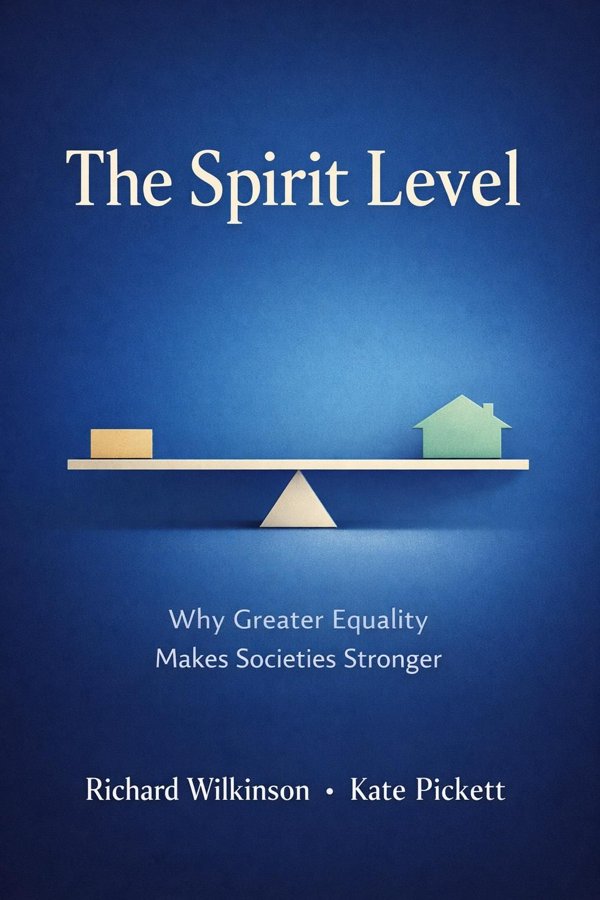
The Spirit Level: Why Greater Equality Makes Societies Stronger: Summary & Key Insights
by Richard Wilkinson, Kate Pickett
 10 min9 chaptersAudio available
Key Takeaways from The Spirit Level: Why Greater Equality Makes Societies Stronger
A society can grow richer while becoming more fractured at the same time.
More money does improve living standards up to a point, but beyond that point, equality matters more than abundance.
People do not suffer from inequality only through empty wallets; they suffer through bruised social relationships.
When inequality rises, emotional distress often spreads far beyond the poorest households.
Social outcomes that seem unrelated often turn out to share the same roots.
What Is The Spirit Level: Why Greater Equality Makes Societies Stronger About?
The Spirit Level: Why Greater Equality Makes Societies Stronger by Richard Wilkinson, Kate Pickett is a sociology book spanning 6 pages. What if the biggest driver of social well-being is not how rich a country is, but how evenly its wealth is shared? In The Spirit Level, epidemiologists Richard Wilkinson and Kate Pickett make a bold and deeply influential argument: among affluent societies, income inequality is one of the most powerful forces shaping health, safety, trust, education, and quality of life. Drawing on international comparisons and state-level data, they show that wider income gaps are linked to higher rates of mental illness, violence, imprisonment, obesity, and social distrust, while more equal societies tend to perform better across the board. This book matters because it shifts the debate from individual failure to social structure. Rather than asking why some people struggle, Wilkinson and Pickett ask what kind of society produces worse outcomes for nearly everyone. Their expertise as public health researchers gives the book unusual authority, grounding its claims in epidemiology, sociology, and population data rather than ideology alone. The result is a provocative, evidence-based case that greater equality is not merely a moral goal, but a practical foundation for healthier, safer, and more resilient societies.
This FizzRead summary covers all 9 key chapters of The Spirit Level: Why Greater Equality Makes Societies Stronger in approximately 10 minutes, distilling the most important ideas, arguments, and takeaways from Richard Wilkinson, Kate Pickett's work. Also available as an audio summary and Key Quotes Podcast.
The Spirit Level: Why Greater Equality Makes Societies Stronger
What if the biggest driver of social well-being is not how rich a country is, but how evenly its wealth is shared? In The Spirit Level, epidemiologists Richard Wilkinson and Kate Pickett make a bold and deeply influential argument: among affluent societies, income inequality is one of the most powerful forces shaping health, safety, trust, education, and quality of life. Drawing on international comparisons and state-level data, they show that wider income gaps are linked to higher rates of mental illness, violence, imprisonment, obesity, and social distrust, while more equal societies tend to perform better across the board.
This book matters because it shifts the debate from individual failure to social structure. Rather than asking why some people struggle, Wilkinson and Pickett ask what kind of society produces worse outcomes for nearly everyone. Their expertise as public health researchers gives the book unusual authority, grounding its claims in epidemiology, sociology, and population data rather than ideology alone. The result is a provocative, evidence-based case that greater equality is not merely a moral goal, but a practical foundation for healthier, safer, and more resilient societies.
Who Should Read The Spirit Level: Why Greater Equality Makes Societies Stronger?
This book is perfect for anyone interested in sociology and looking to gain actionable insights in a short read. Whether you're a student, professional, or lifelong learner, the key ideas from The Spirit Level: Why Greater Equality Makes Societies Stronger by Richard Wilkinson, Kate Pickett will help you think differently.
- ✓Readers who enjoy sociology and want practical takeaways
- ✓Professionals looking to apply new ideas to their work and life
- ✓Anyone who wants the core insights of The Spirit Level: Why Greater Equality Makes Societies Stronger in just 10 minutes
Want the full summary?
Get instant access to this book summary and 100K+ more with Fizz Moment.
Get Free SummaryAvailable on App Store • Free to download
Key Chapters
A society can grow richer while becoming more fractured at the same time. That is the starting point for Wilkinson and Pickett’s analysis of inequality. They argue that it is not enough to know how wealthy a country is on average; we must also know how that wealth is distributed. Economists use tools such as the Gini coefficient, income ratios between top and bottom earners, and comparisons across social groups to capture how far apart people are materially. For the authors, those gaps matter because they influence status, security, and the texture of everyday social life.
The book focuses especially on affluent countries, where basic national wealth no longer explains major differences in social outcomes. Once societies have reached a certain level of prosperity, the decisive question becomes whether people live relatively close to one another in material terms or whether large hierarchies dominate social relations. A society with steep income differences tends to amplify competition, insecurity, and status anxiety. A more equal one tends to reduce those pressures and support cooperation.
This idea can be applied locally as well as nationally. Two neighborhoods with similar average incomes can feel very different if one contains extreme disparities between luxury and deprivation while the other is broadly middle-income. The same principle applies inside companies, schools, and cities: large gaps can weaken solidarity and increase tension.
The practical lesson is simple: when evaluating social progress, look beyond GDP and averages. Ask how resources, opportunities, and dignity are distributed across the whole population.
More money does improve living standards up to a point, but beyond that point, equality matters more than abundance. One of the book’s most striking findings is that among rich nations, higher average income does not reliably translate into longer life expectancy or better overall health. Instead, societies with narrower income gaps tend to have healthier populations.
Wilkinson and Pickett argue that this pattern cannot be explained solely by access to food, shelter, or medicine. In wealthy societies, the key mechanism is often psychosocial rather than purely material. Chronic stress caused by insecurity, low social status, and constant comparison can affect the body through hormones, inflammation, and behavior. These pressures shape rates of heart disease, infant mortality, addiction, and other health outcomes.
The authors also emphasize that inequality harms people across the social spectrum, not just those at the bottom. Even middle-income individuals in highly unequal societies often experience lower life expectancy and worse health than their counterparts in more equal ones. This makes inequality a population-wide public health issue rather than a niche concern about poverty.
In practice, this means health policy cannot stop at hospitals and insurance coverage. Public health also depends on wages, housing stability, labor protections, and the social environment in which people live. A country may invest heavily in medical treatment while still producing poor health if status competition and insecurity remain intense.
The takeaway is to think of health as social as well as biological. If you want a healthier society, support policies and institutions that reduce chronic stress by narrowing economic distance and strengthening everyday security.
People do not suffer from inequality only through empty wallets; they suffer through bruised social relationships. A central insight of The Spirit Level is that large income differences heighten status anxiety. When hierarchies become steeper, people become more sensitive to where they stand, how they are judged, and whether they are respected. This can create a culture of comparison that quietly erodes well-being.
In more unequal societies, social evaluation carries greater weight. Appearance, prestige, educational credentials, neighborhood, and occupation become stronger markers of worth. That can make ordinary life more stressful, from school classrooms to workplaces to public spaces. People may become more defensive, more fearful of shame, and more motivated to signal success through consumption or competition.
The authors connect these pressures to wider social problems. If individuals feel constantly ranked, they may experience greater anxiety, reduced trust, and weaker social bonds. Children can absorb these pressures early, learning that value is tied to relative standing rather than contribution or character. Adults may overwork, overspend, or withdraw socially in response.
You can see this mechanism in everyday settings. In a highly stratified workplace, employees may be less likely to admit mistakes, ask for help, or collaborate freely. In a more equal environment, people often feel safer participating without fear of humiliation. The social tone changes when status differences are less extreme.
The actionable takeaway is to reduce unnecessary status barriers wherever you have influence. In teams, schools, or communities, create norms of respect, shared voice, and inclusion so people are valued for more than rank or income.
Social outcomes that seem unrelated often turn out to share the same roots. One of the book’s most compelling contributions is its argument that educational performance, crime rates, and social cohesion are all influenced by the level of inequality in a society. Wider income gaps can undermine trust, increase alienation, and make long-term investment in learning more difficult.
In unequal societies, schools are not just places of learning; they can become arenas of status competition. Children and teenagers may be more preoccupied with hierarchy, exclusion, and self-protection, leaving fewer emotional resources for concentration and confidence. Communities with weaker trust may also struggle to build stable support systems around young people.
Crime is examined through a similar lens. Wilkinson and Pickett do not present crime simply as the result of individual pathology. They suggest that violence and antisocial behavior often flourish where humiliation, exclusion, and social distance are greatest. If people feel disrespected, marginalized, or cut off from the mainstream, conflict can become more likely.
Trust is the thread connecting these outcomes. In more equal societies, people are generally more likely to believe that others will act fairly and that institutions serve the common good. That trust supports cooperation in neighborhoods, schools, and civic life. In more unequal societies, suspicion becomes more rational because social interests are more sharply divided.
The actionable takeaway is to strengthen equality as a foundation for safer and more effective communities. If you want better schools and lower crime, do not focus only on punishment or test scores; also work to reduce the social divisions that weaken trust and shared belonging.
Children do not choose the social climate they inherit, yet that climate shapes their development profoundly. Wilkinson and Pickett show that inequality affects family life, child well-being, and the opportunities available to the next generation. This influence is not limited to material deprivation, though that matters greatly. It also includes stress in the home, social comparison among parents, and the erosion of community support.
Parents living in highly unequal societies often experience stronger pressures related to work, status, and financial insecurity. Long hours, unstable employment, debt, or the need to keep up appearances can drain emotional energy. Children then feel the effects indirectly through family tension, reduced time, and fewer buffers against adversity. Inequality can also intensify the fear of falling behind, making parenting more anxious and competitive.
The book suggests that more equal societies create healthier conditions for child development because families are less exposed to extreme status pressures and communities are better able to provide informal support. Children benefit when adults trust one another, when neighborhoods feel safe, and when schools are less stratified by class difference.
A practical application is to rethink what counts as child policy. It is not only childcare funding or school reform, but also wage policy, housing affordability, parental leave, and neighborhood investment. These wider structures shape the daily environment in which children grow.
The takeaway is to view equality as intergenerational. If you want children to thrive, focus not just on correcting individual disadvantages after they appear, but on building a social world that gives families stability, dignity, and room to care well.
One of the book’s most controversial claims is also one of its most important: inequality is not only bad for the poor; it damages the whole society. Wilkinson and Pickett argue that the effects of large income gaps spread upward as well as downward. In highly unequal countries, even relatively comfortable people often have worse health, lower trust, and weaker quality of life than similar people in more equal countries.
This matters because it challenges the common belief that inequality is a trade-off some can escape. The authors suggest that no one is fully insulated from a fractured social environment. Fear of crime, low trust, status competition, gated living, educational anxiety, and political polarization affect broad segments of the population. A society can be affluent on paper while still feeling tense, lonely, and defensive in practice.
Consider the difference between private advantage and public well-being. Wealthier families may buy safer housing, better schools, or private healthcare, but they still live in the same social atmosphere. They still navigate a culture with more suspicion and sharper divisions. Social goods such as trust, cohesion, and public safety are difficult to privatize fully.
This insight has practical implications for public debate. It suggests that reducing inequality should not be framed only as charity or redistribution from winners to losers. It is better understood as collective self-interest: a way to improve the social environment everyone depends on.
The takeaway is to broaden the conversation. When discussing inequality, ask not only who has less, but what kind of society everyone is forced to live in when the gaps become too wide.
If inequality is socially produced, it can also be socially reduced. Wilkinson and Pickett end with a practical argument: the harms they describe are not inevitable features of modern life, but outcomes shaped by institutions, laws, and collective choices. That means societies have real leverage to change direction.
The book points toward several broad routes. One is redistributive policy, including progressive taxation, robust public services, and income supports that reduce the distance between top and bottom. Another is pre-distribution: shaping wages and ownership before taxes through stronger unions, pay ratios, employee participation, and business models that share rewards more fairly. The authors are especially interested in institutional arrangements that make equality part of the economy itself rather than only a correction afterward.
This policy agenda is not solely about government transfer systems. It also concerns the values embedded in workplaces, schools, and civic life. A company that limits executive pay multiples, a city that invests in mixed-income housing, or a school system that avoids deep segregation by class all contribute to a more equal social fabric.
Importantly, the authors frame reform as both ethical and pragmatic. Reducing inequality is not only about fairness in abstraction; it is a way to create healthier, safer, and more trusting societies. The evidence presented throughout the book is meant to show that equality works.
The actionable takeaway is to support institutions that compress extremes of status and income. Whether as a voter, manager, educator, or citizen, favor policies that spread power, opportunity, and security more broadly across society.
All Chapters in The Spirit Level: Why Greater Equality Makes Societies Stronger
About the Authors
Richard G. Wilkinson is a British social epidemiologist whose work has focused on health inequalities, social class, and the broader social determinants of health. He is widely recognized for showing how relative status and income distribution influence population well-being, not just individual outcomes. Kate Pickett is a British epidemiologist and professor of epidemiology at the University of York, known for her research on health inequality, child development, and public health policy. Together, Wilkinson and Pickett became internationally known for translating complex social science into a powerful public argument about the consequences of inequality. They also co-founded The Equality Trust, an organization dedicated to raising awareness of the social and health effects of unequal income distribution and promoting policies that support a fairer society.
Get This Summary in Your Preferred Format
Read or listen to the The Spirit Level: Why Greater Equality Makes Societies Stronger summary by Richard Wilkinson, Kate Pickett anytime, anywhere. FizzRead offers multiple formats so you can learn on your terms — all free.
Available formats: App · Audio · PDF · EPUB — All included free with FizzRead
Download The Spirit Level: Why Greater Equality Makes Societies Stronger PDF and EPUB Summary
Key Quotes from The Spirit Level: Why Greater Equality Makes Societies Stronger
“A society can grow richer while becoming more fractured at the same time.”
“More money does improve living standards up to a point, but beyond that point, equality matters more than abundance.”
“People do not suffer from inequality only through empty wallets; they suffer through bruised social relationships.”
“When inequality rises, emotional distress often spreads far beyond the poorest households.”
“Social outcomes that seem unrelated often turn out to share the same roots.”
Frequently Asked Questions about The Spirit Level: Why Greater Equality Makes Societies Stronger
The Spirit Level: Why Greater Equality Makes Societies Stronger by Richard Wilkinson, Kate Pickett is a sociology book that explores key ideas across 9 chapters. What if the biggest driver of social well-being is not how rich a country is, but how evenly its wealth is shared? In The Spirit Level, epidemiologists Richard Wilkinson and Kate Pickett make a bold and deeply influential argument: among affluent societies, income inequality is one of the most powerful forces shaping health, safety, trust, education, and quality of life. Drawing on international comparisons and state-level data, they show that wider income gaps are linked to higher rates of mental illness, violence, imprisonment, obesity, and social distrust, while more equal societies tend to perform better across the board. This book matters because it shifts the debate from individual failure to social structure. Rather than asking why some people struggle, Wilkinson and Pickett ask what kind of society produces worse outcomes for nearly everyone. Their expertise as public health researchers gives the book unusual authority, grounding its claims in epidemiology, sociology, and population data rather than ideology alone. The result is a provocative, evidence-based case that greater equality is not merely a moral goal, but a practical foundation for healthier, safer, and more resilient societies.
More by Richard Wilkinson, Kate Pickett
You Might Also Like

Between the World and Me
Ta-Nehisi Coates
10 min
Half the Sky
Nicholas D. Kristof, Sheryl WuDunn
10 min
Men Explain Things To Me
Rebecca Solnit
10 min
Rational Ritual
Michael Suk-Young Chwe
10 min
The New Jim Crow
Michelle Alexander
10 min
Beyond Culture
Edward T. Hall
10 minBrowse by Category
Ready to read The Spirit Level: Why Greater Equality Makes Societies Stronger?
Get the full summary and 100K+ more books with Fizz Moment.