
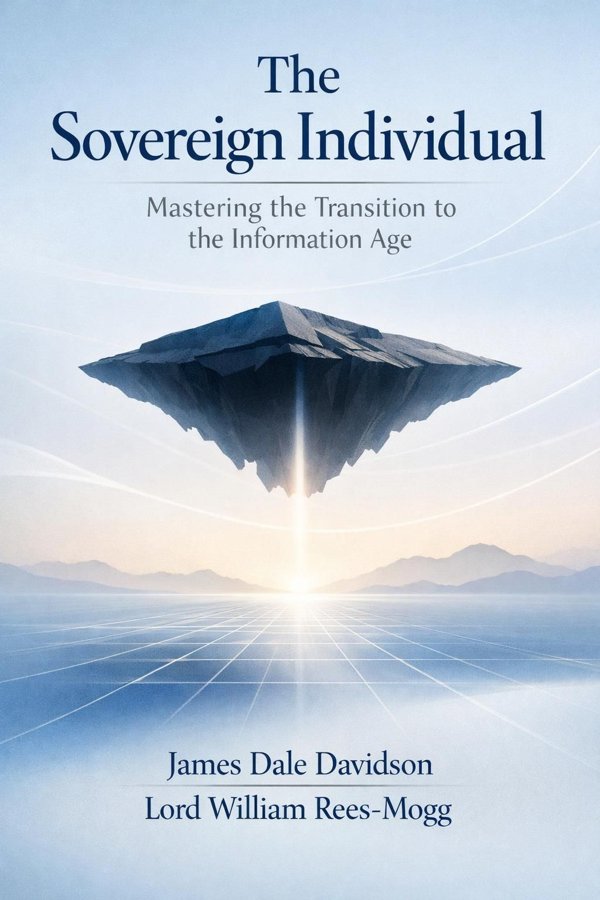
The Sovereign Individual: Summary & Key Insights
 10 min9 chaptersAudio available
Key Takeaways from The Sovereign Individual
One of the book’s most provocative claims is that history is not random; it follows shifts in how societies organize violence, information, and wealth.
A central argument of The Sovereign Individual is that the nation-state was the signature institution of the Industrial Age, not a permanent feature of human life.
The book’s defining figure is the sovereign individual: a person whose economic value, mobility, and independence make them less dependent on mass institutions.
A striking insight from the book is that wealth in the information age behaves differently from wealth in the industrial age.
Industrial society supported mass politics because it concentrated workers, industries, and revenue streams in forms governments could easily reach.
What Is The Sovereign Individual About?
The Sovereign Individual by James Dale Davidson is a non-fiction book published in 1997 spanning 9 pages. The Sovereign Individual argues that the digital age will reshape power as dramatically as the Agricultural and Industrial Revolutions once did. James Dale Davidson and William Rees-Mogg propose that when information becomes mobile, encrypted, and hard to control, the foundations of the modern nation-state begin to weaken. Governments that once dominated through taxation, regulation, borders, and monopoly over force will struggle to contain wealth and talent that can move globally at the speed of networks. In their view, this shift will produce a new kind of person: the sovereign individual, someone able to operate with greater independence from traditional institutions. What makes the book enduring is not that every prediction came true exactly as written, but that it offers a bold framework for thinking about technology, political authority, wealth creation, and personal freedom. It matters because many of its themes now feel familiar: remote work, digital capital, global competition for talent, online identity, financial decentralization, and distrust of mass institutions. Davidson wrote from the perspective of an investor and political forecaster, bringing a macrohistorical lens to questions of power, economics, and social change.
This FizzRead summary covers all 9 key chapters of The Sovereign Individual in approximately 10 minutes, distilling the most important ideas, arguments, and takeaways from James Dale Davidson's work. Also available as an audio summary and Key Quotes Podcast.
The Sovereign Individual
The Sovereign Individual argues that the digital age will reshape power as dramatically as the Agricultural and Industrial Revolutions once did. James Dale Davidson and William Rees-Mogg propose that when information becomes mobile, encrypted, and hard to control, the foundations of the modern nation-state begin to weaken. Governments that once dominated through taxation, regulation, borders, and monopoly over force will struggle to contain wealth and talent that can move globally at the speed of networks. In their view, this shift will produce a new kind of person: the sovereign individual, someone able to operate with greater independence from traditional institutions.
What makes the book enduring is not that every prediction came true exactly as written, but that it offers a bold framework for thinking about technology, political authority, wealth creation, and personal freedom. It matters because many of its themes now feel familiar: remote work, digital capital, global competition for talent, online identity, financial decentralization, and distrust of mass institutions. Davidson wrote from the perspective of an investor and political forecaster, bringing a macrohistorical lens to questions of power, economics, and social change.
Who Should Read The Sovereign Individual?
This book is perfect for anyone interested in non-fiction and looking to gain actionable insights in a short read. Whether you're a student, professional, or lifelong learner, the key ideas from The Sovereign Individual by James Dale Davidson will help you think differently.
- ✓Readers who enjoy non-fiction and want practical takeaways
- ✓Professionals looking to apply new ideas to their work and life
- ✓Anyone who wants the core insights of The Sovereign Individual in just 10 minutes
Want the full summary?
Get instant access to this book summary and 100K+ more with Fizz Moment.
Get Free SummaryAvailable on App Store • Free to download
Key Chapters
One of the book’s most provocative claims is that history is not random; it follows shifts in how societies organize violence, information, and wealth. Davidson argues that every major civilization rests on a dominant way of controlling people and resources. In agricultural societies, power was tied to land, physical proximity, and military force. In the industrial era, states gained enormous strength by taxing mass production, educating uniform populations, and mobilizing large armies. The key insight is that political systems are not timeless truths. They are temporary structures built on the technologies of their age.
This idea helps explain why old institutions often seem so clumsy when the world changes. A bureaucracy designed for factories and paper records struggles in a world of software, global finance, and mobile talent. The authors suggest that the same forces that once made kings obsolete may now be making centralized states less effective. When information can travel instantly and economic value comes from knowledge rather than fixed assets, power drifts away from large, place-based systems.
You can see this logic in modern life. A creator with an online audience, a software engineer working across borders, or an entrepreneur incorporating in one country while living in another all operate in ways that previous eras made difficult. The lesson is not that history repeats perfectly, but that tools change institutions.
Actionable takeaway: Study technological shifts before trusting political assumptions. If the tools of power are changing, your career, investments, and citizenship strategy should change with them.
A central argument of The Sovereign Individual is that the nation-state was the signature institution of the Industrial Age, not a permanent feature of human life. It became powerful because factories, railways, centralized records, and mass communication made people easier to monitor, tax, educate, conscript, and organize. But the information age reverses many of those advantages. As wealth becomes less physical and more digital, governments find it harder to control where value is created and where it goes.
Davidson does not say states disappear overnight. Instead, he argues that they lose bargaining power. Highly productive individuals and businesses gain more leverage because they can relocate, structure their affairs internationally, and move capital more easily. That changes the relationship between the citizen and the state. Instead of populations being captive to a single system, governments increasingly compete to attract talent, investment, and entrepreneurship.
This helps explain trends visible today: tax competition between jurisdictions, digital nomad visas, global corporate structures, and the migration of founders to friendlier regulatory environments. It also sheds light on public frustration. Many states still promise industrial-era benefits and control, but they no longer command the same economic terrain. As a result, they often compensate with more surveillance, more bureaucracy, or more debt.
The practical application is not to become anti-government, but to become realistic. Institutional power is becoming more contested and uneven. Individuals who understand this can make smarter decisions about residency, business formation, legal protections, and where they build their lives.
Actionable takeaway: Treat governments like competing service providers, not unquestioned masters, and evaluate which jurisdictions best support your freedom, security, and productivity.
The book’s defining figure is the sovereign individual: a person whose economic value, mobility, and independence make them less dependent on mass institutions. This is not merely a political identity. It is an economic and strategic one. In earlier eras, survival depended heavily on belonging to a tribe, a kingdom, or a national system. In the information age, Davidson argues, individuals who control specialized knowledge, digital assets, or global networks can act with a degree of autonomy once reserved for elites.
The sovereign individual is not necessarily a libertarian hero or a billionaire technologist. It could be a consultant with clients on multiple continents, a founder running a remote company, a writer with direct audience revenue, or an investor whose assets are internationally diversified. What matters is reduced dependence on any single employer, state, or social structure. The individual becomes more “sovereign” by increasing optionality.
This concept is powerful because it reframes success. Instead of climbing one institutional ladder, you build resilience through portability. Skills that travel, income streams that are location-independent, legal structures that reduce vulnerability, and communities that extend beyond geography all increase sovereignty. At the same time, the book warns that this path will not be available equally to everyone. The information age can widen inequality between adaptable knowledge workers and those still tied to mass systems.
In practice, becoming more sovereign may mean building digital skills, owning intellectual property, developing a global network, or reducing exposure to single-point failures. Independence is not absolute; it is built gradually through choices.
Actionable takeaway: Increase your personal sovereignty by making your income, skills, assets, and relationships more portable than your circumstances currently require.
A striking insight from the book is that wealth in the information age behaves differently from wealth in the industrial age. Factories, mines, and farmland are visible and rooted in place, which makes them easy to tax and regulate. But software, financial capital, intellectual property, and high-level expertise can move quickly and quietly. As wealth becomes lighter, people who create it gain more negotiating power.
That shift transforms work as well. Industrial society rewarded standardization, scale, and middle-management coordination. Information society rewards originality, technical knowledge, brand, networks, and speed. The most valuable contributors are often those who solve rare problems rather than those who fit neatly into bureaucratic systems. This helps explain why a small startup can now outperform a much larger incumbent, and why one exceptional engineer, investor, or creator can command outsized rewards.
For ordinary readers, this idea is highly practical. It suggests that long-term security no longer comes mainly from stable employment within a large institution. It comes from developing scarce capabilities and from participating in systems where your output can scale. A lawyer who builds a niche practice online, a teacher who turns expertise into courses, or a designer who licenses work globally is participating in this new logic. The economic premium shifts toward leverage.
The risk, however, is that many people remain trained for an economy that is fading. If your value depends on routine, place-bound tasks, you are more vulnerable to automation, outsourcing, and declining institutional protection.
Actionable takeaway: Build wealth around portable value: specialized skills, ownership, intellectual property, digital distribution, and assets that are not trapped in one local system.
The authors make a controversial argument: mass democracy, as developed in the industrial era, becomes harder to sustain when economic life no longer revolves around a broad, taxable middle class. Industrial society supported mass politics because it concentrated workers, industries, and revenue streams in forms governments could easily reach. But when productive capital becomes intangible and mobile, states face growing difficulty funding expansive promises while maintaining legitimacy.
Davidson suggests that this leads to political instability. Governments may try to preserve support through borrowing, inflation, symbolic conflict, or heavier extraction from those who remain visible. Citizens, meanwhile, become more polarized because the state has less real capacity to satisfy competing demands. Politics becomes noisier precisely as institutions become less capable. In this view, democratic systems do not necessarily vanish, but they become more performative, more financially stressed, and more mistrusted.
Many modern patterns echo this concern: rising public debt, political spectacle, distrust of experts, and battles over who bears the cost of large welfare and administrative systems. The book invites readers to look beneath headlines and ask a harder question: can industrial-era political arrangements survive when their tax and control base is eroding?
This does not require cynicism about democracy itself. Rather, it calls for realism about the economic preconditions that made 20th-century democratic states workable. If those conditions weaken, political adaptation becomes unavoidable.
Actionable takeaway: Pay attention not only to elections, but to the fiscal and technological foundations of governance. Durable political systems depend on economic realities, not just ideals.
Long before digital platforms became everyday infrastructure, The Sovereign Individual envisioned the emergence of cyber-economies: spaces where exchange, reputation, work, and community increasingly occur outside traditional territorial limits. In these environments, jurisdiction matters less than connectivity, and market participation depends more on code, trust systems, and networks than on physical location.
The core idea is that cyberspace creates a parallel arena for economic life. Individuals can earn, collaborate, publish, invest, and organize globally without requiring the permission structures that dominated earlier eras. This reduces barriers to entry while also increasing competition. A programmer in one country can sell to clients in another. A writer can monetize directly from readers. A company can be distributed across continents and still function coherently.
At the same time, cyber-economies produce new gatekeepers. Platforms, protocols, and digital payment systems can become as influential as old institutions once were. The dream of decentralization is real, but so is the risk of dependence on infrastructure controlled by a few corporations or governments. That tension is central to modern digital life.
For readers, the practical lesson is to understand the economic geography of the internet. Opportunity now often lies in joining global markets rather than local hierarchies. But success requires digital trust, adaptability, and strategic positioning. Your reputation, audience, and online capabilities increasingly function as economic capital.
Actionable takeaway: Participate intentionally in cyber-economies by building a strong digital identity, learning online distribution, and choosing platforms and tools that maximize both reach and independence.
The authors do not portray the move into the information age as smooth. They expect disruption, financial shocks, institutional confusion, and episodes of coercion as old systems resist decline. This transition logic is crucial. It is easy to read the book as a straight-line story of technological progress, but Davidson’s deeper point is that entrenched powers rarely surrender quietly. They adapt, overreach, and sometimes intensify control precisely when their long-term position is weakening.
This creates a paradox. As individuals gain new tools of independence, governments and legacy institutions may respond with tighter regulation, surveillance, narrative management, or punitive taxation. Volatility becomes normal because two operating systems coexist: the industrial system trying to preserve itself and the digital system undermining it. During that overlap, uncertainty can feel extreme.
We can see versions of this in market instability, sudden policy changes, disputes over digital privacy, and recurring battles over who controls payment rails, data, and speech. The transition also affects careers. Entire professions may lose status while new ones emerge rapidly. Social narratives lag behind economic reality, leaving many people confused about what to prepare for.
The practical implication is psychological as much as financial. If you expect linear stability, you will be repeatedly disappointed. If you expect contested transition, you can build buffers. Cash reserves, diversified assets, multiple income sources, legal awareness, and emotional adaptability all matter more in this environment.
Actionable takeaway: Prepare for turbulence rather than perfection. Build redundancy into your finances, work, and life so that disorder becomes manageable instead of catastrophic.
Perhaps the most useful message in The Sovereign Individual is that large historical shifts reward preparation, not passive belief. The authors are not simply predicting a new era; they are urging readers to position themselves within it. If power is decentralizing and wealth is becoming more mobile, then personal strategy matters enormously. Those who remain dependent on outdated institutions may lose autonomy. Those who adapt can gain leverage.
Adaptation begins with mindset. Instead of assuming one employer, one country, one pension system, or one social script will guarantee security, readers are encouraged to think in terms of flexibility and optionality. This means cultivating high-value skills, understanding taxes and jurisdictions, protecting privacy, diversifying assets, and building networks that operate across borders and industries. It also means taking reputation seriously. In a networked world, trust can become one of your greatest assets.
Examples are everywhere. A professional who learns remote-first collaboration becomes more location-independent. An entrepreneur who structures ownership thoughtfully gains resilience. A household that reduces debt and increases skills can withstand political and economic instability better than one dependent on a single system. Adaptation is not a grand ideological act; it is a series of practical moves.
The broader lesson is empowering: history may be turbulent, but individuals are not helpless. By understanding structural change early, you can make choices that increase freedom and reduce fragility.
Actionable takeaway: Conduct a personal sovereignty audit. Review your income, location dependence, legal exposure, skills, privacy, and assets, then strengthen the weakest point first.
All Chapters in The Sovereign Individual
About the Author
James Dale Davidson is an American investor, author, and economic forecaster known for writing about markets, taxation, political change, and long-term social trends. He built a reputation by analyzing how large structural forces affect wealth creation and personal freedom, often emphasizing the limits of centralized government and the opportunities created by technological change. Davidson has written several books on finance and public policy and has been influential among readers interested in macroeconomic shifts and independent thinking. He is best known to many readers for co-authoring The Sovereign Individual with William Rees-Mogg, a book that argued the information age would weaken nation-states and empower globally mobile individuals. His work combines investment insight, historical interpretation, and bold forecasting.
Get This Summary in Your Preferred Format
Read or listen to the The Sovereign Individual summary by James Dale Davidson anytime, anywhere. FizzRead offers multiple formats so you can learn on your terms — all free.
Available formats: App · Audio · PDF · EPUB — All included free with FizzRead
Download The Sovereign Individual PDF and EPUB Summary
Key Quotes from The Sovereign Individual
“One of the book’s most provocative claims is that history is not random; it follows shifts in how societies organize violence, information, and wealth.”
“A central argument of The Sovereign Individual is that the nation-state was the signature institution of the Industrial Age, not a permanent feature of human life.”
“The book’s defining figure is the sovereign individual: a person whose economic value, mobility, and independence make them less dependent on mass institutions.”
“A striking insight from the book is that wealth in the information age behaves differently from wealth in the industrial age.”
“The authors make a controversial argument: mass democracy, as developed in the industrial era, becomes harder to sustain when economic life no longer revolves around a broad, taxable middle class.”
Frequently Asked Questions about The Sovereign Individual
The Sovereign Individual by James Dale Davidson is a non-fiction book that explores key ideas across 9 chapters. The Sovereign Individual argues that the digital age will reshape power as dramatically as the Agricultural and Industrial Revolutions once did. James Dale Davidson and William Rees-Mogg propose that when information becomes mobile, encrypted, and hard to control, the foundations of the modern nation-state begin to weaken. Governments that once dominated through taxation, regulation, borders, and monopoly over force will struggle to contain wealth and talent that can move globally at the speed of networks. In their view, this shift will produce a new kind of person: the sovereign individual, someone able to operate with greater independence from traditional institutions. What makes the book enduring is not that every prediction came true exactly as written, but that it offers a bold framework for thinking about technology, political authority, wealth creation, and personal freedom. It matters because many of its themes now feel familiar: remote work, digital capital, global competition for talent, online identity, financial decentralization, and distrust of mass institutions. Davidson wrote from the perspective of an investor and political forecaster, bringing a macrohistorical lens to questions of power, economics, and social change.
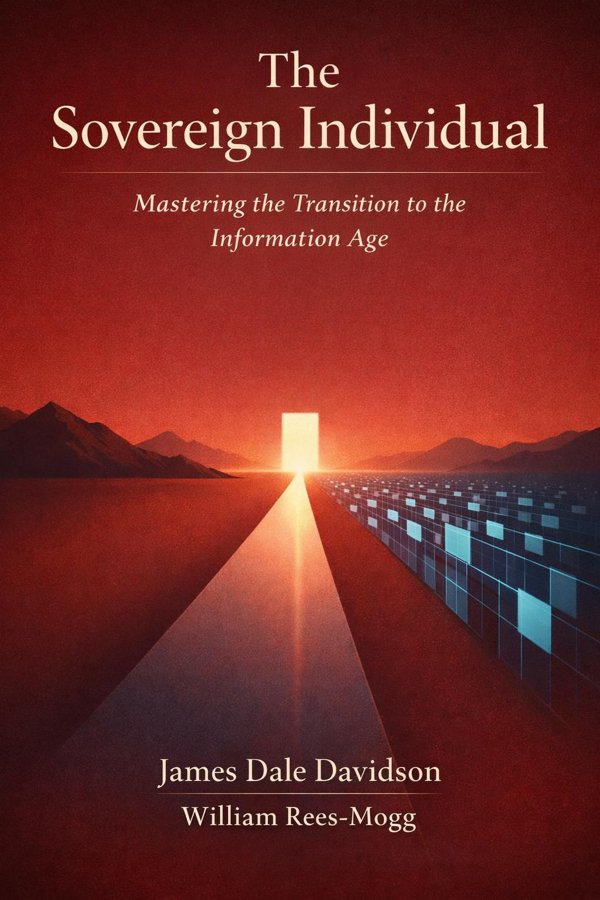
More by James Dale Davidson
You Might Also Like



Browse by Category
Ready to read The Sovereign Individual?
Get the full summary and 100K+ more books with Fizz Moment.