
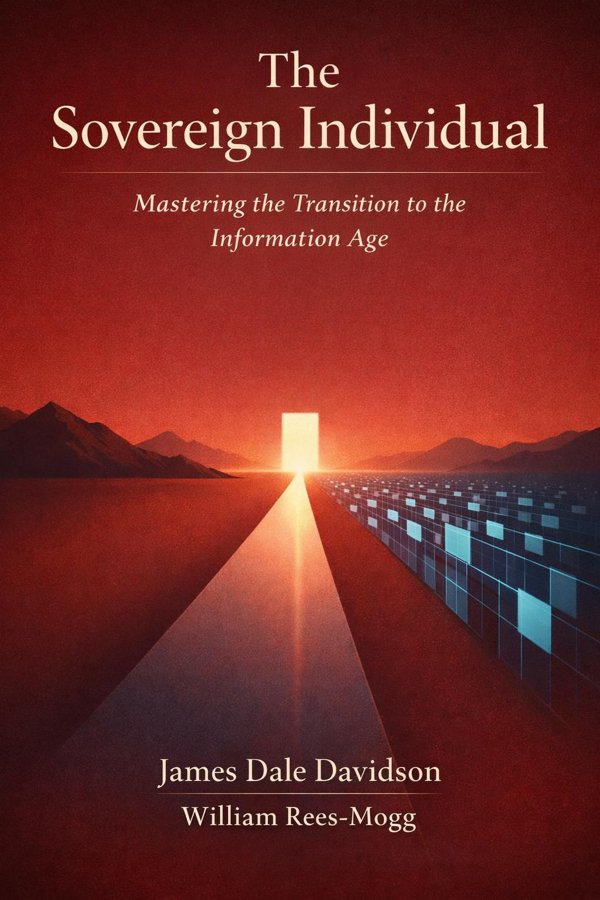
The Sovereign Individual: Mastering the Transition to the Information Age: Summary & Key Insights
by James Dale Davidson, William Rees-Mogg
 10 min9 chaptersAudio available
Key Takeaways from The Sovereign Individual: Mastering the Transition to the Information Age
History changes most dramatically when the tools of production change.
A state is strongest when it can easily identify wealth, tax it, and compel compliance.
The most important figure in the book is not a corporation or a government, but a person.
When wealth becomes intangible, money itself begins to change character.
Political power has always rested partly on a monopoly of violence.
What Is The Sovereign Individual: Mastering the Transition to the Information Age About?
The Sovereign Individual: Mastering the Transition to the Information Age by James Dale Davidson, William Rees-Mogg is a economics book spanning 9 pages. The Sovereign Individual is a bold, provocative forecast about what happens when information becomes the most valuable resource in society. James Dale Davidson and William Rees-Mogg argue that just as agriculture created kingdoms and industry created mass nation-states, digital technology is reshaping power at its foundations. In their view, the information age weakens centralized government, transforms money, changes work, and gives highly mobile, skilled individuals unprecedented leverage over institutions. The result is the rise of the “sovereign individual”: a person able to earn, invest, communicate, and protect wealth beyond the traditional reach of geography and bureaucracy. What makes the book matter is not simply its predictions, but its framework. It invites readers to see history as a sequence of technological revolutions that rearrange politics, economics, and social hierarchy. Many of its claims remain controversial, yet its themes—digital money, remote work, global talent, declining trust in institutions, and jurisdictional competition—feel strikingly relevant. Davidson, an investor and economic forecaster, and Rees-Mogg, a distinguished journalist and editor, combine macroeconomic analysis with historical interpretation to offer a sweeping guide to an age in which individuals may become more powerful than the states that once contained them.
This FizzRead summary covers all 9 key chapters of The Sovereign Individual: Mastering the Transition to the Information Age in approximately 10 minutes, distilling the most important ideas, arguments, and takeaways from James Dale Davidson, William Rees-Mogg's work. Also available as an audio summary and Key Quotes Podcast.
The Sovereign Individual: Mastering the Transition to the Information Age
The Sovereign Individual is a bold, provocative forecast about what happens when information becomes the most valuable resource in society. James Dale Davidson and William Rees-Mogg argue that just as agriculture created kingdoms and industry created mass nation-states, digital technology is reshaping power at its foundations. In their view, the information age weakens centralized government, transforms money, changes work, and gives highly mobile, skilled individuals unprecedented leverage over institutions. The result is the rise of the “sovereign individual”: a person able to earn, invest, communicate, and protect wealth beyond the traditional reach of geography and bureaucracy.
What makes the book matter is not simply its predictions, but its framework. It invites readers to see history as a sequence of technological revolutions that rearrange politics, economics, and social hierarchy. Many of its claims remain controversial, yet its themes—digital money, remote work, global talent, declining trust in institutions, and jurisdictional competition—feel strikingly relevant. Davidson, an investor and economic forecaster, and Rees-Mogg, a distinguished journalist and editor, combine macroeconomic analysis with historical interpretation to offer a sweeping guide to an age in which individuals may become more powerful than the states that once contained them.
Who Should Read The Sovereign Individual: Mastering the Transition to the Information Age?
This book is perfect for anyone interested in economics and looking to gain actionable insights in a short read. Whether you're a student, professional, or lifelong learner, the key ideas from The Sovereign Individual: Mastering the Transition to the Information Age by James Dale Davidson, William Rees-Mogg will help you think differently.
- ✓Readers who enjoy economics and want practical takeaways
- ✓Professionals looking to apply new ideas to their work and life
- ✓Anyone who wants the core insights of The Sovereign Individual: Mastering the Transition to the Information Age in just 10 minutes
Want the full summary?
Get instant access to this book summary and 100K+ more with Fizz Moment.
Get Free SummaryAvailable on App Store • Free to download
Key Chapters
History changes most dramatically when the tools of production change. That is the book’s starting insight: political systems do not lead civilization so much as adapt to deeper shifts in technology. Agriculture made land the central source of wealth, so societies organized around territory, hereditary rule, and taxation of crops. Industrialization made scale, factories, and mass labor decisive, so centralized states, standing armies, public schooling, and national bureaucracies rose to dominance. In Davidson and Rees-Mogg’s telling, the information age alters the equation again by making knowledge, code, networks, and financial mobility more valuable than physical location.
This matters because institutions built for one era often become brittle in the next. A tax system designed to monitor factories struggles to follow digital income. A bureaucracy built for standardized workers performs poorly in a world of freelancers, founders, and global contractors. Even cultural expectations lag: many people still assume security comes from lifelong employment and national identity, while wealth increasingly flows to those who can create, learn, and move quickly across borders.
You can see this pattern in everyday life. A software engineer in Lisbon can work for a company in San Francisco, hold assets in multiple jurisdictions, and educate herself through online communities rather than national systems alone. A small creator or analyst can reach a global market without owning industrial infrastructure. The key lesson is not that politics becomes irrelevant, but that technology rewrites the bargaining power between individuals and institutions.
Actionable takeaway: When evaluating your career or finances, focus less on today’s dominant institutions and more on the technological forces changing how value is created, stored, and controlled.
A state is strongest when it can easily identify wealth, tax it, and compel compliance. The authors argue that the nation-state reached its peak in the industrial era because wealth was visible and immobile: factories sat in one place, workers gathered physically, banks operated through regulated channels, and mass populations could be shaped through schools, media, and conscription. Information technology erodes these advantages by making capital, skills, and enterprise more mobile than ever before.
The decline the book describes is not necessarily the dramatic collapse of governments, but a gradual weakening of their monopoly power. If productive citizens can relocate, structure income internationally, or build digital businesses detached from local infrastructure, governments face a new form of competition. Tax rates, regulation, legal stability, and quality of life begin to matter more because individuals and firms can compare jurisdictions and choose among them. This creates pressure on states to become more efficient, less extractive, and more service-oriented.
Examples of this shift are now common. High-skilled professionals move to cities or countries with better tax rules and stronger digital infrastructure. Companies distribute teams across multiple regions. Entrepreneurs choose where to incorporate, where to bank, and where to hold intellectual property. Even public debates around citizenship, residency, and digital nomad visas reflect a world in which people increasingly treat jurisdiction as a strategic choice.
The authors may overstate how quickly states will weaken, but their core point remains powerful: political authority becomes less absolute when wealth and talent can exit. Governments cannot assume loyalty if they no longer offer the best environment for productive people.
Actionable takeaway: Treat geography as a decision variable; compare jurisdictions for taxes, rule of law, business climate, and personal freedom rather than accepting your default location as permanent.
The most important figure in the book is not a corporation or a government, but a person. The “sovereign individual” is someone whose productive power comes from portable knowledge rather than fixed assets. This person can earn through expertise, entrepreneurship, investment, or intellectual property; protect wealth through legal and financial sophistication; and reduce dependence on any single state or employer. Sovereignty here does not mean isolation. It means negotiating with institutions from a position of choice rather than subordination.
The authors see this figure as the emerging elite of the information age. In the industrial era, advancement often came through belonging to large organizations—governments, corporations, unions, universities. In the information era, leverage shifts toward individuals who can convert specialized skill into global income streams. A programmer, writer, trader, consultant, designer, researcher, or founder can now build a career across borders, platforms, and networks. Reputation, adaptability, and asymmetric skill matter more than conformity to organizational ladders.
This idea helps explain why some people thrive amid disruption while others feel increasingly exposed. The sovereign individual invests in self-education, builds financial buffers, maintains optionality, and avoids overreliance on one source of approval. For example, a lawyer might combine local practice with international advisory work, digital publishing, and online teaching. A designer might diversify clients across countries, invoice through global platforms, and turn expertise into a productized service.
The concept is aspirational but also demanding. It requires discipline, technical literacy, long-term planning, and the emotional strength to operate without the old guarantees of institutional life.
Actionable takeaway: Build personal sovereignty by increasing your portability—develop scarce skills, own part of your income stream, and reduce dependence on any single employer, platform, or country.
When wealth becomes intangible, money itself begins to change character. Davidson and Rees-Mogg argue that the information revolution will undermine governments’ ability to control currency, tax savings, and quietly inflate away purchasing power. In earlier eras, rulers debased coinage or manipulated national currencies because most people had few alternatives. But if technology enables faster capital movement, private financial innovation, and new stores of value, citizens gain more ways to protect wealth from political mismanagement.
This argument anticipated a world of digital payments, borderless investing, algorithmic markets, and serious interest in non-state monetary alternatives. The deeper point is broader than any one technology: people seek assets that are harder to seize, dilute, or monitor. In unstable systems, capital moves toward protection. That can mean holding diversified global assets, using legal structures across jurisdictions, owning productive businesses, or embracing emerging forms of digital value transfer.
The book also implies a new tax environment. If governments cannot easily tax mobile capital, they may lean more heavily on visible labor, property, or consumption—or they may compete to attract wealth by offering better terms. For individuals, this means financial literacy becomes a civic necessity, not a luxury. Understanding inflation, jurisdiction risk, asset custody, and currency exposure becomes central to preserving autonomy.
A practical example is the modern investor who spreads risk across domestic and international equities, holds some liquid reserves in different currencies, and remains alert to policy changes that can affect after-tax returns. Another is the entrepreneur who chooses business structures intentionally rather than reactively.
Actionable takeaway: Strengthen financial sovereignty by diversifying across asset types, jurisdictions, and income sources, while learning how policy and inflation affect the real value of your wealth.
Political power has always rested partly on a monopoly of violence. The authors contend that technological change transforms not only economics but also the cost and distribution of force. In the industrial age, large states had an enormous advantage because military power depended on mass armies, heavy equipment, and centralized production. Information technology, however, can increase the influence of smaller actors by making coordination cheaper, intelligence more accessible, and disruption more asymmetric.
This has unsettling implications. Security becomes less about visible battlefield conflict and more about networks, cyber vulnerabilities, economic sabotage, surveillance, and targeted disruption. The same technologies that empower individuals economically can also empower criminals, extremist groups, or private actors who exploit digital dependence. In that environment, governments may become simultaneously less capable in some areas and more intrusive in others, expanding surveillance as compensation for weakening control.
At a personal level, security becomes multidimensional. It is no longer enough to think only in terms of physical safety. Digital identity, financial account security, data privacy, backup systems, and reputational resilience all become part of modern self-defense. A freelancer whose laptop is stolen, accounts are hacked, or payment rails are frozen can experience a form of paralysis once associated only with physical threats.
The book’s broader insight is that social transitions often produce instability. When old systems lose legitimacy and new ones are not fully established, uncertainty rises. Individuals who prepare early are less vulnerable. This preparation includes legal awareness, cybersecurity habits, diversified banking relationships, and contingency planning for travel, communication, and income continuity.
Actionable takeaway: Expand your definition of security—protect not just your person and property, but also your data, digital identity, financial access, and ability to operate during disruptions.
Democracy is often treated as the natural endpoint of political progress, but the authors argue that the mass-democratic nation-state was a product of industrial conditions rather than a permanent settlement. Industrial economies rewarded scale, standardization, and broad political mobilization. Mass electorates, centralized parties, welfare systems, and national media fit a world in which large populations worked, consumed, and fought in synchronized ways. As economic life becomes more individualized and global, that model comes under pressure.
The tension emerges because democratic politics tends to distribute benefits through territorial majorities, while information-age wealth often accrues to mobile minorities with specialized skills and global reach. This creates resentment on both sides. Productive citizens may feel trapped by taxation and regulation designed for older economic models. Less mobile citizens may see the new elite as detached and unaccountable. The result can be polarization, populism, fiscal stress, and a widening gap between political promises and economic realities.
You can observe this in debates over remote work, globalization, taxation of technology firms, and the obligations of wealthy individuals who can relocate more easily than average voters. Political systems built around national labor blocs struggle to represent a world of digital creators, multinational capital, and fragmented identities. The book does not celebrate this tension so much as diagnose it.
For readers, the lesson is to avoid naïve assumptions about political stability. Institutions may continue, but their legitimacy can weaken when they no longer align with how people produce value. Civic participation still matters, yet personal resilience matters more when political systems become reactive and overstretched.
Actionable takeaway: Stay politically aware, but do not outsource your future to public systems alone; build independent capacities in income, savings, education, and community.
One of the clearest predictions in the book is that work will increasingly reward brains over brawn and leverage over routine effort. In an industrial system, income often depended on standardized labor performed at scale within large organizations. In the information economy, value migrates toward judgment, creativity, design, code, analysis, brand, and network effects. The individual who can create something once and distribute it globally gains leverage that industrial workers rarely possessed.
This does not mean everyone becomes an entrepreneur in the romantic sense. It means the labor market itself changes structure. Stable hierarchies give way to project work, remote collaboration, specialized contracting, and outcome-based compensation. Workers who rely on easily replicable tasks face downward pressure, while those who combine technical competence with adaptability can command far greater rewards. A single data scientist, product strategist, or content creator may influence millions in value through systems, software, or audiences.
The practical consequence is that career security no longer comes primarily from tenure. It comes from relevance. The strongest professionals build capabilities that travel across industries and geographies: communication, problem-solving, sales, coding, research, design, negotiation, and domain expertise. They also learn to package knowledge into assets—courses, products, software, intellectual property, advisory retainers, or investment vehicles.
Consider two professionals with the same intelligence: one depends entirely on a local employer; the other develops a public reputation, multiple clients, and a digital product. The second has more shocks to absorb and more upside to capture. This is the logic of sovereignty applied to work.
Actionable takeaway: Convert your labor into leverage by building skills and assets that can scale beyond your hours—such as content, code, systems, intellectual property, or a trusted niche reputation.
Greater freedom does not automatically produce a better society. One of the more underappreciated themes of the book is that the rise of sovereign individuals creates moral strain as well as opportunity. When people gain the ability to move wealth, avoid weak institutions, and live beyond traditional constraints, they also face harder questions about responsibility, loyalty, and justice. If the most capable can exit, what happens to the communities left behind? If power shifts from public institutions to private networks, who protects the vulnerable? If efficiency becomes the highest value, what happens to solidarity?
The authors do not offer a fully developed moral philosophy, but they make clear that periods of transition can intensify inequality and social fragmentation. A world of highly autonomous individuals can become dynamic and innovative, yet also harsher, more transactional, and more unstable. That is why self-governance matters. Sovereignty without discipline degrades into opportunism. Freedom without ethics produces mistrust, and mistrust eventually increases coercion.
For modern readers, this theme has direct relevance. The ability to arbitrage jurisdictions, optimize taxes, or work from anywhere may be legal and strategic, but it does not remove obligations to family, employees, clients, and local communities. Long-term success still depends on trust, reputation, and reciprocal relationships. A founder who treats every connection purely instrumentally may gain in the short run and fail in the long run.
The deeper insight is simple: as external control weakens, internal character matters more. In a more fluid world, personal ethics become part of economic infrastructure.
Actionable takeaway: Pursue autonomy with integrity—build systems for decision-making that protect your reputation, honor commitments, and align long-term freedom with responsibility.
The book’s practical advice can be summed up in one principle: do not fight the tide of civilizational change; position yourself within it. The transition to the information age, as the authors describe it, will be uneven, politically turbulent, and psychologically uncomfortable. Many institutions will respond defensively, trying to preserve tax bases, labor models, currencies, and authority structures built for an earlier era. Individuals who cling too tightly to those structures risk becoming dependent on systems that are losing effectiveness.
Adaptation begins with mindset. Instead of assuming the future will resemble the recent past, the reader is urged to think in scenarios. What if your profession becomes global? What if your country becomes less fiscally stable? What if digital identity, reputation, and online income matter more than formal credentials? What if your children need flexibility and problem-solving more than standardized pathways? These are not abstract questions; they shape decisions about education, savings, housing, legal structures, and career design.
A practical adaptation strategy includes several layers: portable skills, diversified assets, geographic flexibility, strong networks, continuous learning, and reduced dependence on any monopoly provider of income or opportunity. It also means emotional adaptation—learning to tolerate ambiguity and act without waiting for institutional permission. The person who sees transition as threat becomes defensive. The person who sees it as reorganization becomes strategic.
The book’s tone can be dramatic, but its most durable value lies in this forward-looking discipline. Whether every prediction proves correct is less important than the habit of preparing for a world in which change compounds and centralized guarantees weaken.
Actionable takeaway: Conduct a personal transition audit—review your skills, savings, location, tax exposure, digital security, and income concentration, then strengthen the areas that make you too dependent on a single system.
All Chapters in The Sovereign Individual: Mastering the Transition to the Information Age
About the Authors
James Dale Davidson was an American investor, financial writer, and forecaster known for exploring long-term economic and political trends. He wrote extensively about taxation, monetary policy, wealth preservation, and the shifting relationship between citizens and the state. William Rees-Mogg was a distinguished British journalist, public commentator, and former editor of The Times, widely recognized for his writing on politics, economics, and social transformation. Together, they combined Davidson’s market-oriented analysis with Rees-Mogg’s historical and editorial depth. Their collaboration on The Sovereign Individual produced one of the most influential and debated books about the transition from the industrial age to the information age, especially for readers interested in freedom, global mobility, and the future of wealth.
Get This Summary in Your Preferred Format
Read or listen to the The Sovereign Individual: Mastering the Transition to the Information Age summary by James Dale Davidson, William Rees-Mogg anytime, anywhere. FizzRead offers multiple formats so you can learn on your terms — all free.
Available formats: App · Audio · PDF · EPUB — All included free with FizzRead
Download The Sovereign Individual: Mastering the Transition to the Information Age PDF and EPUB Summary
Key Quotes from The Sovereign Individual: Mastering the Transition to the Information Age
“History changes most dramatically when the tools of production change.”
“A state is strongest when it can easily identify wealth, tax it, and compel compliance.”
“The most important figure in the book is not a corporation or a government, but a person.”
“When wealth becomes intangible, money itself begins to change character.”
“Political power has always rested partly on a monopoly of violence.”
Frequently Asked Questions about The Sovereign Individual: Mastering the Transition to the Information Age
The Sovereign Individual: Mastering the Transition to the Information Age by James Dale Davidson, William Rees-Mogg is a economics book that explores key ideas across 9 chapters. The Sovereign Individual is a bold, provocative forecast about what happens when information becomes the most valuable resource in society. James Dale Davidson and William Rees-Mogg argue that just as agriculture created kingdoms and industry created mass nation-states, digital technology is reshaping power at its foundations. In their view, the information age weakens centralized government, transforms money, changes work, and gives highly mobile, skilled individuals unprecedented leverage over institutions. The result is the rise of the “sovereign individual”: a person able to earn, invest, communicate, and protect wealth beyond the traditional reach of geography and bureaucracy. What makes the book matter is not simply its predictions, but its framework. It invites readers to see history as a sequence of technological revolutions that rearrange politics, economics, and social hierarchy. Many of its claims remain controversial, yet its themes—digital money, remote work, global talent, declining trust in institutions, and jurisdictional competition—feel strikingly relevant. Davidson, an investor and economic forecaster, and Rees-Mogg, a distinguished journalist and editor, combine macroeconomic analysis with historical interpretation to offer a sweeping guide to an age in which individuals may become more powerful than the states that once contained them.
You Might Also Like
Business Adventures
John Brooks
10 min
Nudge
Richard H. Thaler, Cass R. Sunstein
10 min
The Hitchhiker"s Guide to the Galaxy
Douglas Adams
10 minThe Muqaddimah
Ibn Khaldun
10 minThe Outsiders
William N. Thorndike
10 min
A Little History of Economics
Niall Kishtainy
10 minBrowse by Category
Ready to read The Sovereign Individual: Mastering the Transition to the Information Age?
Get the full summary and 100K+ more books with Fizz Moment.