
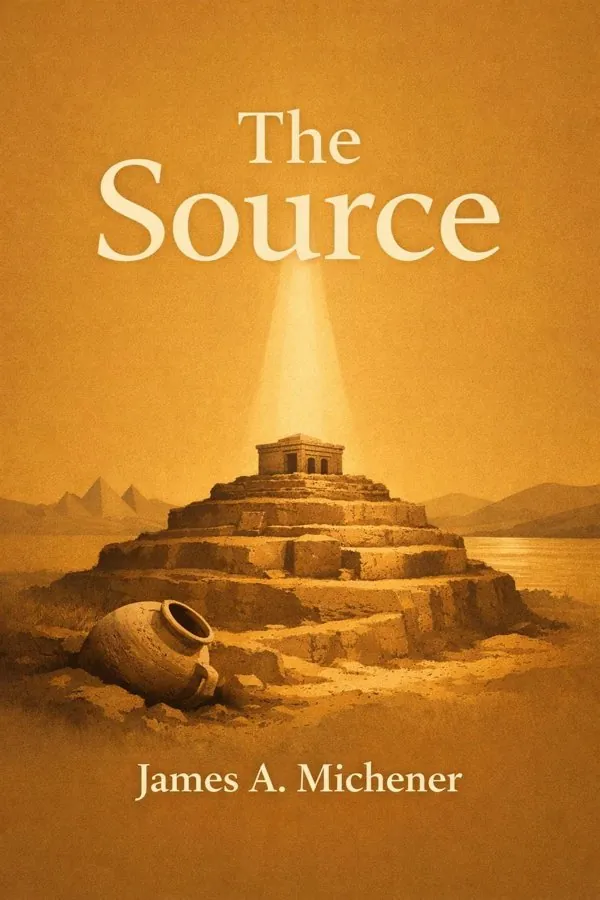
The Source: Summary & Key Insights
 10 min10 chaptersAudio available
Key Takeaways from The Source
Civilization does not begin with monuments; it begins with people trying to survive together.
People rarely worship ideas alone; they worship the forces they fear and depend upon.
A nation becomes powerful when it believes its story has meaning beyond survival.
Power creates order, but conscience asks whether the order deserves to exist.
What survives when a people loses control of its land?
What Is The Source About?
The Source by James A. Michener is a world_history book spanning 9 pages. What if one patch of earth could tell the story of civilization itself? In The Source, James A. Michener uses that powerful idea to create one of the most ambitious historical novels of the twentieth century. Set around the fictional archaeological mound, or tell, of Makor in the land of Israel, the book moves layer by layer through thousands of years of human life—from prehistoric settlement to Canaanite religion, Hebrew nationhood, Greek and Roman rule, Islamic and Crusader conflict, Ottoman decline, Zionist aspiration, and the birth of modern Israel. Each buried stratum becomes a doorway into a vanished world, revealing how beliefs, customs, and political struggles accumulate over time. The novel matters because it turns history into lived experience: instead of presenting dates and abstractions, it shows how ordinary people inherit fear, faith, memory, and hope. Michener was uniquely suited to this task. Renowned for vast, deeply researched novels such as Hawaii and Centennial, he combined scholarly discipline with a storyteller’s gift, making The Source both an engrossing narrative and a profound meditation on religion, identity, and historical continuity.
This FizzRead summary covers all 10 key chapters of The Source in approximately 10 minutes, distilling the most important ideas, arguments, and takeaways from James A. Michener's work. Also available as an audio summary and Key Quotes Podcast.
The Source
What if one patch of earth could tell the story of civilization itself? In The Source, James A. Michener uses that powerful idea to create one of the most ambitious historical novels of the twentieth century. Set around the fictional archaeological mound, or tell, of Makor in the land of Israel, the book moves layer by layer through thousands of years of human life—from prehistoric settlement to Canaanite religion, Hebrew nationhood, Greek and Roman rule, Islamic and Crusader conflict, Ottoman decline, Zionist aspiration, and the birth of modern Israel. Each buried stratum becomes a doorway into a vanished world, revealing how beliefs, customs, and political struggles accumulate over time. The novel matters because it turns history into lived experience: instead of presenting dates and abstractions, it shows how ordinary people inherit fear, faith, memory, and hope. Michener was uniquely suited to this task. Renowned for vast, deeply researched novels such as Hawaii and Centennial, he combined scholarly discipline with a storyteller’s gift, making The Source both an engrossing narrative and a profound meditation on religion, identity, and historical continuity.
Who Should Read The Source?
This book is perfect for anyone interested in world_history and looking to gain actionable insights in a short read. Whether you're a student, professional, or lifelong learner, the key ideas from The Source by James A. Michener will help you think differently.
- ✓Readers who enjoy world_history and want practical takeaways
- ✓Professionals looking to apply new ideas to their work and life
- ✓Anyone who wants the core insights of The Source in just 10 minutes
Want the full summary?
Get instant access to this book summary and 100K+ more with Fizz Moment.
Get Free SummaryAvailable on App Store • Free to download
Key Chapters
Civilization does not begin with monuments; it begins with people trying to survive together. In the earliest imagined stratum of Makor, Michener introduces the Ur family, primitive settlers who stand not as precise historical figures but as representatives of humanity’s first fragile communities. Their lives are shaped by hunger, fear, mating, childbirth, death, and the dawning realization that cooperation offers advantages brute force alone cannot secure. Through them, the novel suggests that history is rooted less in kings and battles than in ordinary families learning how to live beside one another.
This section matters because it frames all later developments—religion, law, politics, war—as extensions of basic human needs. The Ur family does not possess theology in a formal sense, yet they react to nature with awe. They do not have institutions, but they form habits. They do not have written memory, yet they create continuity through kinship and ritual. Michener’s insight is that every grand civilization grows out of these simple beginnings.
A practical way to think about this idea is to notice how modern societies still depend on prehistoric instincts shaped into social systems. Communities today still organize around food security, family structures, mutual defense, and shared stories. Whether in a neighborhood, a company, or a nation, the same question remains: how do individuals become a functioning group?
The Ur family reminds readers to look beneath modern complexity and recognize the enduring foundations of social life. Actionable takeaway: when studying any culture or conflict, start with the basic human needs—security, belonging, memory, and survival—that lie underneath its institutions.
People rarely worship ideas alone; they worship the forces they fear and depend upon. In Makor’s Canaanite age, Michener explores a world animated by fertility cults, local deities, sacrificial rites, and seasonal rhythms. Gods such as Baal and El are not abstract philosophical constructs but expressions of agricultural anxiety, communal identity, and political power. Rain, harvest, childbirth, and war all appear tied to divine favor. Religion here is not a separate sphere of life—it is woven into every civic and domestic act.
Michener uses this era to show that organized religion often emerges as a social technology as much as a spiritual response. Priests gain influence because they interpret uncertainty. Temples become centers of economy and authority. Rituals bind people together, but they can also justify hierarchy and violence. This does not make the faith of the Canaanites meaningless; rather, it reveals religion as a human attempt to impose order on a dangerous world.
The modern application is surprisingly direct. Even today, societies create symbolic systems to manage uncertainty—whether through religion, nationalism, ideology, or market faith. Leaders still use ritual, language, and shared myths to unify people. Communities still long for reassurance that chaos can be controlled.
By dramatizing the age of Baal and El, Michener helps readers understand why polytheistic systems flourished and why they proved emotionally persuasive. These religions answered practical needs before they were replaced by newer visions of moral and divine order. Actionable takeaway: when encountering beliefs different from your own, ask what fear, hope, or social need those beliefs were designed to address.
A nation becomes powerful when it believes its story has meaning beyond survival. In the Hebrew settlement of Makor, Michener shifts from tribal adaptation to covenantal identity. The arrival and development of Hebrew life introduce a radically different moral imagination: one God, a chosen people, and a historical destiny tied not only to land but to law. This is one of the book’s central turning points, because religion now becomes ethical as well as ritual. The sacred is no longer merely what ensures fertility or victory; it also judges behavior.
Michener portrays the Hebrews as neither flawless heroes nor simple invaders. They are a people in formation, struggling to balance tribal loyalty, spiritual calling, military necessity, and internal division. Their distinctiveness comes from the belief that history itself is meaningful—that events reveal a covenantal relationship with the divine. This concept transforms the land of Israel from territory into memory-laden promise.
In practical terms, this idea helps explain why certain places become non-negotiable in human history. Land is rarely just economic real estate; it carries stories, sacred obligations, and collective identity. The Hebrew settlement also shows how shared law can hold a scattered people together across time. Modern nations, communities, and even organizations rely on the same principle: durable identity requires more than common ancestry; it requires shared norms and a narrative of purpose.
This section of The Source is essential for understanding the later persistence of Jewish identity through conquest, exile, and return. Actionable takeaway: examine the stories and principles that define your community, because people remain united longer by shared meaning than by shared circumstance.
Power creates order, but conscience asks whether the order deserves to exist. In the age of kings and prophets, Makor becomes a stage for one of the Bible’s enduring tensions: the conflict between political necessity and moral accountability. Monarchies centralize authority, build institutions, wage wars, and create national prestige. Yet prophets arise to challenge corruption, idolatry, injustice, and the arrogance of rulers. Michener presents this not as a simple contest between good and evil but as a structural struggle built into civilization itself.
The kings embody statecraft. They must protect borders, collect taxes, manage alliances, and preserve cohesion. The prophets embody a different kind of authority��one rooted in truth-telling rather than office. They insist that no kingdom can endure if it sacrifices justice for expedience. This tension is one of Michener’s most relevant insights: societies need both builders and critics, institutions and moral correctives.
The lesson applies far beyond ancient Israel. Modern democracies depend on similar balances between government and dissent, leadership and accountability, national interest and ethical principle. Journalists, reformers, judges, clergy, and whistleblowers often play prophetic roles when systems become self-protective. At the same time, critics who ignore practical realities can also destabilize communities. The challenge is not choosing one side forever, but maintaining a living dialogue between power and principle.
Michener shows that civilizations decay when rulers become immune to criticism or when ideals lose contact with real governance. The greatness of a culture is measured not only by what it builds, but by whether it can hear unwelcome truth. Actionable takeaway: in any institution you belong to, support structures that allow principled criticism before crisis forces change.
What survives when a people loses control of its land? One of The Source’s deepest themes is that identity can endure conquest if it is carried in memory, ritual, and text. As armies pass through the region and empires reshape Makor, Michener explores how communities respond when political sovereignty is broken. Defeat might scatter populations, destroy cities, or interrupt institutions, but it does not automatically erase a civilization. Sometimes suffering intensifies identity rather than dissolving it.
This is especially important in the Jewish historical experience, where exile becomes not only trauma but a mechanism of preservation. Traditions are codified. Stories are retold. Practices become portable. Sacred memory shifts from temple-centered geography to forms of life that can travel. Michener’s insight is subtle: displacement can threaten identity, but it can also force a people to discover what is truly essential.
The practical application is broad. Families in diaspora communities, migrant populations, and displaced cultural groups often face the same question: what core practices should be preserved when the surrounding environment changes? Language, holidays, food, education, and storytelling become tools of continuity. Institutions matter, but habits matter too.
Michener refuses to romanticize loss; exile brings grief, fragmentation, and conflict. Yet he also demonstrates that resilient cultures are not defined solely by political control. They endure because they can translate memory into daily life. This idea helps explain why the land of Israel remains emotionally and spiritually central even during centuries when many Jews lived elsewhere. Actionable takeaway: if you want a tradition to survive change, embed it in repeatable practices, not only in places or monuments.
Civilizations do not only fight on battlefields; they compete in ideas, habits, and definitions of the good life. In the Hellenistic and Roman periods, Michener examines what happens when Jewish tradition encounters the cosmopolitan power of Greek culture and then the administrative force of Rome. This era brings roads, cities, language, trade, law, philosophy, and imperial order—but also pressure to assimilate, compromise, and reinterpret old loyalties.
The brilliance of Michener’s treatment lies in showing that cultural conflict is rarely absolute. Some people resist foreign influence fiercely. Others adapt selectively. Still others embrace the prestige and practical benefits of empire. Hellenization and Romanization are not just imposed from above; they enter daily life through education, commerce, architecture, and ambition. The result is a layered society where identity becomes increasingly contested.
This tension remains highly relevant today. Globalization often creates similar dilemmas. A local culture may gain access to wealth, technology, and broader exchange, but also fear the erosion of its language, customs, or moral framework. Individuals face these pressures too: how much should one adapt to dominant systems without losing oneself?
Michener does not suggest that isolation is the answer. Instead, he shows that strong identities can engage outside influences intelligently when they know what is negotiable and what is sacred. The Roman and Hellenistic chapters illuminate the long history of cultural hybridity, resistance, and reinvention in the region.
Actionable takeaway: when facing powerful external influences, define your non-negotiable values clearly, then adapt flexibly in everything else.
The same land can inspire devotion in many peoples, and that shared devotion can become a source of tragedy. In the Crusader and Islamic eras, Michener highlights the violent entanglement of faith, empire, and memory. Jerusalem and the surrounding land are revered by multiple traditions, each with sincere conviction and historical grievance. The result is not simply religious difference, but competing sacred geographies. Every conquest claims legitimacy; every loss feels unbearable.
Michener’s great achievement here is nuance. He does not reduce one side to pure nobility and the other to barbarism. Instead, he shows how piety can coexist with cruelty, and how political ambitions often hide behind religious language. Crusaders arrive with visions of redemption and glory, yet bring slaughter. Islamic rulers may offer periods of coexistence and sophistication, yet remain participants in military struggle and domination. Human beings repeatedly elevate holy causes while behaving in profoundly unholy ways.
This pattern still matters. Many modern conflicts are intensified when identity, territory, and transcendence overlap. Negotiation becomes harder when land is not just strategic but sacred. That does not make peace impossible, but it means historical empathy is essential. Lasting solutions require acknowledging not only current interests but inherited wounds.
By treating all sides as historically real rather than symbolically convenient, Michener invites readers to move beyond propaganda. The land is contested because it matters deeply, not because one group invented attachment and others merely intruded. Actionable takeaway: when evaluating a conflict over land or identity, study the rival memories involved before assuming it can be solved by logic alone.
History is not made only in dramatic revolutions; often it lingers in long seasons of endurance. In the Ottoman period, Michener turns from spectacular conquest to slower patterns of administration, decline, habit, and survival. The region is no longer the center of world-shaping empire in the way readers may expect, yet life continues. Villagers farm, families marry, local leaders maneuver, and religious communities preserve themselves amid neglect, bureaucracy, and uneven authority. The land does not disappear from history; it sinks into a quieter register.
This section is important because it challenges the tendency to see historical significance only in moments of crisis. The Ottoman centuries reveal how societies can persist without flourishing, and how local identities survive under distant rule. Michener also shows that apparent stagnation often masks subtle change: demographic shifts, land arrangements, religious relations, and external interest slowly alter the future.
A practical lesson emerges for anyone studying institutions or societies today. Long periods that seem static may actually be preparing later upheaval. A company, nation, or community can appear stable while unresolved structural tensions accumulate beneath the surface. The absence of headlines does not mean the absence of history.
The Ottoman era also underscores the resilience of ordinary life. Even when governments are inefficient or indifferent, people maintain continuity through labor, faith, custom, and family. This is one reason the land remains historically alive in Michener’s novel: it is carried forward not only by rulers but by those who simply remain.
Actionable takeaway: pay attention to slow-moving historical conditions, because future turning points are often prepared during periods others dismiss as uneventful.
A people can live for centuries in dispersion and still refuse to surrender the idea of home. In Michener’s account of the modern Zionist movement, the ancient themes of covenant, exile, memory, and land return in political form. Zionism emerges not as a single motive but as a convergence of forces: persistent religious longing, modern nationalism, European antisemitism, intellectual revival, agricultural settlement, and the practical conviction that Jewish survival requires self-determination.
Michener is careful to portray this movement as both idealistic and difficult. For many Jews, returning to the land represents historical restoration and moral necessity. Yet the land is not empty, and national rebirth immediately raises questions about Arab inhabitants, competing claims, and the meaning of justice after long suffering. One of the strengths of The Source is that it frames Zionism not as a simplistic triumph but as the latest chapter in an already crowded history.
The modern application reaches beyond this particular case. National movements often draw power from memory, especially when communities feel vulnerable, humiliated, or exiled. Shared symbols, historical education, language revival, and settlement efforts can turn aspiration into political reality. But legitimate hope does not erase the complexity of coexistence.
Michener helps readers see why Zionism inspired devotion: it joined emotion, history, religion, and political realism. At the same time, he refuses to pretend that one people’s return automatically resolves all moral questions. Actionable takeaway: when assessing any nationalist movement, distinguish between the authenticity of its historical longing and the practical challenges it creates for others already on the ground.
The birth of a state is never merely a beginning; it is the collision of many unfinished pasts. In the final movement of The Source, Michener brings the story toward the founding of modern Israel, showing how archaeology, religion, nationalism, trauma, and international politics converge in a decisive historical moment. The new state appears as both fulfillment and rupture: a realization of ancient longing for many Jews, and a source of dispossession, fear, and conflict for others in the region.
What makes this conclusion powerful is the way the excavation frame deepens it. The archaeologists uncovering Makor are not neutral observers standing outside history. Their interpretations are shaped by modern identity, ideology, scholarship, and urgency. In other words, history is not only something discovered in the ground; it is also argued over in the present. The founding of Israel becomes the clearest example of this principle. Ancient evidence matters because modern people use it to understand who belongs, what is sacred, and what justice requires.
This has broad practical relevance. Debates about heritage, borders, and legitimacy are rarely settled by facts alone, but facts still matter enormously. Evidence can illuminate claims, challenge myths, and complicate slogans. Responsible citizenship requires the humility to recognize that the present inherits more than it chooses.
Michener ends not with a neat solution but with a sharpened awareness of continuity. Modern Israel is not detached from the ages beneath it; it stands upon them. Actionable takeaway: approach contemporary political conflicts historically, because present arguments make the most sense when you understand the many layers beneath them.
All Chapters in The Source
About the Author
James A. Michener (1907–1997) was an American novelist celebrated for his expansive historical fiction and meticulous research. He first gained major recognition with Tales of the South Pacific, which won the Pulitzer Prize for Fiction and later inspired the famous musical South Pacific. Over the following decades, he became known for sweeping, place-centered novels such as Hawaii, Centennial, Chesapeake, Poland, and The Source. His books typically span centuries, tracing the cultural, political, and spiritual development of a region through interconnected generations. Michener’s hallmark was his ability to synthesize history, anthropology, religion, and storytelling into narratives that were both educational and dramatically compelling. Beyond writing, he was also known for his philanthropy and support of education, the arts, and public institutions.
Get This Summary in Your Preferred Format
Read or listen to the The Source summary by James A. Michener anytime, anywhere. FizzRead offers multiple formats so you can learn on your terms — all free.
Available formats: App · Audio · PDF · EPUB — All included free with FizzRead
Download The Source PDF and EPUB Summary
Key Quotes from The Source
“Civilization does not begin with monuments; it begins with people trying to survive together.”
“People rarely worship ideas alone; they worship the forces they fear and depend upon.”
“A nation becomes powerful when it believes its story has meaning beyond survival.”
“Power creates order, but conscience asks whether the order deserves to exist.”
“What survives when a people loses control of its land?”
Frequently Asked Questions about The Source
The Source by James A. Michener is a world_history book that explores key ideas across 10 chapters. What if one patch of earth could tell the story of civilization itself? In The Source, James A. Michener uses that powerful idea to create one of the most ambitious historical novels of the twentieth century. Set around the fictional archaeological mound, or tell, of Makor in the land of Israel, the book moves layer by layer through thousands of years of human life—from prehistoric settlement to Canaanite religion, Hebrew nationhood, Greek and Roman rule, Islamic and Crusader conflict, Ottoman decline, Zionist aspiration, and the birth of modern Israel. Each buried stratum becomes a doorway into a vanished world, revealing how beliefs, customs, and political struggles accumulate over time. The novel matters because it turns history into lived experience: instead of presenting dates and abstractions, it shows how ordinary people inherit fear, faith, memory, and hope. Michener was uniquely suited to this task. Renowned for vast, deeply researched novels such as Hawaii and Centennial, he combined scholarly discipline with a storyteller’s gift, making The Source both an engrossing narrative and a profound meditation on religion, identity, and historical continuity.
More by James A. Michener

You Might Also Like
The Age of Capital
Eric Hobsbawm
10 min
The Gulag Archipelago
Aleksandr Solzhenitsyn
10 min
Jerusalem: The Biography
Simon Sebag Montefiore
10 min
The Anglo-Saxons
James Campbell
10 min
The Boer War
Thomas Pakenham
10 min
The Industrial Revolutionaries: The Making of the Modern World 1776–1914
Gavin Weightman
10 minBrowse by Category
Ready to read The Source?
Get the full summary and 100K+ more books with Fizz Moment.