
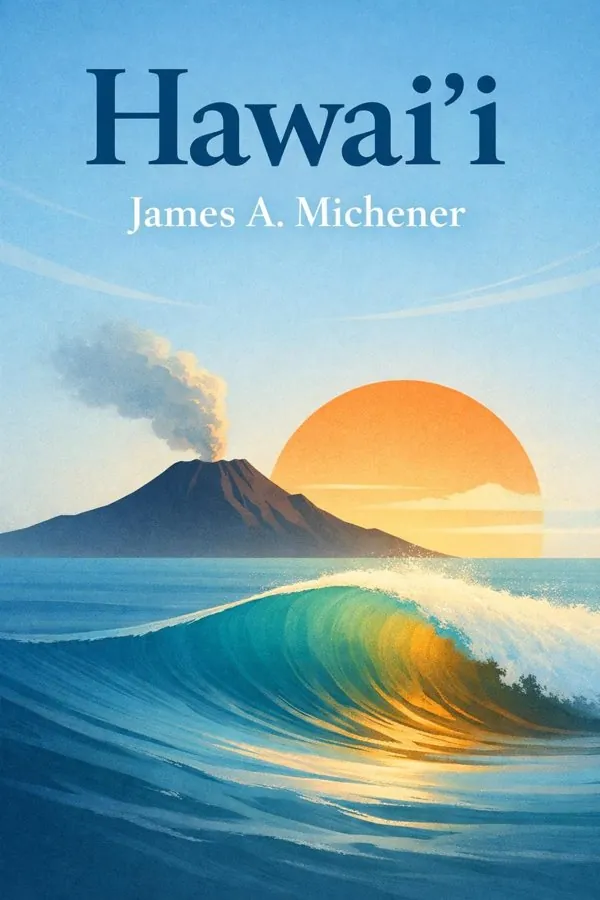
Hawai'i: Summary & Key Insights
 10 min10 chaptersAudio available
Key Takeaways from Hawai'i
Before any human society can exist, there must first be a stage on which history can unfold.
Civilizations often begin with acts of astonishing courage, and Michener presents the first Polynesian voyagers as among history’s boldest pioneers.
Every society creates rules to make the world meaningful, and in early Hawaiian life those rules were inseparable from the sacred.
When different worlds meet, transformation never moves in only one direction.
Good intentions do not guarantee good outcomes, and Michener uses the missionary presence in Hawaii to explore this difficult truth.
What Is Hawai'i About?
Hawai'i by James A. Michener is a world_history book spanning 7 pages. James A. Michener’s Hawai'i is far more than a historical novel about a tropical archipelago. It is an ambitious, panoramic reconstruction of how islands are born, how civilizations take root, and how identity is repeatedly remade under the pressure of migration, faith, commerce, and power. Beginning with the volcanic creation of the Hawaiian Islands and moving through the arrival of Polynesian voyagers, Christian missionaries, Asian laborers, American businessmen, and modern political forces, Michener turns Hawaii into a lens for understanding world history itself. The book matters because it refuses simple narratives. Hawaii is not portrayed as paradise alone, nor as tragedy alone, but as a place shaped by courage, exploitation, adaptation, and endurance. Michener’s authority lies in the signature strengths that made him one of the twentieth century’s best-known historical novelists: expansive research, strong narrative architecture, and an ability to make large historical processes feel intimate through individual lives. For readers interested in colonialism, cultural change, migration, and the making of modern societies, Hawai'i offers both a gripping story and a profound meditation on what it means to belong to a place.
This FizzRead summary covers all 10 key chapters of Hawai'i in approximately 10 minutes, distilling the most important ideas, arguments, and takeaways from James A. Michener's work. Also available as an audio summary and Key Quotes Podcast.
Hawai'i
James A. Michener’s Hawai'i is far more than a historical novel about a tropical archipelago. It is an ambitious, panoramic reconstruction of how islands are born, how civilizations take root, and how identity is repeatedly remade under the pressure of migration, faith, commerce, and power. Beginning with the volcanic creation of the Hawaiian Islands and moving through the arrival of Polynesian voyagers, Christian missionaries, Asian laborers, American businessmen, and modern political forces, Michener turns Hawaii into a lens for understanding world history itself. The book matters because it refuses simple narratives. Hawaii is not portrayed as paradise alone, nor as tragedy alone, but as a place shaped by courage, exploitation, adaptation, and endurance. Michener’s authority lies in the signature strengths that made him one of the twentieth century’s best-known historical novelists: expansive research, strong narrative architecture, and an ability to make large historical processes feel intimate through individual lives. For readers interested in colonialism, cultural change, migration, and the making of modern societies, Hawai'i offers both a gripping story and a profound meditation on what it means to belong to a place.
Who Should Read Hawai'i?
This book is perfect for anyone interested in world_history and looking to gain actionable insights in a short read. Whether you're a student, professional, or lifelong learner, the key ideas from Hawai'i by James A. Michener will help you think differently.
- ✓Readers who enjoy world_history and want practical takeaways
- ✓Professionals looking to apply new ideas to their work and life
- ✓Anyone who wants the core insights of Hawai'i in just 10 minutes
Want the full summary?
Get instant access to this book summary and 100K+ more with Fizz Moment.
Get Free SummaryAvailable on App Store • Free to download
Key Chapters
Before any human society can exist, there must first be a stage on which history can unfold. Michener begins Hawai'i with geology because he wants readers to see that the islands are not merely locations on a map but creations of immense natural force. Rising from volcanic eruptions on the ocean floor, the Hawaiian Islands emerge slowly, violently, and magnificently. This opening reframes the entire novel: human ambition, conflict, and culture are important, but they take place within a much longer story shaped by earth and sea.
By grounding the narrative in volcanic creation, Michener emphasizes humility. Kingdoms rise and fall, religions spread and recede, and economies boom and collapse, yet the islands themselves were formed through processes so ancient and powerful that human timelines seem brief by comparison. This perspective gives the novel unusual depth. Hawaii becomes not just a political or cultural territory, but a living environment that shapes every society that arrives there.
In practical terms, this idea reminds us that geography is never neutral. Fertile volcanic soil makes agriculture possible. Isolation creates both protection and vulnerability. Harsh seas limit contact while also rewarding extraordinary navigators. Even today, natural conditions continue to influence housing, tourism, conservation, and disaster planning across island communities.
Michener’s point extends beyond Hawaii. Every society is shaped by the land beneath it, whether through rivers, mountains, deserts, or coastlines. To understand a people, we must first understand their environment. Actionable takeaway: when studying any nation or culture, begin by asking how geography and natural history made its human story possible.
Civilizations often begin with acts of astonishing courage, and Michener presents the first Polynesian voyagers as among history’s boldest pioneers. Long before modern instruments, they crossed vast stretches of open Pacific Ocean using stars, currents, clouds, and memory. Their arrival in Hawaii was not an accident but the result of disciplined skill, communal knowledge, and spiritual confidence. By highlighting their navigational brilliance, Michener restores dignity to a people too often described by outsiders as primitive.
Once these voyagers reached the islands, survival required more than bravery. They had to transport plants, animals, customs, stories, and social systems across the sea, then adapt them to unfamiliar terrain. In Michener’s telling, settlement is both a feat of exploration and an act of cultural design. The early Hawaiians do not simply occupy land; they build a world. They establish religious practices, hierarchies, agricultural methods, and relationships to nature that define Hawaiian life for generations.
This idea matters because it challenges modern assumptions about progress and intelligence. Navigation without compasses, ecological management without industrial tools, and social coordination without written bureaucracies all demonstrate forms of sophistication that colonial narratives often ignored. Similar reassessments are valuable today when we evaluate indigenous knowledge, traditional medicine, or local environmental stewardship.
For readers, the lesson is practical as well as historical. Great achievements do not always depend on advanced technology; they often depend on deep observation, shared memory, and collective trust. Actionable takeaway: give more respect to accumulated cultural knowledge, especially in communities whose expertise has been overlooked by dominant historical narratives.
Every society creates rules to make the world meaningful, and in early Hawaiian life those rules were inseparable from the sacred. Michener explores the kapu system, priestly authority, ritual practice, and chiefly power not as exotic curiosities but as the organizing framework of a civilization. Through these institutions, the Hawaiians defined purity, power, gender roles, land use, and political legitimacy. Social order was maintained not only through force but through belief.
What makes this portrayal compelling is that Michener shows both the strength and the vulnerability of such a system. Sacred order can unify a people, provide moral clarity, and connect daily life to cosmic meaning. At the same time, rigid systems can become brittle when circumstances change. Drought, war, ambition, or foreign contact can expose tensions beneath the surface. The very beliefs that stabilize a community may also limit its flexibility.
This theme has broad relevance. Modern societies also rely on invisible systems of legitimacy, whether constitutional law, market confidence, religious values, or social norms. These frameworks feel permanent until crisis reveals how dependent they are on collective agreement. Organizations, families, and nations all function through shared assumptions that can either hold communities together or leave them fragile when tested.
Michener encourages readers to see culture as both inheritance and construction. Traditions deserve respect, but they should also be examined for how well they serve changing conditions. Actionable takeaway: identify the unwritten rules that shape your own community or workplace, and ask which ones create resilience and which ones may become obstacles during periods of change.
When different worlds meet, transformation never moves in only one direction. Michener’s account of first sustained contact between Hawaiians and Westerners avoids the simplistic idea that one side brought civilization while the other merely received it. Instead, he shows contact as a destabilizing exchange that reshaped everyone involved. Hawaiians encountered new goods, weapons, diseases, religions, and political pressures. Foreign sailors, traders, and settlers encountered a society whose sophistication, beauty, and complexity challenged their assumptions.
Yet this meeting was tragically unequal. Disease devastated native populations. Trade altered power balances. Missionaries brought literacy and moral discipline, but also condemnation of native customs. Western legal and economic systems gradually displaced indigenous structures. Michener captures the ambiguity of contact: some changes expanded possibility, while others destroyed worlds.
This idea remains highly relevant in our global age. Cross-cultural interaction can generate innovation, empathy, and mutual learning, but it can also produce extraction, misunderstanding, and domination when one side controls capital, weapons, or institutions. We see similar dynamics in modern development projects, tourism economies, digital platforms, and international business relationships.
The practical application is to resist romantic or triumphalist accounts of exchange. Whenever cultures meet, we should ask: Who benefits? Who bears the hidden costs? Which traditions are enriched, and which are erased? Michener’s greatest insight here is that contact is not a single event but an ongoing negotiation of power and identity. Actionable takeaway: when evaluating any cultural exchange, look beyond surface benefits and examine the deeper imbalances that may shape the relationship.
Good intentions do not guarantee good outcomes, and Michener uses the missionary presence in Hawaii to explore this difficult truth. The missionaries arrive with conviction, discipline, and a genuine belief that they are saving souls and improving lives. They bring literacy, formal education, new forms of family structure, and a written framework that helps preserve language and record history. In many respects, their labor is sincere and transformative.
But Michener refuses to present missionary influence as simple benevolence. Their moral certainty often leads them to dismiss Hawaiian beliefs, sexuality, ritual life, and social practices as sinful or inferior. In trying to reform society, they also help weaken indigenous authority and pave the way for broader Western domination. Their descendants and allies become increasingly entangled with land ownership, commerce, and political control. Spiritual mission gradually overlaps with social engineering and economic influence.
This theme offers an important lesson for modern institutions. Schools, charities, governments, and nonprofit organizations often enter communities believing they are bringing progress. Sometimes they do provide real benefits. But when reformers fail to respect local knowledge or recognize their own cultural assumptions, help can become control. The same pattern appears in international aid, urban redevelopment, and corporate philanthropy.
Michener’s treatment encourages moral self-examination. It is possible to act from principle and still participate in harm. The challenge is not to abandon values but to pair them with humility and listening. Actionable takeaway: before trying to improve a community, ask whether you truly understand its existing strengths, and whether your solution empowers local people or replaces them.
Economic growth often hides a complicated moral bill, and Michener shows this clearly through the rise of plantation Hawaii. As sugar transforms the islands, land, labor, and political influence become increasingly concentrated. Plantation agriculture creates immense wealth for owners and investors, links Hawaii more tightly to global markets, and accelerates infrastructure development. But this prosperity depends on a labor system built through inequality, coercion, and the strategic importation of workers from abroad.
Michener carefully traces how planters seek labor from China, Japan, the Philippines, Portugal, and elsewhere, creating a society that is both diverse and stratified. The plantations become engines of opportunity for some migrants, who escape poverty and build new family futures. At the same time, they impose exhausting work, social segregation, and limited autonomy. Hawaii’s multiculturalism, in this account, emerges not from abstract harmony but from an economic order that needed bodies and discipline.
The wider significance is enormous. Many modern societies celebrate diversity without fully confronting the labor systems that produced it. Agricultural empires, industrial cities, and service economies often depend on migrants while denying them equal status. Michener reveals how capitalism can generate both inclusion and exploitation at once.
This idea is useful today for understanding debates over immigration, labor rights, and supply chains. The products we consume often carry histories of invisible hardship. Actionable takeaway: whenever an economy appears prosperous, look closely at who performs the hardest work, who captures the profits, and whether the system gives workers a genuine path to dignity and security.
A nation’s character is often forged not by a single founding people, but by repeated waves of arrival. One of Michener’s most powerful contributions is his portrayal of Hawaii as a society continuously remade by immigrants. Chinese merchants, Japanese laborers, Korean workers, Portuguese families, Filipino migrants, and American newcomers all carry their customs, ambitions, resentments, and hopes into island life. Over time, Hawaii becomes neither purely native nor simply colonial, but a layered cultural mosaic.
Michener does not romanticize this process. Immigration creates misunderstanding, competition, and prejudice alongside adaptation and exchange. Different groups occupy different positions in the social hierarchy. Marriages, neighborhoods, work arrangements, and schools become sites where boundaries are tested and identities renegotiated. Yet out of these tensions emerges a distinctly Hawaiian pluralism, one in which food, language, faith, and family life reflect multiple inheritances.
This matters because many readers wrestle with the same question in their own societies: can diversity become belonging rather than fragmentation? Michener suggests that shared identity is not created by erasing difference but by living through conflict, necessity, and gradual mutual recognition. A common culture forms when people build everyday life together.
The practical lesson applies to cities, workplaces, and classrooms. Integration is not automatic. It requires institutions, patience, and a willingness to move beyond stereotypes. Communities become stronger when they create real interaction rather than symbolic coexistence. Actionable takeaway: engage seriously with the histories of the immigrant groups around you, because understanding how communities were formed is essential to building more inclusive institutions in the present.
Political sovereignty is rarely lost all at once; more often, it is eroded through a sequence of pressures that gradually narrow a nation’s freedom. In Michener’s account of the Hawaiian monarchy and annexation, the fall of the kingdom is not an inevitable historical transition but a struggle shaped by economic interests, foreign interference, internal division, and strategic calculation. Native rulers attempt modernization, diplomacy, and constitutional reform, yet they face opponents who increasingly treat Hawaii as an asset to be controlled rather than a nation to be respected.
What gives this section of the novel its force is the way Michener ties politics to everyday systems of influence. Land ownership, missionary descendants, plantation fortunes, and U.S. expansionism all converge. Legal arguments and moral rhetoric are used to justify outcomes driven largely by power. The loss of sovereignty becomes a lesson in how empires often operate: not always through dramatic conquest, but through commercial entanglement, elite alliances, and claims of stability or progress.
This theme remains strikingly contemporary. Small states today still navigate pressure from larger powers through trade dependence, military agreements, debt, and political interference. The forms have changed, but the structural problem endures: how can a community preserve self-determination when stronger actors define the terms of survival?
Michener’s deeper message is that political independence depends on more than symbolic leadership. It requires economic leverage, institutional strength, and broad unity. Actionable takeaway: when examining any political takeover or constitutional crisis, ask not just what was said publicly, but which interests controlled land, money, law, and international support behind the scenes.
War often modernizes societies at a terrible speed, and Michener shows how the twentieth century, especially through military conflict, reshaped Hawaii into a strategic center of the Pacific world. The islands become far more than a remote cultural crossroads; they are transformed into military infrastructure, transportation hubs, and symbols of American power. The Second World War, with Pearl Harbor as its defining shock, intensifies Hawaii’s integration into global politics and modern systems of communication, defense, and commerce.
This transformation brings contradictory effects. Military investment stimulates jobs, roads, ports, and urban growth. Hawaii gains visibility and importance within the United States. Yet the expansion of strategic significance also deepens federal control, alters local priorities, and reinforces the idea that the islands exist for purposes larger powers define. Traditional rhythms of life are disrupted by the demands of war and modernization.
Michener’s insight is that modernity is rarely a clean process of improvement. It brings mobility, income, and infrastructure, but also standardization, dependency, and cultural displacement. This dynamic can be observed in many regions where war, industrialization, or strategic development rapidly change social life. Progress is real, but so are the losses hidden behind it.
For contemporary readers, the lesson is to evaluate modernization in human terms rather than only economic ones. New roads, bases, or industries may increase output while undermining local autonomy or memory. Actionable takeaway: whenever a community is transformed by large-scale development or security concerns, assess both the visible gains and the less visible costs to culture, land, and self-determination.
The deepest question in Hawai'i is not who arrived first or who gained power, but what it means to belong after centuries of upheaval. Michener’s answer is nuanced: belonging in Hawaii is not static inheritance alone, nor can it be reduced to legal status or economic success. It emerges from relationship to land, respect for history, participation in shared life, and the ability of cultures to survive without disappearing. Native Hawaiian identity persists despite colonization, demographic change, and political loss, while newer communities also become woven into the islands’ social fabric.
This final idea gives the novel its emotional and philosophical weight. Michener does not deny the violence of dispossession, yet he also shows that cultures are not merely victims of history. They adapt, absorb, resist, and rearticulate themselves. Food, language, family ties, ceremony, memory, and local custom become vehicles of endurance. Hawaii’s identity is therefore not pure or frozen. It is resilient precisely because it has been tested.
This has obvious relevance far beyond the islands. Many individuals today live in mixed societies, diasporic families, or postcolonial nations where identity is layered rather than singular. Michener offers a way to think about belonging that avoids both rigid purity and shallow multicultural slogans. True belonging requires memory, reciprocity, and care.
The practical implication is personal as well as civic. To belong somewhere, one must do more than consume its beauty or claim its opportunities. One must learn its history and contribute responsibly to its future. Actionable takeaway: if you love a place, study the people who shaped it, honor what was lost, and participate in preserving what still endures.
All Chapters in Hawai'i
About the Author
James A. Michener (1907-1997) was an American novelist, essayist, and historian best known for his sweeping, meticulously researched historical epics. He rose to prominence with Tales of the South Pacific, which won the Pulitzer Prize for Fiction in 1948 and later inspired the famous musical South Pacific. Michener became known for novels that traced the development of entire regions or civilizations across centuries, including Hawai'i, Alaska, Centennial, Chesapeake, and The Source. His work combined accessible storytelling with serious historical inquiry, making complex social, political, and cultural change engaging for general readers. Beyond his literary career, Michener was also a public intellectual and philanthropist, donating substantial portions of his wealth to educational, cultural, and charitable institutions.
Get This Summary in Your Preferred Format
Read or listen to the Hawai'i summary by James A. Michener anytime, anywhere. FizzRead offers multiple formats so you can learn on your terms — all free.
Available formats: App · Audio · PDF · EPUB — All included free with FizzRead
Download Hawai'i PDF and EPUB Summary
Key Quotes from Hawai'i
“Before any human society can exist, there must first be a stage on which history can unfold.”
“Civilizations often begin with acts of astonishing courage, and Michener presents the first Polynesian voyagers as among history’s boldest pioneers.”
“Every society creates rules to make the world meaningful, and in early Hawaiian life those rules were inseparable from the sacred.”
“When different worlds meet, transformation never moves in only one direction.”
“Good intentions do not guarantee good outcomes, and Michener uses the missionary presence in Hawaii to explore this difficult truth.”
Frequently Asked Questions about Hawai'i
Hawai'i by James A. Michener is a world_history book that explores key ideas across 10 chapters. James A. Michener’s Hawai'i is far more than a historical novel about a tropical archipelago. It is an ambitious, panoramic reconstruction of how islands are born, how civilizations take root, and how identity is repeatedly remade under the pressure of migration, faith, commerce, and power. Beginning with the volcanic creation of the Hawaiian Islands and moving through the arrival of Polynesian voyagers, Christian missionaries, Asian laborers, American businessmen, and modern political forces, Michener turns Hawaii into a lens for understanding world history itself. The book matters because it refuses simple narratives. Hawaii is not portrayed as paradise alone, nor as tragedy alone, but as a place shaped by courage, exploitation, adaptation, and endurance. Michener’s authority lies in the signature strengths that made him one of the twentieth century’s best-known historical novelists: expansive research, strong narrative architecture, and an ability to make large historical processes feel intimate through individual lives. For readers interested in colonialism, cultural change, migration, and the making of modern societies, Hawai'i offers both a gripping story and a profound meditation on what it means to belong to a place.
More by James A. Michener
You Might Also Like
The Age of Capital
Eric Hobsbawm
10 min
The Gulag Archipelago
Aleksandr Solzhenitsyn
10 min
Jerusalem: The Biography
Simon Sebag Montefiore
10 min
The Anglo-Saxons
James Campbell
10 min
The Boer War
Thomas Pakenham
10 min
The Industrial Revolutionaries: The Making of the Modern World 1776–1914
Gavin Weightman
10 minBrowse by Category
Ready to read Hawai'i?
Get the full summary and 100K+ more books with Fizz Moment.