
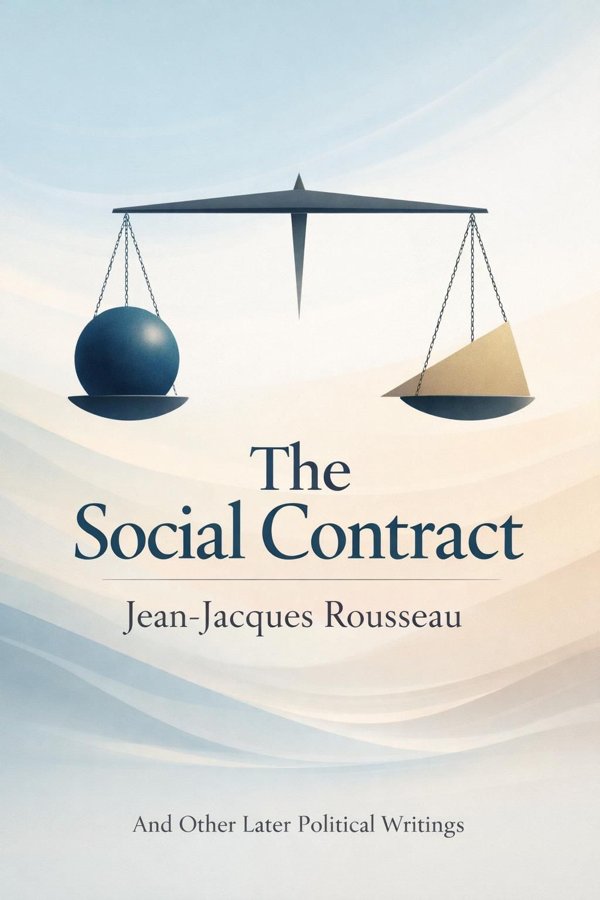
The Social Contract: And Other Later Political Writings: Summary & Key Insights
 10 min9 chaptersAudio available
Key Takeaways from The Social Contract: And Other Later Political Writings
A society becomes dangerous the moment it mistakes power for legitimacy.
Political community is not simply a crowd living near one another; it begins when individuals become a collective moral body.
The deepest challenge of politics is not how to count preferences, but how to distinguish private interests from the common good.
A government may administer the state, but it never owns sovereignty.
A true law does not target persons; it speaks in general terms to a whole people about matters affecting all.
What Is The Social Contract: And Other Later Political Writings About?
The Social Contract: And Other Later Political Writings by Jean-Jacques Rousseau is a western_phil book spanning 10 pages. Published in 1762, The Social Contract is Jean-Jacques Rousseau’s bold answer to one of political philosophy’s oldest questions: what makes power legitimate? Rousseau rejects the idea that force, tradition, or inherited privilege can create rightful authority. Instead, he argues that a political community is legitimate only when free and equal individuals agree to unite under laws they prescribe to themselves. From this argument emerges his most famous and controversial idea: the general will, the shared public will aimed at the common good. What makes this book endure is not just its historical influence, but its continuing relevance. Modern debates about democracy, citizenship, representation, inequality, civic identity, and the limits of government still turn on questions Rousseau helped define. He asks whether obedience can coexist with freedom, whether a people can remain sovereign after creating government, and how a state can preserve both unity and equality. Rousseau writes not as a detached technician of politics, but as a passionate moral thinker. His authority rests on the depth of his challenge: if political life is to be just, it must make citizens not merely subjects of power, but authors of the laws under which they live.
This FizzRead summary covers all 9 key chapters of The Social Contract: And Other Later Political Writings in approximately 10 minutes, distilling the most important ideas, arguments, and takeaways from Jean-Jacques Rousseau's work. Also available as an audio summary and Key Quotes Podcast.
The Social Contract: And Other Later Political Writings
Published in 1762, The Social Contract is Jean-Jacques Rousseau’s bold answer to one of political philosophy’s oldest questions: what makes power legitimate? Rousseau rejects the idea that force, tradition, or inherited privilege can create rightful authority. Instead, he argues that a political community is legitimate only when free and equal individuals agree to unite under laws they prescribe to themselves. From this argument emerges his most famous and controversial idea: the general will, the shared public will aimed at the common good.
What makes this book endure is not just its historical influence, but its continuing relevance. Modern debates about democracy, citizenship, representation, inequality, civic identity, and the limits of government still turn on questions Rousseau helped define. He asks whether obedience can coexist with freedom, whether a people can remain sovereign after creating government, and how a state can preserve both unity and equality.
Rousseau writes not as a detached technician of politics, but as a passionate moral thinker. His authority rests on the depth of his challenge: if political life is to be just, it must make citizens not merely subjects of power, but authors of the laws under which they live.
Who Should Read The Social Contract: And Other Later Political Writings?
This book is perfect for anyone interested in western_phil and looking to gain actionable insights in a short read. Whether you're a student, professional, or lifelong learner, the key ideas from The Social Contract: And Other Later Political Writings by Jean-Jacques Rousseau will help you think differently.
- ✓Readers who enjoy western_phil and want practical takeaways
- ✓Professionals looking to apply new ideas to their work and life
- ✓Anyone who wants the core insights of The Social Contract: And Other Later Political Writings in just 10 minutes
Want the full summary?
Get instant access to this book summary and 100K+ more with Fizz Moment.
Get Free SummaryAvailable on App Store • Free to download
Key Chapters
A society becomes dangerous the moment it mistakes power for legitimacy. Rousseau opens The Social Contract by attacking a comforting illusion that has justified empires, monarchies, and private domination for centuries: the idea that whoever can command has the right to rule. For him, force may produce obedience, but it can never produce obligation. If someone submits because they are threatened, they have yielded to necessity, not consent. The instant the coercive pressure disappears, so does the supposed duty to obey.
This distinction is foundational. Rousseau is not denying that governments can exercise power; he is denying that power alone explains why people ought to obey laws. A robber with a weapon can force you to hand over your money, but no one would say the robber has legitimate authority. Rousseau insists that political rule must be different in kind, not merely in scale. It must rest on a moral basis accepted by those subject to it.
The argument has clear contemporary relevance. A company manager may have the power to impose policies, but employees are more likely to see them as legitimate when rules are transparent, consistently applied, and tied to shared purposes. A state may enforce emergency measures, but lasting legitimacy depends on public justification and lawful process, not only on police capacity. Even in families or classrooms, authority works best when it is recognized as rightful rather than merely feared.
Rousseau’s point is a warning against cynicism. If we assume politics is only organized domination, then justice disappears from view. But if we ask what would make authority rightful, we begin to separate mere control from legitimate rule.
Actionable takeaway: Whenever you encounter authority, ask not just who has power, but what gives that power a moral claim to obedience.
The deepest challenge of politics is not how to count preferences, but how to distinguish private interests from the common good. Rousseau’s concept of the general will is his answer. The general will is not simply whatever most people happen to want at a given moment. Nor is it the sum of all personal desires. It is the collective will directed toward what benefits the political community as a whole.
This distinction matters because people often vote, argue, and organize around partial interests. A wealthy faction may want lower taxes that shift burdens onto the poor. A regional bloc may pursue advantages that harm national cohesion. A temporary majority may support measures that undermine equal citizenship. In such cases, the “will of all” exists as an aggregate of private preferences, but the general will is absent because the decision does not aim at the common good.
Rousseau is not naive about this difficulty. He knows citizens can be misled by factions, propaganda, vanity, or ignorance. That is why institutions and civic culture matter. Public deliberation should help people think not only as consumers, workers, or group members, but as citizens asking what justice requires for all. A good example is public health policy. Individuals may dislike taxes that fund universal healthcare or sanitation systems, but when citizens consider the welfare and stability of the entire community, they may recognize such measures as expressions of the common good.
The idea remains provocative because it asks more of democracy than preference satisfaction. It asks citizens to rise above narrow interest. For Rousseau, freedom in political life requires this moral discipline; otherwise democracy becomes merely a struggle among factions.
Actionable takeaway: When evaluating a public issue, deliberately separate what benefits you personally from what would fairly benefit the community as a whole.
A government may administer the state, but it never owns sovereignty. Rousseau draws a sharp line between the sovereign and the government, and this distinction is one of his most important contributions to democratic thought. The sovereign is the people acting collectively through the general will. Government, by contrast, is only the executive agent charged with carrying out laws and managing public affairs.
This means sovereignty cannot be alienated, transferred, or represented in the full sense. A king cannot legitimately possess it. An elite assembly cannot permanently absorb it. Even elected officials do not become sovereign simply because citizens voted for them. Representatives may administer, interpret, and implement, but the fundamental authority to legislate for the political body remains with the people. Rousseau fears that once citizens treat government as the true source of authority, they become passive subjects rather than active members of a republic.
Modern democracies still wrestle with this issue. Elections can create the illusion that political participation ends once ballots are cast. But Rousseau would warn that when public life is reduced to occasional voting while policy is dominated by bureaucracies, parties, courts, donors, or executive power, sovereignty drifts away from the people. Civic disengagement then becomes both a cause and a symptom of political decline.
The distinction also helps explain why constitutional limits, referendums, public accountability, and civic participation matter. If government is an agent rather than a master, it must remain answerable to the public. A city council, for example, is legitimate not because officials are superior, but because they operate under authority delegated by citizens and constrained by law.
Rousseau’s point is demanding: a free people cannot simply have rulers; it must remain the author of its political order.
Actionable takeaway: Treat elected institutions as instruments of public sovereignty, and stay engaged after elections through scrutiny, participation, and civic oversight.
A true law does not target persons; it speaks in general terms to a whole people about matters affecting all. Rousseau insists that law is legitimate only when it is general in both source and object. It must arise from the sovereign people, and it must apply broadly rather than serving private interests, personal grudges, or special privileges.
This principle is crucial because it separates law from decree. A decree might appoint a specific official, punish a named individual, or grant a private exemption. Such acts may be necessary in administration, but they are not laws in the strict sense Rousseau cares about. Law, properly understood, establishes the framework within which all citizens relate as equals. It embodies public reason rather than favoritism.
The practical implications are significant. Consider tax systems: a law designed with clear, general criteria that apply equally across citizens is more consistent with Rousseau’s ideal than one filled with loopholes benefiting politically connected groups. Or think about criminal justice: rules that are publicly known and generally applied command more legitimacy than selective enforcement aimed at disfavored communities. Even workplace policies reflect the same logic. Standards gain acceptance when they are transparent, general, and not invented to punish particular employees.
Rousseau’s emphasis on generality also helps preserve liberty. If rulers can shape laws around particular persons or factions, everyone lives under uncertainty, vulnerable to arbitrary treatment. General laws create a space where citizens know the rules and stand equal before them.
This idea still underlies modern rule-of-law ideals. Citizens may disagree about what laws should say, but legitimacy requires that laws be public, impersonal, and directed toward common conditions rather than private advantage.
Actionable takeaway: Support rules and institutions that are transparent, general, and equally applied, and be wary of policies tailored to reward friends or punish enemies.
No political form is self-sustaining; every government contains vulnerabilities that can pull it away from the public good. Rousseau analyzes monarchy, aristocracy, and democracy not as abstract labels alone, but as practical arrangements with characteristic strengths and dangers. He is skeptical that any single form suits all peoples equally. Geography, size, customs, wealth, and civic habits all influence which institutions may function best.
Monarchy can be efficient, but it concentrates power dangerously and tempts rulers to confuse private interest with public welfare. Aristocracy, especially in an elective form, may offer competence and deliberation, but it risks becoming oligarchic and self-serving. Direct democracy most fully reflects popular sovereignty, yet Rousseau doubts that it is workable except in small, relatively simple states where citizens can assemble and deliberate effectively. His famous realism appears here: good political design must fit actual circumstances, not just ideals.
Yet his broader warning is even more important. Governments naturally tend to expand their own power. Executives seek independence from the people, administrators accumulate discretion, and officeholders develop interests separate from the public. Over time, the machinery created to serve the sovereign may begin to dominate it. This is political decay.
Modern examples are everywhere: agencies that become insulated from public accountability, parties that prioritize their survival over civic trust, or leaders who justify emergency powers long after emergencies pass. Rousseau reminds us that institutional design matters, but vigilance matters more. Even a well-constructed system can deteriorate if citizens cease to monitor it.
His analysis remains relevant because it combines flexibility with suspicion. Political forms should be judged by how well they preserve liberty, equality, and public control, not by ideological slogans.
Actionable takeaway: Judge governments not by their labels, but by whether their institutions remain accountable and prevent power from hardening into self-serving rule.
A free people may be sovereign, but it often needs guidance in learning how to become one. Rousseau introduces the figure of the legislator to explain this paradox. The legislator is not a ruler who commands by force, nor a sovereign who replaces the people’s will. Rather, this extraordinary founder helps shape institutions, customs, and laws so that a people can recognize and pursue its common good.
This role is delicate and almost paradoxical. The legislator must understand human passions, social conditions, history, and moral psychology. He must design institutions that fit the people rather than impose abstract schemes. Yet because legitimacy belongs to the people, the legislator cannot simply dictate. He proposes, frames, educates, and inspires; the people must ultimately assent.
Rousseau uses this concept to acknowledge that political communities do not spring fully formed from a contract. Citizens need civic education, symbols, habits, and institutions that make public-mindedness possible. Founding is therefore both constitutional and cultural. A written charter alone is not enough. A society also needs practices that teach citizens to value equality, participation, and the common good.
In modern terms, the “legislator” may be distributed across constitutional framers, reformers, judges, educators, civil society leaders, and public intellectuals. For example, a nation emerging from dictatorship may need not only elections, but careful constitutional design, truth commissions, new civic rituals, and educational reform to sustain democratic life. Similarly, an organization undergoing reform may need leaders who can redesign incentives and culture, not just rewrite formal rules.
Rousseau’s lesson is that institutions succeed only when they resonate with the character and conditions of the people who live under them. Political architecture requires moral imagination.
Actionable takeaway: When building or reforming institutions, focus not only on formal rules, but on the civic habits and shared values people will need to make those rules work.
Every political community depends on shared beliefs, but those beliefs can either support freedom or destroy it. Rousseau’s discussion of civil religion is one of the most controversial parts of The Social Contract. He argues that states need a minimal public creed: not a detailed theology, but a set of civic sentiments that bind citizens to the laws and to one another. These include commitment to justice, the sanctity of the social contract, and loyalty to the political community.
Rousseau is responding to a real problem. A state can possess laws and institutions yet still fracture if citizens lack any moral attachment to the common order. If people view public life only as a marketplace of interests, civic solidarity weakens. On the other hand, when religious institutions claim authority superior to the civil order, divided loyalties can threaten political unity. Rousseau therefore seeks a middle path: a civil faith compatible with tolerance but strong enough to sustain citizenship.
Today, civil religion can be understood more broadly as civic culture. Constitutional patriotism, public remembrance, national ceremonies, shared commitments to rights, or respect for democratic norms all play a similar role. The best versions unite diverse people without requiring uniformity of private belief. The worst versions become nationalism, exclusion, or ideological conformity.
A practical example is the way societies commemorate founding events or civic tragedies. Such rituals can reinforce a sense of shared fate and mutual obligation. But if they are used to silence dissent or stigmatize minorities, they betray Rousseau’s larger aim of a cohesive yet free political community.
His enduring insight is that law alone cannot hold a republic together. Citizens also need shared moral commitments that make public duty meaningful.
Actionable takeaway: Help strengthen civic life by supporting inclusive public values and rituals that unite people around justice, responsibility, and democratic belonging.
The central paradox of Rousseau’s political philosophy is also its greatest challenge: genuine freedom is not doing whatever one happens to want, but living under laws one has prescribed to oneself as a member of the sovereign people. This claim can sound restrictive at first, yet Rousseau believes it solves the problem of social life. In nature, individuals may have independence, but they lack security, moral equality, and stable justice. Civil freedom arises when each person participates in a lawful order that protects all while expressing the general will.
Rousseau distinguishes natural liberty from civil and moral liberty. Natural liberty is simply the power to pursue one’s desires within one’s strength. Civil liberty is the freedom secured by law within a political community. Moral liberty is deeper still: it is self-mastery, the condition in which a person is not enslaved to impulse or domination, but acts according to principles they can rationally endorse. In this sense, freedom is inseparable from citizenship.
This idea has practical implications beyond politics. In personal life, people often experience rules not as constraints but as conditions of freedom. A musician practices discipline to gain artistic command. A team agrees to procedures so collaboration becomes possible. A democratic workplace follows shared rules so no one is subject to arbitrary favoritism. Structure, when collectively justified, can enhance rather than diminish freedom.
Of course, Rousseau’s formulation has been criticized because rulers may falsely claim to know what people “really” will. That danger is real. But Rousseau’s ideal remains powerful when tied to genuine participation, equality, and common legislation.
Actionable takeaway: Redefine freedom not as escape from all restraint, but as participation in fair rules that you and others could reasonably recognize as your own.
All Chapters in The Social Contract: And Other Later Political Writings
About the Author
Jean-Jacques Rousseau (1712–1778) was a Genevan-born philosopher, writer, and composer whose work reshaped modern political and moral thought. Though often associated with the Enlightenment, he stood apart from many of his contemporaries by emphasizing the moral costs of inequality, social corruption, and artificial refinement. His major works include Discourse on the Origin of Inequality, Émile, and The Social Contract, each of which explores how human beings are formed by society and how freedom might be preserved within it. Rousseau’s ideas influenced the French Revolution, democratic theory, educational philosophy, and later romanticism. He remains one of the most debated thinkers in Western philosophy because he linked politics to questions of virtue, identity, and collective self-rule with unusual force and originality.
Get This Summary in Your Preferred Format
Read or listen to the The Social Contract: And Other Later Political Writings summary by Jean-Jacques Rousseau anytime, anywhere. FizzRead offers multiple formats so you can learn on your terms — all free.
Available formats: App · Audio · PDF · EPUB — All included free with FizzRead
Download The Social Contract: And Other Later Political Writings PDF and EPUB Summary
Key Quotes from The Social Contract: And Other Later Political Writings
“A society becomes dangerous the moment it mistakes power for legitimacy.”
“Political community is not simply a crowd living near one another; it begins when individuals become a collective moral body.”
“The deepest challenge of politics is not how to count preferences, but how to distinguish private interests from the common good.”
“A government may administer the state, but it never owns sovereignty.”
“A true law does not target persons; it speaks in general terms to a whole people about matters affecting all.”
Frequently Asked Questions about The Social Contract: And Other Later Political Writings
The Social Contract: And Other Later Political Writings by Jean-Jacques Rousseau is a western_phil book that explores key ideas across 9 chapters. Published in 1762, The Social Contract is Jean-Jacques Rousseau’s bold answer to one of political philosophy’s oldest questions: what makes power legitimate? Rousseau rejects the idea that force, tradition, or inherited privilege can create rightful authority. Instead, he argues that a political community is legitimate only when free and equal individuals agree to unite under laws they prescribe to themselves. From this argument emerges his most famous and controversial idea: the general will, the shared public will aimed at the common good. What makes this book endure is not just its historical influence, but its continuing relevance. Modern debates about democracy, citizenship, representation, inequality, civic identity, and the limits of government still turn on questions Rousseau helped define. He asks whether obedience can coexist with freedom, whether a people can remain sovereign after creating government, and how a state can preserve both unity and equality. Rousseau writes not as a detached technician of politics, but as a passionate moral thinker. His authority rests on the depth of his challenge: if political life is to be just, it must make citizens not merely subjects of power, but authors of the laws under which they live.
More by Jean-Jacques Rousseau

You Might Also Like
A Little History of Philosophy
Nigel Warburton
10 min
Areopagitica
John Milton
10 min
How To Think Like A Philosopher: Essential Principles For Clear Thinking
Peter Cave
10 min
Language, Truth and Logic
A. J. Ayer
10 min
The Age of Reason
Thomas Paine
10 min
The Essays
Michel De Montaigne
10 minBrowse by Category
Ready to read The Social Contract: And Other Later Political Writings?
Get the full summary and 100K+ more books with Fizz Moment.