
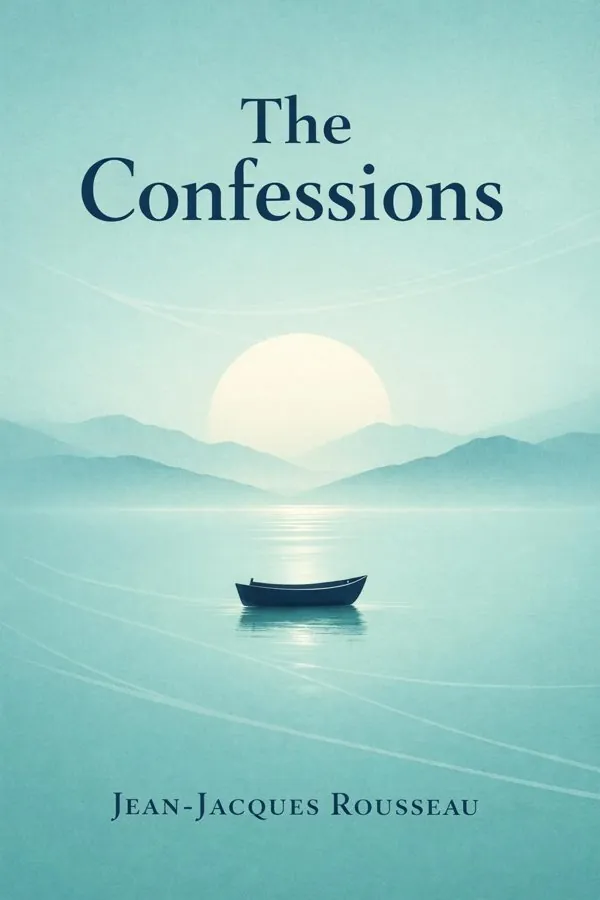
The Confessions: Summary & Key Insights
 10 min7 chaptersAudio available
What Is The Confessions About?
The Confessions by Jean-Jacques Rousseau is a classics book spanning 7 pages. The Confessions is the autobiographical work of Jean-Jacques Rousseau, written between 1765 and 1770. In this deeply introspective text, Rousseau recounts his life from his childhood in Geneva to his mature years, revealing his thoughts, faults, and emotions with unprecedented honesty. The work is considered a foundational text of modern autobiography, exploring human nature, society, and the pursuit of personal truth.
This FizzRead summary covers all 7 key chapters of The Confessions in approximately 10 minutes, distilling the most important ideas, arguments, and takeaways from Jean-Jacques Rousseau's work. Also available as an audio summary and Key Quotes Podcast.
The Confessions
The Confessions is the autobiographical work of Jean-Jacques Rousseau, written between 1765 and 1770. In this deeply introspective text, Rousseau recounts his life from his childhood in Geneva to his mature years, revealing his thoughts, faults, and emotions with unprecedented honesty. The work is considered a foundational text of modern autobiography, exploring human nature, society, and the pursuit of personal truth.
Who Should Read The Confessions?
This book is perfect for anyone interested in classics and looking to gain actionable insights in a short read. Whether you're a student, professional, or lifelong learner, the key ideas from The Confessions by Jean-Jacques Rousseau will help you think differently.
- ✓Readers who enjoy classics and want practical takeaways
- ✓Professionals looking to apply new ideas to their work and life
- ✓Anyone who wants the core insights of The Confessions in just 10 minutes
Want the full summary?
Get instant access to this book summary and 100K+ more with Fizz Moment.
Get Free SummaryAvailable on App Store • Free to download
Key Chapters
I was born in Geneva in 1712, and my first breath was a sigh over my mother’s grave. She died bringing me into the world, and this origin marked my existence with a sense of loss and longing that would never leave me. My father, a watchmaker, tried to fill that absence with love and imagination. Nights we spent reading together—Plutarch, romances, adventures—were my true education. These readings awakened in me a taste for virtue and heroism but also an excess of sensitivity, for I lived more in the world of feeling than of prudence.
Geneva, with its republican rigor and austere faith, was a soil that nourished liberty, yet the boy I was found there little tenderness. Discipline, punishment, the cruelty of masters—all assaulted my desire for understanding and affection. My apprenticeship to an engraver, intended to straighten my character, became a school of humiliation and rebellion. The injustice of punishment without cause ignited in me an instinctive revolt against authority that reason later confirmed. When I fled Geneva at sixteen, it was not mere boyish mischief—it was a declaration of independence. I was seeking a world where kindness might coexist with virtue.
My flight brought me into the orbit of Madame de Warens, the woman who became both a mother and a lover, a benefactress and a challenge to my conscience. Her house at Annecy was a sanctuary where my heart, bruised by rejection, found warmth. Under her care, I converted to Catholicism—an act less of conviction than of gratitude, but it opened before me new horizons of thought and sentiment. She awakened in me the capacity to admire wisdom through gentleness and to associate faith with tenderness rather than dogma.
Yet what seemed maternal gradually became amorous. In Madame de Warens, I discovered that love can elevate and enslave at once. Our bond was pure in intention but fraught in consequence. Through her, I learned that affection may educate the heart more profoundly than argument ever could. She encouraged my love of nature, of music, of contemplation—all seeds that would later blossom in my philosophy. Still, this period of contentment was shadowed by dependence. My passion, once spiritual, became possessive; the more I adored her, the less I belonged to myself. To confess this is to admit that even the noblest attachment can conceal self-deception.
+ 5 more chapters — available in the FizzRead app
All Chapters in The Confessions
About the Author
Jean-Jacques Rousseau (1712–1778) was a Genevan philosopher, writer, and composer, and one of the most influential figures of the Enlightenment. His works, including The Social Contract and Emile, or On Education, profoundly shaped political philosophy, pedagogy, and literature. His exploration of human nature and individual freedom left a lasting mark on Western thought.
Get This Summary in Your Preferred Format
Read or listen to the The Confessions summary by Jean-Jacques Rousseau anytime, anywhere. FizzRead offers multiple formats so you can learn on your terms — all free.
Available formats: App · Audio · PDF · EPUB — All included free with FizzRead
Download The Confessions PDF and EPUB Summary
Key Quotes from The Confessions
“I was born in Geneva in 1712, and my first breath was a sigh over my mother’s grave.”
“My flight brought me into the orbit of Madame de Warens, the woman who became both a mother and a lover, a benefactress and a challenge to my conscience.”
Frequently Asked Questions about The Confessions
The Confessions by Jean-Jacques Rousseau is a classics book that explores key ideas across 7 chapters. The Confessions is the autobiographical work of Jean-Jacques Rousseau, written between 1765 and 1770. In this deeply introspective text, Rousseau recounts his life from his childhood in Geneva to his mature years, revealing his thoughts, faults, and emotions with unprecedented honesty. The work is considered a foundational text of modern autobiography, exploring human nature, society, and the pursuit of personal truth.
More by Jean-Jacques Rousseau
You Might Also Like
Browse by Category
Ready to read The Confessions?
Get the full summary and 100K+ more books with Fizz Moment.