
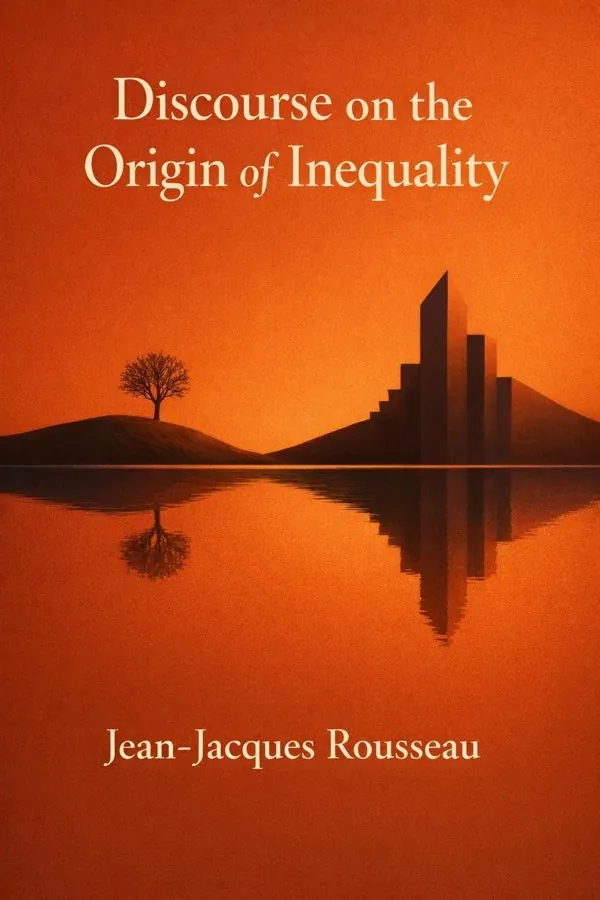
Discourse on the Origin of Inequality: Summary & Key Insights
 10 min9 chaptersAudio available
Key Takeaways from Discourse on the Origin of Inequality
To understand inequality, Rousseau insists, we must first imagine human beings before they were shaped by society.
Long before formal ethics, laws, or religion tell us how to behave, Rousseau believes human beings possess a natural aversion to the suffering of others.
Human complexity did not appear all at once; Rousseau presents it as a slow unfolding.
One of Rousseau’s most enduring insights is that human misery increases when we stop simply being and start measuring ourselves against others.
With this image, Rousseau does not mean that all ownership is literally fraudulent.
What Is Discourse on the Origin of Inequality About?
Discourse on the Origin of Inequality by Jean-Jacques Rousseau is a western_phil book spanning 4 pages. First published in 1755, Discourse on the Origin of Inequality is Jean-Jacques Rousseau’s bold attempt to explain how human beings moved from a relatively free and independent condition into a deeply unequal social order. Rather than writing a conventional history, Rousseau constructs a philosophical genealogy: he asks what humans may have been like before laws, property, status, and organized society reshaped their desires and relationships. His central distinction between natural inequality and moral or political inequality remains one of the most influential ideas in modern thought. Natural differences, such as strength, age, or health, are limited; social inequality, by contrast, is built through convention, comparison, and power. The book matters because it challenges one of civilization’s favorite assumptions—that progress automatically improves human life. Rousseau argues that refinement, wealth, and institutions often produce dependence, vanity, and domination instead of freedom. A major Enlightenment thinker and author of The Social Contract and Emile, Rousseau writes here with philosophical daring and moral urgency. This work is essential for anyone interested in justice, politics, modern society, and the hidden costs of civilization.
This FizzRead summary covers all 9 key chapters of Discourse on the Origin of Inequality in approximately 10 minutes, distilling the most important ideas, arguments, and takeaways from Jean-Jacques Rousseau's work. Also available as an audio summary and Key Quotes Podcast.
Discourse on the Origin of Inequality
First published in 1755, Discourse on the Origin of Inequality is Jean-Jacques Rousseau’s bold attempt to explain how human beings moved from a relatively free and independent condition into a deeply unequal social order. Rather than writing a conventional history, Rousseau constructs a philosophical genealogy: he asks what humans may have been like before laws, property, status, and organized society reshaped their desires and relationships. His central distinction between natural inequality and moral or political inequality remains one of the most influential ideas in modern thought. Natural differences, such as strength, age, or health, are limited; social inequality, by contrast, is built through convention, comparison, and power. The book matters because it challenges one of civilization’s favorite assumptions—that progress automatically improves human life. Rousseau argues that refinement, wealth, and institutions often produce dependence, vanity, and domination instead of freedom. A major Enlightenment thinker and author of The Social Contract and Emile, Rousseau writes here with philosophical daring and moral urgency. This work is essential for anyone interested in justice, politics, modern society, and the hidden costs of civilization.
Who Should Read Discourse on the Origin of Inequality?
This book is perfect for anyone interested in western_phil and looking to gain actionable insights in a short read. Whether you're a student, professional, or lifelong learner, the key ideas from Discourse on the Origin of Inequality by Jean-Jacques Rousseau will help you think differently.
- ✓Readers who enjoy western_phil and want practical takeaways
- ✓Professionals looking to apply new ideas to their work and life
- ✓Anyone who wants the core insights of Discourse on the Origin of Inequality in just 10 minutes
Want the full summary?
Get instant access to this book summary and 100K+ more with Fizz Moment.
Get Free SummaryAvailable on App Store • Free to download
Key Chapters
To understand inequality, Rousseau insists, we must first imagine human beings before they were shaped by society. This is the book’s most provocative move: instead of assuming that people are naturally political, competitive, or ambitious, Rousseau asks what humans might be like in a pre-social condition. His “natural man” is not a noble hero or a savage brute. He is solitary, physically capable, driven by simple needs, and guided by two basic impulses: self-preservation and pity. He does not seek domination because he lacks the social framework that makes domination meaningful. He does not obsess over reputation because no audience exists to flatter or judge him.
Rousseau’s state of nature is not a literal historical report. It is a philosophical tool used to strip away customs and institutions so we can see which human tendencies are original and which are socially produced. In this state, natural inequalities exist—some people may be stronger, faster, or healthier than others—but these differences carry limited social consequences. Since there is little accumulation, no private property, and few durable relationships, one person’s advantage rarely becomes another’s subordination.
This idea remains useful today. Many behaviors we treat as “just human nature”—status anxiety, endless comparison, aggressive competition—may actually be products of social systems. Consider social media: it does not merely display vanity; it structures it, rewarding visibility, comparison, and image management. Rousseau would say such habits reveal not human essence but social conditioning.
Actionable takeaway: when judging yourself or others, ask whether a trait is truly natural or whether it has been amplified by institutions, incentives, and comparison.
Long before formal ethics, laws, or religion tell us how to behave, Rousseau believes human beings possess a natural aversion to the suffering of others. This feeling, which he calls pity or compassion, is one of the foundations of his anthropology. It challenges the view that humans are naturally cruel egoists who can only be restrained by force or rational morality. For Rousseau, the earliest human is not virtuous in the civilized sense, but neither is he vicious. He simply recoils from unnecessary harm when he encounters another vulnerable creature.
This matters because Rousseau roots morality less in abstract reasoning than in lived feeling. Before people become sophisticated enough to justify domination with theories, they are capable of a spontaneous sympathy that moderates self-interest. In the state of nature, self-love is basic and limited: one seeks one’s own preservation without needing to humiliate others. Pity keeps that instinct from becoming brutal.
In modern life, we often assume that better arguments produce better conduct. Rousseau reminds us that institutions can sharpen intelligence while dulling compassion. A society may become more technically advanced yet less humane if it rewards indifference, bureaucracy, or competition. Think of workplaces where efficiency metrics matter more than people’s exhaustion, or public debates where winning an argument matters more than understanding another person’s pain.
Rousseau is not saying feeling alone is sufficient for justice. Rather, he warns that a morality detached from compassion becomes cold and performative. The healthiest moral life combines self-concern with an unwillingness to exploit others.
Actionable takeaway: strengthen your moral judgment by paying attention not only to principles, but also to whether your choices preserve your capacity for empathy.
Rousseau’s most famous claim may also be his most explosive: the true founder of civil society was the first person who enclosed land, declared “this is mine,” and found others willing to believe him. With this image, Rousseau does not mean that all ownership is literally fraudulent. He means that private property marks a civilizational turning point. Once land, resources, and goods can be stably claimed, protected, inherited, and accumulated, human differences become institutionalized. Temporary advantages harden into lasting hierarchies.
Property changes everything. It creates incentives for labor, planning, and cooperation, but it also creates scarcity in a new sense—not merely the scarcity of nature, but the scarcity produced by exclusion. When one person owns what another needs, dependence follows. Wealth allows some to command time, effort, and obedience from others. The rich can secure comfort and influence; the poor must submit, bargain, or struggle. Inequality becomes structural rather than incidental.
Rousseau’s insight extends beyond land. In modern societies, property includes capital, housing, intellectual assets, and access to networks. Consider urban housing markets: when ownership concentrates, shelter becomes not just a need but a lever of power. Or think of digital platforms, where the ownership of infrastructure shapes who can earn, speak, or compete. Property is never merely material; it organizes social possibility.
Rousseau is not giving a technical economic theory. He is exposing the moral shift by which convention is naturalized. Once property exists, people begin to treat socially constructed inequalities as if they were inevitable facts.
Actionable takeaway: whenever you encounter inequality, ask not only who has more, but what rules of ownership and exclusion made that distribution possible.
Inequality does not emerge only because some possess more. It grows because social life becomes organized around mutual dependence under unequal terms. As agriculture and metallurgy develop in Rousseau’s account, humans no longer live by simple, direct relations to nature. They specialize, exchange, and rely on one another’s work. This increases productivity, but it also traps people in webs of necessity. The blacksmith needs the farmer, the farmer needs tools, the laborer needs access to land, and everyone becomes more vulnerable to interruption, debt, and domination.
Division of labor can improve living standards, but Rousseau wants us to see its political cost. When your survival depends on social arrangements you do not control, freedom becomes conditional. The wealthy may appear more civilized, but their comfort often rests on the constrained labor of others. Meanwhile, the poor are compelled to work not only for subsistence but for the maintenance of a social order that disadvantages them.
This speaks directly to modern economies. Many people today have legal freedom yet little practical independence. A worker may technically choose among employers, but crushing rents, healthcare costs, or debt can make that “choice” narrow and coercive. Gig work, precarious contracts, and constant availability can create a polished form of dependence hidden beneath the language of flexibility.
Rousseau does not propose a return to primitive isolation. His point is diagnostic: societies often celebrate refinement while ignoring the unequal dependencies refinement produces. Progress can mask servitude.
Actionable takeaway: assess your own work and institutions by a deeper standard than efficiency—ask whether they increase genuine independence or merely reorganize dependence in more sophisticated forms.
One of Rousseau’s sharpest arguments is that political institutions often arise not to eliminate inequality, but to stabilize it. As conflicts over property intensify, the wealthy face a problem: how can they preserve their advantages without constant violence? Their solution is ingenious. They propose laws, courts, and political order in the name of peace and common safety. The poor, exhausted by insecurity and persuaded by promises of protection, consent. In this way, inequality is legalized and domination gains moral legitimacy.
Rousseau’s target is not law as such. He is exposing how law can function ideologically. Institutions present themselves as neutral guardians of everyone’s interests while quietly preserving the conditions that benefit the powerful. The result is a deception more effective than force alone, because the dominated participate in their own subordination. They believe they are entering a fair agreement when in fact the terms have already been shaped against them.
This remains an unsettling lens for modern politics. Rules about taxation, housing, voting access, labor classification, education, and policing often appear universal while producing highly unequal effects. A policy can be formally equal yet substantively biased if it assumes resources, time, or security that only some citizens possess. Rousseau teaches us to ask who benefits from a legal arrangement and whose vulnerabilities it disguises.
His analysis also anticipates later critiques of ideology: power is strongest when it is normalized, proceduralized, and framed as common sense. Political order can be both necessary and corrupting.
Actionable takeaway: when evaluating laws and institutions, look beyond their stated purpose and examine whose interests they consolidate, whose risks they reduce, and whose burdens they leave intact.
Rousseau’s criticism of civilization is not that culture, science, or politeness are worthless. It is that they often beautify corruption instead of curing it. As societies become more refined, people learn manners, rhetoric, taste, and etiquette. They appear more humane. Yet beneath this polish, Rousseau sees increasing hypocrisy. Individuals conceal their motives, flatter for advantage, and treat reputation as a form of currency. Civilization trains people to seem virtuous before it makes them virtuous.
This is one of Rousseau’s most uncomfortable lessons: improvement in appearance can coincide with decline in character. A society may have elegant art, advanced institutions, and sophisticated public discourse while still being driven by envy, domination, and vanity. The issue is not refinement itself but the social incentives that shape it. When social standing depends on performance, sincerity becomes costly.
Modern examples are everywhere. Corporations promote values while exploiting workers. Public figures speak of authenticity while carefully managing brands. Even personal relationships can become strategic, curated for display rather than grounded in mutual honesty. Rousseau would say civilization often multiplies masks. We become experts at signaling goodness while remaining dependent on approval.
Yet this critique is not pure pessimism. It calls us back to integrity. Rousseau values forms of life in which actions track real needs and sentiments more closely, where simplicity reduces the gap between what people are and what they pretend to be.
Actionable takeaway: choose one area of life—work, friendship, public identity—where you can reduce performance and increase sincerity, even at the cost of looking less impressive.
All Chapters in Discourse on the Origin of Inequality
About the Author
Jean-Jacques Rousseau (1712–1778) was a Genevan-born philosopher, writer, and composer whose ideas reshaped modern political, educational, and moral thought. Though associated with the Enlightenment, he often challenged its confidence in progress, arguing that civilization could corrupt as much as it improved. His major works include Discourse on the Origin of Inequality, The Social Contract, Emile, and Confessions. Rousseau explored questions of freedom, human nature, education, authenticity, and the legitimacy of political authority. His writings influenced the French Revolution, democratic theory, romantic literature, and later critiques of modern society. What makes Rousseau enduring is his ability to expose the hidden tensions between social advancement and human flourishing, asking whether wealth, culture, and institutions truly make people better—or simply more dependent.
Get This Summary in Your Preferred Format
Read or listen to the Discourse on the Origin of Inequality summary by Jean-Jacques Rousseau anytime, anywhere. FizzRead offers multiple formats so you can learn on your terms — all free.
Available formats: App · Audio · PDF · EPUB — All included free with FizzRead
Download Discourse on the Origin of Inequality PDF and EPUB Summary
Key Quotes from Discourse on the Origin of Inequality
“To understand inequality, Rousseau insists, we must first imagine human beings before they were shaped by society.”
“Long before formal ethics, laws, or religion tell us how to behave, Rousseau believes human beings possess a natural aversion to the suffering of others.”
“Human complexity did not appear all at once; Rousseau presents it as a slow unfolding.”
“One of Rousseau’s most enduring insights is that human misery increases when we stop simply being and start measuring ourselves against others.”
“Rousseau’s most famous claim may also be his most explosive: the true founder of civil society was the first person who enclosed land, declared “this is mine,” and found others willing to believe him.”
Frequently Asked Questions about Discourse on the Origin of Inequality
Discourse on the Origin of Inequality by Jean-Jacques Rousseau is a western_phil book that explores key ideas across 9 chapters. First published in 1755, Discourse on the Origin of Inequality is Jean-Jacques Rousseau’s bold attempt to explain how human beings moved from a relatively free and independent condition into a deeply unequal social order. Rather than writing a conventional history, Rousseau constructs a philosophical genealogy: he asks what humans may have been like before laws, property, status, and organized society reshaped their desires and relationships. His central distinction between natural inequality and moral or political inequality remains one of the most influential ideas in modern thought. Natural differences, such as strength, age, or health, are limited; social inequality, by contrast, is built through convention, comparison, and power. The book matters because it challenges one of civilization’s favorite assumptions—that progress automatically improves human life. Rousseau argues that refinement, wealth, and institutions often produce dependence, vanity, and domination instead of freedom. A major Enlightenment thinker and author of The Social Contract and Emile, Rousseau writes here with philosophical daring and moral urgency. This work is essential for anyone interested in justice, politics, modern society, and the hidden costs of civilization.
More by Jean-Jacques Rousseau
You Might Also Like
A Little History of Philosophy
Nigel Warburton
10 min
Areopagitica
John Milton
10 min
How To Think Like A Philosopher: Essential Principles For Clear Thinking
Peter Cave
10 min
Language, Truth and Logic
A. J. Ayer
10 min
The Age of Reason
Thomas Paine
10 min
The Essays
Michel De Montaigne
10 minBrowse by Category
Ready to read Discourse on the Origin of Inequality?
Get the full summary and 100K+ more books with Fizz Moment.