
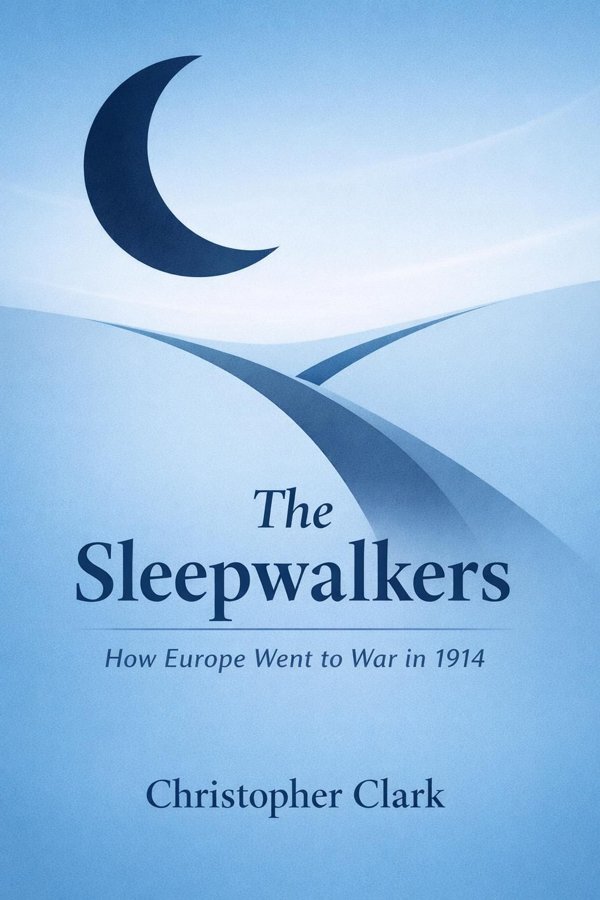
The Sleepwalkers: How Europe Went to War in 1914: Summary & Key Insights
 10 min10 chapters
Key Takeaways from The Sleepwalkers: How Europe Went to War in 1914
A common mistake in hindsight is to imagine pre-1914 Europe as a decaying old order simply waiting to collapse.
Great wars often begin at the margins rather than the center.
Empires do not need to be militarily weak to feel politically fragile.
Power does not eliminate anxiety; it can intensify it.
Alliances are designed to create security, but they can also multiply danger.
What Is The Sleepwalkers: How Europe Went to War in 1914 About?
The Sleepwalkers: How Europe Went to War in 1914 by Christopher Clark is a world_history book spanning 10 pages. Christopher Clark’s The Sleepwalkers: How Europe Went to War in 1914 is one of the most influential modern histories of the origins of the First World War. Rather than retelling a familiar story in which one nation bears sole responsibility, Clark reconstructs the tangled chain of crises, alliances, fears, ambitions, and errors that pushed Europe into catastrophe. His central insight is unsettling: the war was not inevitable, and it was not simply engineered by a single villain. It emerged from choices made by leaders across Europe who acted with purpose, yet without grasping the full consequences of their actions. The book matters because it challenges simplified moral narratives and replaces them with a sharper, more realistic view of how complex systems collapse. Clark moves from the unstable politics of the Balkans to the corridors of power in Vienna, Berlin, St. Petersburg, Paris, and London, revealing how local violence became a continental disaster. As a distinguished historian of modern Europe and a leading scholar of German and Prussian history, Clark brings exceptional authority, balance, and narrative power to the subject. The result is a gripping study of diplomacy, miscalculation, and political blindness that still feels urgently relevant.
This FizzRead summary covers all 10 key chapters of The Sleepwalkers: How Europe Went to War in 1914 in approximately 10 minutes, distilling the most important ideas, arguments, and takeaways from Christopher Clark's work.
The Sleepwalkers: How Europe Went to War in 1914
Christopher Clark’s The Sleepwalkers: How Europe Went to War in 1914 is one of the most influential modern histories of the origins of the First World War. Rather than retelling a familiar story in which one nation bears sole responsibility, Clark reconstructs the tangled chain of crises, alliances, fears, ambitions, and errors that pushed Europe into catastrophe. His central insight is unsettling: the war was not inevitable, and it was not simply engineered by a single villain. It emerged from choices made by leaders across Europe who acted with purpose, yet without grasping the full consequences of their actions.
The book matters because it challenges simplified moral narratives and replaces them with a sharper, more realistic view of how complex systems collapse. Clark moves from the unstable politics of the Balkans to the corridors of power in Vienna, Berlin, St. Petersburg, Paris, and London, revealing how local violence became a continental disaster. As a distinguished historian of modern Europe and a leading scholar of German and Prussian history, Clark brings exceptional authority, balance, and narrative power to the subject. The result is a gripping study of diplomacy, miscalculation, and political blindness that still feels urgently relevant.
Who Should Read The Sleepwalkers: How Europe Went to War in 1914?
This book is perfect for anyone interested in world_history and looking to gain actionable insights in a short read. Whether you're a student, professional, or lifelong learner, the key ideas from The Sleepwalkers: How Europe Went to War in 1914 by Christopher Clark will help you think differently.
- ✓Readers who enjoy world_history and want practical takeaways
- ✓Professionals looking to apply new ideas to their work and life
- ✓Anyone who wants the core insights of The Sleepwalkers: How Europe Went to War in 1914 in just 10 minutes
Want the full summary?
Get instant access to this book summary and 100K+ more with Fizz Moment.
Get Free SummaryAvailable on App Store • Free to download
Key Chapters
A common mistake in hindsight is to imagine pre-1914 Europe as a decaying old order simply waiting to collapse. Clark insists on the opposite: Europe was vibrant, innovative, wealthy, and politically alive. Industrial growth, technological change, mass politics, imperial competition, and cultural confidence gave the continent enormous energy. That matters because it means the war did not arise from a civilization already dead on its feet. It erupted from a world that still believed in progress.
Clark shows that this was a Europe of expanding newspapers, growing electorates, railway networks, and increasingly assertive states. Leaders did not think they were sleepwalking in the ordinary sense of drifting passively. They believed they were managing pressures within modern political systems. Public opinion mattered more than before, nationalism was becoming a mass force, and strategic planning had grown more rigid. The result was a dangerous combination: modern states with powerful administrative tools, but political elites still accustomed to private bargaining, prestige politics, and limited crisis management.
A practical lesson follows from this historical setting. Crises often emerge not from obviously broken systems, but from high-functioning ones under strain. Organizations, governments, and even companies can appear confident and successful right up to the moment when hidden tensions align. Strong economies and advanced institutions do not eliminate the risk of catastrophic decisions.
When evaluating any major crisis, resist stories that portray collapse as inevitable. Look instead at the active choices made within a seemingly stable system. The actionable takeaway: whenever a system looks prosperous and resilient, ask what pressures are building beneath the surface and who is assuming they can control them.
Great wars often begin at the margins rather than the center. In Clark’s account, the Balkans were not a mere prelude to the real story but the place where Europe’s larger rivalries became explosive. Serbia, emboldened after the Balkan Wars, emerged as both a rising regional power and a magnet for South Slav nationalism. Its ambitions frightened Austria-Hungary, inspired radicals, and complicated the calculations of Russia, which saw itself as Serbia’s protector.
Clark pays close attention to the internal complexity of Serbia. It was not a unified strategic actor but a state in which official institutions overlapped with nationalist networks, military factions, and covert actors. Groups such as the Black Hand operated in a gray zone between patriotism, conspiracy, and terror. This blurred line between state policy and unofficial violence made the region exceptionally dangerous. Austro-Hungarian leaders could plausibly see Serbia as a direct threat, even when the Serbian government itself was divided and not fully in control.
The Balkans also mattered because they exposed how local conflicts can trigger wider commitments. A regional dispute involving border changes, ethnic claims, or political assassinations can pull in larger powers if prestige, alliances, and strategic access are at stake. Modern parallels are easy to find: peripheral conflicts can escalate rapidly when outside powers view them as tests of credibility.
Clark’s treatment reminds readers to take small states seriously. They are not simply pawns in great power games; they can drive events, exploit rivalries, and alter the strategic landscape. The actionable takeaway: in any international conflict, pay close attention to regional actors, domestic factions, and unofficial networks, because the spark often comes from places larger powers misunderstand.
Empires do not need to be militarily weak to feel politically fragile. One of Clark’s most important revisions is his portrait of Austria-Hungary as a state haunted by internal vulnerability. The Habsburg monarchy was not just a tired relic; it was a complex multinational empire trying to govern competing identities, languages, interests, and constitutional arrangements. Its leaders worried that Serbian nationalism threatened not merely prestige abroad but cohesion at home.
This fear shaped Vienna’s response to the assassination of Archduke Franz Ferdinand. Austrian policymakers did not see Serbia only as a troublesome neighbor. They saw it as the center of a movement capable of destabilizing their own South Slav populations. In that sense, the conflict was existential. What looks irrational from a distance can become understandable when viewed through the lens of regime survival. Clark does not excuse Austria-Hungary’s decisions, but he explains why its leaders considered a hard line necessary.
The empire’s internal complexity also made decisive policy harder. Different officials, ministers, and military figures interpreted the threat differently, and delay could coexist with aggressiveness. This is a recurring feature of large institutions: fragmentation can produce both hesitation and overreaction. The fear of appearing weak often pushes leaders toward high-risk choices.
The broader application is clear. Organizations under internal stress often externalize their anxieties. A company facing internal competition may launch a reckless strategic move; a government facing domestic pressure may take a confrontational stance abroad. To understand behavior, examine internal insecurity as closely as external threats.
The actionable takeaway: when a leader seems to overreact to an outside challenge, ask what domestic vulnerabilities make the issue feel non-negotiable. Internal fragility often drives external escalation.
Power does not eliminate anxiety; it can intensify it. Clark presents Imperial Germany not as a cartoon aggressor with a single master plan, but as a formidable state trapped between ambition, encirclement fears, alliance obligations, and strategic impatience. Germany’s leaders believed time might be working against them. Russia was modernizing, France was aligned with Russia, and Britain’s relationship with Germany had deteriorated. Under those conditions, a future conflict could appear more dangerous than a present one.
This helps explain Berlin’s fateful support for Austria-Hungary during the July Crisis. The so-called “blank cheque” was not simply casual recklessness. It reflected Germany’s desire to preserve its only reliable great-power ally, avoid diplomatic humiliation, and maintain strategic initiative. Yet those aims were pursued through assumptions that proved disastrously optimistic. German leaders expected a localized war or a manageable crisis, not a general European conflagration.
Clark also emphasizes the role of military planning. Once mobilization timetables and war scenarios dominate political thinking, leaders begin to interpret diplomacy through the lens of operational necessity. Planning becomes a trap. What was meant to provide security narrows room for maneuver and makes delay seem dangerous.
The practical lesson extends beyond military history. Highly capable organizations can become prisoners of their own models. When leaders trust plans more than changing reality, they confuse preparedness with wisdom. Strategic sophistication can produce rigidity.
The actionable takeaway: whenever institutions rely on elaborate contingency plans, ask whether those plans leave space for adaptation. The more powerful an organization is, the more carefully it must guard against acting from fear, haste, and overconfidence at the same time.
Alliances are designed to create security, but they can also multiply danger. Clark shows how France and Russia, often treated as reacting powers rather than initiating ones, were essential to the logic of escalation in 1914. Russia saw itself as protector of Serbia and as a great power whose prestige had already suffered in previous crises. France, bound to Russia by alliance and eager not to stand isolated against Germany, had strong reasons to support its partner.
Neither state simply stumbled along passively. Russian decision-makers were influenced by strategic fears, domestic politics, military planning, and a sense that backing down again would weaken their status in the Balkans and beyond. French leaders, meanwhile, understood that alliance credibility mattered. If Russia could not trust France in a crisis, the European balance would shift dramatically. In this way, the alliance system turned support into a test of national reliability.
Clark’s analysis is especially powerful because it avoids moral simplification. He does not argue that France and Russia “caused” the war in the conventional sense. He shows instead that their choices mattered at every stage. Mobilization decisions, diplomatic signaling, and expectations about enemy intentions all fed a cycle in which each actor believed firmness was defensive.
This is highly relevant to modern politics and business. Partnerships create obligations that can limit flexibility. A firm may feel compelled to support a risky subsidiary; a state may endorse an ally more forcefully than prudence recommends. Commitments intended to deter conflict can become mechanisms of entrapment.
The actionable takeaway: treat every alliance, partnership, or long-term commitment as both a source of strength and a potential escalation pathway. Before a crisis arrives, clarify what support actually means and where the limits are.
History often remembers a dramatic event and forgets the system that gave it force. The assassination of Archduke Franz Ferdinand in Sarajevo was shocking, but Clark shows that its significance lay in how political actors interpreted and used it. Gavrilo Princip’s bullets did not mechanically produce world war. They struck a Europe already primed by alliance tensions, nationalist fears, strategic plans, and unresolved Balkan disputes.
Clark carefully reconstructs the assassination plot and the murky connections between Serbian nationalist networks and elements within the Serbian state. This detail matters because it reveals how terrorism and state weakness can destabilize international politics. The assassination became more than a crime; it became evidence, symbol, provocation, and diplomatic weapon. For Austria-Hungary, it was proof that Serbia had to be confronted. For Germany, it was a moment to support an ally. For Russia, it raised the question of whether Austria intended to crush Serbia outright.
The broader insight is that catalytic events derive their meaning from political context. A terrorist attack, border incident, cyber breach, or assassination does not speak for itself. Leaders, institutions, and publics construct its significance through narratives of blame, honor, deterrence, and necessity. Those narratives then shape what seems possible.
This has practical value today. After any shocking event, the most important questions are not only what happened, but how the event is framed, who gains authority to define it, and which preexisting agendas are activated. Emotional clarity can coexist with strategic confusion.
The actionable takeaway: when a crisis begins with a dramatic incident, do not stop at the event itself. Examine the networks behind it, the interests shaping its interpretation, and the larger system that turns a spark into an inferno.
The most chilling part of Clark’s book is the July Crisis itself: a month in which diplomats, monarchs, generals, and ministers made consequential choices under pressure, uncertainty, and mutual suspicion. Clark’s great achievement is to restore contingency to this period. War did not unfold automatically. At multiple moments, different decisions might have slowed or redirected events. Yet the structure of the crisis made wise choices increasingly difficult.
Austria-Hungary delayed, then issued an ultimatum designed to be severe. Germany encouraged firmness while hoping for localization. Russia hesitated but moved toward mobilization to avoid another humiliating retreat. France supported Russia. Britain searched for mediation but struggled to impose clarity. Each government believed it was responding to danger; each step taken for security intensified danger for others. Timing became critical. Delays looked suspicious, mobilization looked aggressive, and compromise looked like weakness.
Clark’s portrayal of the July Crisis is a master class in how complex systems produce escalation. No single actor controlled the whole picture. Information was incomplete, communication was inconsistent, and decisions were shaped by emotion, prestige, and institutional routines. A chain reaction emerged from overlapping rationalities rather than universal madness.
The practical application is broad. In any fast-moving crisis, leaders need mechanisms that slow tempo, improve shared information, and preserve off-ramps. Without them, organizations become trapped in action-forcing sequences where every move reduces future choices.
The actionable takeaway: in moments of high tension, create pause points. Build procedures that force reassessment before irreversible steps are taken, because speed and seriousness are not the same thing.
One reason the crisis spiraled was that Europe’s capitals were not reading the same script. Clark shows that Paris, London, and St. Petersburg interpreted the unfolding events through different strategic cultures, priorities, and assumptions. The same diplomatic move could appear defensive in one capital, provocative in another, and ambiguous in a third. These mismatched perceptions magnified the danger.
In St. Petersburg, the issue was bound up with status, Balkan influence, and fear that Austria-Hungary, backed by Germany, would crush Serbia and weaken Russian credibility. In Paris, alliance management and the broader balance against Germany were central. In London, policymakers were less tightly bound by continental commitments and more divided internally, but they increasingly viewed the crisis through the lens of European equilibrium and the threat posed by a German victory. Britain’s ambiguity, meanwhile, may have encouraged false assumptions elsewhere about whether it would intervene.
Clark’s point is not simply that states disagreed. It is that their disagreement was structured by institutions, history, and expectations. Leaders rarely act on raw facts; they act on interpreted realities. This is true in diplomacy, corporate strategy, and even personal conflict. People often assume they are reacting to the same situation when they are actually inhabiting different narratives.
A practical example is any multilateral negotiation where each side believes it is being clear while others hear something else. Ambiguity can preserve flexibility in the short term but generate disaster when stakes rise.
The actionable takeaway: when managing a conflict, do not assume others interpret signals as you do. Test assumptions explicitly. Ask how your actions are likely to be decoded in other decision-making environments.
Clark’s epilogue carries the book beyond 1914 and into a broader warning about political modernity. The leaders of Europe were not unconscious; they were alert, active, and often intelligent. Yet they moved through a landscape they did not fully understand, guided by assumptions that felt reasonable inside their own institutions. That is what makes them “sleepwalkers.” The term captures not passivity but limited awareness within systems of enormous consequence.
The enduring relevance of the book lies here. Today’s world also contains alliance chains, regional flashpoints, nationalist emotion, media pressure, opaque networks, and technologies that compress decision time. Governments still face the temptation to signal resolve, preserve credibility, and rely on rigid plans. Publics still demand certainty where none exists. The mechanisms differ, but the pattern is familiar: complexity breeds overconfidence, and overconfidence accelerates commitment.
Clark’s history therefore works as a guide to modern risk. It encourages readers to think less in terms of evil masterminds and more in terms of interaction, misperception, procedural momentum, and institutional blindness. In practical settings, this applies to foreign policy, crisis management, business strategy, and leadership under pressure. Catastrophe often arrives through perfectly explainable steps that no one adequately challenges.
The book’s deepest lesson is moral as well as analytical. Serious leaders must cultivate historical imagination: the ability to see how one’s own certainties may appear from outside and what chain reactions they might unleash.
The actionable takeaway: practice structured doubt. In any high-stakes decision, ask what you may be missing, which assumptions feel safest, and how your next move could trigger responses you do not intend.
All Chapters in The Sleepwalkers: How Europe Went to War in 1914
About the Author
Christopher Clark is a British historian renowned for his work on modern European history, particularly Germany and Prussia. He has served as Professor of Modern European History at the University of Cambridge and is widely respected for combining deep archival research with clear, elegant narrative. Clark first gained broad recognition with Iron Kingdom: The Rise and Downfall of Prussia, 1600–1947, a major study of the Prussian state and its legacy. In The Sleepwalkers, he brought that same rigor to one of history’s most contested questions: how Europe went to war in 1914. His scholarship is noted for its balance, independence, and willingness to challenge orthodox interpretations. Rather than offering easy blame or neat moral conclusions, Clark excels at revealing the complexity of political decision-making in moments of crisis.
Get This Summary in Your Preferred Format
Read or listen to the The Sleepwalkers: How Europe Went to War in 1914 summary by Christopher Clark anytime, anywhere. FizzRead offers multiple formats so you can learn on your terms — all free.
Available formats: App · Audio · PDF · EPUB — All included free with FizzRead
Download The Sleepwalkers: How Europe Went to War in 1914 PDF and EPUB Summary
Key Quotes from The Sleepwalkers: How Europe Went to War in 1914
“A common mistake in hindsight is to imagine pre-1914 Europe as a decaying old order simply waiting to collapse.”
“Great wars often begin at the margins rather than the center.”
“Empires do not need to be militarily weak to feel politically fragile.”
“Power does not eliminate anxiety; it can intensify it.”
“Alliances are designed to create security, but they can also multiply danger.”
Frequently Asked Questions about The Sleepwalkers: How Europe Went to War in 1914
The Sleepwalkers: How Europe Went to War in 1914 by Christopher Clark is a world_history book that explores key ideas across 10 chapters. Christopher Clark’s The Sleepwalkers: How Europe Went to War in 1914 is one of the most influential modern histories of the origins of the First World War. Rather than retelling a familiar story in which one nation bears sole responsibility, Clark reconstructs the tangled chain of crises, alliances, fears, ambitions, and errors that pushed Europe into catastrophe. His central insight is unsettling: the war was not inevitable, and it was not simply engineered by a single villain. It emerged from choices made by leaders across Europe who acted with purpose, yet without grasping the full consequences of their actions. The book matters because it challenges simplified moral narratives and replaces them with a sharper, more realistic view of how complex systems collapse. Clark moves from the unstable politics of the Balkans to the corridors of power in Vienna, Berlin, St. Petersburg, Paris, and London, revealing how local violence became a continental disaster. As a distinguished historian of modern Europe and a leading scholar of German and Prussian history, Clark brings exceptional authority, balance, and narrative power to the subject. The result is a gripping study of diplomacy, miscalculation, and political blindness that still feels urgently relevant.
You Might Also Like
The Age of Capital
Eric Hobsbawm
10 min
The Gulag Archipelago
Aleksandr Solzhenitsyn
10 min
Jerusalem: The Biography
Simon Sebag Montefiore
10 min
The Anglo-Saxons
James Campbell
10 min
The Boer War
Thomas Pakenham
10 min
The Industrial Revolutionaries: The Making of the Modern World 1776–1914
Gavin Weightman
10 minBrowse by Category
Ready to read The Sleepwalkers: How Europe Went to War in 1914?
Get the full summary and 100K+ more books with Fizz Moment.