
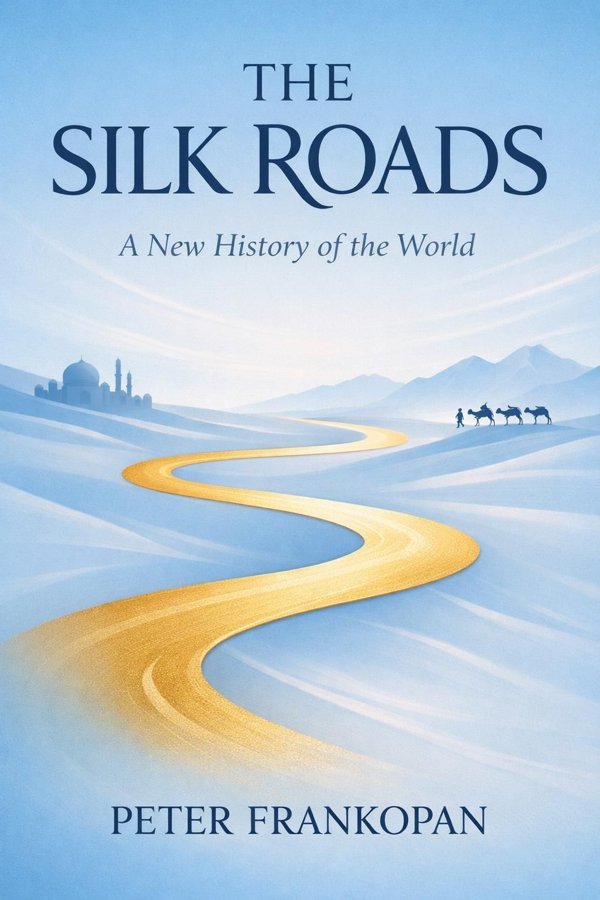
The Silk Roads: A New History of the World: Summary & Key Insights
 10 min9 chaptersAudio available
Key Takeaways from The Silk Roads: A New History of the World
History often begins where textbooks choose to look, and Frankopan asks us to look east.
Buddhism spread from India into Central Asia and China.
Empires are often remembered for battles and kings, but Frankopan shows that their deeper logic was control over exchange.
Spices, textiles, precious metals, knowledge, and luxury goods from Asia and the Islamic world created enormous incentives for Europeans to find direct access to eastern markets.
One of the most powerful themes in The Silk Roads is that global history is a story of redirected circulation.
What Is The Silk Roads: A New History of the World About?
The Silk Roads: A New History of the World by Peter Frankopan is a world_history book spanning 12 pages. The Silk Roads: A New History of the World is a bold retelling of global history that shifts the spotlight away from Europe and places Central Asia, Persia, the Middle East, and the great trading corridors between East and West at the center of the human story. Peter Frankopan argues that the regions linking China, India, the Mediterranean, and the Islamic world were not peripheral backwaters, but the true heart of civilization for much of history. Across these routes traveled not only silk, silver, spices, and slaves, but also religions, technologies, diseases, armies, and ideas that transformed entire societies. What makes this book so compelling is its ability to reframe familiar events—from the rise of empires and the Crusades to colonial expansion, oil politics, and modern globalization—through a different map. Frankopan shows that power has long flowed through networks of exchange, and that the struggle to control those networks has shaped the world more than national myths often admit. As a historian and Oxford professor of global history, Frankopan brings deep scholarship and a panoramic perspective, making this an essential book for anyone who wants to understand how the modern world was really made.
This FizzRead summary covers all 9 key chapters of The Silk Roads: A New History of the World in approximately 10 minutes, distilling the most important ideas, arguments, and takeaways from Peter Frankopan's work. Also available as an audio summary and Key Quotes Podcast.
The Silk Roads: A New History of the World
The Silk Roads: A New History of the World is a bold retelling of global history that shifts the spotlight away from Europe and places Central Asia, Persia, the Middle East, and the great trading corridors between East and West at the center of the human story. Peter Frankopan argues that the regions linking China, India, the Mediterranean, and the Islamic world were not peripheral backwaters, but the true heart of civilization for much of history. Across these routes traveled not only silk, silver, spices, and slaves, but also religions, technologies, diseases, armies, and ideas that transformed entire societies.
What makes this book so compelling is its ability to reframe familiar events—from the rise of empires and the Crusades to colonial expansion, oil politics, and modern globalization—through a different map. Frankopan shows that power has long flowed through networks of exchange, and that the struggle to control those networks has shaped the world more than national myths often admit. As a historian and Oxford professor of global history, Frankopan brings deep scholarship and a panoramic perspective, making this an essential book for anyone who wants to understand how the modern world was really made.
Who Should Read The Silk Roads: A New History of the World?
This book is perfect for anyone interested in world_history and looking to gain actionable insights in a short read. Whether you're a student, professional, or lifelong learner, the key ideas from The Silk Roads: A New History of the World by Peter Frankopan will help you think differently.
- ✓Readers who enjoy world_history and want practical takeaways
- ✓Professionals looking to apply new ideas to their work and life
- ✓Anyone who wants the core insights of The Silk Roads: A New History of the World in just 10 minutes
Want the full summary?
Get instant access to this book summary and 100K+ more with Fizz Moment.
Get Free SummaryAvailable on App Store • Free to download
Key Chapters
History often begins where textbooks choose to look, and Frankopan asks us to look east. Instead of starting with Greece or Rome as the obvious cradle of world civilization, he begins with Persia, which he presents as one of the first great powers to bind vast territories into a functioning imperial system. The Persian Empire did not merely conquer; it connected. Through roads, administrative systems, shared languages, taxation, and relative religious tolerance, it created a model for managing diversity across huge distances.
This matters because it changes how we think about the foundations of globalization. The Persian world linked the Mediterranean to Central Asia and beyond, making movement possible for merchants, officials, ideas, and armies. Infrastructure was power. Roads allowed goods to circulate faster, but they also allowed rulers to gather intelligence, levy taxes, and project authority. Frankopan shows that the story of world history is not just about military victories; it is also about who creates the networks everyone else depends on.
A practical way to apply this idea is to think of modern power in similar terms. Today, the equivalent of imperial roads might be ports, fiber-optic cables, payment systems, shipping lanes, and energy pipelines. The societies that shape these systems often influence the world far beyond what their size alone suggests.
Actionable takeaway: when studying any era, ask not only who ruled, but who built and controlled the routes, systems, and institutions that connected people across distance.
Goods rarely travel alone. One of Frankopan’s most important insights is that the Silk Roads were never just commercial highways; they were cultural arteries through which religions, languages, artistic forms, and intellectual traditions moved. Buddhism spread from India into Central Asia and China. Christianity expanded through eastern communities as well as western ones. Islam moved rapidly across trading networks, building not only spiritual communities but legal, scholarly, and commercial worlds.
This broader vision helps explain why trade mattered so much. Merchants, monks, pilgrims, scholars, and diplomats were all participants in the same larger system. A caravan carrying silk might also carry manuscripts, stories, rituals, and scientific knowledge. As these met local traditions, they were adapted rather than simply copied. The result was not one-way influence, but constant exchange.
Frankopan’s perspective encourages readers to see cultural identity as historically interconnected rather than sealed off. Many traditions that later appear ancient and “pure” were shaped through contact. Even conflict often accelerated exchange, as conquerors borrowed from the people they ruled and defeated societies absorbed foreign practices.
In practical terms, this idea is useful when interpreting today’s debates about globalization and identity. Cultural mixing is not a modern anomaly; it is a longstanding condition of human history. Recognizing that can soften simplistic narratives about civilizations being isolated or self-made.
Actionable takeaway: whenever you encounter a religion, language, or cultural tradition, look for the routes of contact that helped shape it rather than assuming it developed in isolation.
Empires are often remembered for battles and kings, but Frankopan shows that their deeper logic was control over exchange. From Alexander’s campaigns to Roman ambitions, from Arab expansion to Mongol dominance, the most successful powers understood that wealth and influence flowed through strategic corridors. To command crossroads was to command taxation, diplomacy, military movement, and access to distant resources.
This helps explain why regions in Central Asia and the Middle East were so frequently contested. They were not marginal spaces between “real” civilizations; they were the meeting points that made civilizations rich and influential. Frankopan highlights how imperial competition often centered on cities, caravan routes, and fertile commercial zones rather than abstract ideology alone. Political authority followed economic geography.
The Mongols are a strong example. Though often remembered primarily for destruction, they also enabled long-distance trade and relative security across Eurasia. Their rule made it easier for goods, travelers, and knowledge to move from China to Europe. This did not make conquest benign, but it does show how empire could simultaneously devastate and integrate.
The lesson reaches into the present. Major powers still compete over chokepoints, logistics hubs, maritime passages, and strategic regions rich in resources or transit value. The language may now be about development, security, or investment, but the underlying logic remains familiar.
Actionable takeaway: to understand why a region becomes a geopolitical flashpoint, examine its role in larger networks of trade, transport, energy, and communication rather than looking only at borders or ideology.
The story of the West often presents Europe’s rise as the natural outcome of internal superiority, but Frankopan offers a more unsettling interpretation: Europe’s ascent was inseparable from its long dependence on, and pursuit of, the riches of the East. Spices, textiles, precious metals, knowledge, and luxury goods from Asia and the Islamic world created enormous incentives for Europeans to find direct access to eastern markets. Exploration was not simply curiosity; it was commercial urgency.
This reframing casts the so-called Age of Discovery in a new light. Voyages by Portuguese and Spanish sailors were driven by the desire to bypass intermediaries and tap directly into existing networks of wealth. Europe was entering a world already deeply connected, not inventing connection from scratch. Oceanic expansion shifted routes and eventually redistributed power, but it did so by redirecting older patterns of exchange centered further east.
Frankopan’s argument is useful because it prevents triumphalist history. It reminds us that rising powers are often borrowers before they become leaders. Europe learned, adapted, copied, financed, and competed within systems whose core had long existed elsewhere.
In modern terms, this resembles how emerging companies or nations grow by integrating into established networks before reshaping them. Success often depends less on isolated genius than on strategic access to flows of capital, knowledge, and supply.
Actionable takeaway: when evaluating the rise of any power, look beyond its internal achievements and ask what external networks, borrowed resources, and preexisting systems made that rise possible.
One of the most powerful themes in The Silk Roads is that global history is a story of redirected circulation. As European empires expanded, they did not merely add new territories to the map; they reorganized how wealth, labor, and resources moved around the world. Colonialism shifted the balance of power by controlling production zones, sea routes, extraction systems, and captive markets. The result was not just empire overseas, but a transformation of the world economy.
Frankopan places colonial competition in a broader Eurasian context. Rather than seeing imperialism as a purely European drama, he shows how it was tied to the decline, disruption, or subordination of older centers in Asia and the Middle East. Regions once central to exchange became battlegrounds, buffer zones, or suppliers within systems increasingly shaped by western powers.
This is especially important for understanding inequality. The modern wealth gap between regions did not emerge naturally through merit or innovation alone; it was deeply influenced by coercive trade arrangements, military domination, and the extraction of human and natural resources. Cotton, opium, sugar, silver, and labor were all drawn into imperial circuits designed to enrich distant capitals.
You can apply this lens today by examining how historical trade patterns continue to influence development, debt, infrastructure, and political instability. Many contemporary economic structures have colonial roots, even when the language around them has changed.
Actionable takeaway: when assessing modern global inequality, trace the historical systems of extraction and route control that helped channel wealth toward some regions while weakening others.
If silk once symbolized global connection, oil became the defining commodity of the modern age. Frankopan shows that the Industrial Revolution did more than mechanize production in Europe; it transformed the strategic importance of entire regions. Industrial economies needed raw materials, fuel, labor, and markets at unprecedented scale. This intensified imperial ambitions and made control over energy resources central to global politics.
The Middle East’s importance grew dramatically with the rise of oil. What had long mattered because of geography, trade, and empire now mattered also because modern states, navies, factories, and later automobiles depended on petroleum. Frankopan demonstrates that many twentieth-century interventions, alliances, and conflicts cannot be understood without recognizing how deeply industrial societies relied on secure access to energy.
This helps connect world history to daily life. The conveniences of modern transportation, manufacturing, and consumption were built on supply chains rooted in geopolitics. Energy is not just an economic variable; it shapes diplomacy, war, and the fate of nations.
The same pattern continues today, though the resources may include natural gas, rare earth minerals, semiconductor inputs, and strategic technology infrastructure. Whenever a commodity becomes essential to modern life, the places producing or transporting it gain global significance.
Actionable takeaway: to understand current international tensions, identify which resources are indispensable to modern economies and which regions or routes control their extraction, processing, or delivery.
Frankopan presents the nineteenth and twentieth centuries as a continuation of an older struggle for the heart of Eurasia. The so-called Great Game between Britain and Russia was not just a colorful rivalry of spies and mountain passes; it reflected the enduring importance of Central Asia as a zone of access, influence, and fear. Whoever shaped these lands could threaten India, project power toward the Middle East, or interrupt rival ambitions.
Seen this way, geopolitics is less about isolated events than about recurring patterns. The names of empires change, but the strategic anxieties remain familiar. Buffer states, proxy conflicts, infrastructure races, and contests over political allegiance all appear again and again in the regions surrounding the Silk Roads. Frankopan connects these dynamics to the world wars, the collapse of empires, and the Cold War, showing that the old crossroads remained central even when public attention shifted elsewhere.
This historical continuity is especially useful for understanding why outside powers repeatedly intervene in places like Afghanistan, Iran, the Caucasus, or the Levant. These are not random trouble spots. They sit near routes, resources, and strategic junctions that have attracted external interest for centuries.
In practical terms, this idea helps readers resist shallow news cycles. What looks like sudden instability often has deep roots in longstanding competition over influence, transit, and regional alignment.
Actionable takeaway: when a crisis erupts in Eurasia or the Middle East, ask what longer strategic contest lies beneath the headlines and which powers stand to gain from shaping the corridor.
The two world wars are often told primarily as European catastrophes, but Frankopan broadens the frame. He shows that these conflicts were deeply tied to imperial networks, colonial manpower, access to resources, and struggles over strategic regions far beyond Europe itself. Soldiers from India, Africa, the Middle East, and Central Asia were drawn into wars whose consequences remade the political map of the Silk Roads.
After the wars, old empires weakened or collapsed, but the regions between Europe and Asia did not become less important. They became sites of nationalist struggle, partition, ideological contest, and external intervention. The decline of Ottoman, Russian, British, and other imperial structures created vacuums that were quickly filled by new states, new ambitions, and new rivalries. Borders drawn in haste or under foreign influence would later fuel enduring tension.
Frankopan’s framing is valuable because it prevents us from isolating “global” wars from the global systems that fed them. Access to oil, shipping lanes, manpower, and industrial inputs all mattered. So did propaganda, religious politics, and promises made to local actors during wartime.
This has practical relevance for how we understand state fragility today. Many contemporary conflicts are linked to settlements imposed after periods of great-power warfare, when external strategy mattered more than local coherence.
Actionable takeaway: when examining modern regional conflicts, look back to wartime deals, imperial collapse, and border-making processes that may have planted the seeds of later instability.
Frankopan ends by bringing history directly into the present. The old Silk Roads are not dead relics; they have returned in new forms. Energy corridors, rail networks, digital infrastructure, pipeline politics, Chinese investment, Middle Eastern capital, and renewed Eurasian integration all suggest that the center of gravity in world affairs may again be moving eastward. The regions once seen as peripheral are reemerging as decisive.
This is one of the book’s most provocative contributions. It challenges the assumption that the modern world will remain permanently organized around Atlantic power. As Asian economies rise and cross-continental projects expand, the old logic of connection through Eurasia gains fresh relevance. Frankopan does not argue for a simple reversal of fortune, but he clearly suggests that understanding the future requires understanding these older patterns of geography and exchange.
For readers, this perspective has real-world usefulness. It changes how we interpret infrastructure projects, sanctions, trade agreements, and competition over logistics and technology. A railway, port, or data corridor is never just a commercial asset; it can become a political instrument that reorients entire regions.
At a personal level, the book encourages global literacy. Investors, students, business leaders, policy thinkers, and curious readers all benefit from looking beyond familiar western-centric narratives to see where influence is accumulating.
Actionable takeaway: follow the emerging networks of infrastructure, energy, finance, and technology across Asia and the Middle East, because they offer some of the clearest clues to the next chapter of world history.
All Chapters in The Silk Roads: A New History of the World
About the Author
Peter Frankopan is a British historian, author, and professor of global history at the University of Oxford, where he is widely recognized for his work on Byzantium, Eurasia, and the interconnected history of civilizations. He has built his reputation by challenging Eurocentric interpretations of the past and drawing attention to the importance of Central Asia, Persia, the Middle East, and the wider Asian world in shaping global events. Frankopan writes for both scholarly and general audiences, combining deep research with clear, ambitious storytelling. His best-known book, The Silk Roads, brought him international acclaim for reframing world history around the routes that connected continents. Across his work, he emphasizes exchange, movement, and geography as central forces in the making of the modern world.
Get This Summary in Your Preferred Format
Read or listen to the The Silk Roads: A New History of the World summary by Peter Frankopan anytime, anywhere. FizzRead offers multiple formats so you can learn on your terms — all free.
Available formats: App · Audio · PDF · EPUB — All included free with FizzRead
Download The Silk Roads: A New History of the World PDF and EPUB Summary
Key Quotes from The Silk Roads: A New History of the World
“History often begins where textbooks choose to look, and Frankopan asks us to look east.”
“Empires are often remembered for battles and kings, but Frankopan shows that their deeper logic was control over exchange.”
“Spices, textiles, precious metals, knowledge, and luxury goods from Asia and the Islamic world created enormous incentives for Europeans to find direct access to eastern markets.”
“One of the most powerful themes in The Silk Roads is that global history is a story of redirected circulation.”
“If silk once symbolized global connection, oil became the defining commodity of the modern age.”
Frequently Asked Questions about The Silk Roads: A New History of the World
The Silk Roads: A New History of the World by Peter Frankopan is a world_history book that explores key ideas across 9 chapters. The Silk Roads: A New History of the World is a bold retelling of global history that shifts the spotlight away from Europe and places Central Asia, Persia, the Middle East, and the great trading corridors between East and West at the center of the human story. Peter Frankopan argues that the regions linking China, India, the Mediterranean, and the Islamic world were not peripheral backwaters, but the true heart of civilization for much of history. Across these routes traveled not only silk, silver, spices, and slaves, but also religions, technologies, diseases, armies, and ideas that transformed entire societies. What makes this book so compelling is its ability to reframe familiar events—from the rise of empires and the Crusades to colonial expansion, oil politics, and modern globalization—through a different map. Frankopan shows that power has long flowed through networks of exchange, and that the struggle to control those networks has shaped the world more than national myths often admit. As a historian and Oxford professor of global history, Frankopan brings deep scholarship and a panoramic perspective, making this an essential book for anyone who wants to understand how the modern world was really made.
More by Peter Frankopan
You Might Also Like
The Age of Capital
Eric Hobsbawm
10 min
The Gulag Archipelago
Aleksandr Solzhenitsyn
10 min
Jerusalem: The Biography
Simon Sebag Montefiore
10 min
The Anglo-Saxons
James Campbell
10 min
The Boer War
Thomas Pakenham
10 min
The Industrial Revolutionaries: The Making of the Modern World 1776–1914
Gavin Weightman
10 minBrowse by Category
Ready to read The Silk Roads: A New History of the World?
Get the full summary and 100K+ more books with Fizz Moment.