
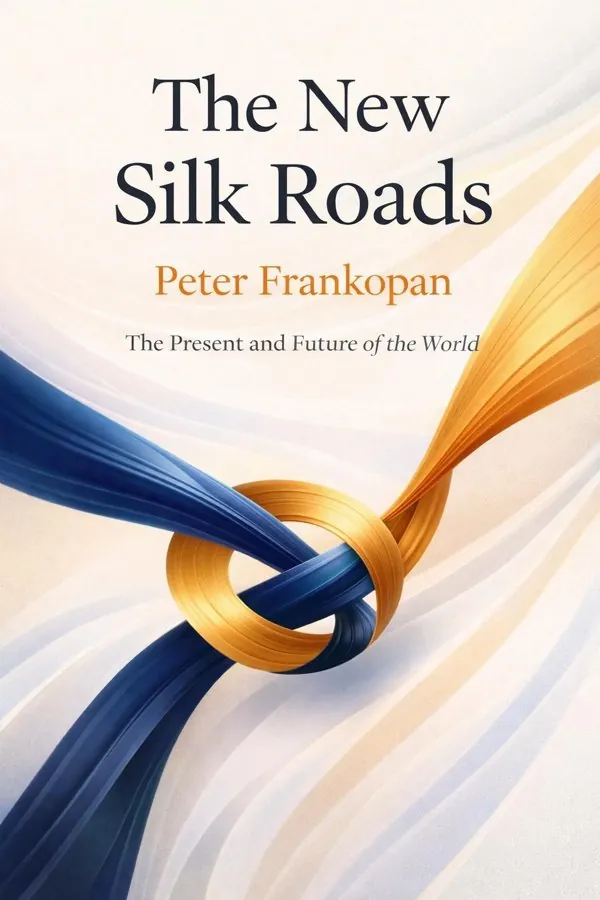
The New Silk Roads: The Present and Future of the World: Summary & Key Insights
 10 min10 chaptersAudio available
Key Takeaways from The New Silk Roads: The Present and Future of the World
The most important geopolitical changes often begin before people are ready to name them.
Infrastructure is never just concrete and steel; it is influence made visible.
Regions once described as peripheral are becoming central to the future of global power.
When established powers feel squeezed, they rarely stand still.
Prosperity can hide vulnerability until the surrounding world changes.
What Is The New Silk Roads: The Present and Future of the World About?
The New Silk Roads: The Present and Future of the World by Peter Frankopan is a world_history book spanning 11 pages. In The New Silk Roads, Peter Frankopan argues that the center of gravity in world affairs is shifting decisively eastward. This is not simply a story about China’s growth or the revival of old trade routes. It is a broader account of how power, capital, energy, ideas, technology, and political influence are being reorganized across Asia, the Middle East, Africa, and beyond. Frankopan shows that the assumptions that shaped the Western-led order after World War II no longer explain the world as well as they once did. What makes this book especially valuable is its wide-angle perspective. Rather than focusing narrowly on one country or crisis, Frankopan traces the links between infrastructure investment, diplomatic realignment, resource competition, religion, environmental stress, and digital transformation. He reveals how highways, ports, pipelines, fiber-optic cables, and financial networks are quietly redrawing the map of global power. As a historian and professor of global history at Oxford, Frankopan brings unusual authority to this subject. He combines historical depth with geopolitical analysis, helping readers see today’s headlines as part of a much larger pattern. The result is an accessible but ambitious portrait of a world entering a more interconnected, contested, and multipolar age.
This FizzRead summary covers all 10 key chapters of The New Silk Roads: The Present and Future of the World in approximately 10 minutes, distilling the most important ideas, arguments, and takeaways from Peter Frankopan's work. Also available as an audio summary and Key Quotes Podcast.
The New Silk Roads: The Present and Future of the World
In The New Silk Roads, Peter Frankopan argues that the center of gravity in world affairs is shifting decisively eastward. This is not simply a story about China’s growth or the revival of old trade routes. It is a broader account of how power, capital, energy, ideas, technology, and political influence are being reorganized across Asia, the Middle East, Africa, and beyond. Frankopan shows that the assumptions that shaped the Western-led order after World War II no longer explain the world as well as they once did.
What makes this book especially valuable is its wide-angle perspective. Rather than focusing narrowly on one country or crisis, Frankopan traces the links between infrastructure investment, diplomatic realignment, resource competition, religion, environmental stress, and digital transformation. He reveals how highways, ports, pipelines, fiber-optic cables, and financial networks are quietly redrawing the map of global power.
As a historian and professor of global history at Oxford, Frankopan brings unusual authority to this subject. He combines historical depth with geopolitical analysis, helping readers see today’s headlines as part of a much larger pattern. The result is an accessible but ambitious portrait of a world entering a more interconnected, contested, and multipolar age.
Who Should Read The New Silk Roads: The Present and Future of the World?
This book is perfect for anyone interested in world_history and looking to gain actionable insights in a short read. Whether you're a student, professional, or lifelong learner, the key ideas from The New Silk Roads: The Present and Future of the World by Peter Frankopan will help you think differently.
- ✓Readers who enjoy world_history and want practical takeaways
- ✓Professionals looking to apply new ideas to their work and life
- ✓Anyone who wants the core insights of The New Silk Roads: The Present and Future of the World in just 10 minutes
Want the full summary?
Get instant access to this book summary and 100K+ more with Fizz Moment.
Get Free SummaryAvailable on App Store • Free to download
Key Chapters
The most important geopolitical changes often begin before people are ready to name them. Frankopan’s starting point is that the Western-led global order, built in the aftermath of World War II, is no longer the uncontested framework for organizing power and prosperity. Institutions such as the International Monetary Fund, the World Bank, NATO, and the World Trade Organization reflected Western priorities and Western assumptions about markets, security, governance, and legitimacy. For decades, this system shaped how nations traded, borrowed, defended themselves, and imagined development.
But the book argues that this order had limits from the start. It depended on military power, financial dominance, control over key institutions, and the belief that Western models were universally desirable. Over time, however, wars, financial crises, domestic polarization, uneven globalization, and the rise of non-Western economies weakened that confidence. Countries across Asia, the Middle East, and Africa increasingly sought alternatives that gave them more room to maneuver.
Frankopan does not claim the West has disappeared. Rather, he shows that it now operates in a world where others can set terms too. A country seeking infrastructure finance may turn to Beijing instead of Washington. A state under diplomatic pressure may hedge by deepening ties with Turkey, India, Russia, or Gulf powers. Trade routes and investment flows no longer move mainly through Atlantic institutions.
For readers, this idea has practical value. It helps explain why global politics now feels fragmented: older institutions still matter, but they no longer monopolize influence. To understand the present, stop assuming that Western priorities are the default map of the world.
Infrastructure is never just concrete and steel; it is influence made visible. Frankopan presents China’s rise as the single most transformative force in the new global landscape, and he treats the Belt and Road Initiative as a strategic project of enormous scale. Rather than viewing it as a simple development program, he frames it as a way of reorganizing trade, diplomacy, logistics, finance, and political relationships across Eurasia, Africa, and beyond.
China’s approach is powerful because it solves practical problems while advancing long-term interests. Railways reduce transport time. Ports expand commercial access. Roads connect inland regions to global markets. Energy pipelines reduce dependence on vulnerable shipping lanes. Digital infrastructure builds dependence on Chinese systems and standards. In each case, development and leverage move together.
Frankopan also highlights the appeal of this model. Many governments need capital fast, often without the governance conditions attached by Western lenders. Chinese financing can therefore look pragmatic and attractive, especially in places where infrastructure gaps constrain growth. Yet the benefits come with risks: debt burdens, political dependency, corruption concerns, and strategic vulnerability.
Examples range from port developments in the Indian Ocean to overland rail links into Europe and major investment projects in Central Asia. The larger point is that China is not merely joining the old global order; it is helping construct a parallel architecture centered on its own priorities.
The actionable takeaway is simple: when assessing any major project today, ask not just who pays for it, but whose networks, standards, and strategic interests it ultimately strengthens.
Regions once described as peripheral are becoming central to the future of global power. A major theme of The New Silk Roads is that Central Asia and the Middle East are no longer best understood as isolated problem zones defined only by war, instability, or authoritarianism. They are critical crossroads where energy, transport, religion, security, and diplomacy intersect.
Frankopan shows how geography is regaining strategic importance. Central Asia sits between China, Russia, South Asia, the Middle East, and Europe, making it a natural corridor for pipelines, highways, rail links, and digital infrastructure. The Middle East remains pivotal not only because of oil and gas, but because it links maritime trade routes, investment capital, migration flows, and ideological influence. Gulf states, Iran, Turkey, and others are all repositioning themselves in response to the weakening of old certainties.
This rebalancing has visible examples. Gulf sovereign wealth funds invest across continents. Turkey pursues a more assertive regional role. Iran uses geography and alliances to project influence despite sanctions. Central Asian states seek to balance China, Russia, and the West while benefiting from transit and resource wealth. These moves are not random; they reflect a world in which strategic location once again creates opportunity.
Frankopan’s insight challenges a common Western habit of seeing these regions mainly through the lens of crisis. They are also sites of ambition, statecraft, and connectivity. Understanding them requires following roads, pipelines, ports, and partnerships as closely as military conflicts.
The takeaway: if you want to understand tomorrow’s world economy and security environment, pay close attention to the states that sit between larger powers, because connectors often become kingmakers.
When established powers feel squeezed, they rarely stand still. Frankopan argues that Russia’s global strategy reflects a search for relevance, security, and leverage in a world where Western integration no longer seems either possible or desirable on former terms. Rather than seeing Russia solely as a European power, the book emphasizes its growing orientation toward Asia, the Middle East, and the spaces in between.
This reorientation has economic, diplomatic, and strategic dimensions. Russia seeks energy partnerships with China, arms relationships across the Middle East and Asia, and influence over transport and political networks in Central Asia. Sanctions and deteriorating relations with Europe have accelerated this shift, but the trend also reflects a deeper geopolitical calculation: if the Atlantic world becomes less welcoming, Russia can still shape the Eurasian one.
Frankopan’s broader point is that Russia remains influential not because it offers a universal model, but because it can disrupt, bargain, and reposition itself across multiple theaters. It uses military intervention, cyber operations, resource politics, and selective alliances to retain a seat at the table. In Syria, for example, Moscow demonstrated that relatively targeted intervention could restore strategic presence. In energy markets, pipelines and exports become instruments of both revenue and pressure.
For readers, the practical lesson is to view Russia not as a static declining power, but as an adaptive one operating through geography, energy, and strategic opportunism. That makes its behavior more understandable, even when it remains destabilizing.
Actionable takeaway: analyze Russia by following its external relationships and infrastructure links, not just its rhetoric; its strategy often becomes clearer at the level of routes, resources, and regional alignments.
Prosperity can hide vulnerability until the surrounding world changes. Frankopan portrays Europe as a region with immense wealth, institutional sophistication, and cultural influence, yet one struggling to define itself in a rapidly shifting geopolitical environment. Europe benefited enormously from the postwar order, but that order also allowed many of its states to postpone hard questions about defense, energy dependence, borders, and strategic autonomy.
The book highlights several pressures converging at once. Economic integration delivered stability, but also produced tensions between national sovereignty and supranational governance. Dependence on external energy supplies exposed strategic fragility. Migration crises tested political cohesion. Internal populism and fragmentation weakened confidence. Meanwhile, China’s investments, Russia’s assertiveness, and America’s unpredictability forced Europe to confront the possibility that it can no longer rely on old assumptions.
Frankopan is especially sharp on the tension between values and interests. Europe often speaks the language of norms, law, and multilateralism, but it must operate in a world increasingly shaped by hard power, financial statecraft, and infrastructure competition. Debates over ports, telecommunications systems, sanctions, and energy corridors reveal how deeply external powers can shape European options.
A practical example is how a port acquisition, pipeline project, or 5G contract can become a geopolitical issue rather than a technical one. These decisions influence supply chains, security dependencies, and diplomatic leverage for years.
The takeaway is useful well beyond Europe: do not confuse institutional maturity with strategic resilience. Any society that wants long-term stability must regularly ask where its hidden dependencies lie and how they could be exploited in a more competitive world.
Decline is often overstated, but so is permanence. Frankopan’s treatment of the United States is nuanced: America remains a military, technological, financial, and cultural superpower, yet it no longer enjoys the near-uncontested authority it held after the Cold War. The issue is not simple collapse. It is the erosion of monopoly power in a world where other actors can increasingly resist, bypass, or outmaneuver Washington.
The book suggests that American influence has been weakened by long wars, domestic political polarization, uneven economic gains from globalization, and strategic overreach. Even when the United States retains overwhelming capabilities, it cannot always translate them into durable outcomes. Rivals and partners alike now test its resolve, hedge against its unpredictability, and diversify their relationships.
Frankopan also emphasizes that power is becoming more distributed across sectors. The United States remains central to global finance, higher education, innovation, entertainment, and security alliances. Yet China can rival it in infrastructure financing, Gulf states can shape capital flows, regional powers can mediate conflicts, and digital platforms can influence politics beyond state control. This means America still matters immensely, but it increasingly operates within a crowded field.
A practical way to see this is through sanctions, trade disputes, and technology restrictions. These remain potent tools, but their repeated use encourages others to develop parallel payment systems, alternative supply chains, and domestic technological capacity.
Actionable takeaway: understand the United States as first among major powers, not as the sole architect of the international order. In business, policy, or investing, build scenarios that account for American strength alongside growing global alternatives.
Globalization did not end; it changed direction, shape, and ownership. One of Frankopan’s most compelling insights is that global trade networks are being reorganized through new corridors of transport, finance, manufacturing, and political cooperation. The old mental map of a world centered on transatlantic exchange is becoming less useful as supply chains deepen across Asia, the Middle East, East Africa, and inland Eurasia.
This rewiring is visible in logistics as much as in diplomacy. New rail connections reduce shipping times between China and Europe. Ports along the Indian Ocean gain strategic and commercial significance. Free trade zones attract manufacturing and re-export businesses. Regional agreements strengthen non-Western trade blocs. Energy routes shift with new pipelines and liquefied natural gas investments. Fiber-optic cables and digital payment systems create parallel routes for information and commerce.
Frankopan’s larger point is that trade routes are also political routes. Whoever builds and manages the arteries of exchange can influence standards, customs regimes, debt relationships, legal frameworks, and security arrangements. This is why roads, ports, and industrial parks should not be seen as neutral economic assets. They shape future dependencies.
For businesses and policymakers, the practical relevance is immediate. A firm sourcing inputs from one region may discover that the critical chokepoint lies elsewhere. A country seeking resilience may need to diversify shipping lanes, suppliers, and payment systems rather than merely increase volume.
The takeaway: map your assumptions about trade. Ask where goods, energy, money, and data actually move, who controls those channels, and how quickly those routes could shift under political or environmental stress.
Nature is not outside geopolitics; it is one of its deepest foundations. Frankopan argues that environmental stress and resource competition are becoming central to international relations. Water scarcity, desertification, pollution, extreme weather, and the race for energy resources are not side issues to be solved after growth. They already influence migration, state stability, investment patterns, and diplomatic bargaining.
The classic example is oil and gas, which still structure alliances and conflicts across the Middle East, Russia, Central Asia, and maritime trade routes. But Frankopan broadens the lens. Water access can shape regional tensions. Melting ice can open new strategic routes. Agricultural stress can intensify social pressure and political unrest. Renewable energy transitions can reduce some dependencies while creating new ones around rare earths, battery supply chains, and green technology manufacturing.
This perspective helps explain why infrastructure projects often target not just transport but also pipelines, dams, power grids, and extraction zones. Control over resources and the means to distribute them remains a fundamental source of influence. It also clarifies why environmental crises can trigger cascading consequences, from food insecurity to cross-border displacement.
In practical terms, governments and organizations that ignore ecological risk often misread strategic risk. A drought can become a financial problem. A flood can become a supply-chain crisis. A polluted city can become a political liability.
Actionable takeaway: treat environmental factors as core variables in any serious analysis of the future. Whether you are evaluating countries, companies, or policies, ask how resource availability and climate stress will affect resilience, stability, and leverage.
Power does not move only through armies and markets; it also travels through belief, identity, and information. Frankopan stresses that any serious picture of the modern world must include cultural renewal, religious energy, and digital geopolitics. These forces shape loyalties, narratives, and social organization in ways that can reinforce or undermine formal state power.
Religion, in his account, remains a major political force across the Silk Roads and beyond. It influences domestic legitimacy, transnational networks, charitable systems, education, and conflict dynamics. States and movements alike use religious language to mobilize support and define purpose. At the same time, cultural confidence is rising in many non-Western societies, reducing the automatic prestige once attached to Western norms.
Technology amplifies these shifts. Information now flows through platforms, cables, satellites, and devices that can spread ideas instantly across borders. Digital systems affect surveillance, propaganda, commerce, elections, and diplomacy. A state that controls data infrastructure or online ecosystems gains powerful tools for shaping behavior and perception. This is why telecom equipment, social media, cybersecurity, and platform governance have become geopolitical issues.
Practical examples include the export of digital surveillance technologies, online influence campaigns, the global reach of streaming media, and the use of apps and payment systems to tie users into wider ecosystems. Soft power and hard power increasingly overlap.
The takeaway is clear: if you want to understand who influences the future, look not only at territory and GDP, but at narratives, networks, and platforms. The battle for minds and data is now inseparable from the battle for markets and states.
The coming world will not be neatly divided between one leader and one challenger. Frankopan’s concluding vision is that we are moving into a multipolar era in which power is dispersed, overlapping, and frequently transactional. China is central to this transformation, but it is not the whole story. India, Russia, Turkey, Iran, the Gulf states, the European Union, the United States, and other regional actors all shape outcomes in different ways, often simultaneously.
Multipolarity does not mean balance or harmony. In fact, Frankopan suggests it may produce greater uncertainty. Middle powers can switch alignments issue by issue. States can cooperate economically while competing militarily. Infrastructure and finance can bind countries together even as ideology pulls them apart. This complexity makes the world more fluid but also more difficult to predict.
The advantage of Frankopan’s framework is that it discourages simplistic thinking. Instead of asking which single country will dominate, he invites readers to examine how networks of influence intersect. A port project, energy contract, technology standard, military base, and media alliance may each point to a different center of gravity. The future will be defined by these layered relationships.
For individuals, organizations, and governments, this means adaptability matters more than certainty. Strategies built for a unipolar world can become liabilities in a system where multiple powers shape outcomes and local conditions matter more.
Actionable takeaway: build a habit of scenario thinking. Assume that influence will come from many directions at once, and design plans that are flexible enough to operate in a world of shifting partnerships, competing standards, and regional power centers.
All Chapters in The New Silk Roads: The Present and Future of the World
About the Author
Peter Frankopan is a British historian, author, and professor of global history at the University of Oxford. He is widely known for his ability to reinterpret world history through the connections between regions rather than through a narrowly Western lens. His bestselling book The Silk Roads established him as a major public historian by showing how Asia, the Middle East, and the routes linking them have long been central to global development. In The New Silk Roads, he extends that perspective into the present, examining how modern trade, diplomacy, energy, and technology are reshaping world power. Frankopan’s work is valued for combining scholarly range with clarity and relevance, making complex historical and geopolitical questions accessible to a broad international audience.
Get This Summary in Your Preferred Format
Read or listen to the The New Silk Roads: The Present and Future of the World summary by Peter Frankopan anytime, anywhere. FizzRead offers multiple formats so you can learn on your terms — all free.
Available formats: App · Audio · PDF · EPUB — All included free with FizzRead
Download The New Silk Roads: The Present and Future of the World PDF and EPUB Summary
Key Quotes from The New Silk Roads: The Present and Future of the World
“The most important geopolitical changes often begin before people are ready to name them.”
“Infrastructure is never just concrete and steel; it is influence made visible.”
“Regions once described as peripheral are becoming central to the future of global power.”
“When established powers feel squeezed, they rarely stand still.”
“Prosperity can hide vulnerability until the surrounding world changes.”
Frequently Asked Questions about The New Silk Roads: The Present and Future of the World
The New Silk Roads: The Present and Future of the World by Peter Frankopan is a world_history book that explores key ideas across 10 chapters. In The New Silk Roads, Peter Frankopan argues that the center of gravity in world affairs is shifting decisively eastward. This is not simply a story about China’s growth or the revival of old trade routes. It is a broader account of how power, capital, energy, ideas, technology, and political influence are being reorganized across Asia, the Middle East, Africa, and beyond. Frankopan shows that the assumptions that shaped the Western-led order after World War II no longer explain the world as well as they once did. What makes this book especially valuable is its wide-angle perspective. Rather than focusing narrowly on one country or crisis, Frankopan traces the links between infrastructure investment, diplomatic realignment, resource competition, religion, environmental stress, and digital transformation. He reveals how highways, ports, pipelines, fiber-optic cables, and financial networks are quietly redrawing the map of global power. As a historian and professor of global history at Oxford, Frankopan brings unusual authority to this subject. He combines historical depth with geopolitical analysis, helping readers see today’s headlines as part of a much larger pattern. The result is an accessible but ambitious portrait of a world entering a more interconnected, contested, and multipolar age.
More by Peter Frankopan
You Might Also Like
The Age of Capital
Eric Hobsbawm
10 min
The Gulag Archipelago
Aleksandr Solzhenitsyn
10 min
Jerusalem: The Biography
Simon Sebag Montefiore
10 min
The Anglo-Saxons
James Campbell
10 min
The Boer War
Thomas Pakenham
10 min
The Industrial Revolutionaries: The Making of the Modern World 1776–1914
Gavin Weightman
10 minBrowse by Category
Ready to read The New Silk Roads: The Present and Future of the World?
Get the full summary and 100K+ more books with Fizz Moment.