
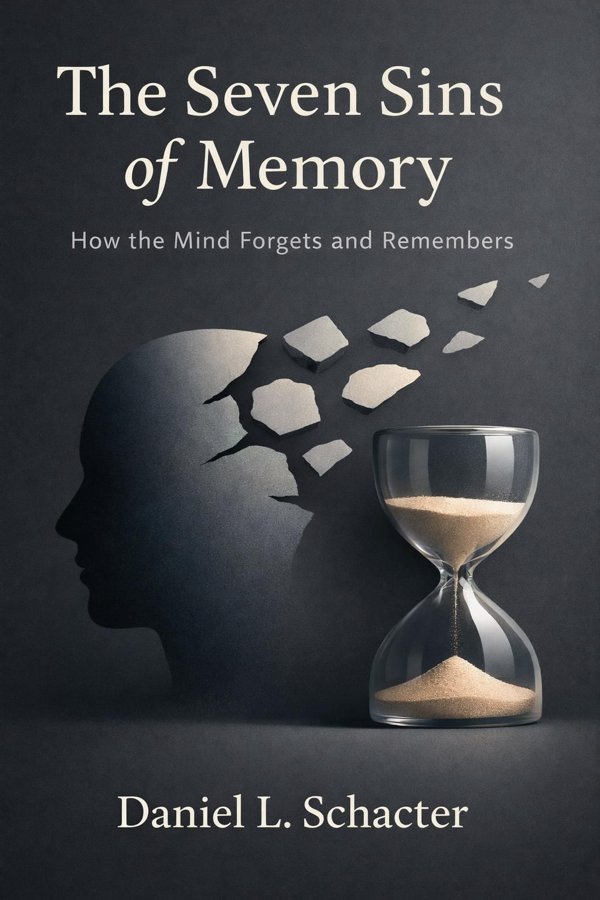
The Seven Sins of Memory: How the Mind Forgets and Remembers: Summary & Key Insights
 10 min10 chaptersAudio available
What Is The Seven Sins of Memory: How the Mind Forgets and Remembers About?
The Seven Sins of Memory: How the Mind Forgets and Remembers by Daniel L. Schacter is a cognition book spanning 10 pages. In this influential work, Harvard psychologist Daniel L. Schacter explores the ways in which memory can fail us. He identifies seven fundamental 'sins' of memory—transience, absent-mindedness, blocking, misattribution, suggestibility, bias, and persistence—each illustrating how our recollections are not perfect recordings but dynamic reconstructions. Drawing on cognitive psychology and neuroscience, Schacter explains how these memory errors are not flaws but byproducts of an adaptive system designed for efficiency and survival.
This FizzRead summary covers all 10 key chapters of The Seven Sins of Memory: How the Mind Forgets and Remembers in approximately 10 minutes, distilling the most important ideas, arguments, and takeaways from Daniel L. Schacter's work. Also available as an audio summary and Key Quotes Podcast.
The Seven Sins of Memory: How the Mind Forgets and Remembers
In this influential work, Harvard psychologist Daniel L. Schacter explores the ways in which memory can fail us. He identifies seven fundamental 'sins' of memory—transience, absent-mindedness, blocking, misattribution, suggestibility, bias, and persistence—each illustrating how our recollections are not perfect recordings but dynamic reconstructions. Drawing on cognitive psychology and neuroscience, Schacter explains how these memory errors are not flaws but byproducts of an adaptive system designed for efficiency and survival.
Who Should Read The Seven Sins of Memory: How the Mind Forgets and Remembers?
This book is perfect for anyone interested in cognition and looking to gain actionable insights in a short read. Whether you're a student, professional, or lifelong learner, the key ideas from The Seven Sins of Memory: How the Mind Forgets and Remembers by Daniel L. Schacter will help you think differently.
- ✓Readers who enjoy cognition and want practical takeaways
- ✓Professionals looking to apply new ideas to their work and life
- ✓Anyone who wants the core insights of The Seven Sins of Memory: How the Mind Forgets and Remembers in just 10 minutes
Want the full summary?
Get instant access to this book summary and 100K+ more with Fizz Moment.
Get Free SummaryAvailable on App Store • Free to download
Key Chapters
Of all the sins of memory, transience is perhaps the most familiar. It is the fading of specific details as time passes, the quiet wearing away of once-vivid experiences. You might remember attending a wedding but forget the shade of the bride’s dress or the music that played as she walked down the aisle. Psychologically, such forgetting often frustrates us—we speak of it as loss. Yet, as I’ve discovered in years of research, it serves a vital adaptive purpose.
Memory thrives on efficiency, not permanence. Our brains do not maintain endless archives because doing so would consume immense neural resources and clutter our ability to discern what truly matters now. From a cognitive perspective, transience reflects the decline in accessibility of memory traces that are no longer frequently retrieved or relevant. Studies show that neural connections representing an unused memory gradually weaken; hippocampal and cortical patterns that once encoded specific episodes degrade through interference, restructuring, and updating.
When looked at through the lens of evolution, such forgetting is a blessing disguised as decay. By allowing irrelevant content to fade, memory sharpens our focus on what aids survival and decision-making. Imagine if every detail of every day were indelibly etched—our minds would grind to a halt under the weight of clutter. So transience, though it often feels like failure, represents an intelligent housekeeping system of the mind: a pruning of experience that allows flexibility, creativity, and adaptation.
You may have walked into a room only to forget why you entered it, or driven halfway to work before realizing you left your phone at home. These everyday lapses illustrate absent-mindedness, a sin rooted not in memory’s storage but in attention’s failure. When we are distracted or preoccupied during an event, its encoding into memory is incomplete. No matter how powerful memory mechanisms might be, attention is the gatekeeper through which all experience must pass.
Cognitive experiments show that divided attention during learning drastically reduces later recall. Brain imaging confirms this: diminished activity in the hippocampus and prefrontal regions correlates with encoding lapses. Absent-mindedness often arises not only because modern life overwhelms us with stimuli but also because prospective memory—the ability to remember to perform future actions—depends on the same attentional control we use for ongoing tasks. When that balance falters, errors occur.
But even this sin serves a function. Our attentional systems evolved to prioritize the most pressing goals, not to record each mundane event. Forgetfulness in routine contexts allows cognitive resources to be allocated to novel or urgent problems. Still, in a world that prizes multitasking, absent-mindedness highlights memory’s dependence on mindful engagement. It teaches us that remembering begins not with storage but with presence.
+ 8 more chapters — available in the FizzRead app
All Chapters in The Seven Sins of Memory: How the Mind Forgets and Remembers
About the Author
Daniel L. Schacter is a cognitive psychologist and professor at Harvard University, known for his research on human memory and amnesia. His work has significantly influenced the understanding of how memory functions and fails, bridging psychology and neuroscience.
Get This Summary in Your Preferred Format
Read or listen to the The Seven Sins of Memory: How the Mind Forgets and Remembers summary by Daniel L. Schacter anytime, anywhere. FizzRead offers multiple formats so you can learn on your terms — all free.
Available formats: App · Audio · PDF · EPUB — All included free with FizzRead
Download The Seven Sins of Memory: How the Mind Forgets and Remembers PDF and EPUB Summary
Key Quotes from The Seven Sins of Memory: How the Mind Forgets and Remembers
“Of all the sins of memory, transience is perhaps the most familiar.”
“You may have walked into a room only to forget why you entered it, or driven halfway to work before realizing you left your phone at home.”
Frequently Asked Questions about The Seven Sins of Memory: How the Mind Forgets and Remembers
The Seven Sins of Memory: How the Mind Forgets and Remembers by Daniel L. Schacter is a cognition book that explores key ideas across 10 chapters. In this influential work, Harvard psychologist Daniel L. Schacter explores the ways in which memory can fail us. He identifies seven fundamental 'sins' of memory—transience, absent-mindedness, blocking, misattribution, suggestibility, bias, and persistence—each illustrating how our recollections are not perfect recordings but dynamic reconstructions. Drawing on cognitive psychology and neuroscience, Schacter explains how these memory errors are not flaws but byproducts of an adaptive system designed for efficiency and survival.
More by Daniel L. Schacter
You Might Also Like

A Field Guide to Lies: Critical Thinking in the Information Age
Daniel J. Levitin
10 min
A Theory of Cognitive Dissonance
Leon Festinger
10 min
Black-And-White Thinking: The Burden of a Binary Brain in a Complex World
Kevin Dutton
10 min
Born Liars: Why We Can’t Live Without Deceit
Ian Leslie
10 min
Collective Illusions: Conformity, Complicity, and the Science of Why We Make Bad Decisions
Todd Rose
10 min
Concrete Mathematics: A Foundation for Computer Science
Ronald L. Graham, Donald E. Knuth, Oren Patashnik
10 minBrowse by Category
Ready to read The Seven Sins of Memory: How the Mind Forgets and Remembers?
Get the full summary and 100K+ more books with Fizz Moment.