
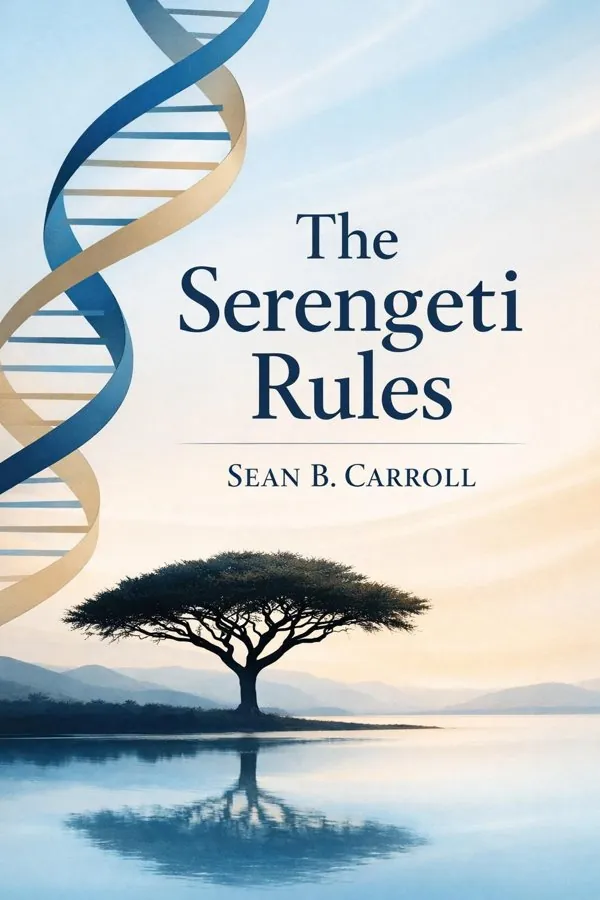
The Serengeti Rules: The Quest to Discover How Life Works and Why It Matters: Summary & Key Insights
 10 min9 chaptersAudio available
Key Takeaways from The Serengeti Rules: The Quest to Discover How Life Works and Why It Matters
A great scientific revolution often begins with a deceptively simple question.
Life would quickly descend into chaos without internal brakes.
The body is not stable because it is static; it is stable because it is constantly adjusting.
The most visible drama in nature often hides an invisible logic.
Not all species exert influence in proportion to their numbers.
What Is The Serengeti Rules: The Quest to Discover How Life Works and Why It Matters About?
The Serengeti Rules: The Quest to Discover How Life Works and Why It Matters by Sean B. Carroll is a life_science book spanning 8 pages. What if the same logic that controls genes inside a bacterium also helps explain why wolves shape rivers, why sea otters protect kelp forests, and why ecosystems collapse when key species disappear? In The Serengeti Rules, acclaimed biologist Sean B. Carroll argues that life is governed by recurring patterns of regulation that operate across every scale of nature. From molecules and cells to bodies, populations, and entire landscapes, living systems survive because something limits, balances, or restrains something else. Carroll tells this story through a blend of scientific detective work, biography, and environmental case studies, showing how major discoveries in genetics, physiology, and ecology revealed nature’s hidden control systems. The book matters because it offers more than intellectual insight: it gives us a framework for addressing some of the world’s biggest problems, including disease, biodiversity loss, overfishing, and ecosystem degradation. Carroll writes with the authority of a leading evolutionary biologist and gifted science communicator, making complex ideas vivid, memorable, and urgently relevant to anyone who wants to understand how life works and how humans can help restore its balance.
This FizzRead summary covers all 9 key chapters of The Serengeti Rules: The Quest to Discover How Life Works and Why It Matters in approximately 10 minutes, distilling the most important ideas, arguments, and takeaways from Sean B. Carroll's work. Also available as an audio summary and Key Quotes Podcast.
The Serengeti Rules: The Quest to Discover How Life Works and Why It Matters
What if the same logic that controls genes inside a bacterium also helps explain why wolves shape rivers, why sea otters protect kelp forests, and why ecosystems collapse when key species disappear? In The Serengeti Rules, acclaimed biologist Sean B. Carroll argues that life is governed by recurring patterns of regulation that operate across every scale of nature. From molecules and cells to bodies, populations, and entire landscapes, living systems survive because something limits, balances, or restrains something else. Carroll tells this story through a blend of scientific detective work, biography, and environmental case studies, showing how major discoveries in genetics, physiology, and ecology revealed nature’s hidden control systems. The book matters because it offers more than intellectual insight: it gives us a framework for addressing some of the world’s biggest problems, including disease, biodiversity loss, overfishing, and ecosystem degradation. Carroll writes with the authority of a leading evolutionary biologist and gifted science communicator, making complex ideas vivid, memorable, and urgently relevant to anyone who wants to understand how life works and how humans can help restore its balance.
Who Should Read The Serengeti Rules: The Quest to Discover How Life Works and Why It Matters?
This book is perfect for anyone interested in life_science and looking to gain actionable insights in a short read. Whether you're a student, professional, or lifelong learner, the key ideas from The Serengeti Rules: The Quest to Discover How Life Works and Why It Matters by Sean B. Carroll will help you think differently.
- ✓Readers who enjoy life_science and want practical takeaways
- ✓Professionals looking to apply new ideas to their work and life
- ✓Anyone who wants the core insights of The Serengeti Rules: The Quest to Discover How Life Works and Why It Matters in just 10 minutes
Want the full summary?
Get instant access to this book summary and 100K+ more with Fizz Moment.
Get Free SummaryAvailable on App Store • Free to download
Key Chapters
A great scientific revolution often begins with a deceptively simple question. In this case, the question was: how do cells know when to turn genes on and off? Carroll begins with the work of Jacques Monod and François Jacob in mid-twentieth-century France, where researchers studying bacteria uncovered one of biology’s most powerful ideas: life depends on regulation. Genes are not just passive blueprints. They are activated, silenced, and modulated according to changing conditions. Their work on the lac operon showed that cells respond intelligently to their environment by producing proteins only when needed, conserving energy and improving survival.
This discovery changed biology because it replaced the image of life as a fixed mechanical program with a dynamic system of control. A cell is constantly sensing, comparing, and adjusting. It uses molecular switches, feedback loops, and inhibitors to maintain order amid change. That insight became foundational not only for genetics but for understanding cancer, development, metabolism, and immunity.
Carroll emphasizes that the significance of Monod and Jacob’s work lies in the pattern it revealed. Inhibitors restrain processes. Signals release those restraints. Regulators coordinate competing functions. This same logic appears again and again throughout nature.
A practical application is modern medicine. Many drugs work by blocking or enhancing regulatory signals, whether targeting bacterial growth, hormones, or immune responses. Understanding biological regulation also helps researchers design synthetic gene circuits in biotechnology.
Actionable takeaway: when trying to understand any living system, start by asking not just what parts are present, but what controls what. The deepest insight often lies in the regulators.
Life would quickly descend into chaos without internal brakes. After the first discoveries of gene regulation, biologists found that cells are full of feedback systems that keep processes within safe limits. Enzymes are switched on and off. Hormones rise and fall. Immune cells attack invaders, then stand down to avoid harming the body. Carroll shows that this logic of balance is not an exception in biology; it is the rule.
Feedback loops come in two main forms. Negative feedback stabilizes a system by counteracting change. If a substance becomes too abundant, its production is reduced. Positive feedback amplifies a response, often to push a process to completion, as in blood clotting or cell division. Both forms are essential, but negative feedback is especially central to the book because it reveals how life avoids extremes.
This idea matters because many diseases are, at heart, failures of regulation. Diabetes involves disrupted glucose control. Autoimmune disorders reflect immune overreaction. Cancer emerges when growth signals escape normal restraints. Rather than seeing illness as the appearance of something entirely foreign, Carroll encourages readers to view it as a broken control system.
The same principle applies in everyday life. Consider body temperature: your body sweats when it is hot and shivers when it is cold, maintaining a narrow range that permits survival. At the cellular level, similar balancing acts are happening constantly and invisibly.
Actionable takeaway: whether you are thinking about health, biology, or even organizational systems, look for feedback loops. Stability depends less on strength than on well-designed mechanisms of correction.
The body is not stable because it is static; it is stable because it is constantly adjusting. Carroll extends the idea of regulation from genes to whole organisms, showing how physiology depends on coordinated controls that maintain internal balance, or homeostasis. Hormones, nerves, organs, and tissues work together to keep blood sugar, salt levels, temperature, oxygen, and countless other variables within survivable bounds.
This is where the book reveals a profound continuity between molecular biology and everyday human experience. The same principle that governs a bacterial gene also helps explain why the pancreas releases insulin, why the kidneys manage water, and why the thyroid influences metabolism. Biological success comes not from letting every process run at maximum capacity, but from carefully calibrating competing needs.
Carroll highlights the history of discoveries in endocrinology and physiology to show that regulation is not merely a technical detail. It is the organizing architecture of life. When control systems break down, the result is often dramatic and dangerous. Excess thyroid hormone speeds metabolism too far; too little slows the body. Blood pressure that is not properly controlled damages vessels and organs over time.
The practical importance is obvious in medicine. Treatments often aim to restore proper regulation rather than simply eliminate symptoms. Physicians manage hypertension, glucose levels, cholesterol, and inflammation by nudging systems back toward balance.
This idea also carries a broader lesson. Human well-being, like physiology, depends on dynamic adjustment rather than rigid constancy. Rest, stress, diet, and activity all affect internal regulation.
Actionable takeaway: think of health as regulation, not perfection. Support habits and treatments that help the body maintain balance instead of pushing any one system to extremes.
The most visible drama in nature often hides an invisible logic. On the Serengeti plains, lions chasing wildebeests may seem like isolated acts of predation, but Carroll shows that predators play a deeper role: they regulate populations and shape the entire structure of ecosystems. This insight emerged from field studies in places like the Serengeti, where ecologists discovered that removing or weakening top predators can unleash sweeping consequences.
Predators do more than kill prey. They prevent prey populations from exploding, change where animals feed, and indirectly protect vegetation. When herbivores are kept in check, grasses and shrubs recover. When plant life remains healthy, insects, birds, and smaller mammals benefit. In this way, a predator’s influence cascades downward through multiple layers of the ecosystem.
This ecological form of regulation mirrors what happens inside cells. Just as repressors keep genes from overexpressing, predators keep prey from overrunning the system. Carroll’s achievement is to make that analogy convincing rather than poetic. The same pattern of limitation preserving balance appears at radically different scales.
The practical implications are enormous. Predator removal through hunting, habitat loss, or fear-driven policies can destabilize landscapes. The restoration of wolves in Yellowstone, for example, is often cited as a case where predators helped reset a damaged system by altering elk behavior and allowing vegetation to rebound.
Actionable takeaway: when evaluating an ecosystem, ask which species act as regulators. Protecting biodiversity is important, but protecting the species that maintain balance is often decisive.
Not all species exert influence in proportion to their numbers. One of the most important ecological ideas in the book is the concept of the keystone species: an organism whose impact on its environment is far greater than its abundance might suggest. Carroll uses classic examples, including sea otters, starfish, and other ecological regulators, to show how a single species can uphold an entire network of life.
Sea otters, for instance, prey on sea urchins. When otters are abundant, urchin populations remain controlled, allowing kelp forests to flourish. Those kelp forests then provide habitat, food, and protection for countless marine organisms. Remove the otters, and urchins multiply, kelp disappears, and the whole ecosystem degrades. The lesson is powerful: balance often depends on a few key constraints.
This idea expands the Serengeti Rules beyond charismatic predators. A keystone regulator may be a predator, grazer, herbivore, or even a disease-controlling species. What matters is its role in structuring the system. Carroll argues that recognizing these relationships is essential for modern conservation because ecosystems can collapse even when many species are still present if the right controlling species are lost.
In policy terms, this changes priorities. Conservation should not focus only on counting species or preserving scenery. It must identify the interactions that maintain resilience. In agriculture and fisheries, ignoring keystone relationships can lead to pest outbreaks, habitat loss, and declining productivity.
Actionable takeaway: in any complex system, look for the small number of actors with outsized influence. Protecting or restoring them can achieve far more than broad but unfocused intervention.
One of Carroll’s boldest claims is that life is understandable because the same governing logic repeats across scales. The Serengeti Rules are not a single law but a family of recurring principles: populations are controlled from above, growth is limited by regulators, imbalance spreads through networks, and stability depends on restraint. This is the book’s central unifying idea.
What makes this argument compelling is that it connects disciplines that are often taught separately. Molecular biologists study genes. Physiologists study organs. Ecologists study predators and food webs. Carroll shows that all of them are, in different ways, studying regulation. Cells need inhibitors and feedback loops. Bodies need hormones and homeostatic controls. Ecosystems need predators, competitors, and nutrient balances. The details differ, but the architecture is similar.
This matters intellectually because it gives readers a more coherent picture of biology. Instead of memorizing isolated facts, we can see life as a nested hierarchy of regulated systems. It also matters practically because solving problems becomes easier when we understand the type of failure involved. Is the issue uncontrolled growth? Missing top-down control? Broken feedback? Loss of resilience? These questions travel well from medicine to conservation.
Carroll does not claim that nature is always harmonious. Regulation can fail, systems can tip, and recovery can be difficult. But he insists that there are patterns, and those patterns make intervention possible.
Actionable takeaway: when faced with complexity, search for recurring structures instead of isolated events. In biology and beyond, understanding the rules of regulation reveals where effective action is possible.
The most dangerous thing humans often remove from nature is not a species but a control mechanism. Carroll argues that many environmental crises result from breaking the regulatory relationships that keep ecosystems stable. Overhunting removes predators. Overfishing depletes top consumers. Pollution disrupts nutrient cycles. Habitat destruction isolates species that once kept one another in check. The result is not just loss, but deregulation.
When top-down controls disappear, prey species can surge. When herbivores become too abundant, vegetation collapses. When nutrient balances shift, algal blooms can smother aquatic life. These are not random disasters. They are the predictable consequences of severing ecological feedback loops. Carroll’s framework helps explain why human actions can trigger disproportionately large effects. We are often tampering with the hidden architecture of balance.
This perspective reshapes environmental responsibility. It is not enough to preserve fragments of wilderness while ignoring the interactions that make them functional. An ecosystem with missing regulators may look intact for a time, but it is living on borrowed stability. The same is true in oceans, forests, grasslands, and even urban landscapes.
Practical examples include the collapse of cod fisheries, the spread of invasive species where natural enemies are absent, and disease outbreaks linked to altered animal communities. Human well-being is bound up with ecological regulation, whether through food systems, water quality, climate resilience, or disease control.
Actionable takeaway: treat environmental management as the restoration of relationships, not just the protection of objects. Ask what controls have been disrupted and how they might be rebuilt.
A scientific idea proves its value when it helps us solve real problems. Carroll shows that the Serengeti Rules are not merely descriptive; they are actionable principles for medicine, public health, and conservation. Once we understand what regulates a system, we can intervene more intelligently. This insight links laboratory science with field ecology in a surprisingly practical way.
In medicine, many therapies already operate on this logic. Cancer drugs may block growth signals or release immune restraints. Cholesterol-lowering medications alter metabolic regulation. Treatments for hypertension, depression, or autoimmune disease often work by adjusting signaling networks rather than attacking a single isolated cause. The more clearly we map control systems, the more precise our interventions can become.
In conservation, the same mindset has led to ecosystem restoration through reintroducing predators, protecting keystone species, and reducing pressures that distort food webs. Marine reserves can allow fish populations and predator-prey dynamics to recover. Wetland restoration can restore nutrient regulation and flood buffering. The key is to move beyond surface symptoms and address the missing or broken regulators.
Carroll also points to the promise of interdisciplinary thinking. Techniques from systems biology, epidemiology, and ecology all contribute to understanding how regulation works in dynamic networks. The best solutions often come from seeing connections others have missed.
For readers, this is one of the book’s most hopeful messages. Human damage is real, but many systems can recover if the right controls are restored.
Actionable takeaway: whether dealing with illness or environmental decline, focus first on identifying the governing controls. Lasting solutions usually come from restoring regulation, not merely suppressing visible symptoms.
The deepest reward of the book is a shift in perspective. Carroll invites readers to see life not as a stack of disconnected subjects but as one integrated phenomenon governed by recurring principles. Genes, hormones, predators, prey, forests, reefs, and human societies all exist within networks of influence. To understand life, we must understand how these networks are regulated.
This integrative view has scientific, ethical, and philosophical force. Scientifically, it encourages cross-disciplinary thinking and helps unify seemingly unrelated findings. Ethically, it reminds us that interventions carry consequences beyond the immediate target. If everything important is connected through regulatory relationships, then carelessness in one domain can create instability in another. Philosophically, it offers a more mature picture of life: not perfect equilibrium, but resilient balance maintained through constant adjustment.
Carroll’s narrative style reinforces this message by moving between famous scientists, iconic ecosystems, and modern environmental challenges. The result is a story of discovery that also becomes a guide to responsibility. Human beings are not outside the system studying it from a distance. We are participants capable of disrupting or repairing the rules that sustain life.
This framework is useful well beyond biology. Organizations, economies, and communities also depend on feedback, restraint, and key regulators. While the analogy should not be pushed too far, it encourages a richer systems mindset.
Actionable takeaway: train yourself to think in relationships rather than isolated parts. The more you see how systems regulate themselves, the better you can understand complexity and act without causing unintended harm.
All Chapters in The Serengeti Rules: The Quest to Discover How Life Works and Why It Matters
About the Author
Sean B. Carroll is an American evolutionary biologist, author, and science communicator celebrated for bridging cutting-edge research and public understanding. He is especially known for his influential work in evolutionary developmental biology, which helped reveal how changes in genes shape animal form and drive evolutionary change. In addition to his scientific career, Carroll has written several acclaimed books that make biology vivid and accessible to general readers. His work often focuses on the deep patterns that connect seemingly separate branches of life science, from genetics to ecology. With The Serengeti Rules, he brings together his strengths as a researcher, historian of science, and storyteller, showing how the principles of regulation unify life across scales and why that knowledge matters for medicine, conservation, and the future of the planet.
Get This Summary in Your Preferred Format
Read or listen to the The Serengeti Rules: The Quest to Discover How Life Works and Why It Matters summary by Sean B. Carroll anytime, anywhere. FizzRead offers multiple formats so you can learn on your terms — all free.
Available formats: App · Audio · PDF · EPUB — All included free with FizzRead
Download The Serengeti Rules: The Quest to Discover How Life Works and Why It Matters PDF and EPUB Summary
Key Quotes from The Serengeti Rules: The Quest to Discover How Life Works and Why It Matters
“A great scientific revolution often begins with a deceptively simple question.”
“Life would quickly descend into chaos without internal brakes.”
“The body is not stable because it is static; it is stable because it is constantly adjusting.”
“The most visible drama in nature often hides an invisible logic.”
“Not all species exert influence in proportion to their numbers.”
Frequently Asked Questions about The Serengeti Rules: The Quest to Discover How Life Works and Why It Matters
The Serengeti Rules: The Quest to Discover How Life Works and Why It Matters by Sean B. Carroll is a life_science book that explores key ideas across 9 chapters. What if the same logic that controls genes inside a bacterium also helps explain why wolves shape rivers, why sea otters protect kelp forests, and why ecosystems collapse when key species disappear? In The Serengeti Rules, acclaimed biologist Sean B. Carroll argues that life is governed by recurring patterns of regulation that operate across every scale of nature. From molecules and cells to bodies, populations, and entire landscapes, living systems survive because something limits, balances, or restrains something else. Carroll tells this story through a blend of scientific detective work, biography, and environmental case studies, showing how major discoveries in genetics, physiology, and ecology revealed nature’s hidden control systems. The book matters because it offers more than intellectual insight: it gives us a framework for addressing some of the world’s biggest problems, including disease, biodiversity loss, overfishing, and ecosystem degradation. Carroll writes with the authority of a leading evolutionary biologist and gifted science communicator, making complex ideas vivid, memorable, and urgently relevant to anyone who wants to understand how life works and how humans can help restore its balance.
More by Sean B. Carroll

You Might Also Like

The Selfish Gene
Richard Dawkins
10 min
Awakenings
Oliver Sacks
10 min
Parasite Rex: Inside the Bizarre World of Nature's Most Dangerous Creatures
Carl Zimmer
10 min
The Atlas of Life on Earth
Various
10 min
The Book of Humans: The Story of How We Became Us
Adam Rutherford
10 min
The Horse
Wendy Williams
10 minBrowse by Category
Ready to read The Serengeti Rules: The Quest to Discover How Life Works and Why It Matters?
Get the full summary and 100K+ more books with Fizz Moment.