
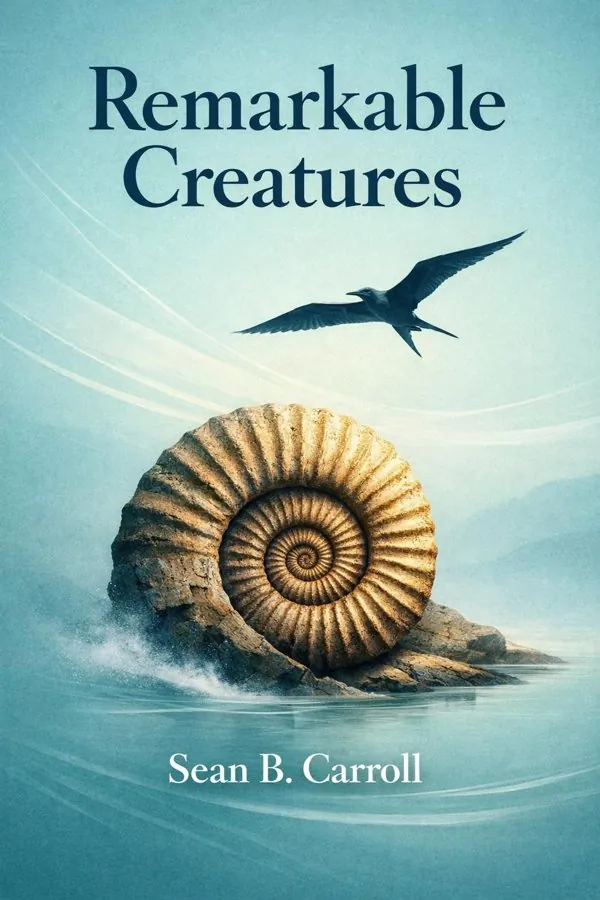
Remarkable Creatures: Epic Adventures in the Search for the Origins of Species: Summary & Key Insights
 10 min9 chaptersAudio available
Key Takeaways from Remarkable Creatures: Epic Adventures in the Search for the Origins of Species
Scientific revolutions rarely begin with a single flash of brilliance; they begin with people who learn how to see.
Ideas become transformative when direct experience forces the mind to confront contradiction.
The most powerful scientific ideas are often unsettling because they replace intuitive stories with causal mechanisms.
Discovery is often portrayed as solitary genius, but history shows that when evidence accumulates, multiple minds may arrive at similar truths.
To understand living species, we must listen to the dead.
What Is Remarkable Creatures: Epic Adventures in the Search for the Origins of Species About?
Remarkable Creatures: Epic Adventures in the Search for the Origins of Species by Sean B. Carroll is a life_science book spanning 6 pages. Remarkable Creatures is a sweeping history of one of science’s greatest revolutions: the discovery of how life changes, diversifies, and leaves clues across deep time. Rather than presenting evolution as a dry set of facts, Sean B. Carroll tells it as a human drama filled with dangerous voyages, obsessive collectors, radical ideas, and moments of breathtaking insight. From early naturalists and fossil hunters to Charles Darwin, Alfred Russel Wallace, and the architects of modern genetics, the book traces how scattered observations became a coherent explanation for the origin of species. What makes the book powerful is its combination of scientific clarity and storytelling energy. Carroll shows that the theory of evolution did not emerge fully formed from a single genius, but from generations of people willing to look closely at nature and follow evidence wherever it led. That matters because it reveals how science actually works: through curiosity, debate, error, persistence, and synthesis. Carroll is especially well suited to tell this story. As a leading evolutionary biologist and gifted science writer, he brings authority, precision, and infectious enthusiasm to one of the most important ideas ever developed.
This FizzRead summary covers all 9 key chapters of Remarkable Creatures: Epic Adventures in the Search for the Origins of Species in approximately 10 minutes, distilling the most important ideas, arguments, and takeaways from Sean B. Carroll's work. Also available as an audio summary and Key Quotes Podcast.
Remarkable Creatures: Epic Adventures in the Search for the Origins of Species
Remarkable Creatures is a sweeping history of one of science’s greatest revolutions: the discovery of how life changes, diversifies, and leaves clues across deep time. Rather than presenting evolution as a dry set of facts, Sean B. Carroll tells it as a human drama filled with dangerous voyages, obsessive collectors, radical ideas, and moments of breathtaking insight. From early naturalists and fossil hunters to Charles Darwin, Alfred Russel Wallace, and the architects of modern genetics, the book traces how scattered observations became a coherent explanation for the origin of species.
What makes the book powerful is its combination of scientific clarity and storytelling energy. Carroll shows that the theory of evolution did not emerge fully formed from a single genius, but from generations of people willing to look closely at nature and follow evidence wherever it led. That matters because it reveals how science actually works: through curiosity, debate, error, persistence, and synthesis. Carroll is especially well suited to tell this story. As a leading evolutionary biologist and gifted science writer, he brings authority, precision, and infectious enthusiasm to one of the most important ideas ever developed.
Who Should Read Remarkable Creatures: Epic Adventures in the Search for the Origins of Species?
This book is perfect for anyone interested in life_science and looking to gain actionable insights in a short read. Whether you're a student, professional, or lifelong learner, the key ideas from Remarkable Creatures: Epic Adventures in the Search for the Origins of Species by Sean B. Carroll will help you think differently.
- ✓Readers who enjoy life_science and want practical takeaways
- ✓Professionals looking to apply new ideas to their work and life
- ✓Anyone who wants the core insights of Remarkable Creatures: Epic Adventures in the Search for the Origins of Species in just 10 minutes
Want the full summary?
Get instant access to this book summary and 100K+ more with Fizz Moment.
Get Free SummaryAvailable on App Store • Free to download
Key Chapters
Scientific revolutions rarely begin with a single flash of brilliance; they begin with people who learn how to see. Before Darwin and Wallace transformed biology, a wide cast of naturalists, explorers, and museum builders spent decades gathering the raw materials of evolutionary thought. They cataloged plants and animals, compared anatomical structures, described fossils, and tried to make sense of Earth’s astonishing diversity. Many of them worked without a unifying theory, but their observations created the foundation on which later breakthroughs would stand.
Carroll shows that figures such as Carl Linnaeus, Georges-Louis Leclerc, Comte de Buffon, Georges Cuvier, and Jean-Baptiste Lamarck were not simply historical footnotes. Linnaeus gave naturalists a shared naming system, allowing scientists across countries to compare findings. Buffon questioned whether species were fixed. Cuvier’s work on fossils demonstrated that extinction was real, undermining the idea of an unchanging world. Lamarck, though wrong in important details, dared to argue that species could transform over time.
This stage of scientific history matters because it teaches us that knowledge grows through infrastructure as much as inspiration. Classification systems, specimen collections, drawings, travel logs, and museums made comparison possible. Without those tools, the evidence for evolution would have remained scattered and less persuasive.
A practical lesson follows from this. In any field, breakthrough thinking often depends on careful groundwork: collecting data, naming patterns, and preserving anomalies rather than ignoring them. Whether you are studying biology, markets, or human behavior, disciplined observation comes before big theory.
Actionable takeaway: build the habit of systematic noticing. Keep records, compare cases, and treat small irregularities as potential clues to larger truths.
Ideas become transformative when direct experience forces the mind to confront contradiction. Darwin’s voyage aboard the HMS Beagle was not just a travel adventure; it was an education in variation, adaptation, and geological time. As he moved from South American coasts to mountain ranges, islands, forests, and fossil beds, he encountered a world far more dynamic than traditional beliefs had allowed.
Carroll emphasizes that Darwin was changed by comparison. He saw fossil mammals in South America that resembled living species from the same region, hinting at continuity through time. He observed that species differed subtly from one place to another, suggesting that environment and isolation mattered. On the Galápagos Islands, closely related birds, tortoises, and plants varied from island to island, raising a profound question: if species were separately created, why did they look like modified versions of mainland relatives?
Just as important, Darwin absorbed new geological thinking, especially the idea that slow processes acting over immense periods could reshape Earth. If landscapes changed gradually yet dramatically over time, perhaps life could as well. Darwin did not instantly invent natural selection during the voyage, but he accumulated the patterns that made the idea possible.
This is a practical model for thinking. Deep understanding often comes from moving across contexts and asking what changes, what remains stable, and why. Leaders compare markets. Designers compare user environments. Students compare cases rather than memorizing isolated facts.
Actionable takeaway: when you face a complex problem, expose yourself to varied examples. Comparison sharpens insight and reveals patterns that a single viewpoint hides.
The most powerful scientific ideas are often unsettling because they replace intuitive stories with causal mechanisms. Darwin’s theory of natural selection did exactly that. Organisms produce more offspring than can survive. Individuals vary. Some variations improve survival or reproduction in a given environment. Those traits become more common over generations. Without any guiding plan, populations gradually adapt.
Carroll presents this not as an abstract formula but as a profound shift in human thought. Before natural selection, the exquisite fit between organisms and environments seemed to require direct design. Why else would a flower and pollinator match so well, or a finch’s beak suit its diet? Darwin’s insight was that cumulative selection could build apparent purpose from countless rounds of differential success.
The elegance of the idea lies in its simplicity and explanatory reach. It accounts for adaptation, divergence, and the branching history of life. It also reframes humanity’s place in nature. Humans are not outside biological law; we are part of the same evolutionary process that shaped every other species.
Modern examples make the concept vivid. Antibiotic resistance evolves because bacteria with resistant traits survive treatment and reproduce. Pesticide resistance follows the same logic. Even viral evolution, as seen in changing variants, reflects the relentless filtering power of selection.
The broader application is that selection processes operate beyond biology. In culture, technology, and business, many alternatives are generated, some fit circumstances better, and successful variants spread. Understanding selection helps us think in systems rather than miracles.
Actionable takeaway: whenever you see a well-fitted outcome, ask what selection pressures may have produced it over time instead of assuming it appeared fully formed.
Discovery is often portrayed as solitary genius, but history shows that when evidence accumulates, multiple minds may arrive at similar truths. Alfred Russel Wallace’s independent formulation of natural selection is one of the most dramatic examples in science. Working in the Amazon and later the Malay Archipelago, Wallace endured disease, shipwreck, financial insecurity, and extreme conditions while collecting specimens and thinking deeply about distribution and adaptation.
Carroll uses Wallace’s story to show both the fairness and the tension of science. Wallace noticed that species were not randomly scattered. Geographic barriers mattered. Closely related species tended to live near one another, and island life displayed striking patterns of divergence. These observations led him toward a mechanism much like Darwin’s. When Wallace sent his essay to Darwin, Darwin was shaken because it closely matched ideas he had been developing for years.
The joint presentation of their work reminds us that science is a communal enterprise shaped by timing, reputation, networks, and ethics. Darwin had amassed extraordinary evidence; Wallace had independently reached the central insight. Together, their names became linked to one of biology’s defining ideas.
There is a practical lesson in this convergence. If two thoughtful people studying reality carefully can arrive at similar conclusions, then truth is not merely personal opinion. At the same time, the episode teaches the importance of documenting work, sharing ideas responsibly, and giving credit generously.
In modern settings, parallel innovation happens constantly in startups, research labs, and creative industries. The response should not be panic but disciplined execution and integrity.
Actionable takeaway: record your thinking, share credit, and recognize that strong ideas often emerge where evidence is ripest, not only where ego is loudest.
To understand living species, we must listen to the dead. Fossils shattered the comforting belief that Earth’s biological history was short, stable, and complete. Layer by layer, paleontologists uncovered extinct creatures unlike anything alive today and transitional forms that linked major groups across time. Carroll highlights how fossil evidence transformed evolution from a provocative idea into a historical science grounded in physical records.
The fossil record did more than display strange beasts. It established sequence. Some organisms appeared only in older rocks, others in younger strata, and major changes unfolded across immense spans of time. This temporal ordering mattered enormously. Evolution was no longer a speculative philosophical possibility; it became a documented pattern of succession, extinction, and innovation.
Carroll also shows that fossils changed how scientists thought about contingency. Entire lineages flourished and vanished. Mass extinctions reset ecosystems. New groups radiated into emptied niches. Life’s history was not a smooth ladder of progress but a branching, interrupted, and deeply contingent process.
This perspective has practical value beyond paleontology. In business, institutions, and personal development, history often looks linear in hindsight but is actually shaped by disruption, replacement, and unexpected openings. What survives is not always the strongest in an abstract sense, but what fits changing conditions.
Fossils also train us to respect incomplete evidence. The record is patchy, yet meaningful patterns still emerge when fragments are assembled carefully. That is true in scientific research, investigative journalism, and strategic decision-making.
Actionable takeaway: study historical evidence in sequence, not just snapshots. Patterns of change over time often reveal causes that isolated facts cannot.
Where a species lives can be as revealing as what it looks like. One of the most compelling lines of evidence for evolution came from biogeography, the study of how organisms are distributed across regions, islands, and continents. Carroll shows that geography repeatedly exposed the weaknesses of fixed-species thinking and strengthened the case for common descent.
Oceanic islands were especially important. They often held species found nowhere else, yet those species resembled nearby mainland forms more than they resembled organisms living in similar environments elsewhere. Why should Galápagos mockingbirds resemble South American birds, or marsupials dominate Australia while placental mammals dominate other continents? The simplest answer was historical relationship: species dispersed, became isolated, and changed.
Wallace pushed this insight further through his famous line dividing Asian and Australian fauna in the Malay Archipelago. Two island groups with similar climates could host very different animal communities because of deep geological history and barriers to dispersal. Evolution, in other words, unfolds not only through adaptation but through movement, separation, and inherited starting points.
Today, biogeography informs conservation, climate science, and disease ecology. Understanding where species evolved and how they move helps predict invasions, biodiversity loss, and ecological fragility. It also cautions us against assuming that similar environments always produce identical outcomes.
In practical life, context matters in the same way. A strategy that works in one region, culture, or organization may fail elsewhere because history and constraints differ. Distribution patterns carry hidden explanations.
Actionable takeaway: when evaluating any system, examine its geography and history together. Location is rarely accidental; it often encodes the path that produced the present.
A brilliant theory can remain incomplete until it explains how its key ingredients are inherited. Darwin understood variation and selection, but he lacked a correct mechanism of heredity. That gap left room for confusion and criticism. Carroll explains how the rise of genetics, beginning with Gregor Mendel’s overlooked experiments and culminating in the modern synthesis, supplied the missing architecture that evolution needed.
Mendel showed that traits are passed through discrete units rather than blending endlessly. This was crucial because blending inheritance would dilute variation and undermine natural selection. Once genes were understood as stable carriers of inherited differences, evolution could be described mathematically and experimentally. Population geneticists later demonstrated how mutation, selection, drift, and gene flow shape changes in gene frequencies over time.
The modern synthesis united Darwin’s natural selection with Mendelian genetics, systematics, paleontology, and field biology. Evolution was no longer just historical inference; it became a predictive framework that connected molecules, organisms, populations, and deep time. Carroll, with his background in evolutionary developmental biology, is especially skilled at showing how later discoveries in DNA and development extended rather than replaced Darwin’s insight.
This matters practically because many modern issues rely on evolutionary genetics: tracking pathogens, managing endangered species, improving crops, and understanding inherited disease risks. More broadly, it reminds us that good explanations often need integration across levels.
In everyday reasoning, this is a useful principle. If your explanation describes what happens but not how the process is transmitted or maintained, it is probably incomplete.
Actionable takeaway: look for mechanisms, not just patterns. A theory becomes truly useful when it explains both outcomes and the processes that generate them.
The history of evolution is not just a story of ideas; it is a story of character under pressure. Carroll repeatedly highlights the courage required to pursue evidence in dangerous environments and to defend unsettling conclusions in skeptical societies. Explorers faced disease, storms, isolation, and financial ruin. Thinkers risked ridicule, religious backlash, and professional conflict. The search for life’s origins demanded physical endurance and intellectual honesty.
Yet courage alone was not enough. What made these figures remarkable was their willingness to revise beliefs. Some cherished assumptions had to be abandoned: species were not fixed, extinction was real, Earth was ancient, and humans belonged within nature rather than above it. Scientific progress required not only bold proposals but also self-correction in the face of stronger evidence.
This combination of conviction and flexibility is one of the book’s deepest themes. Strong scientists care intensely about truth, but they do not confuse truth with personal attachment. Darwin delayed publication in part because he wanted overwhelming evidence. Wallace remained open and exploratory. Later scientists corrected errors in heredity while preserving the core insight of evolution.
That mindset applies widely. In organizations, the best teams are brave enough to test new ideas and humble enough to discard them when data say no. In personal growth, progress depends on replacing flattering stories with accurate ones.
The lesson is especially relevant in an age flooded with opinion. Evidence-based thinking is not passive skepticism; it is active, disciplined revision.
Actionable takeaway: practice strong opinions held loosely. Commit to investigation, but make it a point of pride to update your view when better evidence appears.
The most exciting scientific ideas do not end debate; they open new frontiers. Carroll closes the historical arc by showing that the search for the origins of species did not finish with Darwin, Wallace, or even the modern synthesis. Evolutionary science continues to expand through genomics, developmental biology, paleontology, ecology, and the study of behavior. The adventure remains alive because life keeps presenting deeper layers of complexity.
Today, scientists compare entire genomes across species, reconstruct ancient migrations, identify developmental genes shared across distant organisms, and trace how ecological pressures shape rapid evolutionary change. Evo-devo has revealed that very different animals can use surprisingly similar genetic toolkits. Molecular clocks provide new estimates of divergence times. Fossil discoveries continue to fill important gaps while also raising fresh questions.
Carroll’s larger point is that evolution is not a closed doctrine but a thriving research program. Its strength lies in its ability to absorb new evidence, refine mechanisms, and connect disciplines. That makes the book not just a history lesson but an invitation to scientific curiosity. The same spirit that drove early naturalists into forests and onto ships now drives researchers into laboratories, field stations, and computational databases.
For readers, this has an empowering implication. You do not need to be a professional scientist to participate in the adventure of noticing, questioning, and learning from nature. Birdwatchers, citizen scientists, teachers, and students all contribute to a culture of inquiry.
Actionable takeaway: treat science as an ongoing conversation. Stay curious, follow new discoveries, and remember that the best explanations are the ones still generating meaningful questions.
All Chapters in Remarkable Creatures: Epic Adventures in the Search for the Origins of Species
About the Author
Sean B. Carroll is an American evolutionary biologist, science educator, and acclaimed popular science writer. He is best known for his work in evolutionary developmental biology, a field that examines how changes in genes and developmental processes shape the evolution of animal forms. Carroll has held major academic and research leadership roles, including serving as Vice President for Science Education at the Howard Hughes Medical Institute and as a professor at the University of Maryland. In addition to his scientific contributions, he has become a leading public interpreter of evolution, genetics, and the history of discovery. His books are widely praised for making complex ideas vivid, accurate, and accessible. In Remarkable Creatures, Carroll brings both expert knowledge and a storyteller’s sense of drama to the history of evolutionary science.
Get This Summary in Your Preferred Format
Read or listen to the Remarkable Creatures: Epic Adventures in the Search for the Origins of Species summary by Sean B. Carroll anytime, anywhere. FizzRead offers multiple formats so you can learn on your terms — all free.
Available formats: App · Audio · PDF · EPUB — All included free with FizzRead
Download Remarkable Creatures: Epic Adventures in the Search for the Origins of Species PDF and EPUB Summary
Key Quotes from Remarkable Creatures: Epic Adventures in the Search for the Origins of Species
“Scientific revolutions rarely begin with a single flash of brilliance; they begin with people who learn how to see.”
“Ideas become transformative when direct experience forces the mind to confront contradiction.”
“The most powerful scientific ideas are often unsettling because they replace intuitive stories with causal mechanisms.”
“Discovery is often portrayed as solitary genius, but history shows that when evidence accumulates, multiple minds may arrive at similar truths.”
“To understand living species, we must listen to the dead.”
Frequently Asked Questions about Remarkable Creatures: Epic Adventures in the Search for the Origins of Species
Remarkable Creatures: Epic Adventures in the Search for the Origins of Species by Sean B. Carroll is a life_science book that explores key ideas across 9 chapters. Remarkable Creatures is a sweeping history of one of science’s greatest revolutions: the discovery of how life changes, diversifies, and leaves clues across deep time. Rather than presenting evolution as a dry set of facts, Sean B. Carroll tells it as a human drama filled with dangerous voyages, obsessive collectors, radical ideas, and moments of breathtaking insight. From early naturalists and fossil hunters to Charles Darwin, Alfred Russel Wallace, and the architects of modern genetics, the book traces how scattered observations became a coherent explanation for the origin of species. What makes the book powerful is its combination of scientific clarity and storytelling energy. Carroll shows that the theory of evolution did not emerge fully formed from a single genius, but from generations of people willing to look closely at nature and follow evidence wherever it led. That matters because it reveals how science actually works: through curiosity, debate, error, persistence, and synthesis. Carroll is especially well suited to tell this story. As a leading evolutionary biologist and gifted science writer, he brings authority, precision, and infectious enthusiasm to one of the most important ideas ever developed.
More by Sean B. Carroll
You Might Also Like
The Selfish Gene
Richard Dawkins
10 min
Awakenings
Oliver Sacks
10 min
Parasite Rex: Inside the Bizarre World of Nature's Most Dangerous Creatures
Carl Zimmer
10 min
The Atlas of Life on Earth
Various
10 min
The Book of Humans: The Story of How We Became Us
Adam Rutherford
10 min
The Horse
Wendy Williams
10 minBrowse by Category
Ready to read Remarkable Creatures: Epic Adventures in the Search for the Origins of Species?
Get the full summary and 100K+ more books with Fizz Moment.