
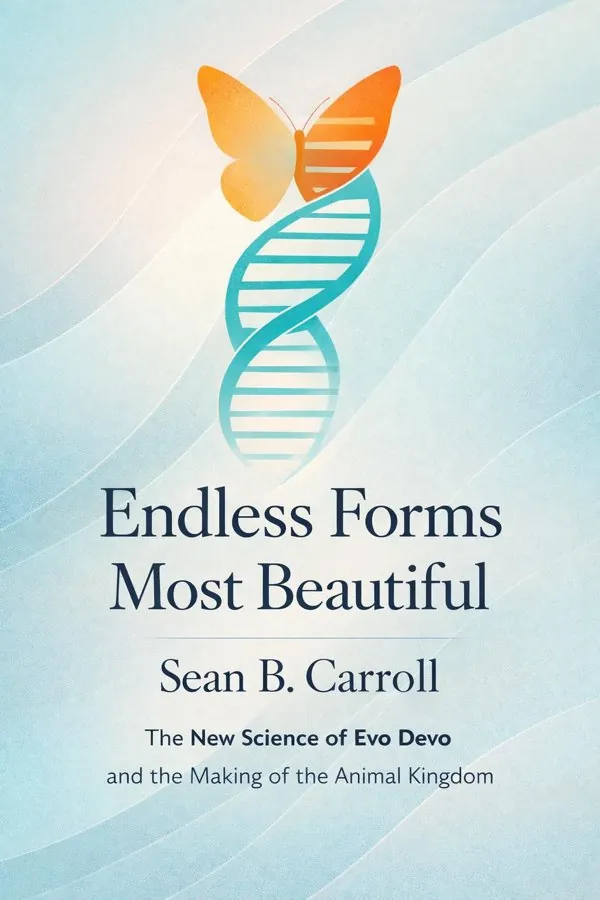
Endless Forms Most Beautiful: The New Science of Evo Devo and the Making of the Animal Kingdom: Summary & Key Insights
 10 min9 chaptersAudio available
Key Takeaways from Endless Forms Most Beautiful: The New Science of Evo Devo and the Making of the Animal Kingdom
A theory of evolution is incomplete if it explains survival but not shape.
The most astonishing fact about animal life may be that enormous outward diversity is built from a surprisingly conserved inner toolkit.
Big anatomical differences can arise without changing the proteins themselves.
If body plans seem miraculous, Hox genes show that they are also remarkably orderly.
Nature is less an inventor of brand-new machinery than a brilliant editor of old instructions.
What Is Endless Forms Most Beautiful: The New Science of Evo Devo and the Making of the Animal Kingdom About?
Endless Forms Most Beautiful: The New Science of Evo Devo and the Making of the Animal Kingdom by Sean B. Carroll is a life_science book spanning 9 pages. Why do animals that look radically different often rely on surprisingly similar genes to build their bodies? In Endless Forms Most Beautiful, evolutionary biologist Sean B. Carroll answers that question by introducing readers to evolutionary developmental biology, or evo devo, the field that connects evolution with the genetic programs that shape embryos. The book shows that the great diversity of animal life did not arise mainly from inventing vast numbers of new genes, but from reusing ancient genetic toolkits in new ways through changes in timing, location, and regulation. Carroll explains one of the most important scientific revolutions in modern biology: the discovery that flies, fish, mice, and humans share deep developmental machinery. He brings abstract genetics to life through vivid examples of wings, limbs, spots, segments, and body plans, showing how small alterations in genetic switches can produce major evolutionary consequences. This matters because it fills a major gap left by Darwin: not whether species evolve, but how new forms are actually built. As a pioneering evo devo researcher and gifted science writer, Carroll is uniquely qualified to guide readers through this transformation in our understanding of life’s history and animal design.
This FizzRead summary covers all 9 key chapters of Endless Forms Most Beautiful: The New Science of Evo Devo and the Making of the Animal Kingdom in approximately 10 minutes, distilling the most important ideas, arguments, and takeaways from Sean B. Carroll's work. Also available as an audio summary and Key Quotes Podcast.
Endless Forms Most Beautiful: The New Science of Evo Devo and the Making of the Animal Kingdom
Why do animals that look radically different often rely on surprisingly similar genes to build their bodies? In Endless Forms Most Beautiful, evolutionary biologist Sean B. Carroll answers that question by introducing readers to evolutionary developmental biology, or evo devo, the field that connects evolution with the genetic programs that shape embryos. The book shows that the great diversity of animal life did not arise mainly from inventing vast numbers of new genes, but from reusing ancient genetic toolkits in new ways through changes in timing, location, and regulation.
Carroll explains one of the most important scientific revolutions in modern biology: the discovery that flies, fish, mice, and humans share deep developmental machinery. He brings abstract genetics to life through vivid examples of wings, limbs, spots, segments, and body plans, showing how small alterations in genetic switches can produce major evolutionary consequences. This matters because it fills a major gap left by Darwin: not whether species evolve, but how new forms are actually built. As a pioneering evo devo researcher and gifted science writer, Carroll is uniquely qualified to guide readers through this transformation in our understanding of life’s history and animal design.
Who Should Read Endless Forms Most Beautiful: The New Science of Evo Devo and the Making of the Animal Kingdom?
This book is perfect for anyone interested in life_science and looking to gain actionable insights in a short read. Whether you're a student, professional, or lifelong learner, the key ideas from Endless Forms Most Beautiful: The New Science of Evo Devo and the Making of the Animal Kingdom by Sean B. Carroll will help you think differently.
- ✓Readers who enjoy life_science and want practical takeaways
- ✓Professionals looking to apply new ideas to their work and life
- ✓Anyone who wants the core insights of Endless Forms Most Beautiful: The New Science of Evo Devo and the Making of the Animal Kingdom in just 10 minutes
Want the full summary?
Get instant access to this book summary and 100K+ more with Fizz Moment.
Get Free SummaryAvailable on App Store • Free to download
Key Chapters
A theory of evolution is incomplete if it explains survival but not shape. Darwin brilliantly showed how natural selection preserves useful variations, yet he had no access to genes, embryos, or the molecular instructions that construct bodies. That left a major unanswered question: how do evolutionary changes actually become physical changes in form, such as longer limbs, new color patterns, or altered body plans?
Carroll argues that evo devo emerged to fill exactly this gap. Classical evolutionary biology described patterns of descent and adaptation, while developmental biology studied how embryos become organisms. For a long time, these fields advanced separately. Evo devo united them by asking how changes in developmental processes produce the forms on which natural selection acts. This shift transformed evolution from a largely historical science into one that could trace visible traits back to genes and regulatory systems.
The importance of this perspective becomes clear in practical examples. Consider the difference between the forelimb of a bat and the arm of a human. Both structures come from similar developmental starting points, but differences in when and where growth genes are activated produce distinct outcomes. Or think of insects with varied appendages; their diversity reflects alterations in developmental instructions, not the invention of entirely new building materials.
The larger lesson is that understanding evolution requires understanding construction. If you want to explain why organisms differ, ask not only which traits were favored, but how embryos were programmed to produce them. Actionable takeaway: when studying any biological trait, look for the developmental mechanism behind the adaptation, not just the adaptive story itself.
Big anatomical differences can arise without changing the proteins themselves. One of Carroll’s central arguments is that many evolutionary transformations are driven not by new genes, but by changes in regulatory DNA, the stretches of noncoding DNA that act like switches controlling when, where, and how strongly genes are turned on. These switches are the logic circuits of development.
This idea helps solve a longstanding puzzle. If humans do not have dramatically more genes than many other organisms, where does morphological complexity come from? The answer lies in regulation. A toolkit gene can be reused in many parts of the body if different switches activate it in different contexts. Evolution can then alter one switch without disrupting the gene’s other functions, making change more precise and less risky.
Carroll illustrates this with examples such as pigmentation patterns in insects and changes in appendages or body structures across species. If a switch activates a gene in one region of an embryo but not another, small mutations in that switch can produce visible differences while leaving the rest of the organism intact. This is one reason regulatory evolution is such a potent source of diversity.
The concept has practical value beyond evolutionary theory. It influences biomedical research into congenital disorders, cancer, and gene expression, where misregulation can matter as much as mutation in a coding sequence. It also changes how we think about innovation in general: systems often become more versatile through better control, not more parts.
Actionable takeaway: pay attention to regulation, not just components. In biology and in complex systems more broadly, outcomes are often shaped less by what parts exist than by how and when they are deployed.
If body plans seem miraculous, Hox genes show that they are also remarkably orderly. Carroll emphasizes that one of the great breakthroughs in developmental biology was the discovery of Hox genes, a family of master regulators that help determine the identity of body regions along the head-to-tail axis. These genes act like positional instructions, telling developing tissues whether they belong in the thorax, abdomen, neck, or other segments.
What makes Hox genes especially striking is their deep conservation across animals. The same basic logic that patterns a fruit fly’s body can also be found in vertebrates. In many species, the physical order of Hox genes on the chromosome even corresponds to the order in which they are activated in the body. This elegant relationship reveals a profound unity behind animal design.
Changes in Hox gene activity can produce dramatic effects. A segment may grow legs instead of antennae, or vertebral identities may shift. Over evolutionary time, modifications in Hox expression contributed to the diversification of body architectures, helping generate major differences across lineages. Yet these changes are not random; they operate within a structured developmental framework.
This has practical significance for anyone trying to understand both evolution and developmental disorders. It explains why some mutations produce large-scale anatomical transformations, and why certain patterns recur across lineages. It also highlights a design principle relevant in many domains: higher-level organizing rules can shape countless downstream outcomes.
Actionable takeaway: when confronted with complex forms, look for the underlying coordinate system. In development, as in architecture or software, master patterning rules often explain more than isolated details.
Nature is less an inventor of brand-new machinery than a brilliant editor of old instructions. Carroll argues that major evolutionary innovations usually emerge through modifications of existing developmental programs. Instead of creating wholly new genes for each new trait, evolution repurposes ancestral networks, alters regulatory switches, and recombines modules to generate fresh structures and functions.
This perspective makes sense of how rapid bursts of innovation can occur without impossible leaps in complexity. Feathers, limbs, jaws, and elaborate color patterns were not conjured from nothing. They evolved through stepwise changes in tissues and regulatory systems that already existed. New traits often begin as modifications of old ones, with selection gradually refining them into structures that seem entirely novel in hindsight.
Carroll’s framework is especially useful in understanding evolutionary transitions in the fossil record. Intermediate forms become more intelligible when we think in terms of altered developmental pathways rather than sudden appearance. For example, changes in the growth and patterning of paired appendages can help explain how fins and limbs relate, while shifts in regulatory timing can account for reductions or elaborations of structures.
The same logic appears in technology and culture. New tools rarely emerge from pure invention; they more often result from recombining familiar components in new ways. Evo devo shows that life works similarly, but over immense timescales and under natural selection.
Actionable takeaway: when evaluating any apparent novelty, ask what older system it may have been built from. Evolutionary understanding improves dramatically when you treat innovation as transformation, not spontaneous creation.
Evolution can experiment because organisms are built in semi-independent parts. Carroll highlights modularity as a crucial principle of development and evolution. Body structures, gene networks, and regulatory systems are often organized into modules, units that can change somewhat independently without collapsing the entire organism. This compartmentalization makes evolutionary change more feasible.
Why does this matter? If every gene affected every trait equally, most mutations would be catastrophic. But when gene regulation is modular, one enhancer can control expression in a wing while another controls expression in a leg. A mutation in the wing enhancer may alter wing shape without disrupting leg development. This allows natural selection to fine-tune particular traits while preserving the rest of the body plan.
Carroll uses this principle to explain how animals can evolve specialized appendages, distinct color patches, or altered structures in one region while maintaining stability elsewhere. Modularity also helps account for repeated evolution, where similar traits arise independently in different lineages because the same developmental modules are available for modification.
The concept has broad applications. In evolutionary theory, modularity explains evolvability, the capacity of organisms to generate useful variation. In engineering and design, modular systems are easier to adapt, repair, and improve. In medicine, understanding modular regulation can clarify why some mutations affect only one tissue or developmental stage.
Actionable takeaway: seek modular organization in complex systems. Whether you are studying biology, designing products, or managing processes, flexibility and innovation become more achievable when changes can be made locally without destabilizing the whole.
The deeper we study life, the more its sameness explains its variety. One of Carroll’s most elegant lessons is that the unity of life and the diversity of life are not competing ideas. They are two sides of the same evolutionary reality. Shared genetic toolkits and conserved developmental pathways reveal common ancestry, while differences in gene regulation, timing, and deployment generate the spectacular range of animal forms.
This insight changes how we interpret biological diversity. Diversity does not mean disconnected origins or endless independent inventions. Instead, it often reflects a limited set of ancient developmental strategies being modified across time and lineages. The same signaling pathways and master regulators can produce radically different outcomes depending on context. That is why a small number of deeply conserved mechanisms can underlie such a vast menagerie of forms.
Carroll also pushes readers toward a more nuanced understanding of complexity. More diverse outcomes do not necessarily require more genes. They require richer patterns of interaction and regulation. This principle helps explain why evolution can be both conservative and creative at once: conservative in preserving useful core systems, creative in rearranging and redirecting them.
The practical value of this idea extends beyond biology. It offers a way to think about innovation in organizations, technologies, and cultures. Diversity often arises from new combinations and rules for using existing resources, not from constant invention of entirely new components.
Actionable takeaway: stop treating similarity and difference as separate puzzles. In evolutionary thinking, ask how shared foundations make diversity possible; that question often reveals the deepest structure of change.
A scientific field matters most when it changes the questions we ask. Carroll presents evo devo not as a niche specialty, but as a transformative framework for the future of biology. By integrating genetics, embryology, paleontology, and comparative anatomy, evo devo reshaped the study of evolution from a focus on gene frequencies and population change alone to a fuller account of how body plans and novel forms arise.
This forward-looking perspective is especially important in the genomic era. As more genomes became available, scientists learned that gene inventories alone could not explain form. The future lies in mapping regulatory networks, developmental pathways, and the architecture of genetic switches. Evo devo thus points biology toward questions of system-level organization: how traits are built, how constraints operate, and how developmental bias channels evolutionary possibilities.
Carroll’s broader contribution is conceptual clarity. He helps readers see that natural selection remains essential, but selection acts on variation generated through development. To understand evolution deeply, one must understand both the origin of variation and the filtering effect of selection. This integrated view is now central to many areas, from evolutionary medicine to synthetic biology.
For readers, the future-oriented lesson is that biology advances when boundaries between disciplines break down. The most fruitful discoveries often happen at the intersections.
Actionable takeaway: cultivate interdisciplinary thinking. Whether in science or other fields, breakthrough understanding often emerges when you connect mechanism, history, and function instead of studying each in isolation.
All Chapters in Endless Forms Most Beautiful: The New Science of Evo Devo and the Making of the Animal Kingdom
About the Author
Sean B. Carroll is an American evolutionary biologist, author, and science educator known for helping define the field of evolutionary developmental biology. His research has focused on how genes control animal development and how changes in those genetic programs drive evolutionary change. Carroll became widely recognized not only for his scientific contributions, but also for his ability to translate complex biology into clear, engaging prose for general audiences. He has written several acclaimed popular science books and has played a major role in public science communication and education. Carroll has also served as Vice President for Science Education at the Howard Hughes Medical Institute. His work stands out for linking cutting-edge research with broad questions about evolution, form, and the history of life.
Get This Summary in Your Preferred Format
Read or listen to the Endless Forms Most Beautiful: The New Science of Evo Devo and the Making of the Animal Kingdom summary by Sean B. Carroll anytime, anywhere. FizzRead offers multiple formats so you can learn on your terms — all free.
Available formats: App · Audio · PDF · EPUB — All included free with FizzRead
Download Endless Forms Most Beautiful: The New Science of Evo Devo and the Making of the Animal Kingdom PDF and EPUB Summary
Key Quotes from Endless Forms Most Beautiful: The New Science of Evo Devo and the Making of the Animal Kingdom
“A theory of evolution is incomplete if it explains survival but not shape.”
“The most astonishing fact about animal life may be that enormous outward diversity is built from a surprisingly conserved inner toolkit.”
“Big anatomical differences can arise without changing the proteins themselves.”
“If body plans seem miraculous, Hox genes show that they are also remarkably orderly.”
“Nature is less an inventor of brand-new machinery than a brilliant editor of old instructions.”
Frequently Asked Questions about Endless Forms Most Beautiful: The New Science of Evo Devo and the Making of the Animal Kingdom
Endless Forms Most Beautiful: The New Science of Evo Devo and the Making of the Animal Kingdom by Sean B. Carroll is a life_science book that explores key ideas across 9 chapters. Why do animals that look radically different often rely on surprisingly similar genes to build their bodies? In Endless Forms Most Beautiful, evolutionary biologist Sean B. Carroll answers that question by introducing readers to evolutionary developmental biology, or evo devo, the field that connects evolution with the genetic programs that shape embryos. The book shows that the great diversity of animal life did not arise mainly from inventing vast numbers of new genes, but from reusing ancient genetic toolkits in new ways through changes in timing, location, and regulation. Carroll explains one of the most important scientific revolutions in modern biology: the discovery that flies, fish, mice, and humans share deep developmental machinery. He brings abstract genetics to life through vivid examples of wings, limbs, spots, segments, and body plans, showing how small alterations in genetic switches can produce major evolutionary consequences. This matters because it fills a major gap left by Darwin: not whether species evolve, but how new forms are actually built. As a pioneering evo devo researcher and gifted science writer, Carroll is uniquely qualified to guide readers through this transformation in our understanding of life’s history and animal design.
More by Sean B. Carroll
You Might Also Like
The Selfish Gene
Richard Dawkins
10 min
Awakenings
Oliver Sacks
10 min
Parasite Rex: Inside the Bizarre World of Nature's Most Dangerous Creatures
Carl Zimmer
10 min
The Atlas of Life on Earth
Various
10 min
The Book of Humans: The Story of How We Became Us
Adam Rutherford
10 min
The Horse
Wendy Williams
10 minBrowse by Category
Ready to read Endless Forms Most Beautiful: The New Science of Evo Devo and the Making of the Animal Kingdom?
Get the full summary and 100K+ more books with Fizz Moment.