
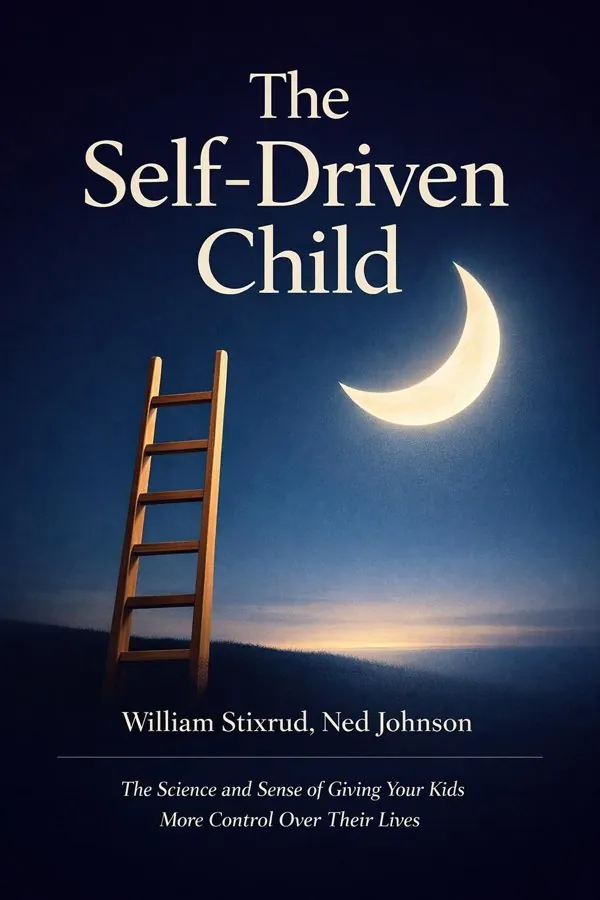
The Self-Driven Child: The Science and Sense of Giving Your Kids More Control Over Their Lives: Summary & Key Insights
by William Stixrud, Ned Johnson
 10 min13 chaptersAudio available
What Is The Self-Driven Child: The Science and Sense of Giving Your Kids More Control Over Their Lives About?
The Self-Driven Child: The Science and Sense of Giving Your Kids More Control Over Their Lives by William Stixrud, Ned Johnson is a parenting book spanning 13 pages. This book explores how parents can help their children develop autonomy, motivation, and resilience by giving them more control over their own lives. Drawing on neuroscience and psychology, the authors argue that self-driven growth leads to better mental health and long-term success.
This FizzRead summary covers all 13 key chapters of The Self-Driven Child: The Science and Sense of Giving Your Kids More Control Over Their Lives in approximately 10 minutes, distilling the most important ideas, arguments, and takeaways from William Stixrud, Ned Johnson's work. Also available as an audio summary and Key Quotes Podcast.
The Self-Driven Child: The Science and Sense of Giving Your Kids More Control Over Their Lives
This book explores how parents can help their children develop autonomy, motivation, and resilience by giving them more control over their own lives. Drawing on neuroscience and psychology, the authors argue that self-driven growth leads to better mental health and long-term success.
Who Should Read The Self-Driven Child: The Science and Sense of Giving Your Kids More Control Over Their Lives?
This book is perfect for anyone interested in parenting and looking to gain actionable insights in a short read. Whether you're a student, professional, or lifelong learner, the key ideas from The Self-Driven Child: The Science and Sense of Giving Your Kids More Control Over Their Lives by William Stixrud, Ned Johnson will help you think differently.
- ✓Readers who enjoy parenting and want practical takeaways
- ✓Professionals looking to apply new ideas to their work and life
- ✓Anyone who wants the core insights of The Self-Driven Child: The Science and Sense of Giving Your Kids More Control Over Their Lives in just 10 minutes
Want the full summary?
Get instant access to this book summary and 100K+ more with Fizz Moment.
Get Free SummaryAvailable on App Store • Free to download
Key Chapters
The feeling of control—or the lack of it—has deep biological roots. In the brain, the prefrontal cortex acts as the executive center, regulating thought, emotion, and decision-making. It is also the system that interprets whether we are in charge of our lives or at the mercy of circumstance. When a child feels chronically powerless, stress hormones flood the body, impairing memory and logical reasoning. Conversely, when a child experiences autonomy, neural networks associated with learning and curiosity light up.
Ned and I often say that the prefrontal cortex is trained by doing: by making choices, solving problems, and experiencing consequences. When parents take over these tasks, the brain’s self-regulative machinery never gets proper practice. Neuropsychological research confirms that children who are allowed to make their own decisions—even small ones—develop stronger executive functioning. They learn to tolerate discomfort, weigh options, and trust their ability to recover from setbacks. This is not permissiveness; it is development in action.
I recall one study showing that rats given some control over their environment—able to press a lever for food or adjust lighting—had healthier stress profiles than those who were purely passive. Humans work the same way. We do not thrive in captivity. We thrive when we know our choices matter. And the cumulative result is profound resilience.
Modern childhood is saturated with stress: academic competition, social comparison, and digital overwhelm. But what damages kids most is not stress itself—it is the absence of control over stress. Chronic helplessness rewires the brain toward anxiety and avoidance. When children think, “I have no say,” their bodies live in perpetual fight-or-flight.
As parents, we sometimes contribute to this unknowingly. We micromanage schedules, correct every mistake, and worry so loudly that our children internalize the message that life is a test they will fail without supervision. But the antidote to stress is not protection—it is competence. When children are trusted to handle challenges and supported through their inevitable failures, they learn physiological calm. They begin to see stress as something to be managed, not feared. This reframing builds the emotional circuitry required for resilience.
I often tell parents that your goal is not to eliminate your child’s stress but to equip them to navigate it. That begins with empathy, conversation, and the courage to step back when instinct says step in.
+ 11 more chapters — available in the FizzRead app
All Chapters in The Self-Driven Child: The Science and Sense of Giving Your Kids More Control Over Their Lives
About the Authors
William Stixrud, Ph.D., is a clinical neuropsychologist and faculty member at Children's National Medical Center and George Washington University School of Medicine. Ned Johnson is a professional tutor and founder of PrepMatters, a tutoring service in Washington, D.C.
Get This Summary in Your Preferred Format
Read or listen to the The Self-Driven Child: The Science and Sense of Giving Your Kids More Control Over Their Lives summary by William Stixrud, Ned Johnson anytime, anywhere. FizzRead offers multiple formats so you can learn on your terms — all free.
Available formats: App · Audio · PDF · EPUB — All included free with FizzRead
Download The Self-Driven Child: The Science and Sense of Giving Your Kids More Control Over Their Lives PDF and EPUB Summary
Key Quotes from The Self-Driven Child: The Science and Sense of Giving Your Kids More Control Over Their Lives
“The feeling of control—or the lack of it—has deep biological roots.”
“Modern childhood is saturated with stress: academic competition, social comparison, and digital overwhelm.”
Frequently Asked Questions about The Self-Driven Child: The Science and Sense of Giving Your Kids More Control Over Their Lives
The Self-Driven Child: The Science and Sense of Giving Your Kids More Control Over Their Lives by William Stixrud, Ned Johnson is a parenting book that explores key ideas across 13 chapters. This book explores how parents can help their children develop autonomy, motivation, and resilience by giving them more control over their own lives. Drawing on neuroscience and psychology, the authors argue that self-driven growth leads to better mental health and long-term success.
You Might Also Like

Never Enough
Jennifer Breheny Wallace
10 min
Bluey: Sleepytime
Joe Brumm
10 min
In My Heart: A Book of Feelings
Jo Witek
10 min
Love From The Crayons
Drew Daywalt, Oliver Jeffers
10 min
Pete The Cat: Big Easter Adventure
James Dean, Kimberly Dean
10 min
Smart Money Smart Kids: Raising the Next Generation to Win with Money
Dave Ramsey, Rachel Cruze
10 minBrowse by Category
Ready to read The Self-Driven Child: The Science and Sense of Giving Your Kids More Control Over Their Lives?
Get the full summary and 100K+ more books with Fizz Moment.