
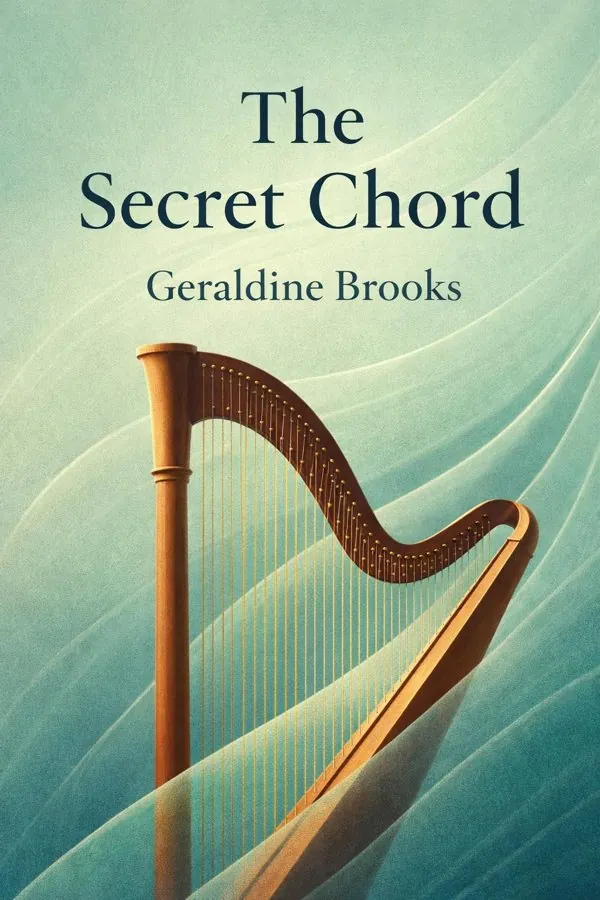
The Secret Chord: Summary & Key Insights
 10 min10 chaptersAudio available
Key Takeaways from The Secret Chord
History is never neutral, especially when it is written by someone who loved the subject and feared him at the same time.
Greatness often begins in obscurity, where inner life is formed long before the world notices.
A single act of courage can create a public identity that a person spends the rest of life trying to inhabit.
Some of the most life-shaping bonds are not inherited but chosen.
Who we become in uncertainty often matters more than how we look in victory.
What Is The Secret Chord About?
The Secret Chord by Geraldine Brooks is a bestsellers book spanning 11 pages. Geraldine Brooks’s The Secret Chord is a bold, lyrical reimagining of the life of King David, one of the most celebrated and troubling figures in biblical literature. Rather than presenting David as a distant icon, Brooks renders him as a deeply human ruler: gifted, magnetic, ruthless, tender, inspired, and fatally flawed. The story is told through the voice of Natan, the prophet charged with recording David’s life, a choice that gives the novel both intimacy and moral tension. Natan admires the king, serves him, and at times must confront him, making the narrative feel less like legend and more like living memory. What makes this novel matter is its refusal to simplify greatness. Brooks explores how power enlarges both virtue and weakness, how private desire shapes public destiny, and how history is always filtered through those who survive to tell it. A Pulitzer Prize-winning novelist and former foreign correspondent, Brooks brings rare authority to historical fiction, combining meticulous research with psychological depth. The result is a novel that speaks not only to biblical history, but to timeless questions about leadership, loyalty, ambition, love, and the cost of becoming unforgettable.
This FizzRead summary covers all 10 key chapters of The Secret Chord in approximately 10 minutes, distilling the most important ideas, arguments, and takeaways from Geraldine Brooks's work. Also available as an audio summary and Key Quotes Podcast.
The Secret Chord
Geraldine Brooks’s The Secret Chord is a bold, lyrical reimagining of the life of King David, one of the most celebrated and troubling figures in biblical literature. Rather than presenting David as a distant icon, Brooks renders him as a deeply human ruler: gifted, magnetic, ruthless, tender, inspired, and fatally flawed. The story is told through the voice of Natan, the prophet charged with recording David’s life, a choice that gives the novel both intimacy and moral tension. Natan admires the king, serves him, and at times must confront him, making the narrative feel less like legend and more like living memory.
What makes this novel matter is its refusal to simplify greatness. Brooks explores how power enlarges both virtue and weakness, how private desire shapes public destiny, and how history is always filtered through those who survive to tell it. A Pulitzer Prize-winning novelist and former foreign correspondent, Brooks brings rare authority to historical fiction, combining meticulous research with psychological depth. The result is a novel that speaks not only to biblical history, but to timeless questions about leadership, loyalty, ambition, love, and the cost of becoming unforgettable.
Who Should Read The Secret Chord?
This book is perfect for anyone interested in bestsellers and looking to gain actionable insights in a short read. Whether you're a student, professional, or lifelong learner, the key ideas from The Secret Chord by Geraldine Brooks will help you think differently.
- ✓Readers who enjoy bestsellers and want practical takeaways
- ✓Professionals looking to apply new ideas to their work and life
- ✓Anyone who wants the core insights of The Secret Chord in just 10 minutes
Want the full summary?
Get instant access to this book summary and 100K+ more with Fizz Moment.
Get Free SummaryAvailable on App Store • Free to download
Key Chapters
History is never neutral, especially when it is written by someone who loved the subject and feared him at the same time. One of the most compelling ideas in The Secret Chord is the decision to tell David’s life through Natan, the prophet and counselor who becomes both witness and interpreter. This framing transforms the novel from a simple retelling into a meditation on memory, responsibility, and moral courage.
Natan is not an omniscient narrator floating above events. He is implicated in them. He has advised kings, kept dangerous secrets, and watched the distance grow between David’s divine calling and his earthly appetites. Because of this, his voice carries tension. He wants to honor what was extraordinary in David, yet he cannot hide what was destructive. Brooks uses that tension to show how truth often emerges not from certainty, but from honest struggle.
This matters beyond the novel. In real life, we often become narrators of powerful people: leaders at work, parents in families, founders in institutions, even public figures we admire. The temptation is always to turn them into heroes or villains. Brooks suggests a wiser path: tell the fuller story. Hold brilliance and failure in the same frame.
A practical application is to examine the stories you tell about authority in your own life. Do you excuse wrongdoing because someone is talented? Do you erase complexity because clarity feels safer? Whether you are writing, leading, mentoring, or remembering, integrity begins when you resist simplification.
Actionable takeaway: When evaluating a person of influence, ask yourself, “What truth am I tempted to omit?” and start there.
Greatness often begins in obscurity, where inner life is formed long before the world notices. Brooks returns repeatedly to David’s youth in Bethlehem to show that his rise is not merely political luck or battlefield opportunity. It is rooted in attentiveness: to the land, to animals, to silence, and above all to music. As a shepherd boy, David develops both watchfulness and imagination, qualities that later make him at once a poet, strategist, and king.
In Brooks’s telling, music is not ornamental. It is central to David’s being. His harp becomes a means of communion, consolation, and influence. The same sensitivity that allows him to soothe Saul’s tormented mind also equips him to perceive currents others miss. Music here symbolizes more than art; it represents the capacity to hear a deeper order in the world, the “secret chord” that connects beauty, grief, and destiny.
This idea has practical resonance. We tend to celebrate visible achievements while overlooking the hidden disciplines that make them possible. David’s early life reminds us that solitude can prepare us for leadership better than applause can. The habits formed when no one is watching—practice, attention, emotional depth, and patience—often determine how we act when power finally arrives.
For modern readers, this can mean protecting time for reflective work rather than constant performance. A manager who learns to listen deeply, an artist who keeps refining craft in private, or a student who builds concentration away from distraction is doing the same kind of preparation.
Actionable takeaway: Identify one quiet practice that strengthens your inner life—journaling, music, reading, prayer, or focused reflection—and treat it as preparation for future responsibility.
A single act of courage can create a public identity that a person spends the rest of life trying to inhabit. David’s victory over Goliath launches him into fame, but Brooks is careful to show that triumph is never simple. The same event that marks him as chosen also makes him dangerous in the eyes of Saul. Public success, in other words, does not secure peace; it attracts rivalry, projection, and fear.
Brooks portrays David’s early rise as a collision between charisma and political reality. He is not only brave but useful, not only inspired but visible. Songs are sung about him, and songs have consequences. Reputation begins to shape destiny. Saul’s jealousy intensifies because David’s renown exposes the king’s fragility. This is one of the novel’s sharpest insights: power often becomes unstable when symbolic authority shifts before formal authority does.
The idea applies widely today. In workplaces, communities, and creative fields, someone’s breakthrough can trigger admiration and resentment at once. Success changes relationships. People who once felt secure may become defensive; supporters may begin to expect invincibility. Brooks reminds us that recognition is not the end of struggle but the start of a more complex one.
A practical lesson is to prepare for the social consequences of achievement. If you gain influence, think about how to stay grounded, avoid needless provocation, and recognize insecurity in others without becoming captive to it. Courage must be paired with discernment. Winning one battle does not mean you understand the battlefield that follows.
Actionable takeaway: When success raises your profile, pause to assess how relationships are shifting and respond with humility, clarity, and strategic awareness.
Some of the most life-shaping bonds are not inherited but chosen. In The Secret Chord, the relationship between David and Jonathan is one of the emotional anchors of the novel. Brooks presents their connection as profound, intimate, and politically charged. Jonathan, Saul’s son, should by dynastic logic see David as a threat. Instead, he recognizes him as a kindred spirit and binds himself to him in loyalty that transcends ordinary alliance.
What makes this relationship so powerful is that it stands against the logic of succession, tribal expectation, and family obligation. Jonathan chooses devotion over entitlement. David, in turn, experiences a kind of understanding that few others can offer him. Their bond reveals a recurring Brooks theme: love and loyalty are often strongest where they are least convenient.
This idea has important implications. Modern life still places enormous pressure on blood ties, status expectations, and transactional networks. Yet many people are sustained most deeply by friendships, mentors, collaborators, and companions who see them clearly and stay loyal without possessing them. Chosen kinship can be a source of courage, moral grounding, and emotional refuge.
Practically, this invites readers to reconsider what they owe the people who have stood beside them freely. It also raises a more difficult question: do we honor relationships only when they are advantageous, or also when they are costly? Jonathan’s love is meaningful precisely because it asks sacrifice.
Actionable takeaway: Identify one person who has offered you steadfast loyalty, and strengthen that bond through gratitude, honesty, and concrete reciprocity rather than assumption.
Who we become in uncertainty often matters more than how we look in victory. David’s years of flight from Saul are among the most formative in Brooks’s novel. Exile strips him of comfort, status, and predictability, but it also reveals and develops the traits that later define his reign: adaptability, cunning, generosity toward followers, and a dangerous familiarity with violence.
Brooks does not romanticize hardship. Exile is humiliating, exhausting, and morally compromising. David survives by negotiating with dubious allies, moving through hostile territories, and making decisions under constant threat. Yet these pressures teach him how fractured power really is. He learns that leadership is not only about command but about reading people, building loyalty, managing scarcity, and choosing which line not to cross.
One of the most striking elements of this section is David’s restraint toward Saul. Despite repeated opportunities, he does not seize the throne by killing the king. That restraint becomes a key part of his legitimacy. Brooks shows that what a person refuses to do can shape destiny as much as what he accomplishes.
For readers, exile can stand for any period of professional instability, grief, displacement, or waiting. These seasons often feel like interruptions, but they may be where judgment is sharpened and identity clarified. The challenge is to emerge more discerning rather than merely more defensive.
A practical application is to ask, during difficult transitions, not only “How do I survive this?” but “What habits am I building under pressure?” Hard times can cultivate patience and courage, or bitterness and opportunism.
Actionable takeaway: In your current challenge, choose one non-negotiable principle you will not abandon, even if compromise seems expedient.
A ruler’s deepest ambitions become visible in the city he builds. When David consolidates power and establishes Jerusalem, Brooks shows leadership moving from improvisation to institution. This is no longer the story of a gifted fugitive surviving danger; it is the story of a king shaping national identity. Jerusalem becomes more than a political center. It is symbol, strategy, and spiritual theater all at once.
Brooks highlights how David understands the importance of unifying disparate tribes through shared sacred and civic focus. By making Jerusalem his capital and bringing the Ark there, he fuses religious meaning with royal authority. It is a brilliant act of statecraft, but also a revealing one. The city embodies David’s genius for symbolic action. He knows that power must be seen, felt, and believed, not merely enforced.
Yet Brooks also suggests that institution-building contains risk. Once authority stabilizes, it can become insulated. The flexibility that made David effective in adversity can harden into entitlement inside the palace. What begins as vision can slowly justify excess. The same king who creates order also creates distance between himself and ordinary consequence.
This has strong contemporary relevance. Whether in business, politics, nonprofits, or families, building structures is necessary. Vision without systems collapses. But systems can also protect ego, obscure accountability, and transform service into self-preservation. Leaders must revisit the purpose behind the structures they create.
Practically, if you are building a team or organization, ask not only whether your system is efficient, but whether it still reflects the values that inspired it. Institutions are not neutral; they train behavior.
Actionable takeaway: Review one structure you lead—meeting rhythms, policies, communication habits, or traditions—and ask whether it serves the mission or merely preserves authority.
Private appetite becomes public tragedy when power removes ordinary limits. Brooks’s treatment of David’s relationships with Michal, Abigail, and Bathsheba reveals how love in the novel is never separate from status, vulnerability, and political consequence. Each woman illuminates a different dimension of David: his need to be seen, his hunger for solace, his capacity for tenderness, and his willingness to take what should not be his.
Michal brings royal legitimacy and personal complexity; Abigail embodies intelligence and steadiness; Bathsheba becomes the most devastating example of desire entangled with kingship. Brooks refuses simplistic moral categories here. David is not a cartoon seducer, nor are these women mere plot devices. Instead, the novel shows how emotional longing, loneliness, entitlement, and unchecked access can distort judgment.
The Bathsheba episode is especially important because it marks a turning point. David’s earlier flaws could coexist with his charisma; here, his privilege openly consumes another person’s life and sets off cascading destruction. Brooks underscores a hard truth: power does not merely tempt people to do wrong; it often convinces them that their wants are exceptional.
This theme remains urgent. In modern settings, from executive offices to cultural institutions, the abuse of privilege often begins with self-justifying stories: I deserve this, I am different, no one will be harmed, my gifts outweigh my failures. Brooks exposes that logic as ruinous.
A practical application is to build accountability before temptation arrives. Boundaries, honest peers, and clear ethical standards are not signs of weakness but protections against self-deception.
Actionable takeaway: Examine one area where your status, experience, or access gives you unusual freedom, and put a concrete boundary in place to prevent misuse.
The measure of a society is often found in whether anyone can tell the truth to its most powerful person. One of the defining moments in The Secret Chord is Natan’s confrontation of David after his sin with Bathsheba and the arranged death of Uriah. Brooks presents this not only as a biblical turning point but as a profound study in moral accountability. Natan risks safety, favor, and perhaps his life in order to speak judgment where flattery would have been easier.
What makes the scene so memorable is the method. Natan does not begin with accusation alone; he tells a story that awakens David’s own moral perception. Only after the king condemns the injustice in the parable does Natan reveal, in effect, that the guilty man is David himself. Brooks thereby illustrates a deep truth about conscience: people often recognize wrongdoing more clearly in abstraction than in themselves.
This dynamic appears everywhere. Leaders condemn corruption while excusing their own excesses. Parents demand integrity from children while avoiding self-examination. Organizations defend values publicly while violating them internally. The novel insists that moral language means little without self-application.
Brooks also suggests that rebuke, when rooted in truth rather than humiliation, can become a final form of loyalty. Natan does not expose David because he hates him. He does so because the alternative is complicity. In that sense, accountability is not the enemy of greatness; it is one of the last things that can preserve it.
Actionable takeaway: Invite one trusted person to challenge you honestly when your behavior and values no longer align, and make it safe for them to tell the truth.
The deepest consequences of wrongdoing often unfold not in public disgrace, but in the private fractures that follow. Brooks traces this with devastating power in the story of Absalom’s rebellion. David’s household becomes a theater of unresolved grief, favoritism, violence, and silence. The king who unified tribes cannot govern the chaos within his own family.
Brooks shows that Absalom’s revolt does not emerge from nowhere. It grows out of earlier failures: David’s passivity after sexual violence within the family, his inconsistent justice, and his inability to reconcile paternal love with kingly responsibility. Absalom is both son and political challenger, wounded child and dangerous rival. This complexity prevents the conflict from becoming merely strategic. It is tragic precisely because affection and threat are inseparable.
One of the novel’s strongest insights is that authority in one sphere does not guarantee wisdom in another. David can command armies and shape a kingdom, yet remain indecisive where emotional courage is required. Many readers will recognize this pattern. People can be highly competent professionally while neglecting painful issues at home, assuming time or status will solve what only honest intervention can address.
The rebellion also reveals that unaddressed injustice rarely stays contained. What is ignored in private eventually erupts in public. Families, teams, and institutions all suffer when leaders avoid conflict for the sake of comfort or image.
A practical lesson is to deal early with breaches of trust, favoritism, and hidden resentment. Compassion does not mean passivity, and love without accountability can become a form of abandonment.
Actionable takeaway: Identify one unresolved conflict in a close relationship or team, and take a first concrete step toward addressing it directly and fairly.
A meaningful life is not a tidy one, and Brooks’s final achievement is her refusal to make David easier than he is. In the later years of the novel, the king is no longer simply a figure of vigor and appetite. He is aging, remembering, grieving, and increasingly aware that his legacy will outlive his explanations. This is where the title’s central metaphor becomes clearest: the “secret chord” is the hidden resonance that binds ecstasy to sorrow, calling to consequence, and greatness to brokenness.
Brooks suggests that David endures in memory not because he was morally consistent, but because he was fully alive to extremes of human experience. He wrote songs of praise and lament, forged a kingdom and damaged a family, inspired devotion and caused suffering. His story forces readers to confront an uncomfortable truth: historical greatness and personal goodness are not the same thing.
That insight matters today because culture often swings between idolizing leaders and canceling them into flatness. Brooks offers a more demanding approach. She asks us to live with contradiction without surrendering judgment. Complexity is not absolution. At the same time, failure does not erase all value. Wisdom lies in discerning both clearly.
For readers, this becomes an invitation to examine their own lives honestly. What songs are we writing with our choices? What kind of memory are we building in the lives of others? Legacy is not only what history says about us; it is what our actions leave behind in those closest to us.
Actionable takeaway: Write down the three qualities you most want to be remembered for, then compare them with your actual habits and make one immediate change.
All Chapters in The Secret Chord
About the Author
Geraldine Brooks is an Australian-American novelist and journalist celebrated for her richly researched historical fiction. Born in Sydney, she began her career in journalism and worked as a foreign correspondent for The Wall Street Journal, reporting from regions including the Middle East, Africa, and the Balkans. Her firsthand experience covering conflict, religion, and political upheaval gave her a sharp understanding of history’s human dimensions, a quality that deeply informs her novels. Brooks achieved major literary recognition with March, which won the Pulitzer Prize for Fiction, and has since written acclaimed works such as People of the Book, Caleb’s Crossing, The Secret Chord, and Horse. Her fiction is known for combining meticulous historical detail with emotional intelligence, vivid prose, and psychologically complex characters.
Get This Summary in Your Preferred Format
Read or listen to the The Secret Chord summary by Geraldine Brooks anytime, anywhere. FizzRead offers multiple formats so you can learn on your terms — all free.
Available formats: App · Audio · PDF · EPUB — All included free with FizzRead
Download The Secret Chord PDF and EPUB Summary
Key Quotes from The Secret Chord
“History is never neutral, especially when it is written by someone who loved the subject and feared him at the same time.”
“Greatness often begins in obscurity, where inner life is formed long before the world notices.”
“A single act of courage can create a public identity that a person spends the rest of life trying to inhabit.”
“Some of the most life-shaping bonds are not inherited but chosen.”
“Who we become in uncertainty often matters more than how we look in victory.”
Frequently Asked Questions about The Secret Chord
The Secret Chord by Geraldine Brooks is a bestsellers book that explores key ideas across 10 chapters. Geraldine Brooks’s The Secret Chord is a bold, lyrical reimagining of the life of King David, one of the most celebrated and troubling figures in biblical literature. Rather than presenting David as a distant icon, Brooks renders him as a deeply human ruler: gifted, magnetic, ruthless, tender, inspired, and fatally flawed. The story is told through the voice of Natan, the prophet charged with recording David’s life, a choice that gives the novel both intimacy and moral tension. Natan admires the king, serves him, and at times must confront him, making the narrative feel less like legend and more like living memory. What makes this novel matter is its refusal to simplify greatness. Brooks explores how power enlarges both virtue and weakness, how private desire shapes public destiny, and how history is always filtered through those who survive to tell it. A Pulitzer Prize-winning novelist and former foreign correspondent, Brooks brings rare authority to historical fiction, combining meticulous research with psychological depth. The result is a novel that speaks not only to biblical history, but to timeless questions about leadership, loyalty, ambition, love, and the cost of becoming unforgettable.
More by Geraldine Brooks


You Might Also Like

The Godfather
Mario Puzo
10 min
The Handmaid's Tale
Margaret Atwood
10 min
The Hunger Games
Suzanne Collins
10 min
The Nightingale
Kristin Hannah
10 min
The Seven Husbands of Evelyn Hugo
Taylor Jenkins Reid
10 min
Backwater Justice
Fern Michaels
10 minBrowse by Category
Ready to read The Secret Chord?
Get the full summary and 100K+ more books with Fizz Moment.