
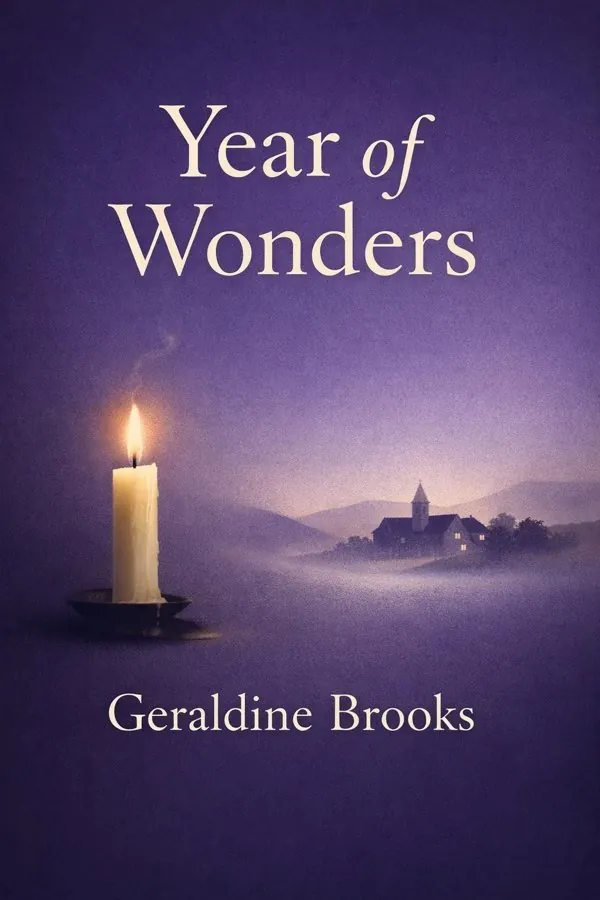
Year of Wonders: A Novel of the Plague: Summary & Key Insights
 10 min9 chaptersAudio available
Key Takeaways from Year of Wonders: A Novel of the Plague
Disaster is most frightening when it enters through an everyday door.
Real courage is sometimes the decision to stay put.
Catastrophe does not simply reveal character; it can create it.
Belief becomes most visible when certainty collapses.
A community under pressure can become both more intimate and more brutal.
What Is Year of Wonders: A Novel of the Plague About?
Year of Wonders: A Novel of the Plague by Geraldine Brooks is a classics book spanning 4 pages. What happens when an ordinary community is asked to choose sacrifice over self-preservation? Geraldine Brooks’s Year of Wonders: A Novel of the Plague answers that question through the unforgettable story of Anna Frith, a young widow living in the Derbyshire village of Eyam in 1666. When the bubonic plague arrives in a bundle of cloth, the village makes a radical decision: to quarantine itself so the disease will not spread beyond its borders. From that premise, Brooks builds a powerful historical novel about fear, faith, grief, social order, and moral courage. What makes the book so compelling is that it combines intimate human drama with sweeping moral questions. Anna begins as a practical, working woman with little power, yet the catastrophe forces her into profound transformation. Around her, Brooks depicts a village under pressure, where kindness and cruelty, reason and superstition, devotion and hypocrisy all intensify. Brooks brings exceptional authority to the story through her background as a journalist and her gift for vivid historical detail. The result is a classic work of historical fiction that feels both deeply rooted in the seventeenth century and urgently relevant to any age of crisis.
This FizzRead summary covers all 9 key chapters of Year of Wonders: A Novel of the Plague in approximately 10 minutes, distilling the most important ideas, arguments, and takeaways from Geraldine Brooks's work. Also available as an audio summary and Key Quotes Podcast.
Year of Wonders: A Novel of the Plague
What happens when an ordinary community is asked to choose sacrifice over self-preservation? Geraldine Brooks’s Year of Wonders: A Novel of the Plague answers that question through the unforgettable story of Anna Frith, a young widow living in the Derbyshire village of Eyam in 1666. When the bubonic plague arrives in a bundle of cloth, the village makes a radical decision: to quarantine itself so the disease will not spread beyond its borders. From that premise, Brooks builds a powerful historical novel about fear, faith, grief, social order, and moral courage.
What makes the book so compelling is that it combines intimate human drama with sweeping moral questions. Anna begins as a practical, working woman with little power, yet the catastrophe forces her into profound transformation. Around her, Brooks depicts a village under pressure, where kindness and cruelty, reason and superstition, devotion and hypocrisy all intensify. Brooks brings exceptional authority to the story through her background as a journalist and her gift for vivid historical detail. The result is a classic work of historical fiction that feels both deeply rooted in the seventeenth century and urgently relevant to any age of crisis.
Who Should Read Year of Wonders: A Novel of the Plague?
This book is perfect for anyone interested in classics and looking to gain actionable insights in a short read. Whether you're a student, professional, or lifelong learner, the key ideas from Year of Wonders: A Novel of the Plague by Geraldine Brooks will help you think differently.
- ✓Readers who enjoy classics and want practical takeaways
- ✓Professionals looking to apply new ideas to their work and life
- ✓Anyone who wants the core insights of Year of Wonders: A Novel of the Plague in just 10 minutes
Want the full summary?
Get instant access to this book summary and 100K+ more with Fizz Moment.
Get Free SummaryAvailable on App Store • Free to download
Key Chapters
Disaster is most frightening when it enters through an everyday door. At the beginning of Year of Wonders, Anna Frith’s life is narrow but recognizable: she is a widow, a mother, and a servant in the household of the rector, Michael Mompellion. Her world is built from routine labor, small loyalties, village gossip, and the constant need to survive. Brooks deliberately grounds the novel in this ordinary existence so that the arrival of plague feels even more shocking. The disease does not begin with spectacle; it comes through a bolt of cloth carrying infected fleas, an object tied to trade, domestic work, and normal life.
This opening matters because it shows how fragile stability really is. No one in Eyam imagines that a common delivery will unravel the entire moral and social fabric of the village. The people initially respond as communities often do in the face of early danger: with denial, confusion, rumor, and the hope that the problem is temporary. Brooks uses Anna’s perspective to capture that transition from routine to terror with emotional precision.
There is a modern lesson here. Major disruptions rarely announce themselves in dramatic terms at first. They often appear in minor abnormalities, isolated incidents, or events people prefer to dismiss. In workplaces, families, or societies, paying attention to the first signs of breakdown can change the outcome.
The novel’s opening reminds readers to respect the hidden power of ordinary conditions. What looks stable may already contain the seed of upheaval. Actionable takeaway: take early warnings seriously, especially when they arrive disguised as normal inconvenience rather than obvious catastrophe.
Real courage is sometimes the decision to stay put. One of the defining acts in Year of Wonders is the village’s choice to quarantine itself, preventing residents from leaving and outsiders from entering. Under Michael Mompellion’s leadership, Eyam agrees to endure isolation so neighboring communities might be spared. It is an extraordinary act of communal ethics: the villagers sacrifice their own safety, comfort, and freedom in service of a wider human good.
Brooks does not romanticize this choice. Quarantine is not noble in the abstract; it is painful in practice. It cuts off livelihoods, intensifies fear, and creates conditions in which grief has no relief. Yet the decision reveals something essential about moral responsibility. The villagers cannot control the plague’s arrival, but they can control whether they become agents of further destruction. That distinction gives the novel much of its emotional and philosophical force.
The quarantine also exposes the uneven burden of sacrifice. The poor suffer differently from the wealthy. Women and laborers carry practical duties that others can evade. Even so, the act of containment becomes a shared discipline, one that depends not on perfection but on enough people honoring a common promise.
This idea extends beyond epidemics. Communities today face collective threats ranging from public health emergencies to environmental crises. In each case, responsible action may require inconvenience, restraint, and trust in a larger purpose.
Brooks asks whether ordinary people can choose solidarity over self-interest. Her answer is cautious but hopeful. Actionable takeaway: when your choices affect others, measure them not only by personal cost but by the harm they may prevent.
Catastrophe does not simply reveal character; it can create it. Anna Frith begins the novel with intelligence, resilience, and practical strength, but she does not yet fully grasp her own capacities. As plague tears through Eyam, she is forced beyond the boundaries of service, obedience, and accepted female roles. Grief, danger, and moral confusion become the harsh conditions under which she develops agency.
Brooks makes Anna’s transformation gradual and convincing. She tends the sick, witnesses death at close range, and learns to navigate moments where custom offers no guidance. Her education does not come from books alone, though she values knowledge; it comes from experience, observation, and the necessity of acting when no one else can. By the end of the novel, Anna is no longer defined only by widowhood, motherhood, or class position. She has become a person capable of judgment, endurance, and independent moral vision.
This growth matters because it is not sentimental. Anna does not become stronger because suffering is beautiful. She becomes stronger because survival requires adaptation, and because she refuses to let pain make her passive. Brooks portrays resilience not as emotional invulnerability but as a willingness to continue choosing, caring, and thinking under impossible pressure.
Readers can apply this insight to their own lives. Personal crises often strip away familiar identities, forcing people to ask who they are without their routines, status, or plans. Growth may begin not with confidence but with the decision to take the next necessary step.
Anna’s arc is a powerful reminder that identity is not fixed at the start of the story. Actionable takeaway: in difficult seasons, focus less on feeling ready and more on acting with courage in the role directly before you.
Belief becomes most visible when certainty collapses. Year of Wonders places faith at the center of communal survival, but Brooks refuses to present religion as simple comfort. In Eyam, faith inspires sacrifice, compassion, discipline, and hope. Michael Mompellion’s spiritual leadership helps persuade the village to quarantine, and for a time, religious meaning gives suffering a framework people can endure. Yet the same atmosphere of fear also fuels fanaticism, judgment, and superstition.
Brooks is especially interested in the difference between faith that humbles and faith that dominates. Some characters respond to plague by serving others, accepting mystery, and holding fast to ethical duty. Others cling to rigid explanations, search for scapegoats, or use religious language to intensify control. As death multiplies, the line between conviction and delusion grows dangerously thin. In this way, the novel explores not just religion itself but what humans do with it under stress.
Anna’s own spiritual journey is one of the most compelling aspects of the story. She begins within a world shaped by Christian belief, but plague exposes the limitations of easy piety. Over time, she becomes more skeptical of inherited authority and more committed to direct moral perception. Her transformation suggests that mature belief may require doubt, honesty, and the courage to reject destructive certainties.
This theme resonates far beyond the novel’s historical setting. In any crisis, people seek narratives that make chaos feel legible. Those narratives can guide responsible action, or they can harden into harmful absolutes.
Brooks invites readers to examine whether their beliefs produce compassion or cruelty. Actionable takeaway: when fear rises, test every certainty by its fruits—does it deepen humanity, or does it justify harm?
A community under pressure can become both more intimate and more brutal. One of the novel’s sharpest insights is that plague does not affect only bodies; it distorts relationships. As death spreads through Eyam, ordinary social bonds begin to fray. Suspicion intensifies. Grief isolates people. Desperation exposes old resentments and awakens new forms of selfishness. Brooks shows how quickly neighbors who once shared labor, rituals, and daily life can become alien to one another when survival feels threatened.
This unraveling is not uniform. Some villagers become more generous, sharing food, labor, or comfort despite the risk. Others retreat into panic or cruelty. The result is a community that is emotionally unstable, where no one can fully predict who will act with dignity and who will collapse into blame. Brooks captures a profound truth: crisis magnifies character, but it also destabilizes it. People may perform great courage one day and moral failure the next.
The novel also demonstrates how fear changes perception. Individuals stop seeing each other as complete human beings and begin seeing possible contamination, danger, or spiritual threat. Once that shift occurs, injustice becomes easier. Accusations spread faster. Compassion becomes selective.
This idea remains deeply relevant. During modern crises, whether medical, political, or economic, fear often narrows empathy and encourages tribal thinking. The challenge is not only to protect oneself but to resist becoming morally diminished in the process.
Brooks suggests that preserving community requires deliberate effort. Trust, generosity, and fairness do not survive automatically under pressure; they must be practiced. Actionable takeaway: in moments of fear, make one conscious choice to treat others as people rather than threats.
History often celebrates leaders while depending on the invisible work of women. In Year of Wonders, Brooks brings that hidden labor to the center. The village’s survival depends not only on sermons, decisions, or public authority, but on nursing, cleaning, gathering, tending children, preparing food, and comforting the dying. Anna and other women carry these burdens repeatedly, often without recognition and always at personal risk.
By focusing on Anna’s perspective, Brooks reorients the story of plague away from official records and toward embodied experience. The crisis is not merely a sequence of deaths; it is also a continuous demand for practical care. Women become healers, organizers, emotional anchors, and witnesses. They are expected to keep life functioning even as life collapses around them. This labor is exhausting, dangerous, and morally complex, because care sometimes means confronting suffering one cannot relieve.
Brooks also examines the constraints placed on women. Their work is necessary, yet their authority is limited. Their knowledge may be dismissed even when it proves useful. Anna’s growth therefore has a political dimension: as she gains competence and insight, she also sees more clearly the structures that have kept her dependent.
The theme extends beyond historical fiction. In families, institutions, and societies, the most essential labor is often undervalued precisely because it is so constant. Care work can appear ordinary even when it is the foundation of survival.
Year of Wonders asks readers to notice who keeps human life going when systems fail. Actionable takeaway: identify the often-unseen labor sustaining your home or community, and respond with recognition, support, and shared responsibility.
When people cannot explain suffering, they often invent causes they can punish. As plague devastates Eyam, uncertainty gives rise to superstition, folk remedies, and accusations against those perceived as strange or threatening. Brooks portrays this not as historical curiosity but as a recurring human tendency. In the absence of reliable knowledge, fear seeks patterns, and those patterns often turn into scapegoating.
The novel’s treatment of supposed healers and suspected witches is especially revealing. Some villagers turn toward charms, rituals, or magical explanations because these offer the illusion of control. Others redirect helplessness into blame, targeting vulnerable figures whose difference makes them convenient symbols of evil. Brooks shows how quickly communities can convert anxiety into persecution, especially when official structures no longer inspire confidence.
This theme is crucial because it highlights the relationship between ignorance and violence. False explanations do not remain harmless beliefs; they shape behavior. They can isolate the innocent, justify cruelty, and distract from practical action. Anna, who values observation and direct experience, increasingly sees the danger of surrendering reason to panic.
The broader lesson is timeless. In any era, confusion invites misinformation. People gravitate toward simple stories that identify villains, promise certainty, or flatter their fears. Yet those stories can be socially destructive, especially in conditions of vulnerability.
Brooks does not claim that reason removes pain. Instead, she suggests that honest attention to reality is morally superior to explanatory fantasies that require victims. Actionable takeaway: when events feel frightening and unclear, resist the urge to blame quickly; seek evidence before accepting comforting or dramatic explanations.
Authority seems strongest before it is challenged. In Year of Wonders, plague becomes a brutal test of every kind of power in the village: religious, social, economic, and domestic. Some leaders rise to the occasion with discipline and care. Others expose vanity, weakness, or hypocrisy. Brooks uses the emergency to ask a fundamental question: what is authority for, if not to protect human dignity under conditions of extreme strain?
Michael Mompellion initially appears to embody principled leadership. He persuades the village to quarantine and provides spiritual structure in the face of chaos. Yet the novel gradually complicates that image, showing how charisma and moral seriousness can coexist with blindness, control, or self-deception. Brooks refuses simplistic heroes and villains. Instead, she reveals that power is always vulnerable to distortion, especially when followers are desperate for certainty.
At the village level, class hierarchy also comes under scrutiny. Wealth does not guarantee courage. Status does not ensure wisdom. In fact, crisis often reveals that those with the least formal power may act with the greatest integrity, while those accustomed to deference may fail when tested.
This insight has practical force. Institutions frequently rely on titles, credentials, or inherited respect to define leadership. But real legitimacy depends on conduct, especially in difficult times. Effective leaders communicate honestly, share burdens, and adapt without abandoning ethical principles.
Brooks invites readers to look beyond appearance and ask how power operates when conditions deteriorate. Actionable takeaway: judge leaders not by confidence alone, but by whether their decisions distribute risk fairly and protect the vulnerable.
Endurance is not the same as return. By the final movement of Year of Wonders, Brooks makes clear that surviving catastrophe does not mean restoring the old world. Too much has been lost. Too many assumptions have been broken. Anna’s future cannot be built on a simple recovery of village life, social rank, or inherited belief. Instead, survival demands reinvention.
This is one of the novel’s most mature insights. Many stories of crisis end with relief, as if the main goal were to outlast danger until normality resumes. Brooks offers a more challenging vision. For those who endure profound loss, the task is not to resume a previous identity but to construct a new one from damaged material. Anna must decide what values, relationships, and forms of freedom are still possible after plague has stripped away almost everything familiar.
Her eventual movement beyond Eyam symbolizes more than escape. It marks a psychological and moral departure from the limits that once defined her life. She carries grief, memory, and hard-won knowledge, but she also claims authorship over her next chapter. This gives the novel a powerful closing energy: not optimism in the naive sense, but renewal grounded in truth.
Readers can apply this lesson in many contexts. Illness, bereavement, career collapse, migration, or social upheaval often leave people unable to return to who they were. The question becomes not how to reclaim the past, but how to live meaningfully after transformation.
Brooks suggests that hope is strongest when it abandons illusion. Actionable takeaway: after major loss, ask not only what ended, but what new self or new life you now have the freedom to create.
All Chapters in Year of Wonders: A Novel of the Plague
About the Author
Geraldine Brooks is an Australian-American novelist and journalist celebrated for her richly researched historical fiction. Before turning fully to novels, she worked as a correspondent for The Wall Street Journal, reporting from the Middle East, Africa, and the Balkans. That journalistic experience sharpened her eye for detail, conflict, and the complexities of human behavior under pressure. Brooks has written several acclaimed novels, including Year of Wonders, People of the Book, Caleb’s Crossing, and March, which won the Pulitzer Prize for Fiction in 2006. Her work often draws on real historical events but focuses on intimate human stories within larger upheavals. Known for elegant prose and strong moral intelligence, Brooks has become one of the most respected contemporary writers of historical fiction.
Get This Summary in Your Preferred Format
Read or listen to the Year of Wonders: A Novel of the Plague summary by Geraldine Brooks anytime, anywhere. FizzRead offers multiple formats so you can learn on your terms — all free.
Available formats: App · Audio · PDF · EPUB — All included free with FizzRead
Download Year of Wonders: A Novel of the Plague PDF and EPUB Summary
Key Quotes from Year of Wonders: A Novel of the Plague
“Disaster is most frightening when it enters through an everyday door.”
“Real courage is sometimes the decision to stay put.”
“Catastrophe does not simply reveal character; it can create it.”
“Belief becomes most visible when certainty collapses.”
“A community under pressure can become both more intimate and more brutal.”
Frequently Asked Questions about Year of Wonders: A Novel of the Plague
Year of Wonders: A Novel of the Plague by Geraldine Brooks is a classics book that explores key ideas across 9 chapters. What happens when an ordinary community is asked to choose sacrifice over self-preservation? Geraldine Brooks’s Year of Wonders: A Novel of the Plague answers that question through the unforgettable story of Anna Frith, a young widow living in the Derbyshire village of Eyam in 1666. When the bubonic plague arrives in a bundle of cloth, the village makes a radical decision: to quarantine itself so the disease will not spread beyond its borders. From that premise, Brooks builds a powerful historical novel about fear, faith, grief, social order, and moral courage. What makes the book so compelling is that it combines intimate human drama with sweeping moral questions. Anna begins as a practical, working woman with little power, yet the catastrophe forces her into profound transformation. Around her, Brooks depicts a village under pressure, where kindness and cruelty, reason and superstition, devotion and hypocrisy all intensify. Brooks brings exceptional authority to the story through her background as a journalist and her gift for vivid historical detail. The result is a classic work of historical fiction that feels both deeply rooted in the seventeenth century and urgently relevant to any age of crisis.
More by Geraldine Brooks


You Might Also Like






Browse by Category
Ready to read Year of Wonders: A Novel of the Plague?
Get the full summary and 100K+ more books with Fizz Moment.