
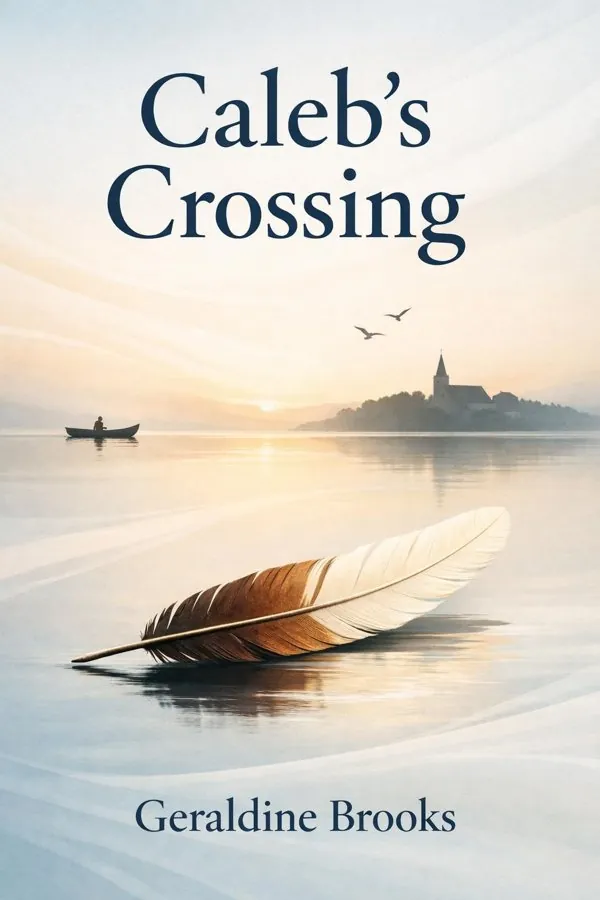
Caleb’s Crossing: Summary & Key Insights
 10 min8 chaptersAudio available
Key Takeaways from Caleb’s Crossing
Sometimes the most radical act is not open defiance, but refusing to let your mind be conquered.
A person who moves between cultures often carries both extraordinary possibility and profound burden.
Education can liberate, but in unequal societies it also reveals who is deemed fully human.
Great suffering often strips away illusion, revealing both the cruelty of a society and the strength required to endure it.
Belief becomes dangerous when certainty leaves no room for humility.
What Is Caleb’s Crossing About?
Caleb’s Crossing by Geraldine Brooks is a classics book spanning 4 pages. Geraldine Brooks’s Caleb’s Crossing is a richly imagined historical novel set in seventeenth-century colonial New England, where faith, power, learning, and survival are in constant conflict. At its center is Bethia Mayfield, the curious and intelligent daughter of a Puritan minister on Martha’s Vineyard, whose life changes when she forms a secret friendship with Caleb, a young Wampanoag man who will eventually become the first Native American to graduate from Harvard. Through Bethia’s voice, Brooks explores what it means to live inside a rigid society while longing for knowledge, freedom, and a wider human understanding. The novel matters because it gives emotional depth to a neglected piece of American history, illuminating both the violence of colonization and the fragile possibilities of cross-cultural connection. Brooks brings unusual authority to this story: a Pulitzer Prize-winning novelist and former journalist, she is known for blending meticulous historical research with intimate, psychologically compelling storytelling. The result is a novel that feels both historically grounded and urgently relevant, asking timeless questions about identity, belonging, education, and the human cost of being forced to cross worlds.
This FizzRead summary covers all 8 key chapters of Caleb’s Crossing in approximately 10 minutes, distilling the most important ideas, arguments, and takeaways from Geraldine Brooks's work. Also available as an audio summary and Key Quotes Podcast.
Caleb’s Crossing
Geraldine Brooks’s Caleb’s Crossing is a richly imagined historical novel set in seventeenth-century colonial New England, where faith, power, learning, and survival are in constant conflict. At its center is Bethia Mayfield, the curious and intelligent daughter of a Puritan minister on Martha’s Vineyard, whose life changes when she forms a secret friendship with Caleb, a young Wampanoag man who will eventually become the first Native American to graduate from Harvard. Through Bethia’s voice, Brooks explores what it means to live inside a rigid society while longing for knowledge, freedom, and a wider human understanding. The novel matters because it gives emotional depth to a neglected piece of American history, illuminating both the violence of colonization and the fragile possibilities of cross-cultural connection. Brooks brings unusual authority to this story: a Pulitzer Prize-winning novelist and former journalist, she is known for blending meticulous historical research with intimate, psychologically compelling storytelling. The result is a novel that feels both historically grounded and urgently relevant, asking timeless questions about identity, belonging, education, and the human cost of being forced to cross worlds.
Who Should Read Caleb’s Crossing?
This book is perfect for anyone interested in classics and looking to gain actionable insights in a short read. Whether you're a student, professional, or lifelong learner, the key ideas from Caleb’s Crossing by Geraldine Brooks will help you think differently.
- ✓Readers who enjoy classics and want practical takeaways
- ✓Professionals looking to apply new ideas to their work and life
- ✓Anyone who wants the core insights of Caleb’s Crossing in just 10 minutes
Want the full summary?
Get instant access to this book summary and 100K+ more with Fizz Moment.
Get Free SummaryAvailable on App Store • Free to download
Key Chapters
Sometimes the most radical act is not open defiance, but refusing to let your mind be conquered. Bethia Mayfield begins Caleb’s Crossing as a young woman trapped inside the narrow expectations of Puritan colonial life. As the daughter of a minister, she is expected to be obedient, pious, and silent about the intellectual hunger that burns within her. She is taught that men are the natural holders of authority and that women must occupy the domestic and moral margins. Yet Brooks gives Bethia an inner life that pushes against every boundary around her. She listens, observes, learns languages, and absorbs ideas even when the world insists that such curiosity is improper.
Bethia’s confinement is not merely personal; it reflects a social order built on hierarchy. Gender, religion, race, and status all determine who may speak, who may study, and who may shape the future. Her struggle therefore becomes larger than a coming-of-age story. It becomes a study of what happens when intelligence is denied expression. Readers can see parallels in any environment where talented people are underestimated because of convention, whether in schools, workplaces, or families.
What makes Bethia compelling is that her resistance is subtle but persistent. She does not always have the power to overturn the system, but she continually refuses to accept its logic in her heart. She pays attention. She thinks for herself. She notices injustice even when she cannot immediately correct it.
The practical lesson is clear: when circumstances restrict your voice, nurture your inner freedom through learning, observation, and moral clarity. Actionable takeaway: identify one place in your life where you have accepted an unnecessary limitation, and begin challenging it through knowledge, confidence, and small deliberate acts.
A person who moves between cultures often carries both extraordinary possibility and profound burden. Caleb, known originally as Cheeshahteaumauk, enters Bethia’s life as far more than a symbol of difference. He is intelligent, spiritually grounded, observant, and deeply shaped by Wampanoag traditions, yet he is also drawn into the world of English education and Christian conversion. Brooks presents him as a figure crossing dangerous boundaries, one whose success is celebrated by colonists precisely because they hope it confirms their own civilizing mission, even while his inner life remains more complex than they can comprehend.
For Bethia, Caleb opens a door onto another moral and intellectual universe. Through him, she encounters ways of understanding land, kinship, spirituality, and community that challenge Puritan assumptions. For the colonial authorities, however, Caleb represents an experiment: can a Native man be remade through language, scripture, and classical learning? The tragedy embedded in this question is that it treats his humanity as conditional and his worth as something to be measured by assimilation.
This idea remains deeply relevant. Many people today are asked, implicitly or explicitly, to succeed by translating themselves into the language of a dominant culture. They may become celebrated as bridges, yet still bear loneliness, scrutiny, and divided expectations. Caleb’s journey helps readers appreciate the emotional labor of navigating multiple identities.
Brooks refuses to reduce him either to victimhood or to triumph. Caleb is brilliant, adaptive, and dignified, but his crossing comes with sacrifice. He gains access to elite learning while risking disconnection from parts of his world.
Actionable takeaway: when engaging across cultures, do not admire someone merely for how well they fit your system. Ask what they are being asked to surrender, and practice listening with respect rather than ownership.
Education can liberate, but in unequal societies it also reveals who is deemed fully human. One of the most striking threads in Caleb’s Crossing is the role of learning as both an opening and a barrier. Harvard, still young in the novel’s historical setting, stands as a symbol of intellectual aspiration, religious mission, and colonial authority. For the English settlers, education is a means of preparing leaders and extending spiritual influence. For Caleb, it becomes an opportunity to enter a domain designed to exclude people like him. For Bethia, it is a world she can approach only indirectly, despite her intelligence.
Brooks uses these contrasts to expose the politics of knowledge. Who gets taught Latin, Greek, scripture, and rhetoric? Who is told that their mind matters? Who must prove exceptional worth simply to be admitted into rooms others enter by birthright? Caleb’s presence at Harvard is historically extraordinary, but the novel never lets readers forget the social cost of that exception. He is admired, but also isolated. Bethia is capable, but dismissed because she is female. Their experiences show that access to education does not erase structural prejudice; it often makes its workings more visible.
This remains true today. Elite institutions still reflect longstanding inequalities, even when they claim universal ideals. A first-generation student, an immigrant, or someone from a marginalized community may find that entry is only the beginning. Belonging, safety, and recognition are separate battles.
The novel encourages readers to think of education not simply as personal advancement, but as a system that distributes dignity and power. If we value learning, we must also ask who is missing, who is tokenized, and who is silently carrying the burden of adaptation.
Actionable takeaway: look at one educational or professional space you belong to and ask who finds it easiest to thrive there. Then take one practical step to make access and belonging more equitable.
Great suffering often strips away illusion, revealing both the cruelty of a society and the strength required to endure it. Midway through Caleb’s Crossing, Bethia’s life is transformed by grief, disruption, and hard labor. Personal losses accumulate, and the relative protection of her family position gives way to a more precarious existence. Brooks uses this shift to deepen the novel beyond ideas of intellectual curiosity and cultural contact. Survival becomes physical, social, and emotional.
Bethia’s descent into servitude and work exposes the fragility of status in colonial society. Even within the English world, power is unevenly distributed, especially for women. A daughter of a minister may still become vulnerable to exploitation once male protection disappears. This movement in the novel reminds readers that rigid societies do not merely limit ambition; they can rapidly erase security. Labor, in Brooks’s telling, is not abstract. It is exhausting, humiliating, and disciplined by authority. Yet it also teaches Bethia how much endurance she possesses.
Her suffering creates a harsher but clearer vision of the world. She becomes less naive about institutions, more skeptical of moral hypocrisy, and more alert to how easily the vulnerable are overlooked. This idea travels well beyond the novel. Hardship often gives people a more realistic understanding of systems they once believed were fair. It can also produce empathy, if pain does not harden into indifference.
Brooks does not romanticize suffering, and that matters. Loss does not automatically ennoble; it wounds. But Bethia’s resilience shows that dignity can survive even when comfort does not.
Actionable takeaway: when facing a season of loss or instability, do not ask only how to return to who you were before. Ask what clearer understanding, stronger boundaries, and deeper compassion this struggle can help you build.
Belief becomes dangerous when certainty leaves no room for humility. Religion saturates Caleb’s Crossing, but Brooks treats faith not as a simple target of criticism nor as a pure source of comfort. Instead, she shows how spiritual conviction can inspire discipline, meaning, and sacrifice while also justifying domination and blindness. The Puritan world of the novel is intensely scriptural, morally serious, and often sincere. Yet its confidence in divine order frequently leads to harsh judgment, patriarchal control, and colonial arrogance.
Bethia’s relationship to faith is especially important. She is formed by Puritan theology, so she cannot easily stand outside it. Her doubts are therefore internal, painful, and morally charged. She is not merely rejecting religion; she is wrestling with whether the God she has been taught to worship is being distorted by the people who claim to serve Him. Caleb, too, encounters Christianity in ways that are intellectually and spiritually demanding, but also politically loaded. Conversion in the novel is never separable from power.
This tension gives the book much of its depth. Brooks asks readers to distinguish between genuine spiritual searching and the use of belief as an instrument of control. That distinction remains urgent today in religious, political, and ideological settings alike. Communities often confuse certainty with righteousness, even though moral seriousness should produce more compassion, not less.
The practical application is not that conviction is bad. Rather, conviction without self-examination is dangerous. The novel invites readers to test whether their beliefs enlarge their humanity or narrow it.
Actionable takeaway: choose one belief or principle you hold strongly and examine how it affects the way you treat people unlike yourself. If it produces contempt more than compassion, it may need deeper reflection.
A society may rely on women’s intelligence while refusing to acknowledge it. One of the quiet triumphs of Caleb’s Crossing is the way Brooks centers female thought in a world that systematically minimizes women. Bethia is not formally educated like her brother or the men at Harvard, yet she is observant, articulate, and deeply capable of interpretation. She learns through listening, memory, conversation, and practical experience. Her intelligence survives in the cracks of a system that denies it public legitimacy.
Brooks uses Bethia’s narration to reveal how much knowledge women carried in early colonial life without being granted authorship or authority. Women managed households, preserved social memory, interpreted emotion, navigated danger, and often recognized hypocrisy more quickly than the men who governed them. Yet their insights were treated as secondary because they lacked official standing. This tension gives the novel much of its emotional force. Bethia sees clearly, but clarity does not equal power.
The theme still resonates. Many women today continue to experience versions of being heard but not credited, consulted but not promoted, essential but undervalued. Informal labor, emotional labor, and interpretive labor remain easy to overlook because they are difficult to quantify. Bethia’s voice reminds readers that exclusion from institutions does not mean absence of wisdom.
At the same time, the novel suggests that hidden intelligence comes at a cost. Constant self-suppression can produce loneliness, frustration, and a fractured sense of self. Recognition matters because it shapes what becomes possible.
Actionable takeaway: notice where invisible intellectual or emotional labor is happening around you, especially from those without formal authority. Name it, credit it publicly, and where possible help convert quiet contribution into real opportunity.
History becomes more unsettling when it shows ordinary people participating in systems of harm. Caleb’s Crossing does not portray colonial America as a struggle between purely evil settlers and purely innocent colonists’ victims, nor does it excuse the violence of colonization. Instead, Brooks creates a morally layered world in which affection, curiosity, faith, ambition, and coercion exist side by side. This complexity is what makes the novel powerful. It reveals how destructive systems endure not only through obvious brutality, but also through good intentions shaped by arrogance.
The English characters often believe they are bringing truth, salvation, or order. Some are capable of tenderness and real admiration toward Native people. Yet these sentiments do not prevent them from participating in dispossession, cultural erasure, and unequal power relations. The Wampanoag characters, meanwhile, are not flattened into symbols; they are strategic, spiritual, conflicted, proud, and adaptive. Brooks insists on human complexity without letting complexity dilute accountability.
This approach helps readers think more clearly about historical injustice. Simplistic moral binaries can be emotionally satisfying, but they often prevent real understanding. If we imagine harm is done only by monsters, we fail to see how institutions recruit ordinary virtues like discipline, duty, and idealism into oppressive projects. That lesson extends well beyond colonial history into modern organizations, governments, and cultures.
The novel therefore asks for mature historical imagination: one that can acknowledge individual nuance while still naming systemic wrongdoing. Compassion for persons does not require silence about structures.
Actionable takeaway: when studying history or evaluating current systems, resist the urge to simplify people into heroes and villains. Instead, ask how power shaped their choices and what responsibilities remain clear despite human complexity.
Encounters across difference rarely transform only one side. The title Caleb’s Crossing refers not just to Caleb’s movement into English institutions, but to the many crossings that structure the novel: between languages, religions, geographies, classes, and inner selves. Bethia crosses into broader awareness through her friendship with Caleb. Caleb crosses into a colonial world that values his brilliance conditionally. Even the settler community is altered, however uneasily, by the presence of Native intelligence it cannot easily dismiss.
Brooks shows that crossing is not a single event but an ongoing process of translation and misrecognition. To move between worlds is to gain perspective, but also to risk dislocation. One learns new codes while seeing old assumptions more clearly. Bethia’s life is permanently changed because she cannot return to the innocence of believing her society’s categories are natural or just. Caleb’s achievements similarly expose the inadequacy of the colonial worldview, even as that same worldview constrains him.
This theme speaks strongly to modern readers living in multicultural societies, global workplaces, or mixed identities. Any genuine encounter across difference changes language, expectations, and self-understanding. But such encounters are only valuable when they move beyond consumption or curiosity into mutual recognition. Otherwise, one party is simply mined for enrichment while the other bears the cost.
The novel’s lasting insight is that crossings are morally demanding. They ask for courage, humility, and the willingness to let one’s worldview be unsettled. That is why they matter.
Actionable takeaway: seek one relationship, book, community, or conversation that genuinely exposes you to a different way of seeing the world, and approach it not as an observer collecting insight but as a person prepared to be changed.
All Chapters in Caleb’s Crossing
About the Author
Geraldine Brooks is an Australian-American author and journalist celebrated for bringing history to life through vivid, emotionally intelligent fiction. Before turning to novels, she worked as a foreign correspondent for The Wall Street Journal, reporting from regions including the Middle East, Africa, and the Balkans. That journalistic background gave her a sharp sense of political complexity and human resilience, qualities that define her fiction. Brooks won the Pulitzer Prize for Fiction for her novel March and has earned wide acclaim for books such as Year of Wonders, People of the Book, Caleb’s Crossing, and Horse. Her work often focuses on overlooked figures and forgotten historical moments, blending rigorous research with intimate storytelling. She is regarded as one of the leading contemporary writers of literary historical fiction.
Get This Summary in Your Preferred Format
Read or listen to the Caleb’s Crossing summary by Geraldine Brooks anytime, anywhere. FizzRead offers multiple formats so you can learn on your terms — all free.
Available formats: App · Audio · PDF · EPUB — All included free with FizzRead
Download Caleb’s Crossing PDF and EPUB Summary
Key Quotes from Caleb’s Crossing
“Sometimes the most radical act is not open defiance, but refusing to let your mind be conquered.”
“A person who moves between cultures often carries both extraordinary possibility and profound burden.”
“Education can liberate, but in unequal societies it also reveals who is deemed fully human.”
“Great suffering often strips away illusion, revealing both the cruelty of a society and the strength required to endure it.”
“Belief becomes dangerous when certainty leaves no room for humility.”
Frequently Asked Questions about Caleb’s Crossing
Caleb’s Crossing by Geraldine Brooks is a classics book that explores key ideas across 8 chapters. Geraldine Brooks’s Caleb’s Crossing is a richly imagined historical novel set in seventeenth-century colonial New England, where faith, power, learning, and survival are in constant conflict. At its center is Bethia Mayfield, the curious and intelligent daughter of a Puritan minister on Martha’s Vineyard, whose life changes when she forms a secret friendship with Caleb, a young Wampanoag man who will eventually become the first Native American to graduate from Harvard. Through Bethia’s voice, Brooks explores what it means to live inside a rigid society while longing for knowledge, freedom, and a wider human understanding. The novel matters because it gives emotional depth to a neglected piece of American history, illuminating both the violence of colonization and the fragile possibilities of cross-cultural connection. Brooks brings unusual authority to this story: a Pulitzer Prize-winning novelist and former journalist, she is known for blending meticulous historical research with intimate, psychologically compelling storytelling. The result is a novel that feels both historically grounded and urgently relevant, asking timeless questions about identity, belonging, education, and the human cost of being forced to cross worlds.
More by Geraldine Brooks


You Might Also Like



Browse by Category
Ready to read Caleb’s Crossing?
Get the full summary and 100K+ more books with Fizz Moment.