
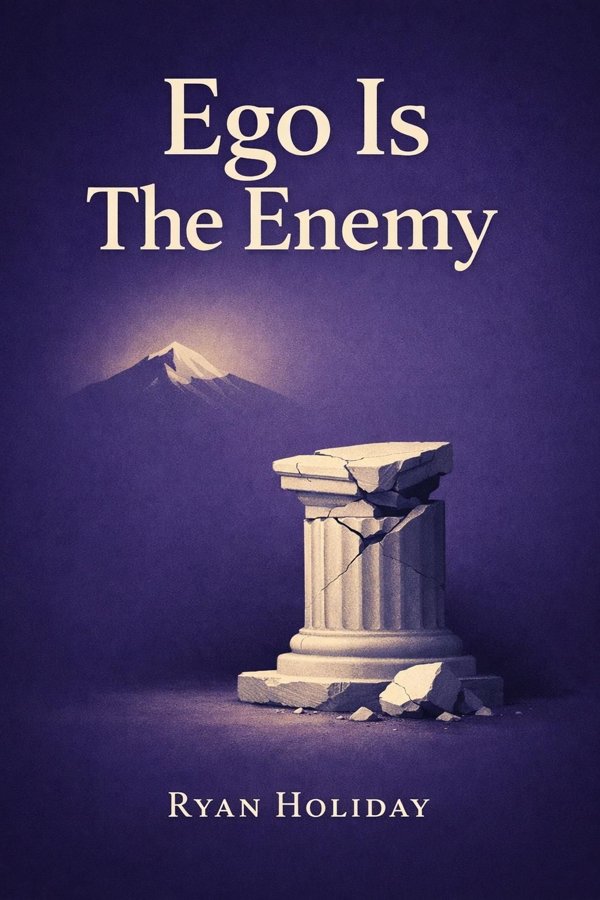
Ego Is The Enemy: Summary & Key Insights
by Ryan Holiday
 10 min9 chaptersAudio available
Key Takeaways from Ego Is The Enemy
At the beginning of any meaningful journey, the greatest danger is not failure but fantasy.
There is a strange pleasure in talking about what we plan to do.
One of ego’s most dangerous tricks is convincing us that talent is enough.
Success is often imagined as the end of struggle, but Holiday argues that it introduces a new and subtler threat.
Attention can be intoxicating.
What Is Ego Is The Enemy About?
Ego Is The Enemy by Ryan Holiday is a mindset book published in 2016 spanning 3 pages. Ego Is The Enemy by Ryan Holiday is a sharp, practical exploration of one of the most destructive forces in human life: the inflated sense of self that clouds judgment, fuels insecurity, and sabotages growth. Rather than treating ego as simple arrogance, Holiday shows how it can appear in many forms—self-importance, obsession with recognition, defensiveness, envy, and the need to always be right. Drawing from Stoic philosophy, military history, sports, politics, and business, he argues that ego can derail us at every stage of life: when we are striving, when we are succeeding, and when we are failing. What makes this book especially powerful is its realism. Holiday does not promise instant confidence or easy success. Instead, he offers a disciplined framework for staying grounded, focused, and effective. He writes with authority shaped by years of studying Stoicism, human behavior, and high-performance cultures, as well as his own experience in media and strategy. For anyone pursuing ambition without self-destruction, Ego Is The Enemy is a compelling reminder that the greatest obstacle is often not outside us, but within us.
This FizzRead summary covers all 9 key chapters of Ego Is The Enemy in approximately 10 minutes, distilling the most important ideas, arguments, and takeaways from Ryan Holiday's work. Also available as an audio summary and Key Quotes Podcast.
Ego Is The Enemy
Ego Is The Enemy by Ryan Holiday is a sharp, practical exploration of one of the most destructive forces in human life: the inflated sense of self that clouds judgment, fuels insecurity, and sabotages growth. Rather than treating ego as simple arrogance, Holiday shows how it can appear in many forms—self-importance, obsession with recognition, defensiveness, envy, and the need to always be right. Drawing from Stoic philosophy, military history, sports, politics, and business, he argues that ego can derail us at every stage of life: when we are striving, when we are succeeding, and when we are failing.
What makes this book especially powerful is its realism. Holiday does not promise instant confidence or easy success. Instead, he offers a disciplined framework for staying grounded, focused, and effective. He writes with authority shaped by years of studying Stoicism, human behavior, and high-performance cultures, as well as his own experience in media and strategy. For anyone pursuing ambition without self-destruction, Ego Is The Enemy is a compelling reminder that the greatest obstacle is often not outside us, but within us.
Who Should Read Ego Is The Enemy?
This book is perfect for anyone interested in mindset and looking to gain actionable insights in a short read. Whether you're a student, professional, or lifelong learner, the key ideas from Ego Is The Enemy by Ryan Holiday will help you think differently.
- ✓Readers who enjoy mindset and want practical takeaways
- ✓Professionals looking to apply new ideas to their work and life
- ✓Anyone who wants the core insights of Ego Is The Enemy in just 10 minutes
Want the full summary?
Get instant access to this book summary and 100K+ more with Fizz Moment.
Get Free SummaryAvailable on App Store • Free to download
Key Chapters
At the beginning of any meaningful journey, the greatest danger is not failure but fantasy. When people first become ambitious, they often confuse wanting to do something important with wanting to be seen as important. That distinction shapes everything. Ryan Holiday argues that ego turns aspiration into performance. Instead of learning, building, and improving, we start talking, posting, imagining, and rehearsing a future identity. We become more interested in the story of success than the work required to earn it.
Holiday shows that real progress begins with humility. Beginners who think they already know enough stop asking questions. Talented people who crave recognition too early waste energy trying to impress others rather than mastering their craft. The antidote is purpose: a commitment to the work itself, not the applause that might someday follow. Purpose is steady, while ego is restless. Purpose asks, “What needs to be done?” Ego asks, “What will people think of me?”
This idea applies everywhere. A new entrepreneur may spend months refining branding while avoiding customer conversations. A writer may announce a book before developing the discipline to write daily. A manager may seek a title rather than learning how to lead. In each case, ego creates an illusion of movement without real progress.
Holiday encourages readers to become students first. Read more than you speak. Practice more than you advertise. Let your effort be private before it becomes public. Ambition is not the problem; unearned self-importance is.
Actionable takeaway: Replace the need to be recognized with the need to improve. Ask yourself each day: am I doing the work, or just enjoying the image of doing the work?
There is a strange pleasure in talking about what we plan to do. It makes us feel committed, intelligent, and capable. But Holiday points out a hard truth: speaking too much about our goals can become a substitute for actually pursuing them. Ego loves public declarations because they create immediate emotional reward. We get attention before we have earned results.
This is why many people lose momentum after announcing a big plan. The mind begins to enjoy the identity associated with the goal rather than the discomfort of the process. A person says they are writing a novel, launching a company, training for a marathon, or changing careers, and the announcement itself provides satisfaction. But the work remains undone.
Holiday’s message is not that secrecy is always superior; it is that discipline matters more than display. Quiet effort protects concentration. It leaves room for mistakes, revision, and growth. Those who are obsessed with appearing impressive often become fragile. They fear looking inexperienced, so they avoid the exact situations where learning happens.
Consider a young professional who constantly speaks about becoming a leader but resists feedback. Or an aspiring creator who spends more time posting productivity quotes than producing original work. In both cases, ego drains energy from execution.
The most effective people usually let their output speak for them. They do not need to narrate every step of the journey because they are busy taking the steps. Silence can be strategic. It reduces pressure, minimizes distraction, and reminds us that results matter more than rhetoric.
Actionable takeaway: Before sharing a goal, complete one concrete step toward it. Create a bias toward evidence over announcement, and let consistency become your loudest statement.
One of ego’s most dangerous tricks is convincing us that talent is enough. The moment we believe we have outgrown learning, growth begins to slow. Holiday emphasizes that mastery depends on remaining teachable, no matter how much success or ability we already possess. The best performers in any field are often the most curious because they know how much they still do not know.
Being a student requires a certain kind of courage. It means admitting ignorance, asking basic questions, seeking criticism, and revisiting fundamentals. Ego resists all of this. It wants to protect an image of competence. It would rather appear knowledgeable than become knowledgeable. But that posture limits progress, especially in competitive environments where adaptation is everything.
Holiday draws on historical and modern examples of individuals who treated every stage of life as an apprenticeship. Their advantage was not merely intelligence; it was receptiveness. They listened carefully, observed deeply, and took correction seriously. They understood that the world keeps changing, and anyone who stops learning becomes vulnerable.
This lesson is practical for professionals, artists, leaders, and students alike. A high performer who seeks coaching stays sharp. A business owner who studies customers instead of assuming they already understand them makes better decisions. A parent who admits mistakes creates stronger relationships than one who insists on authority at all costs.
To stay a student, we must separate identity from feedback. Criticism is not an attack on our worth. It is information. Insecure ego turns every correction into a threat. Confident humility turns it into fuel.
Actionable takeaway: Adopt one beginner’s habit this week: ask for honest feedback, study the basics again, or observe someone more skilled than you without trying to prove yourself.
Success is often imagined as the end of struggle, but Holiday argues that it introduces a new and subtler threat. Once recognition, power, money, or influence arrive, ego can return stronger than before. It tells us that we are exceptional, that our instincts are infallible, that discipline is no longer necessary. Success does not automatically make people wiser; it often reveals whether they were grounded to begin with.
The problem is that success creates insulation. Praise grows louder while criticism becomes easier to ignore. Small indulgences start to feel deserved. Standards slip. A founder stops listening. An athlete stops training with the same urgency. A leader begins to confuse authority with superiority. The very habits that produced success—patience, self-control, openness, consistency—are abandoned because ego believes they are no longer needed.
Holiday warns that many downfalls begin at the peak, not the bottom. The spotlight can distort reality. Public admiration encourages self-mythology, and self-mythology makes people careless. To survive success, a person must resist believing their own legend.
The healthier approach is to treat success as responsibility rather than entitlement. Winning means there is now more to protect, more to steward, and more reason to remain disciplined. A great career, business, or reputation is not preserved by celebrating it endlessly but by continuing the practices that built it.
This principle applies on a smaller scale too. A promotion, a profitable quarter, or a personal milestone can make us complacent if we stop examining ourselves. Gratitude and vigilance are stronger companions to success than pride.
Actionable takeaway: After every win, ask: what habits created this result, and which of them must I continue immediately instead of relaxing now that things are going well?
Attention can be intoxicating. The more visible we become, the easier it is to believe our image instead of reality. Holiday explains that ego thrives in environments filled with praise, admiration, and status. Under the spotlight, people start managing perception rather than substance. They care more about looking powerful than being effective.
This is why public success can quietly undermine private excellence. A person begins saying yes to every interview, invitation, and opportunity because visibility feels validating. But scattered attention weakens focus. The work that created success gets replaced by appearances that celebrate success. Eventually, the foundation erodes.
Holiday’s advice is to remain sober, both literally and metaphorically. Emotional sobriety means staying grounded amid external noise. It means not overreacting to praise, not chasing every ego boost, and not measuring your value by how much attention you receive. The disciplined person remembers that fame and importance are not the same thing.
In practical terms, this might mean protecting time for deep work, maintaining routines that existed before recognition arrived, or surrounding yourself with people who tell the truth instead of feeding your vanity. It could also mean declining opportunities that enlarge your profile but distract from your purpose.
A manager who becomes popular but stops making hard decisions will lose effectiveness. A creator who optimizes for audience reaction rather than quality may gain visibility but lose depth. A public figure who believes every compliment becomes fragile when criticism arrives.
The spotlight does not have to corrupt, but it requires self-command. The goal is not to reject success but to refuse intoxication by it.
Actionable takeaway: Create one grounding ritual that protects you from external noise—daily reflection, limited social media, honest advisors, or uninterrupted work blocks—and treat it as non-negotiable.
People often misunderstand humility as weakness, passivity, or lack of confidence. Holiday reframes it as strength under control. Humility is the capacity to see yourself clearly: neither inflated nor diminished. It allows people to use power without being consumed by it and to perform at a high level without making everything about themselves.
Ego makes people reactive. They need to win every argument, receive every credit, and defend every decision. Humility, by contrast, creates space. A humble leader can delegate. A humble expert can revise a position. A humble teammate can prioritize the mission over personal recognition. These are not small advantages; they are the basis of durable excellence.
Holiday shows that many great achievers were marked not by loud self-belief but by disciplined self-restraint. They did not waste energy asserting superiority. They focused on service, craft, and execution. Because they were not trapped in proving themselves, they had more freedom to do meaningful work.
In everyday life, humility improves relationships and judgment. It helps couples apologize faster, teams collaborate better, and organizations avoid preventable mistakes. It also protects us from overreach. When we understand that we are fallible, we prepare more carefully, listen more closely, and act more responsibly.
Humility does not mean thinking less of yourself. It means thinking of yourself less often. It shifts attention from image to impact. This is especially important when authority increases, because power magnifies personal flaws. Without humility, even talent becomes dangerous.
Actionable takeaway: In your next important interaction, practice one act of deliberate humility: ask more questions, give credit away, admit uncertainty, or focus the conversation on the shared goal rather than your status.
Defeat reveals character with brutal honesty. When plans collapse, reputations suffer, or losses accumulate, ego faces a choice: distort reality to protect pride, or accept reality and grow. Holiday’s insight is that failure itself is not what destroys people. What destroys them is the ego-driven response to failure—denial, blame, bitterness, self-pity, or rage.
Failure can be clarifying because it strips away illusion. It shows what was weak, what was ignored, and what still needs to be built. But to benefit from that clarity, we must stop treating setbacks as personal humiliation. Ego interprets every loss as an assault on identity. It says, “If I failed, I must be worthless,” or “If I failed, someone else must be at fault.” Both reactions prevent learning.
Holiday encourages a more disciplined posture: accept responsibility without dramatizing the event. Study what happened. Separate what was controllable from what was not. Recover your composure, then return to work. Many resilient people are not fearless; they are simply less attached to appearing invulnerable.
Examples are easy to find. An entrepreneur whose first venture collapses can either rewrite the story to protect pride or analyze the business honestly. A professional passed over for promotion can resent colleagues or use the disappointment to improve skills and relationships. A creative whose project is rejected can withdraw in shame or keep refining the craft.
Failure can harden the ego or humble it. One path leads to stagnation; the other to maturity.
Actionable takeaway: After any setback, write down three things: what actually happened, what you can learn, and what specific action you will take next. Reflection turns pain into progress.
One reason ego is so disruptive is that it fuses our worth with our results. We do not simply experience success or failure; we become success or failure in our own minds. Holiday argues that this fusion creates emotional instability. If every win proves our superiority and every loss threatens our identity, then we will always be at the mercy of circumstances.
Detachment does not mean indifference. It means maintaining perspective. You can care deeply about your work while refusing to let outcomes define your entire self. This mindset makes sustained effort possible because it reduces desperation. When ego dominates, mistakes feel unbearable and criticism feels annihilating. When perspective returns, both become manageable.
This idea is especially useful in high-pressure environments. Sales professionals face rejection constantly. Athletes live in public comparison. Founders endure volatile cycles of praise and doubt. Parents and partners often judge themselves harshly after imperfect moments. In all these cases, identity-based thinking creates unnecessary suffering and poor decisions.
Holiday’s Stoic influence is clear here: focus on what is within your control—effort, preparation, conduct, resilience—and loosen your grip on what is not. This creates steadiness. A person who is not enslaved to image can act with more courage because they are no longer protecting a fragile self-concept at every turn.
You are not your last achievement, and you are not your last embarrassment. Results matter, but they are information, not identity. This distinction preserves both ambition and sanity.
Actionable takeaway: Define yourself this week by process rather than outcome. Instead of saying, “I need to win,” choose a controllable standard such as “I will prepare thoroughly, act professionally, and learn from whatever happens.”
Ego flourishes in illusion. It exaggerates strengths, minimizes weaknesses, invents narratives, and resists uncomfortable facts. Holiday’s deeper argument is that freedom begins when we return to reality. Reality tells us what the situation actually is, what our limitations are, what the work demands, and what tradeoffs are unavoidable. Ego hates this because reality does not flatter us. But reality is also where effective action becomes possible.
To live in reality is to stop negotiating with truth. If you are unprepared, admit it. If a relationship is strained, address it. If your business model is weak, face the numbers. If your habits are inconsistent, stop calling yourself disciplined. This honesty is not harshness for its own sake. It is a form of respect—for the facts, for the challenge, and for your own potential.
Holiday suggests that grounded people are often calmer because they do not spend energy defending illusions. They are less reactive, less theatrical, and more capable of making good decisions under pressure. They understand that self-deception is expensive. The sooner you face reality, the sooner you can improve it.
In practice, this may mean keeping a journal to expose rationalizations, asking trusted people for blunt feedback, reviewing mistakes without excuses, or measuring progress with real metrics instead of feelings. It may also mean letting go of a cherished identity that no longer matches the truth.
Reality can feel humbling, but it is far kinder than fantasy in the long run. Ego offers temporary comfort and long-term damage. Reality offers temporary discomfort and lasting strength.
Actionable takeaway: Identify one area of your life where you may be protecting your ego with a story. Replace that story with evidence, and choose one action based on facts rather than self-image.
All Chapters in Ego Is The Enemy
About the Author
Ryan Holiday is an American author, strategist, and one of the most influential modern voices bringing Stoic philosophy to contemporary readers. Born in 1987, he began his career in marketing and media, working with major brands and public figures before turning to writing full-time. He is the bestselling author of books such as The Obstacle Is the Way, Ego Is The Enemy, and Stillness Is the Key, all of which translate ancient wisdom into practical guidance for work, leadership, and personal growth. Holiday is known for combining history, philosophy, and real-world examples in a direct, accessible style. His work has helped a wide audience think more clearly about ambition, resilience, discipline, and self-mastery in a distracted and status-driven world.
Get This Summary in Your Preferred Format
Read or listen to the Ego Is The Enemy summary by Ryan Holiday anytime, anywhere. FizzRead offers multiple formats so you can learn on your terms — all free.
Available formats: App · Audio · PDF · EPUB — All included free with FizzRead
Download Ego Is The Enemy PDF and EPUB Summary
Key Quotes from Ego Is The Enemy
“At the beginning of any meaningful journey, the greatest danger is not failure but fantasy.”
“There is a strange pleasure in talking about what we plan to do.”
“One of ego’s most dangerous tricks is convincing us that talent is enough.”
“Success is often imagined as the end of struggle, but Holiday argues that it introduces a new and subtler threat.”
“The more visible we become, the easier it is to believe our image instead of reality.”
Frequently Asked Questions about Ego Is The Enemy
Ego Is The Enemy by Ryan Holiday is a mindset book that explores key ideas across 9 chapters. Ego Is The Enemy by Ryan Holiday is a sharp, practical exploration of one of the most destructive forces in human life: the inflated sense of self that clouds judgment, fuels insecurity, and sabotages growth. Rather than treating ego as simple arrogance, Holiday shows how it can appear in many forms—self-importance, obsession with recognition, defensiveness, envy, and the need to always be right. Drawing from Stoic philosophy, military history, sports, politics, and business, he argues that ego can derail us at every stage of life: when we are striving, when we are succeeding, and when we are failing. What makes this book especially powerful is its realism. Holiday does not promise instant confidence or easy success. Instead, he offers a disciplined framework for staying grounded, focused, and effective. He writes with authority shaped by years of studying Stoicism, human behavior, and high-performance cultures, as well as his own experience in media and strategy. For anyone pursuing ambition without self-destruction, Ego Is The Enemy is a compelling reminder that the greatest obstacle is often not outside us, but within us.
More by Ryan Holiday
You Might Also Like
Featured In
Browse by Category
Ready to read Ego Is The Enemy?
Get the full summary and 100K+ more books with Fizz Moment.