
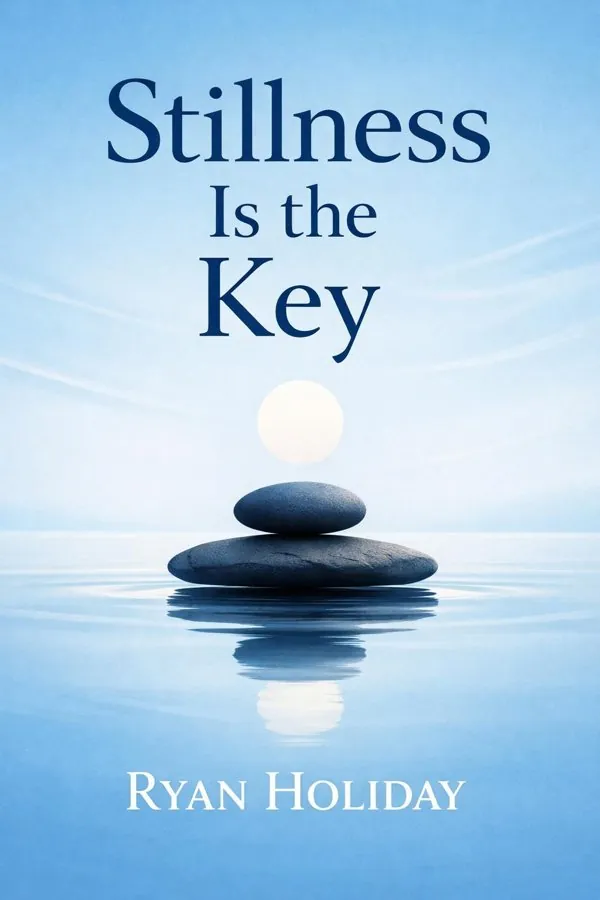
Stillness Is the Key: Summary & Key Insights
by Ryan Holiday
 10 min9 chaptersAudio available
Key Takeaways from Stillness Is the Key
A noisy mind can ruin even the most talented life.
The most exhausting conversations in life are often the ones happening inside our own heads.
Much of human agitation comes from trying to control what was never ours to control.
We often think restlessness comes from external pressure, but Holiday shows that much of it is self-generated through ego and endless desire.
Many people try to solve mental and emotional problems without considering the body, but Holiday insists that stillness is physical as well as psychological.
What Is Stillness Is the Key About?
Stillness Is the Key by Ryan Holiday is a mindset book published in 2019 spanning 4 pages. In Stillness Is the Key, Ryan Holiday argues that one of the greatest competitive advantages in modern life is not speed, aggression, or constant activity, but the ability to remain calm, clear, and grounded. In a culture addicted to noise, urgency, and distraction, Holiday makes the case that stillness is not passivity. It is an active inner discipline that allows people to think better, act wiser, and live more fully. Drawing from Stoicism, Buddhism, Christian spirituality, and the lives of leaders, artists, athletes, and statesmen, he shows that lasting excellence depends on mastering the mind, settling the spirit, and caring for the body. The book matters because it addresses a problem nearly everyone feels: mental overload, emotional reactivity, and physical exhaustion. Holiday writes not as a detached academic but as a skilled interpreter of ancient wisdom for modern life. Known for bringing Stoic philosophy into contemporary conversations about work, ambition, and character, he offers a practical guide for finding peace and power in the middle of chaos.
This FizzRead summary covers all 9 key chapters of Stillness Is the Key in approximately 10 minutes, distilling the most important ideas, arguments, and takeaways from Ryan Holiday's work. Also available as an audio summary and Key Quotes Podcast.
Stillness Is the Key
In Stillness Is the Key, Ryan Holiday argues that one of the greatest competitive advantages in modern life is not speed, aggression, or constant activity, but the ability to remain calm, clear, and grounded. In a culture addicted to noise, urgency, and distraction, Holiday makes the case that stillness is not passivity. It is an active inner discipline that allows people to think better, act wiser, and live more fully. Drawing from Stoicism, Buddhism, Christian spirituality, and the lives of leaders, artists, athletes, and statesmen, he shows that lasting excellence depends on mastering the mind, settling the spirit, and caring for the body. The book matters because it addresses a problem nearly everyone feels: mental overload, emotional reactivity, and physical exhaustion. Holiday writes not as a detached academic but as a skilled interpreter of ancient wisdom for modern life. Known for bringing Stoic philosophy into contemporary conversations about work, ambition, and character, he offers a practical guide for finding peace and power in the middle of chaos.
Who Should Read Stillness Is the Key?
This book is perfect for anyone interested in mindset and looking to gain actionable insights in a short read. Whether you're a student, professional, or lifelong learner, the key ideas from Stillness Is the Key by Ryan Holiday will help you think differently.
- ✓Readers who enjoy mindset and want practical takeaways
- ✓Professionals looking to apply new ideas to their work and life
- ✓Anyone who wants the core insights of Stillness Is the Key in just 10 minutes
Want the full summary?
Get instant access to this book summary and 100K+ more with Fizz Moment.
Get Free SummaryAvailable on App Store • Free to download
Key Chapters
A noisy mind can ruin even the most talented life. Holiday begins with a simple but unsettling truth: most people do not suffer from a lack of intelligence as much as from a lack of mental order. Our attention is constantly pulled apart by news, social media, ambition, anxiety, comparison, and unfinished tasks. When the mind becomes crowded, judgment weakens. We react instead of reflect. We confuse motion with progress and stimulation with insight.
Stillness of mind is not something that appears by accident. It is a discipline built through deliberate control of attention. Holiday draws on Stoic ideas to show that the mind works best when it is not scattered across a dozen worries. Clear thinking requires space. That is why many great leaders, writers, and generals protected time for solitude, journaling, reading, walking, or reflection. These were not luxuries. They were methods of mental sharpening.
In everyday life, this idea applies directly. A manager overwhelmed by emails may make poor decisions simply because she never pauses long enough to see priorities. A student trying to study while checking messages every few minutes may believe he is working hard, while actually sabotaging concentration. A parent carrying constant mental clutter may become irritable over small things because the mind has no room left.
Holiday’s point is that the mind needs filtering, not feeding. We do not need more information as much as better attention. This might mean turning off notifications, setting aside uninterrupted thinking time, writing down worries instead of recycling them, or beginning the day without immediately consuming input.
Actionable takeaway: Create one daily ritual that protects mental clarity for at least 20 minutes, such as journaling, silent walking, or device-free reflection.
The most exhausting conversations in life are often the ones happening inside our own heads. Holiday emphasizes that stillness is impossible when the mind is constantly narrating, judging, replaying, and anticipating. Inner chatter turns small problems into emotional storms. It creates urgency where none exists and keeps us trapped between regret about the past and fear about the future.
This is why practices that interrupt mental noise are so powerful. Meditation, prayer, breath awareness, and reflective silence are not trendy productivity hacks. They are ways of reclaiming authority over consciousness. Holiday does not suggest that we can eliminate thought altogether. Instead, he argues that we can observe thoughts without being ruled by them. That small shift changes everything. When you stop believing every anxious thought deserves your full attention, you gain freedom.
Consider how often unnecessary suffering comes from mental overactivity. A professional receives a short email from a boss and spends hours inventing negative interpretations. An entrepreneur faces a setback and mentally expands it into a permanent failure. An athlete has one bad performance and replays it until confidence collapses. In each case, external reality is less destructive than internal commentary.
Slowing inner chatter allows us to return to what is real. What are the facts? What actually needs to be done? What is within our control right now? These questions cut through mental dramatization. Holiday’s message is practical: the quieter your internal world becomes, the more effective your external actions will be.
Actionable takeaway: When stress rises, pause and write down the exact thought driving the emotion. Then ask, “Is this fact, interpretation, or fear?” That question creates immediate mental distance.
Much of human agitation comes from trying to control what was never ours to control. In the book’s second major movement, Holiday explores spiritual stillness, which begins with surrendering the illusion of total command. This is not about becoming passive or fatalistic. It is about recognizing limits. Pride says everything depends on me. Fear says everything can fall apart at any moment. Obsession says I must force outcomes. Stillness says: do your part, accept uncertainty, and remain steady.
Holiday connects this idea to traditions that value humility, gratitude, and trust. A calm spirit does not need constant validation. It does not build identity solely around achievement, status, or winning. When the ego dominates, even success becomes noisy because it creates more craving, more defensiveness, and more instability. Humility quiets that cycle by placing us in proper perspective.
This has obvious real-world applications. A founder cannot control every market condition, investor reaction, or competitor move, but can control preparation, ethics, and resilience. A parent cannot script a child’s entire future, but can offer love, guidance, and presence. A person dealing with illness cannot command outcomes, but can choose courage and composure.
Spiritual stillness grows when we stop wrestling with reality and start cooperating with it. Gratitude helps because it redirects attention from scarcity to sufficiency. Service helps because it shifts focus from self-importance to contribution. Reflection helps because it reveals how often ego has disguised itself as necessity.
Actionable takeaway: At the end of each day, list two things you controlled well and two things you must release. This strengthens effort without attachment.
We often think restlessness comes from external pressure, but Holiday shows that much of it is self-generated through ego and endless desire. The soul becomes turbulent when it is always chasing more: more recognition, more success, more applause, more certainty, more proof of worth. Ambition itself is not the enemy. The problem begins when desire becomes insatiable and identity depends on external rewards.
Holiday has written extensively about ego in his other work, and here he ties it directly to inner peace. Ego keeps score. It compares, exaggerates slights, seeks control, and resists humility. It makes us interpret ordinary events through a self-centered lens. Desire adds fuel to the fire by convincing us that peace lies just beyond the next accomplishment. Yet once one goal is reached, another appears. The mind never settles because wanting has become a habit.
This pattern is common in modern life. A professional achieves a promotion but cannot enjoy it because she is immediately preoccupied with the next ladder rung. A creator becomes obsessed with metrics and loses touch with the joy of craft. A person spends money not from need, but from the urge to signal status. In all these cases, the soul is disturbed not by circumstance alone, but by attachment.
Stillness requires enoughness. It asks us to separate genuine purpose from compulsive craving. That may mean pursuing excellence while loosening the need for praise, setting goals without making them sacred, or learning to appreciate quiet forms of success that do not attract public attention.
Actionable takeaway: Before pursuing any major goal, ask, “Do I want this for meaning, or for ego?” Honest answers protect the soul from unnecessary agitation.
Many people try to solve mental and emotional problems without considering the body, but Holiday insists that stillness is physical as well as psychological. A tired, overstimulated, poorly cared-for body makes calm nearly impossible. Exhaustion shortens patience. Poor sleep weakens judgment. Constant stimulation keeps the nervous system on alert. If the body is in disorder, the mind will struggle to be clear and the spirit will struggle to be steady.
This is why the book’s third section focuses on rhythm and physical habits. Rest is not laziness. Leisure is not a waste. Sleep, exercise, moderation, and time outdoors are foundations of good judgment. Many high performers break down because they assume discipline means relentless pushing. Holiday counters that sustainable excellence requires recovery. Nature itself moves in cycles. Human beings do too.
Think of how different you are after quality sleep compared with an overstretched week of stress and late nights. Small frustrations become larger. Impulses become harder to resist. Creativity drops. Even moral judgment can weaken. The body is not a machine that can be exploited indefinitely without cost.
Practical stillness may look simple: taking a walk instead of doomscrolling, eating in a way that supports energy rather than spikes and crashes, stretching between work sessions, protecting sleep as seriously as meetings, or building a weekly rhythm that includes silence and physical renewal. These actions may seem ordinary, but they create the biological conditions for wisdom.
Actionable takeaway: Choose one physical practice to anchor your week, such as a daily walk, a fixed bedtime, or one technology-free hour before sleep.
People often imagine stillness as a mood, but Holiday shows that it is more reliably created by structure than by inspiration. When life has no rhythm, everything becomes reactive. We wake up and immediately answer demands. We let urgency set the agenda. We drift from one stimulus to the next and wonder why we feel uncentered. Routine, far from being boring, creates space for calm by reducing avoidable chaos.
Many of history’s most thoughtful people relied on rituals: morning reflection, regular walks, set writing hours, simple meals, Sabbath rest, or evening review. These habits were not signs of rigidity. They protected energy and attention from needless depletion. By making certain choices automatic, routines free us to think deeply about what actually matters.
This principle applies in modern settings as well. A team leader who begins each day by identifying top priorities is less likely to be swallowed by inboxes. A family that keeps regular mealtimes may experience more connection and less stress. A freelancer who starts work without checking social media preserves the best mental hours for creative labor. Good routines reduce friction and guard the conditions of stillness.
Holiday’s deeper point is that discipline and peace are not opposites. In fact, discipline often produces peace. Chaos feels exciting for a while, but over time it fragments us. Deliberate rhythm restores coherence. We begin to trust ourselves because our days are not entirely at the mercy of mood or outside demands.
Actionable takeaway: Design a simple morning or evening routine with three repeatable steps that support calm, and follow it consistently for two weeks before adjusting.
One of the rarest abilities today is full presence. Holiday argues that stillness allows us to inhabit the moment instead of constantly escaping it. This is more than mindfulness jargon. Presence affects the quality of our relationships, work, creativity, and decisions. When attention is divided, life becomes shallow. We miss what is happening because we are half-living in notifications, future plans, or private mental commentary.
To be present is to meet reality directly. In conversation, it means listening without preparing your next response. In work, it means focusing on the task in front of you rather than bouncing between tabs and messages. In family life, it means giving undivided attention instead of offering distracted proximity. Presence is a form of respect. It also improves performance because deep attention produces better results than fragmented effort.
Holiday’s insight is especially relevant in a digital culture that monetizes distraction. Devices are designed to fracture attention. News cycles are built to provoke. Social media rewards reaction, not reflection. In such an environment, the person who can remain present gains a tremendous advantage. They notice more, overreact less, and connect more deeply.
A practical example is the difference between attending a meeting while checking your phone and attending with full concentration. In the first case, you absorb fragments and leave drained. In the second, you catch nuance, ask better questions, and save time because your mind is actually there.
Actionable takeaway: Pick one daily activity, such as a meal, conversation, or work block, and practice doing it with complete attention and no digital interruptions.
The real test of stillness is not whether you can feel calm on a quiet morning, but whether you can think clearly when conditions are difficult. Holiday shows that stillness is a strategic advantage in moments of pressure. Crisis tempts people into haste, emotional decision-making, and narrow thinking. The still person creates a gap between stimulus and response. In that gap, wisdom has a chance.
History offers countless examples of leaders who succeeded because they refused to panic. They gathered facts, controlled emotion, and acted from principle rather than impulse. Holiday uses such stories to make a practical point: composure is not decorative. It is operational. When everyone else is escalating, the calm person can often see the path forward.
This matters in ordinary life too. A heated argument can be transformed if one person refuses to match intensity. A business setback becomes manageable when the response begins with assessment rather than blame. A financial scare is less dangerous when you pause before making desperate decisions. Stillness prevents unforced errors.
This does not mean suppressing feeling or pretending not to care. It means refusing to let emotion take the wheel. Naming what is happening helps: “I am angry,” “I feel embarrassed,” “I want to retaliate.” Once identified, the feeling becomes less likely to dominate behavior. Holiday repeatedly returns to the idea that strength often looks like restraint.
Actionable takeaway: In high-stress moments, delay your first reaction. Take three slow breaths, restate the facts, and decide only after the emotional spike has softened.
The deepest insight of the book is that stillness is not a single tactic but a way of living that joins mind, spirit, and body. We often try to fix life in isolated pieces. We want better focus without better rest, humility without self-examination, calm without changing our habits. Holiday argues that real steadiness emerges when all three dimensions support one another.
A clear mind depends partly on bodily health and spiritual balance. A peaceful spirit is harder to maintain when the mind is overstimulated and the body is exhausted. A well-cared-for body is easier to sustain when the spirit is not driven by compulsive ambition and the mind is not trapped in chaos. These systems are connected. Stillness grows when they are aligned.
This integrated view helps explain why superficial fixes often fail. Someone may try meditation while continuing to overload every hour of the day, then conclude that stillness does not work. Another may improve fitness but remain spiritually restless because life is still organized around ego and comparison. Another may adopt philosophical ideas without creating practical routines. Holiday invites readers to build a complete ecology of calm.
That might mean combining reflective practices, ethical grounding, and physical discipline: morning journaling, gratitude, enough sleep, better boundaries, less digital noise, and regular movement. None of these alone is magic. Together, they form a stable center from which better living becomes possible.
Actionable takeaway: Audit your life across three categories, mind, spirit, and body, and choose one change in each area so your pursuit of stillness becomes holistic rather than partial.
All Chapters in Stillness Is the Key
About the Author
Ryan Holiday is an American author, media strategist, and widely recognized voice in modern Stoic philosophy. He began his career in marketing and became known for his sharp understanding of media, persuasion, and culture before turning his focus to books about character, discipline, and wisdom. Holiday has written several bestselling titles, including The Obstacle Is the Way, Ego Is the Enemy, and Stillness Is the Key, each of which applies ancient philosophical principles to modern challenges in work and life. His writing blends history, biography, and practical self-mastery, making classical ideas accessible to broad audiences. Over the years, he has built a large readership among entrepreneurs, athletes, leaders, and readers of personal development. Holiday is especially known for translating Stoicism into actionable lessons for ambition, resilience, focus, and inner peace.
Get This Summary in Your Preferred Format
Read or listen to the Stillness Is the Key summary by Ryan Holiday anytime, anywhere. FizzRead offers multiple formats so you can learn on your terms — all free.
Available formats: App · Audio · PDF · EPUB — All included free with FizzRead
Download Stillness Is the Key PDF and EPUB Summary
Key Quotes from Stillness Is the Key
“A noisy mind can ruin even the most talented life.”
“The most exhausting conversations in life are often the ones happening inside our own heads.”
“Much of human agitation comes from trying to control what was never ours to control.”
“We often think restlessness comes from external pressure, but Holiday shows that much of it is self-generated through ego and endless desire.”
“Many people try to solve mental and emotional problems without considering the body, but Holiday insists that stillness is physical as well as psychological.”
Frequently Asked Questions about Stillness Is the Key
Stillness Is the Key by Ryan Holiday is a mindset book that explores key ideas across 9 chapters. In Stillness Is the Key, Ryan Holiday argues that one of the greatest competitive advantages in modern life is not speed, aggression, or constant activity, but the ability to remain calm, clear, and grounded. In a culture addicted to noise, urgency, and distraction, Holiday makes the case that stillness is not passivity. It is an active inner discipline that allows people to think better, act wiser, and live more fully. Drawing from Stoicism, Buddhism, Christian spirituality, and the lives of leaders, artists, athletes, and statesmen, he shows that lasting excellence depends on mastering the mind, settling the spirit, and caring for the body. The book matters because it addresses a problem nearly everyone feels: mental overload, emotional reactivity, and physical exhaustion. Holiday writes not as a detached academic but as a skilled interpreter of ancient wisdom for modern life. Known for bringing Stoic philosophy into contemporary conversations about work, ambition, and character, he offers a practical guide for finding peace and power in the middle of chaos.
More by Ryan Holiday

You Might Also Like
Featured In
Browse by Category
Ready to read Stillness Is the Key?
Get the full summary and 100K+ more books with Fizz Moment.