
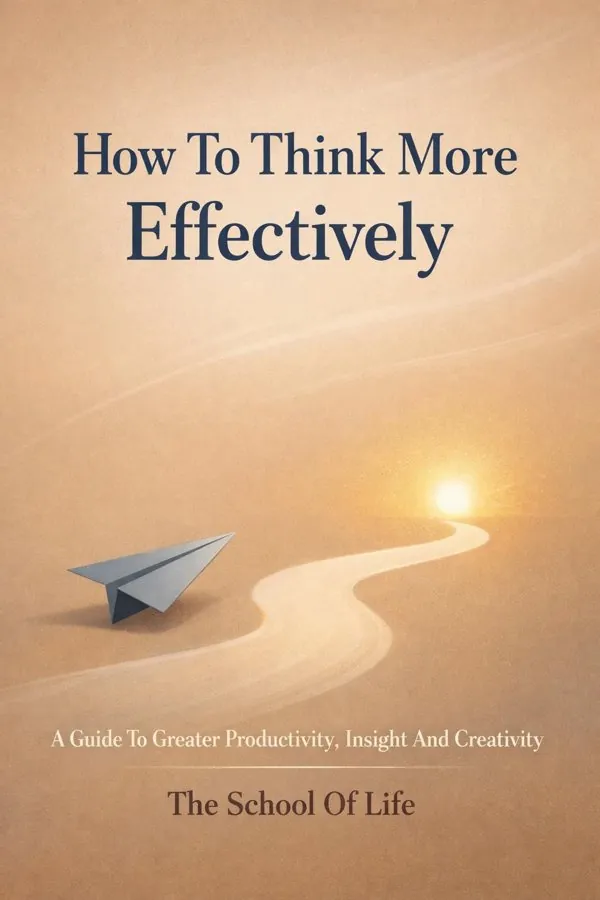
The Book of Life: Summary & Key Insights
 10 min9 chapters
Key Takeaways from The Book of Life
Most valuable thoughts do not arrive as polished conclusions; they appear as vague stirrings, uneasy hunches, or fragments that seem too incomplete to trust.
We like to imagine insight as a dramatic flash of brilliance, but the book insists that real understanding usually unfolds gradually.
A mind under pressure rarely thinks at its best.
Good thinking is not a rare gift; it is a practice supported by habits.
Some ideas can only be heard in silence, while others become clear only when spoken aloud.
What Is The Book of Life About?
The Book of Life by The School of Life is a mindset book published in 2020 spanning 13 pages. The Book of Life by The School of Life is a concise but powerful guide to one of the most important human skills: learning how to think with greater clarity, depth, and usefulness. Rather than treating thought as something automatic or purely intellectual, the book shows that good thinking is fragile, emotional, and highly dependent on the conditions in which it occurs. Our best ideas often arrive quietly, half-formed and easily frightened away by anxiety, distraction, self-doubt, or the pressure to be immediately coherent. The central task, then, is not simply to think more, but to think better. What makes this book especially valuable is its humane approach. It recognizes that insight is not reserved for geniuses; it is available to anyone willing to cultivate patience, self-awareness, and the right mental habits. The School of Life, known worldwide for its work on emotional intelligence and self-knowledge, brings unusual authority to this subject by blending philosophy, psychology, and practical wisdom. The result is a deeply accessible book for readers who want to become more creative, more reflective, and more capable of turning scattered mental activity into meaningful understanding.
This FizzRead summary covers all 9 key chapters of The Book of Life in approximately 10 minutes, distilling the most important ideas, arguments, and takeaways from The School of Life's work.
The Book of Life
The Book of Life by The School of Life is a concise but powerful guide to one of the most important human skills: learning how to think with greater clarity, depth, and usefulness. Rather than treating thought as something automatic or purely intellectual, the book shows that good thinking is fragile, emotional, and highly dependent on the conditions in which it occurs. Our best ideas often arrive quietly, half-formed and easily frightened away by anxiety, distraction, self-doubt, or the pressure to be immediately coherent. The central task, then, is not simply to think more, but to think better.
What makes this book especially valuable is its humane approach. It recognizes that insight is not reserved for geniuses; it is available to anyone willing to cultivate patience, self-awareness, and the right mental habits. The School of Life, known worldwide for its work on emotional intelligence and self-knowledge, brings unusual authority to this subject by blending philosophy, psychology, and practical wisdom. The result is a deeply accessible book for readers who want to become more creative, more reflective, and more capable of turning scattered mental activity into meaningful understanding.
Who Should Read The Book of Life?
This book is perfect for anyone interested in mindset and looking to gain actionable insights in a short read. Whether you're a student, professional, or lifelong learner, the key ideas from The Book of Life by The School of Life will help you think differently.
- ✓Readers who enjoy mindset and want practical takeaways
- ✓Professionals looking to apply new ideas to their work and life
- ✓Anyone who wants the core insights of The Book of Life in just 10 minutes
Want the full summary?
Get instant access to this book summary and 100K+ more with Fizz Moment.
Get Free SummaryAvailable on App Store • Free to download
Key Chapters
Most valuable thoughts do not arrive as polished conclusions; they appear as vague stirrings, uneasy hunches, or fragments that seem too incomplete to trust. One of the book’s most important insights is that we often lose our best ideas because we judge them too early. We expect thinking to look neat from the start, so when a thought appears awkward or emotionally tangled, we dismiss it as unimportant. In reality, this is often the exact form in which genuine insight first enters the mind.
The School of Life argues that thinking is less like downloading a finished answer and more like caring for something delicate until it can take shape. A passing discomfort during a meeting, a repeated irritation in a relationship, or a faint sense that something in your life no longer fits may all be the beginning of an important realization. But if you rush on, check your phone, or demand immediate certainty, the thought disappears.
This is why capturing and protecting early thoughts matters. Keeping a notebook, dictating voice notes during a walk, or pausing after emotionally charged moments can help preserve ideas before they fade. For example, someone who feels repeatedly drained after social events may initially only notice a vague heaviness. If they write that feeling down instead of ignoring it, they may later realize they have been overcommitting to please others.
The practical lesson is simple: treat first thoughts gently. Do not demand eloquence from them. When something faint but persistent appears in your mind, record it, revisit it, and give it time to become intelligible.
We like to imagine insight as a dramatic flash of brilliance, but the book insists that real understanding usually unfolds gradually. A breakthrough is often the visible end point of a long, hidden process in which the mind has been quietly connecting experiences, feelings, memories, and observations. This matters because many people give up on thinking too soon. If clarity does not come immediately, they assume they are not smart enough or that the problem has no answer.
The School of Life reframes insight as a patient act of emotional and intellectual assembly. You notice a pattern, live with a question, revisit an experience, and slowly make links between things that once seemed unrelated. A person may spend months feeling dissatisfied at work before realizing the issue is not workload alone but a deeper conflict between their values and the culture around them. The realization can feel sudden, yet it was prepared by long periods of quiet processing.
This slower model of insight encourages persistence. It also explains why reflective practices matter so much. Walks, journals, conversations, rereading notes, and moments of solitude all help the mind continue its background work. Even apparent mental idleness can be productive if it allows scattered impressions to settle into shape.
A useful application is to stop demanding instant answers to complex questions such as “Why am I unhappy?” or “What should I do next?” Instead, hold the question steadily and return to it with curiosity. The actionable takeaway is to give important problems a longer timeline: revisit them repeatedly, trusting that understanding often comes through accumulation rather than speed.
A mind under pressure rarely thinks at its best. One of the book’s most practical claims is that anxiety does not merely make us uncomfortable; it actively distorts thought. When we are afraid, rushed, ashamed, or desperate to get things right, we become mentally rigid. We cling to obvious answers, avoid difficult truths, and lose contact with the subtler ideas that require calm to emerge.
The School of Life treats effective thinking as an emotional achievement as much as an intellectual one. Fear narrows attention. It makes us defensive, reactive, and simplistic. This is why some of our worst decisions happen when we feel cornered: we send the angry email, commit to the wrong plan, or convince ourselves there are only two options when many more exist. Anxiety creates false urgency, and false urgency kills nuance.
To think well, we need to build conditions of relative safety. That may mean delaying major decisions until our nervous system has settled, taking a walk before responding to conflict, sleeping on a difficult issue, or speaking to someone who helps us feel less alone. In a workplace, it might mean creating meetings where uncertainty is allowed rather than punished. In personal life, it can mean noticing that your panic about a relationship may be preventing you from seeing what is actually happening.
The takeaway is not that we must eliminate anxiety before we think, which is impossible, but that we must account for its effects. Before making sense of a problem, ask: am I frightened right now, and how might that fear be shaping what seems true? Create calm first, then think.
Good thinking is not a rare gift; it is a practice supported by habits. The book emphasizes that the mind produces better ideas when we repeatedly create the right conditions for reflection, attention, and revision. Without helpful habits, even intelligent people become inconsistent thinkers, trapped in distraction, repetition, and mental clutter.
The School of Life encourages readers to view thinking as something that benefits from structure. Just as physical health depends on routines, mental clarity depends on recurring behaviors. These include setting aside uninterrupted time, writing regularly, reviewing observations, reading deeply rather than skimming endlessly, and learning to sit with ambiguity. Habits matter because they reduce reliance on mood. If you only reflect when inspiration strikes, you will miss most of what your mind could discover.
Consider the difference between two people facing a personal dilemma. One constantly ruminates but never externalizes thoughts, so concerns circle endlessly in the head. The other keeps a journal, writes down recurring themes, and revisits entries weekly. The second person is far more likely to notice patterns and move toward insight. Likewise, a manager who schedules quiet planning time before meetings will often think more strategically than one who lives reactively in their inbox.
The point is not to become rigid or obsessive, but to make thought more dependable. A practical system might include ten minutes of morning writing, one daily walk without devices, and a weekly review of unresolved questions. The actionable takeaway is to design at least two recurring habits that protect attention and help your thoughts mature rather than vanish.
Some ideas can only be heard in silence, while others become clear only when spoken aloud. The book highlights a productive tension at the heart of good thinking: we need solitude to hear our own mind, but we also need other people to sharpen, challenge, and complete what we cannot see alone. Relying exclusively on either isolation or social exchange weakens thought.
In solitude, buried feelings and subtle intuitions have space to surface. Without constant input, we begin to notice what we actually think rather than merely what others expect us to think. This is why quiet walks, journaling, and time away from noise are so valuable. Yet solitude also has limits. Left alone too long, we can become circular, self-confirming, or unclear. Conversation introduces friction, perspective, and language. A good listener may help articulate what we only vaguely sensed. A thoughtful disagreement can expose assumptions we did not know we were making.
The School of Life therefore presents thinking as both inward and relational. For example, someone uncertain about changing careers might first reflect privately to identify their fears and desires. Later, discussing the issue with a perceptive friend could reveal practical blind spots or hidden motivations. Similarly, a creative idea developed alone may gain coherence after being explained to a collaborator.
The key is choosing the right kind of conversation. Not every audience supports thought. We need people who are patient, curious, and not overly eager to dominate or judge. The actionable takeaway is to build a two-step process for important questions: first think alone, then test the emerging idea with one trusted person who can help refine it.
Many of us assume we think first and write later, but the book suggests the reverse is often true: we discover what we think by trying to put it into words. Writing is not merely a record of thought; it is one of the most powerful tools for creating thought. The moment we attempt to describe an impression clearly, gaps, contradictions, and hidden meanings begin to reveal themselves.
The School of Life emphasizes that thoughts in the mind can feel fuller and more convincing than they actually are. Once written down, they become inspectable. We can notice repetition, vagueness, emotional distortion, or surprising connections. A person who feels “everything is going wrong” may, after writing for fifteen minutes, realize the issue is actually concentrated in one unresolved conflict. Writing turns an overwhelming cloud into distinguishable parts.
This practice is useful in nearly every area of life. At work, drafting a memo before a meeting can clarify strategy. In relationships, writing a private letter you never send can help you understand what you are truly upset about. In creativity, collecting fragments without judging them can lead to essays, business ideas, or life decisions that otherwise would have remained hidden. Importantly, the writing does not need to be elegant. Messy notes often do the deepest work.
The deeper lesson is that externalizing thought makes it workable. Instead of trusting the mind to hold and process everything internally, use paper or a screen as a thinking partner. The actionable takeaway is to begin a regular thinking practice through writing: choose one recurring question, write about it freely for ten minutes, and look for patterns rather than perfection.
Creativity is often romanticized as freedom without structure, but this book presents it more soberly and more helpfully. Creative thinking arises when we allow unusual connections to form, yet it becomes truly valuable when those connections respond to reality. Imagination matters, but so do relevance, discipline, and emotional truth. The best ideas are not merely novel; they illuminate something real and usable.
The School of Life ties creativity to receptiveness. We become creative when we notice what others overlook, when we allow small details and odd associations to linger, and when we resist the pressure to be conventional too quickly. At the same time, productive thinking asks: what does this idea help explain, solve, or express? That question transforms creativity from daydreaming into contribution.
For example, an entrepreneur may generate many exciting concepts, but only by testing them against actual customer frustrations does one become a viable business. An artist may produce stronger work by paying close attention to personal grief rather than imitating fashionable styles. A teacher may develop a brilliant lesson not through abstract originality alone but by creatively addressing the real confusion students repeatedly face.
This balance also applies to everyday problems. If your life feels stuck, creativity might mean imagining alternative routines, relationships, or definitions of success. Productive thinking then evaluates which of those possibilities genuinely fit your values and circumstances.
The actionable takeaway is to pair every imaginative exercise with a grounding question. After generating ideas, ask: what truth does this express, and where could it make a real difference? That is how creativity becomes effective rather than merely interesting.
We often imagine bad thinking as a technical problem, but many errors begin in emotion. The book argues that emotional intelligence is essential to clear thought because feelings influence what we notice, what we avoid, and what we are willing to admit. Without self-awareness, we mistake defensiveness for certainty, wounded pride for principle, and habit for truth.
This is where cognitive bias and intellectual humility meet. We are naturally tempted to seek evidence that confirms our existing views, to overvalue our own perspective, and to resist information that threatens identity or comfort. The School of Life does not treat these biases as moral failings so much as predictable features of human psychology. The challenge is to recognize them before they harden into distorted judgments.
Emotional intelligence helps by asking not only “Is this argument sound?” but also “Why do I want this to be true?” A manager evaluating an employee, for instance, may realize irritation from an earlier conflict is coloring their judgment. A person arguing with a partner may see that the need to win is preventing them from hearing the actual complaint. Intellectual humility enters when we accept that being wrong is not humiliating but informative.
Practically, this means building reflective pauses into decision-making. Before concluding, ask what emotion is present, what assumption may be driving you, and what evidence would challenge your current view. Invite correction from people who are thoughtful rather than agreeable.
The actionable takeaway is to make one bias-checking habit routine: whenever you feel especially certain, stop and ask what you might be missing. Strong conviction is often the moment when humility is most necessary.
Clear thinking is not a one-time achievement but an ongoing discipline. The book closes around a larger truth: the mind does not remain wise by accident. Insight fades, habits slip, distraction returns, and life continually presents new experiences that demand fresh interpretation. To think effectively over time, we need a sustainable practice that renews attention, preserves curiosity, and keeps us mentally flexible.
The School of Life encourages readers to move away from the fantasy of permanent mastery. You do not become a good thinker once and for all. Instead, you repeatedly return to the basics: noticing half-formed thoughts, creating calm, making time for solitude, writing things down, seeking intelligent dialogue, and questioning your own certainties. This rhythm matters because modern life constantly pulls us toward mental shallowness. Speed, noise, performance, and overstimulation reward reaction more than reflection.
A sustainable thinking life therefore depends on protecting certain conditions. You may need digital boundaries, regular reading, slower mornings, fewer but better conversations, or deliberate periods without input. Over time, these choices compound. Someone who reflects consistently for years will likely make wiser decisions than someone equally intelligent who lives in perpetual haste.
The goal is not academic brilliance but a richer relationship with your own mind. Better thinking improves work, relationships, creativity, and self-understanding because it helps you respond to life with more truth and less confusion.
The actionable takeaway is to build a personal thinking system you can maintain for the long term. Keep it simple, repeatable, and humane: a notebook, a weekly review, a trusted conversation, and regular time to think without interruption.
All Chapters in The Book of Life
About the Author
The School of Life is a cultural and educational organization devoted to helping people develop emotional intelligence, self-knowledge, and practical wisdom. Founded by Alain de Botton and a group of writers, thinkers, and educators, it creates books, articles, films, classes, and tools focused on the major challenges of modern life, including relationships, work, anxiety, identity, and meaning. Its distinctive approach blends philosophy, psychology, literature, and everyday observation, translating big ideas into clear, useful guidance. Rather than offering abstract theory alone, The School of Life aims to make wisdom practical and emotionally relevant. Through its publishing and educational work, it has built a global audience of readers seeking more thoughtful, balanced, and fulfilled lives.
Get This Summary in Your Preferred Format
Read or listen to the The Book of Life summary by The School of Life anytime, anywhere. FizzRead offers multiple formats so you can learn on your terms — all free.
Available formats: App · Audio · PDF · EPUB — All included free with FizzRead
Download The Book of Life PDF and EPUB Summary
Key Quotes from The Book of Life
“Most valuable thoughts do not arrive as polished conclusions; they appear as vague stirrings, uneasy hunches, or fragments that seem too incomplete to trust.”
“We like to imagine insight as a dramatic flash of brilliance, but the book insists that real understanding usually unfolds gradually.”
“A mind under pressure rarely thinks at its best.”
“Good thinking is not a rare gift; it is a practice supported by habits.”
“Some ideas can only be heard in silence, while others become clear only when spoken aloud.”
Frequently Asked Questions about The Book of Life
The Book of Life by The School of Life is a mindset book that explores key ideas across 9 chapters. The Book of Life by The School of Life is a concise but powerful guide to one of the most important human skills: learning how to think with greater clarity, depth, and usefulness. Rather than treating thought as something automatic or purely intellectual, the book shows that good thinking is fragile, emotional, and highly dependent on the conditions in which it occurs. Our best ideas often arrive quietly, half-formed and easily frightened away by anxiety, distraction, self-doubt, or the pressure to be immediately coherent. The central task, then, is not simply to think more, but to think better. What makes this book especially valuable is its humane approach. It recognizes that insight is not reserved for geniuses; it is available to anyone willing to cultivate patience, self-awareness, and the right mental habits. The School of Life, known worldwide for its work on emotional intelligence and self-knowledge, brings unusual authority to this subject by blending philosophy, psychology, and practical wisdom. The result is a deeply accessible book for readers who want to become more creative, more reflective, and more capable of turning scattered mental activity into meaningful understanding.
More by The School of Life
You Might Also Like

Browse by Category
Ready to read The Book of Life?
Get the full summary and 100K+ more books with Fizz Moment.