
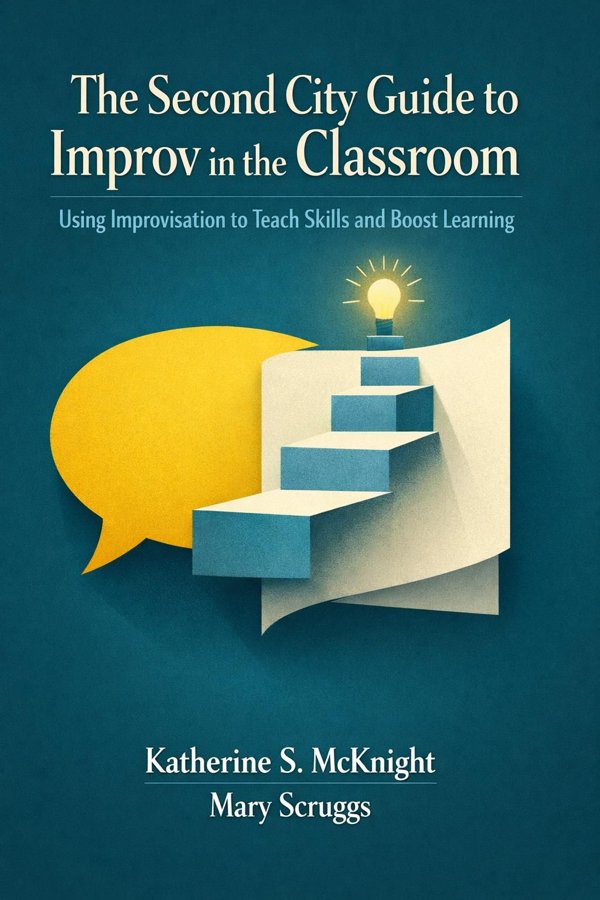
The Second City Guide to Improv in the Classroom: Using Improvisation to Teach Skills and Boost Learning: Summary & Key Insights
by Katherine S. McKnight, Mary Scruggs
 10 min4 chaptersAudio available
What Is The Second City Guide to Improv in the Classroom: Using Improvisation to Teach Skills and Boost Learning About?
The Second City Guide to Improv in the Classroom: Using Improvisation to Teach Skills and Boost Learning by Katherine S. McKnight, Mary Scruggs is a education book spanning 4 pages. This book provides educators with practical techniques from The Second City, the legendary Chicago improv theater, to enhance classroom engagement and learning. It offers step-by-step improv exercises designed to foster creativity, collaboration, and communication among students, helping teachers integrate improvisational methods into various subjects and grade levels.
This FizzRead summary covers all 4 key chapters of The Second City Guide to Improv in the Classroom: Using Improvisation to Teach Skills and Boost Learning in approximately 10 minutes, distilling the most important ideas, arguments, and takeaways from Katherine S. McKnight, Mary Scruggs's work. Also available as an audio summary and Key Quotes Podcast.
The Second City Guide to Improv in the Classroom: Using Improvisation to Teach Skills and Boost Learning
This book provides educators with practical techniques from The Second City, the legendary Chicago improv theater, to enhance classroom engagement and learning. It offers step-by-step improv exercises designed to foster creativity, collaboration, and communication among students, helping teachers integrate improvisational methods into various subjects and grade levels.
Who Should Read The Second City Guide to Improv in the Classroom: Using Improvisation to Teach Skills and Boost Learning?
This book is perfect for anyone interested in education and looking to gain actionable insights in a short read. Whether you're a student, professional, or lifelong learner, the key ideas from The Second City Guide to Improv in the Classroom: Using Improvisation to Teach Skills and Boost Learning by Katherine S. McKnight, Mary Scruggs will help you think differently.
- ✓Readers who enjoy education and want practical takeaways
- ✓Professionals looking to apply new ideas to their work and life
- ✓Anyone who wants the core insights of The Second City Guide to Improv in the Classroom: Using Improvisation to Teach Skills and Boost Learning in just 10 minutes
Want the full summary?
Get instant access to this book summary and 100K+ more with Fizz Moment.
Get Free SummaryAvailable on App Store • Free to download
Key Chapters
When we first introduce improvisational principles to the classroom, we are not asking teachers to abandon structure; we are encouraging flexibility within it. Improvisation begins with a few deceptively simple ideas — listening, agreement, and collaboration — that become profound when practiced deliberately.
Listening, in improv terms, means truly hearing what is said rather than waiting for your turn to speak. In the classroom, listening transforms discussion into dialogue. When students practice active listening through improv games, they begin to notice cues, emotions, and ideas. They respond authentically rather than formulaically. For a teacher, this skill opens doors to student creativity: the more we listen, the more we discover what our students actually know and feel.
Agreement is embodied in the phrase 'Yes, and…'. It is the foundation of all improvisation. Saying 'Yes' accepts the reality offered by a partner. Adding 'and…' builds upon it. Imagine bringing this mindset to group work or brainstorming. Instead of critiquing or dismissing initial ideas, students learn to build on them, creating cooperative momentum. This practice doesn’t mean surrendering critical thinking — it means delaying judgment just long enough to let creative possibilities unfold.
Collaboration is where these principles culminate. On the improv stage, success depends on group cohesion: every performer contributes to the scene’s evolution. In the classroom, collaboration becomes an equalizing force. Students who might otherwise stay silent find their voices; they see learning as a co-created process rather than a set of solitary tasks. Through collaborative improv exercises, the classroom becomes a community — one built on mutual respect, shared responsibility, and creative exploration.
Improvisation thrives on uncertainty, and that’s what makes it a perfect mirror for education. Both depend on navigating the unplanned. When teachers model comfort with uncertainty through improv, students learn resilience. They discover that not having an immediate answer is not a failure, but an opening.
Teaching with improvisation respects the diversity of subjects and age groups. The book breaks down improv integration into tangible pathways that adapt seamlessly to existing lesson plans. For a language class, improv enhances storytelling, character development, and dialogue structure. In social studies, it helps students embody historical figures, re-enact debates, or explore perspectives from different times and cultures. In science, improvisation can become an imaginative tool for hypothesis building or exploratory discussion.
One of the strengths of this Second City method lies in how accessible and scalable it is. You don’t need a drama degree or a stage; you only need space — physical and emotional — for play. Exercises such as 'Group Story', 'Three-Line Scenes', or 'One Word at a Time' allow students to practice sequencing, narrative logic, and collective creativity. In younger grades, games become vehicles for literacy and confidence building. In high school, they serve as structures for critical thinking and collaboration.
Improv exercises also fit naturally within differentiated instruction. Because these activities can be tailored to the abilities and comfort levels of students, they create inclusion by design. Students with varying linguistic, cognitive, or social needs engage equally, since the focus is not on perfect performance but genuine participation. The book reminds teachers that the magic of improv lies in its low barrier to entry: everyone can contribute something, and those contributions matter.
Integrating these activities doesn’t mean adding extra work. They can substitute traditional drills, introduce complex topics, or conclude discussions. The authors offer real classroom narratives where teachers used improv to break through disengagement, to energize morning routines, or to de-stress before exams. The effect was consistently positive — students laughed more, connected better, and learned faster.
Improvisation doesn’t replace pedagogy; it enriches it. It helps educators rediscover joy in teaching and reawakens students’ natural curiosity — making the classroom a space of active creation, not passive reception.
+ 2 more chapters — available in the FizzRead app
All Chapters in The Second City Guide to Improv in the Classroom: Using Improvisation to Teach Skills and Boost Learning
About the Authors
Katherine S. McKnight is an educator, author, and consultant specializing in literacy and teacher professional development. Mary Scruggs was a writer, performer, and director associated with The Second City, known for her contributions to improvisational theater and education.
Get This Summary in Your Preferred Format
Read or listen to the The Second City Guide to Improv in the Classroom: Using Improvisation to Teach Skills and Boost Learning summary by Katherine S. McKnight, Mary Scruggs anytime, anywhere. FizzRead offers multiple formats so you can learn on your terms — all free.
Available formats: App · Audio · PDF · EPUB — All included free with FizzRead
Download The Second City Guide to Improv in the Classroom: Using Improvisation to Teach Skills and Boost Learning PDF and EPUB Summary
Key Quotes from The Second City Guide to Improv in the Classroom: Using Improvisation to Teach Skills and Boost Learning
“When we first introduce improvisational principles to the classroom, we are not asking teachers to abandon structure; we are encouraging flexibility within it.”
“Teaching with improvisation respects the diversity of subjects and age groups.”
Frequently Asked Questions about The Second City Guide to Improv in the Classroom: Using Improvisation to Teach Skills and Boost Learning
The Second City Guide to Improv in the Classroom: Using Improvisation to Teach Skills and Boost Learning by Katherine S. McKnight, Mary Scruggs is a education book that explores key ideas across 4 chapters. This book provides educators with practical techniques from The Second City, the legendary Chicago improv theater, to enhance classroom engagement and learning. It offers step-by-step improv exercises designed to foster creativity, collaboration, and communication among students, helping teachers integrate improvisational methods into various subjects and grade levels.
You Might Also Like

Bedtime Biography: Florence Nightingale
Isabel Thomas
10 min
Introduction To Museum Studies
Howard H. Hoyt
10 min
A Mind for Numbers: How to Excel at Math and Science (Even If You Flunked Algebra)
Barbara Oakley
10 min
AI for Educators: Learning Strategies, Teacher Empowerment, and the Future of Education
Matt Miller
10 min
Animation For Beginners
Morr Meroz
10 min
Artificial Intelligence for Learning
Donald Clark
10 minBrowse by Category
Ready to read The Second City Guide to Improv in the Classroom: Using Improvisation to Teach Skills and Boost Learning?
Get the full summary and 100K+ more books with Fizz Moment.