
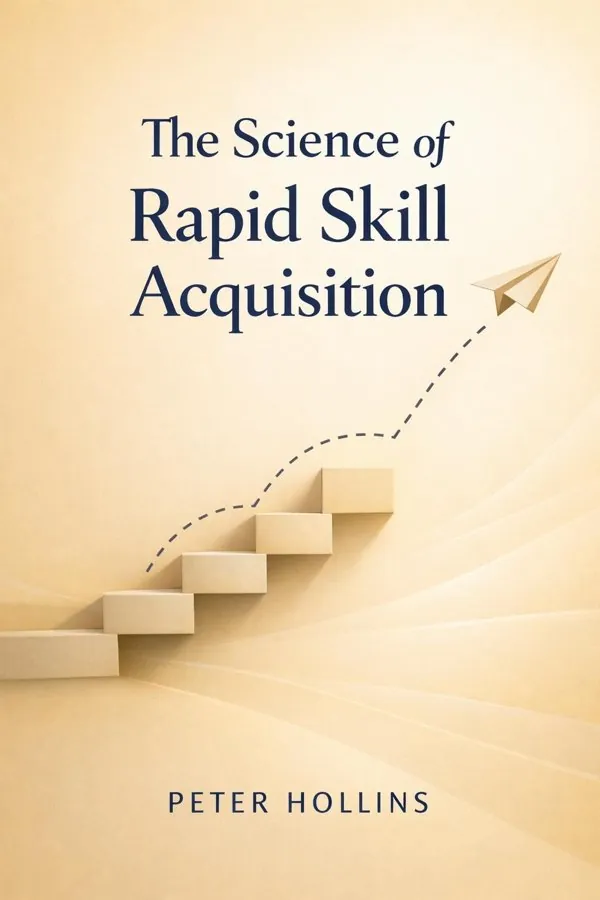
The Science of Rapid Skill Acquisition: Advanced Methods to Learn, Remember, and Master New Skills Faster: Summary & Key Insights
 10 min7 chaptersAudio available
What Is The Science of Rapid Skill Acquisition: Advanced Methods to Learn, Remember, and Master New Skills Faster About?
The Science of Rapid Skill Acquisition: Advanced Methods to Learn, Remember, and Master New Skills Faster by Peter Hollins is a cognition book spanning 7 pages. This book explores scientifically grounded techniques for accelerating the process of learning new skills. Drawing on cognitive psychology and neuroscience, Peter Hollins presents practical strategies for deliberate practice, memory optimization, and efficient learning cycles. The work emphasizes how to structure learning sessions, overcome plateaus, and apply mental models to achieve mastery in less time.
This FizzRead summary covers all 7 key chapters of The Science of Rapid Skill Acquisition: Advanced Methods to Learn, Remember, and Master New Skills Faster in approximately 10 minutes, distilling the most important ideas, arguments, and takeaways from Peter Hollins's work. Also available as an audio summary and Key Quotes Podcast.
The Science of Rapid Skill Acquisition: Advanced Methods to Learn, Remember, and Master New Skills Faster
This book explores scientifically grounded techniques for accelerating the process of learning new skills. Drawing on cognitive psychology and neuroscience, Peter Hollins presents practical strategies for deliberate practice, memory optimization, and efficient learning cycles. The work emphasizes how to structure learning sessions, overcome plateaus, and apply mental models to achieve mastery in less time.
Who Should Read The Science of Rapid Skill Acquisition: Advanced Methods to Learn, Remember, and Master New Skills Faster?
This book is perfect for anyone interested in cognition and looking to gain actionable insights in a short read. Whether you're a student, professional, or lifelong learner, the key ideas from The Science of Rapid Skill Acquisition: Advanced Methods to Learn, Remember, and Master New Skills Faster by Peter Hollins will help you think differently.
- ✓Readers who enjoy cognition and want practical takeaways
- ✓Professionals looking to apply new ideas to their work and life
- ✓Anyone who wants the core insights of The Science of Rapid Skill Acquisition: Advanced Methods to Learn, Remember, and Master New Skills Faster in just 10 minutes
Want the full summary?
Get instant access to this book summary and 100K+ more with Fizz Moment.
Get Free SummaryAvailable on App Store • Free to download
Key Chapters
Every act of learning is a biological event. Our brains constantly reshape themselves through neural plasticity—the ability to form and strengthen connections between neurons. When you practice a new skill, whether typing or juggling, you’re quite literally rewiring your brain. Repetition builds myelin around those neural pathways, increasing the speed and precision of your responses.
One crucial insight I emphasize is that the brain doesn’t distinguish between physical and mental rehearsal. When you visualize performing a skill correctly, the same motor areas that activate during physical execution light up. This means your capacity to learn extends beyond time spent with hands-on practice. By combining actual repetition with vivid mental rehearsal, you accelerate both speed and retention.
Memory formation is another cornerstone. Instead of treating memory as a passive recording device, understanding working memory and long-term encoding transforms how you learn. You don’t remember everything you hear or see; you remember what’s associated, retrieved, and reinforced. The key lies in active recall—testing yourself rather than rereading material. Retrieval strengthens neural pathways much more than review. That’s why techniques like spaced repetition work: they force your brain to rebuild memory traces at spaced intervals, ensuring deep, durable retention.
Learning, then, isn’t a matter of passive absorption—it’s sculpting. Each failure, each correction, each sensory feedback shapes your neural design toward automaticity. If you can understand that structure, you gain control of learning itself.
One of the most destructive myths in learning is the notion of innate genius—this belief that certain people are simply born with gifts others cannot replicate. Science offers a more hopeful and empowering view: mastery is a byproduct of deliberate practice, not raw talent.
Deliberate practice differs drastically from rote repetition. It involves focused effort on areas just beyond your comfort zone, guided by feedback and corrected constantly. This space—the zone of proximal development—is where growth occurs. When you repeat what you already know, you stagnate; when you stretch, you evolve. The violinist refining bow pressure or the programmer debugging logic constructs both engage in deliberate practice—each small correction tightening neural efficiency.
Through studies of experts like chess grandmasters and world-class athletes, we see that extraordinary skill emerges from thousands of hours of intentional, feedback-driven micro improvements, not from broad talent. What matters is consistency and design: the structure of your practice determines the extent of your progress.
The shift in mindset is transformative. If talent is not fixed, then progress becomes predictable. You stop envying what others have and start measuring what you can cultivate. Deliberate practice redefines learning as engineering—you design growth by choosing what to practice, how to evaluate it, and when to rest. Every session becomes an experiment in optimization rather than an act of performance.
+ 5 more chapters — available in the FizzRead app
All Chapters in The Science of Rapid Skill Acquisition: Advanced Methods to Learn, Remember, and Master New Skills Faster
About the Author
Peter Hollins is an American author and psychologist specializing in human behavior, learning science, and personal development. He has written numerous books on self-improvement, productivity, and cognitive psychology, focusing on evidence-based methods for personal growth.
Get This Summary in Your Preferred Format
Read or listen to the The Science of Rapid Skill Acquisition: Advanced Methods to Learn, Remember, and Master New Skills Faster summary by Peter Hollins anytime, anywhere. FizzRead offers multiple formats so you can learn on your terms — all free.
Available formats: App · Audio · PDF · EPUB — All included free with FizzRead
Download The Science of Rapid Skill Acquisition: Advanced Methods to Learn, Remember, and Master New Skills Faster PDF and EPUB Summary
Key Quotes from The Science of Rapid Skill Acquisition: Advanced Methods to Learn, Remember, and Master New Skills Faster
“Every act of learning is a biological event.”
“One of the most destructive myths in learning is the notion of innate genius—this belief that certain people are simply born with gifts others cannot replicate.”
Frequently Asked Questions about The Science of Rapid Skill Acquisition: Advanced Methods to Learn, Remember, and Master New Skills Faster
The Science of Rapid Skill Acquisition: Advanced Methods to Learn, Remember, and Master New Skills Faster by Peter Hollins is a cognition book that explores key ideas across 7 chapters. This book explores scientifically grounded techniques for accelerating the process of learning new skills. Drawing on cognitive psychology and neuroscience, Peter Hollins presents practical strategies for deliberate practice, memory optimization, and efficient learning cycles. The work emphasizes how to structure learning sessions, overcome plateaus, and apply mental models to achieve mastery in less time.
More by Peter Hollins

You Might Also Like

A Field Guide to Lies: Critical Thinking in the Information Age
Daniel J. Levitin
10 min
A Theory of Cognitive Dissonance
Leon Festinger
10 min
Black-And-White Thinking: The Burden of a Binary Brain in a Complex World
Kevin Dutton
10 min
Born Liars: Why We Can’t Live Without Deceit
Ian Leslie
10 min
Collective Illusions: Conformity, Complicity, and the Science of Why We Make Bad Decisions
Todd Rose
10 min
Concrete Mathematics: A Foundation for Computer Science
Ronald L. Graham, Donald E. Knuth, Oren Patashnik
10 minBrowse by Category
Ready to read The Science of Rapid Skill Acquisition: Advanced Methods to Learn, Remember, and Master New Skills Faster?
Get the full summary and 100K+ more books with Fizz Moment.