
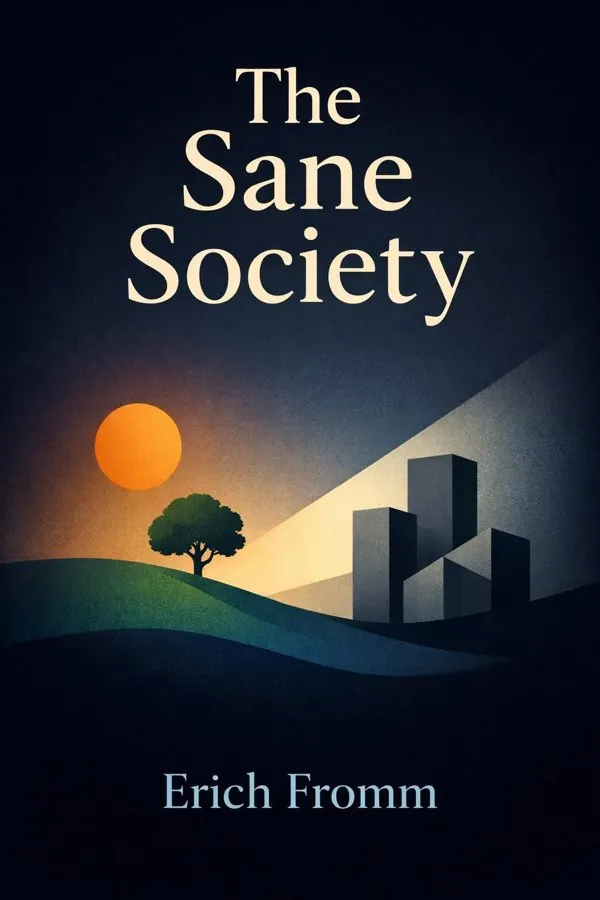
The Sane Society: Summary & Key Insights
by Erich Fromm
 10 min8 chaptersAudio available
Key Takeaways from The Sane Society
A society can look successful on the surface while quietly damaging the people who live inside it.
People do not live by bread alone, and societies become distorted when they pretend otherwise.
The strange burden of freedom is that many people fear it more than they admit.
When the market becomes society’s dominant value system, people begin to treat themselves as commodities.
The fact that millions share a pattern does not make it healthy.
What Is The Sane Society About?
The Sane Society by Erich Fromm is a psychology book spanning 11 pages. What if the real sickness of modern life is not found mainly in individuals, but in the society they are expected to adapt to? In The Sane Society, Erich Fromm delivers a powerful critique of industrial capitalism, arguing that many forms of anxiety, emptiness, conformity, and emotional disconnection are not personal failures but rational responses to an unhealthy social order. Rather than treating mental health as a private matter alone, Fromm asks a deeper question: can a society itself be insane while appearing normal, productive, and successful? Drawing on psychoanalysis, sociology, philosophy, and ethics, Fromm examines how modern people become alienated from their work, from one another, and from their own inner lives. He explores why freedom often becomes frightening, why people escape into conformity, and how market values reshape personality itself. Yet this is not merely a diagnosis of social decay. Fromm also offers a hopeful humanistic vision built on love, meaningful work, creativity, responsibility, and genuine freedom. Written by one of the twentieth century’s most influential social psychologists and humanist thinkers, The Sane Society remains strikingly relevant in an age of burnout, consumerism, loneliness, and identity crisis.
This FizzRead summary covers all 8 key chapters of The Sane Society in approximately 10 minutes, distilling the most important ideas, arguments, and takeaways from Erich Fromm's work. Also available as an audio summary and Key Quotes Podcast.
The Sane Society
What if the real sickness of modern life is not found mainly in individuals, but in the society they are expected to adapt to? In The Sane Society, Erich Fromm delivers a powerful critique of industrial capitalism, arguing that many forms of anxiety, emptiness, conformity, and emotional disconnection are not personal failures but rational responses to an unhealthy social order. Rather than treating mental health as a private matter alone, Fromm asks a deeper question: can a society itself be insane while appearing normal, productive, and successful?
Drawing on psychoanalysis, sociology, philosophy, and ethics, Fromm examines how modern people become alienated from their work, from one another, and from their own inner lives. He explores why freedom often becomes frightening, why people escape into conformity, and how market values reshape personality itself. Yet this is not merely a diagnosis of social decay. Fromm also offers a hopeful humanistic vision built on love, meaningful work, creativity, responsibility, and genuine freedom. Written by one of the twentieth century’s most influential social psychologists and humanist thinkers, The Sane Society remains strikingly relevant in an age of burnout, consumerism, loneliness, and identity crisis.
Who Should Read The Sane Society?
This book is perfect for anyone interested in psychology and looking to gain actionable insights in a short read. Whether you're a student, professional, or lifelong learner, the key ideas from The Sane Society by Erich Fromm will help you think differently.
- ✓Readers who enjoy psychology and want practical takeaways
- ✓Professionals looking to apply new ideas to their work and life
- ✓Anyone who wants the core insights of The Sane Society in just 10 minutes
Want the full summary?
Get instant access to this book summary and 100K+ more with Fizz Moment.
Get Free SummaryAvailable on App Store • Free to download
Key Chapters
People do not live by bread alone, and societies become distorted when they pretend otherwise. Fromm insists that human beings are not driven solely by biological impulses or material incentives. We have existential needs: to relate to others, to transcend passivity, to feel rooted, to possess a stable sense of identity, and to orient our lives around meaning. When these needs are neglected, people do not simply remain neutral; they become anxious, destructive, conformist, or emotionally numb.
This is one of Fromm’s most important contributions. He refuses the narrow view that happiness is just pleasure, comfort, or successful adaptation. A person may eat well, earn well, and still suffer inwardly because deeper human capacities are undeveloped. For example, the need for relatedness cannot be satisfied by constant digital contact if intimacy and care are missing. The need for identity cannot be fulfilled by branding oneself or fitting into a crowd. The need for transcendence cannot be met by endless busyness if one never creates, loves, or contributes.
Fromm also warns that unmet human needs are often channeled into unhealthy substitutes. If people lack genuine belonging, they may seek fusion in nationalism, groupthink, or celebrity culture. If they lack meaning, they may cling to rigid ideologies or compulsive achievement. If they lack rootedness, they may become obsessed with security and routine.
The practical value of this idea is immense. It shifts the question from “Am I functioning?” to “Am I fully alive?” It also asks institutions to do more than produce obedience or efficiency. Families, schools, and workplaces should help people grow into mature, connected, purposeful beings.
Actionable takeaway: Reflect on which of your deeper needs is being undernourished right now—meaning, belonging, identity, creativity, or rootedness—and choose one weekly habit that speaks directly to it.
The strange burden of freedom is that many people fear it more than they admit. Fromm argues that as traditional authorities and fixed social structures weakened in modernity, individuals gained more formal freedom but often became more psychologically insecure. Without clear external anchors, freedom can feel like isolation, uncertainty, and responsibility. As a result, people develop “mechanisms of escape” to avoid the anxiety of being genuinely autonomous.
Fromm identifies several common escapes. One is authoritarianism: submitting to a stronger power or trying to dominate others. Another is destructiveness: attempting to eliminate what feels threatening. A third is automaton conformity: becoming exactly like everyone else so that individuality no longer creates tension. This last mechanism is especially central to The Sane Society. In modern mass culture, people often imagine themselves free while merely absorbing approved desires, opinions, and lifestyles.
Consider the employee who suppresses doubts and adopts the values of corporate culture so completely that personal judgment fades. Or the person who chooses hobbies, political views, and even emotional expressions based mainly on what is socially rewarded. These choices may feel voluntary, yet they are shaped by the fear of standing apart.
Fromm’s insight remains timely. Many modern forms of “choice” mask deeper dependence. An abundance of options does not guarantee inner freedom if one lacks self-knowledge and courage. True freedom is not just freedom from external constraint; it is freedom to act from reason, love, and genuine conviction.
Actionable takeaway: Notice one opinion, preference, or routine you maintain mainly to avoid disapproval. Practice expressing a more authentic stance in a low-risk setting and build your tolerance for honest individuality.
When the market becomes society’s dominant value system, people begin to treat themselves as commodities. Fromm calls this the “market character”: a personality orientation in which individuals experience their worth in terms of exchange value. Instead of asking, “Who am I?” or “What do I believe?”, people ask, “How can I be desirable, competitive, and marketable?” Identity becomes a product to package and sell.
This idea goes far beyond buying and selling goods. In a market-driven culture, charm, flexibility, image, and strategic self-presentation become prized traits. The self is managed like a brand. Success depends on reading demand and adjusting accordingly. A person may become highly skilled at self-promotion yet lose touch with stable convictions or intrinsic interests. The result is often emptiness behind polish.
We can see this everywhere today. Students build resumes before they understand their passions. Workers shape their personalities around employability. Online platforms reward curated personas, making self-expression inseparable from audience approval. Even relationships can become subtly transactional, with people evaluating themselves and others by attractiveness, status, or usefulness.
Fromm does not deny the need to function in economic life. His warning is about allowing market logic to colonize the soul. A healthy person has value that is not reducible to performance, popularity, or profitability. Human dignity must rest on being, not merely on selling.
The practical challenge is to recover forms of activity done for meaning rather than display: conversation without networking, work with craftsmanship, learning without credentialism, and love without calculation. These experiences rebuild a nonmarket center of selfhood.
Actionable takeaway: Identify one important part of your life that has become overly performative. Remove the audience, metrics, or comparison element for a period and reconnect with the activity for its own sake.
The fact that millions share a pattern does not make it healthy. Fromm’s famous idea of the “pathology of normalcy” challenges one of modern society’s most comforting assumptions: that if a way of living is widespread and socially approved, it must be psychologically sound. Fromm argues the opposite. Entire cultures can normalize anxiety, emotional deadness, compulsive consumption, and obedience while calling them maturity or success.
This reverses the usual perspective on mental health. Instead of asking whether an individual is adjusting well to society, Fromm asks whether society itself deserves adjustment. If a person feels uneasy in a culture organized around competition, superficiality, and alienated labor, that discomfort may reflect sensitivity rather than sickness. Conversely, smooth adaptation may signal the loss of spontaneity, depth, or moral awareness.
Examples are easy to find. Chronic overwork is often praised as ambition. Emotional self-protection is rewarded as professionalism. Consumer excess is celebrated as freedom. Loneliness is masked by entertainment. In such conditions, many people function well externally while remaining inwardly fragmented. The danger is that social validation hides personal and collective damage.
Fromm does not romanticize nonconformity for its own sake. Some forms of rebellion are simply reaction. His point is subtler: health must be judged by human flourishing, not by statistical conformity. Do people become more loving, more rational, more creative, more alive? If not, a “normal” society may still be producing pathology.
This insight encourages critical distance. It asks us to evaluate institutions, habits, and cultural ideals by their effect on the human spirit rather than their popularity or efficiency.
Actionable takeaway: Question one socially rewarded behavior in your environment—such as overwork, constant availability, or status competition—and ask whether it truly supports psychological health or merely appears normal.
Psychology becomes shallow when it treats people as bundles of drives or as machines to be adjusted. Fromm’s humanistic psychoanalysis offers a broader view of mental life, one that includes social conditions, moral development, freedom, love, and meaning. He respects Freud’s discoveries but criticizes overly deterministic models that reduce human beings to instinct management. For Fromm, character is shaped not only by childhood and biology but also by economic systems, culture, and existential needs.
This perspective matters because it reframes suffering. A person’s anxiety or emptiness may not stem solely from private conflict; it may express a sensible response to alienating conditions. Therapy, then, should not merely help people function better within unhealthy environments. It should help them become more aware, more independent, and more capable of productive love and meaningful action.
Fromm also distinguishes between having and being. A “having” orientation seeks security through possession, control, and accumulation. A “being” orientation values aliveness, presence, sharing, and genuine experience. Humanistic growth involves shifting from possession-based identity toward lived participation in the world.
In practical terms, this means asking different questions in self-reflection. Not just “How do I reduce symptoms?” but “What kind of person am I becoming?” Not just “How do I fit in?” but “What social pressures are shaping me?” Not just “What do I want?” but “What do I truly value?”
Fromm’s approach is especially useful today because many people feel distressed for reasons that are not merely chemical or personal. Humanistic psychoanalysis honors the link between inner life and social reality while still preserving personal responsibility.
Actionable takeaway: When facing recurring distress, explore both inner patterns and outer conditions. Write down one personal habit and one social pressure contributing to the problem, then address both rather than only one.
Health is more than the absence of disorder; it is the presence of productive, loving, and meaningful life. Fromm’s positive vision of a sane society is not utopian fantasy but a moral and psychological standard. Such a society would be organized around the full development of human capacities rather than the endless expansion of production and consumption. It would encourage people to be active creators of life, not passive consumers of stimulation.
The key concept here is “productiveness,” which Fromm uses in a humanistic sense. To be productive is not simply to be busy or economically efficient. It means using one’s powers in a living, connected, and responsible way. Love, reason, imagination, work, and civic participation can all be productive when they express one’s genuine powers and contribute to the world. A productive person is neither selfishly isolated nor dissolved into conformity.
Fromm envisions institutions that support this kind of life. Work would offer participation and purpose rather than mere compliance. Politics would involve active citizenship instead of manipulation. Economic life would serve human needs instead of turning people into instruments. Communities would foster solidarity without crushing individuality.
Even at the personal level, this idea is practical. A sane life includes rhythms of work, reflection, affection, creativity, and public responsibility. It rejects both passive entertainment as a substitute for living and frantic activity as a substitute for meaning. The goal is not perfection but integrity.
This framework can guide choices about career, community, and daily habits. Does an activity increase your vitality and connectedness, or does it drain and fragment you? Does it help you become more fully human?
Actionable takeaway: Redesign one regular part of your week—work, leisure, or relationships—to make it more participatory, creative, and genuinely life-giving rather than merely efficient or distracting.
Individual well-being cannot be separated from the structure of society. Fromm argues that a sane society requires changes not only in personal values but also in economic organization, political life, education, and culture. Psychological health is not produced by therapy alone. It depends on whether institutions support autonomy, solidarity, and meaningful participation.
Economically, Fromm criticizes systems that treat profit and consumption as ultimate ends. He favors arrangements that preserve personal freedom while orienting production toward human need. Politically, he worries about passive democracy, where citizens formally vote but remain disengaged, manipulated, and powerless. Genuine democracy, for him, requires active participation, informed judgment, and decentralization where possible.
Education is equally central. Schools often prepare children to adapt, compete, and perform rather than to think critically, love truth, or become mature individuals. A healthy education would cultivate reason, imagination, ethical awareness, and the courage to resist dehumanizing norms. Culture too must be reconsidered. When entertainment becomes mass distraction and communication becomes propaganda, people lose the habits of reflection and dialogue needed for freedom.
These arguments feel especially contemporary. Burnout, polarization, misinformation, consumer addiction, and loneliness are not isolated personal glitches. They are linked to the design of institutions and the values they promote. Fromm pushes readers to think systemically without abandoning personal responsibility.
The practical lesson is to widen our moral field of vision. If we want healthier lives, we must ask not only how to cope better, but what kinds of workplaces, schools, media, and civic practices make sanity easier or harder.
Actionable takeaway: Choose one institution you regularly inhabit—workplace, school, online community, or neighborhood—and identify one concrete way to increase participation, dialogue, or human-centered values within it.
All Chapters in The Sane Society
About the Author
Erich Fromm (1900–1980) was a German social psychologist, psychoanalyst, sociologist, and humanistic philosopher whose work bridged psychology and social criticism. Born in Frankfurt, he studied sociology and psychoanalysis and later became associated with the Frankfurt School, though he developed an independent intellectual path. After leaving Nazi Germany, he lived and worked in the United States and Mexico. Fromm is best known for influential books such as Escape from Freedom, The Sane Society, and The Art of Loving. Across his writing, he explored how modern social systems shape personality, freedom, love, ethics, and mental health. He challenged both rigid Freudianism and purely economic theories of human behavior, arguing instead for a humanistic vision in which individuals flourish through reason, creativity, responsibility, and genuine connection with others.
Get This Summary in Your Preferred Format
Read or listen to the The Sane Society summary by Erich Fromm anytime, anywhere. FizzRead offers multiple formats so you can learn on your terms — all free.
Available formats: App · Audio · PDF · EPUB — All included free with FizzRead
Download The Sane Society PDF and EPUB Summary
Key Quotes from The Sane Society
“A society can look successful on the surface while quietly damaging the people who live inside it.”
“People do not live by bread alone, and societies become distorted when they pretend otherwise.”
“The strange burden of freedom is that many people fear it more than they admit.”
“When the market becomes society’s dominant value system, people begin to treat themselves as commodities.”
“The fact that millions share a pattern does not make it healthy.”
Frequently Asked Questions about The Sane Society
The Sane Society by Erich Fromm is a psychology book that explores key ideas across 8 chapters. What if the real sickness of modern life is not found mainly in individuals, but in the society they are expected to adapt to? In The Sane Society, Erich Fromm delivers a powerful critique of industrial capitalism, arguing that many forms of anxiety, emptiness, conformity, and emotional disconnection are not personal failures but rational responses to an unhealthy social order. Rather than treating mental health as a private matter alone, Fromm asks a deeper question: can a society itself be insane while appearing normal, productive, and successful? Drawing on psychoanalysis, sociology, philosophy, and ethics, Fromm examines how modern people become alienated from their work, from one another, and from their own inner lives. He explores why freedom often becomes frightening, why people escape into conformity, and how market values reshape personality itself. Yet this is not merely a diagnosis of social decay. Fromm also offers a hopeful humanistic vision built on love, meaningful work, creativity, responsibility, and genuine freedom. Written by one of the twentieth century’s most influential social psychologists and humanist thinkers, The Sane Society remains strikingly relevant in an age of burnout, consumerism, loneliness, and identity crisis.
More by Erich Fromm
You Might Also Like
The Body Keeps the Score
Bessel van der Kolk
10 min
Surrounded by Idiots
Thomas Erikson
10 min
Emotional Intelligence
Daniel Goleman
10 min
Attached
Amir Levine
10 min
Why Does He Do That
Lundy Bancroft
10 min
Women Who Run with the Wolves
Clarissa Pinkola Estés
10 minBrowse by Category
Ready to read The Sane Society?
Get the full summary and 100K+ more books with Fizz Moment.