
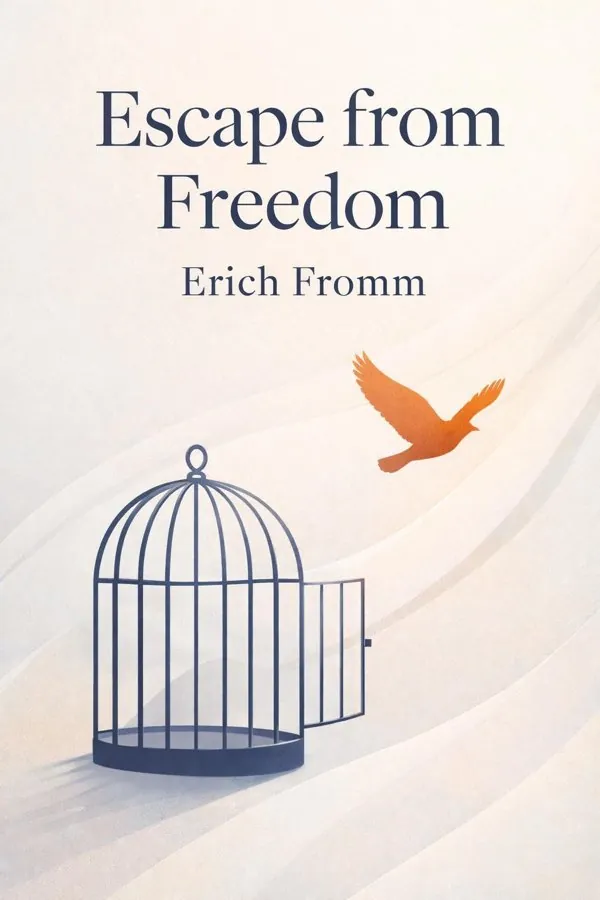
Escape from Freedom: Summary & Key Insights
by Erich Fromm
 10 min11 chaptersAudio available
What Is Escape from Freedom About?
Escape from Freedom by Erich Fromm is a psychology book spanning 11 pages. In this seminal work, Erich Fromm explores the psychological and social conditions that led to the rise of totalitarianism in the 20th century. He argues that modern individuals, having gained freedom from traditional authorities, often experience isolation and anxiety, which can drive them to seek security in authoritarian systems. The book examines the tension between freedom and security, and the ways in which individuals can achieve true freedom through self-realization and love.
This FizzRead summary covers all 11 key chapters of Escape from Freedom in approximately 10 minutes, distilling the most important ideas, arguments, and takeaways from Erich Fromm's work. Also available as an audio summary and Key Quotes Podcast.
Escape from Freedom
In this seminal work, Erich Fromm explores the psychological and social conditions that led to the rise of totalitarianism in the 20th century. He argues that modern individuals, having gained freedom from traditional authorities, often experience isolation and anxiety, which can drive them to seek security in authoritarian systems. The book examines the tension between freedom and security, and the ways in which individuals can achieve true freedom through self-realization and love.
Who Should Read Escape from Freedom?
This book is perfect for anyone interested in psychology and looking to gain actionable insights in a short read. Whether you're a student, professional, or lifelong learner, the key ideas from Escape from Freedom by Erich Fromm will help you think differently.
- ✓Readers who enjoy psychology and want practical takeaways
- ✓Professionals looking to apply new ideas to their work and life
- ✓Anyone who wants the core insights of Escape from Freedom in just 10 minutes
Want the full summary?
Get instant access to this book summary and 100K+ more with Fizz Moment.
Get Free SummaryAvailable on App Store • Free to download
Key Chapters
The story of freedom begins long before the modern era. In the medieval world, life was defined by certainty and belonging. Every person occupied an unquestioned place within the social and cosmic order. The peasant, the noble, the priest — each knew not only what they were expected to do, but who they were. Religion provided meaning and security; community offered identity. In this structure, the individual was scarcely conscious of himself as separate from society.
Yet such unity came at a price: it denied autonomy. The medieval man was bound by authority — spiritual and temporal — and did not face the challenge of self-determination. His economic and social relationships were stable but static; his moral world rooted in tradition but closed to innovation.
With the rise of modern capitalism and the gradual dissolution of feudal ties, this order began to crumble. The discovery of new lands, the expansion of trade, and the emergence of monetary economies shattered the ancient pattern of life. Individuals were set adrift. The Church’s authority weakened; secular thought grew; people began to perceive themselves as independent agents rather than as members of an ordained hierarchy.
But this new independence was ambiguous. It liberated people from external domination, yet also isolated them. Economic changes intensified it: in a market society, human relations became transactional. Identity ceased to stem from birth and tradition, arising instead from competition, success, and profit. As this transformation accelerated, the foundations of belonging eroded, leaving the individual increasingly alone.
So, historical progress toward freedom came intertwined with psychological dislocation. The very forces that created autonomy also created insecurity. The old bonds dissolved faster than the new inner foundations of individuality could form. This is the historical paradox: the process which freed man from old authority prepared the ground for the new servitude of conformity and authoritarianism.
The Renaissance and Reformation mark the birth of individualism as a conscious reality. In the Renaissance, human beings discovered themselves as creators — artists, thinkers, explorers of consciousness and the world. They asserted that man could shape his destiny through reason and imagination. This was an exhilarating liberation from medieval constraints; individuality found its first expression in art and thought.
Yet the Reformation revealed the darker psychological side of that freedom. In Protestant doctrine, particularly Calvinism, the believer faced direct relationship with God without the mediation of Church hierarchy. This placed the full burden of moral responsibility on the individual, but also intensified anxiety. The notion of predestination — that salvation or damnation had been already decided — created profound insecurity. In a universe suddenly stripped of comforting intermediaries, man stood alone before the divine, uncertain and fearful.
Thus emerged a dual consciousness. On one side, the Renaissance gifted the human being creative pride; on the other, the Reformation filled him with existential anxiety and guilt. The economic evolution that accompanied these movements, especially the rise of capitalism, reinforced this tension. The individual was no longer simply part of a community but a self-seeking entity in a competitive marketplace. Success became proof of grace; failure a sign of inner defect.
In this mix of spiritual liberation and psychological strain, modern man found himself balanced between exaltation and despair. The glorification of individuality thus coexisted with an inner craving for certainty and submission. The seeds of future authoritarianism were already there: the need for relief from the anxiety that freedom engendered.
+ 9 more chapters — available in the FizzRead app
All Chapters in Escape from Freedom
About the Author
Erich Fromm (1900–1980) was a German social psychologist, psychoanalyst, sociologist, and humanistic philosopher. A member of the Frankfurt School of critical theory, he is best known for his works on the intersection of psychology and society, including 'The Art of Loving' and 'Man for Himself'. Fromm’s writings emphasize human freedom, ethics, and the potential for personal and social transformation.
Get This Summary in Your Preferred Format
Read or listen to the Escape from Freedom summary by Erich Fromm anytime, anywhere. FizzRead offers multiple formats so you can learn on your terms — all free.
Available formats: App · Audio · PDF · EPUB — All included free with FizzRead
Download Escape from Freedom PDF and EPUB Summary
Key Quotes from Escape from Freedom
“The story of freedom begins long before the modern era.”
“The Renaissance and Reformation mark the birth of individualism as a conscious reality.”
Frequently Asked Questions about Escape from Freedom
Escape from Freedom by Erich Fromm is a psychology book that explores key ideas across 11 chapters. In this seminal work, Erich Fromm explores the psychological and social conditions that led to the rise of totalitarianism in the 20th century. He argues that modern individuals, having gained freedom from traditional authorities, often experience isolation and anxiety, which can drive them to seek security in authoritarian systems. The book examines the tension between freedom and security, and the ways in which individuals can achieve true freedom through self-realization and love.
More by Erich Fromm


You Might Also Like
The Body Keeps the Score
Bessel van der Kolk
10 min
Surrounded by Idiots
Thomas Erikson
10 min
Emotional Intelligence
Daniel Goleman
10 min
Attached
Amir Levine
10 min
Why Does He Do That
Lundy Bancroft
10 min
Women Who Run with the Wolves
Clarissa Pinkola Estés
10 minBrowse by Category
Ready to read Escape from Freedom?
Get the full summary and 100K+ more books with Fizz Moment.