
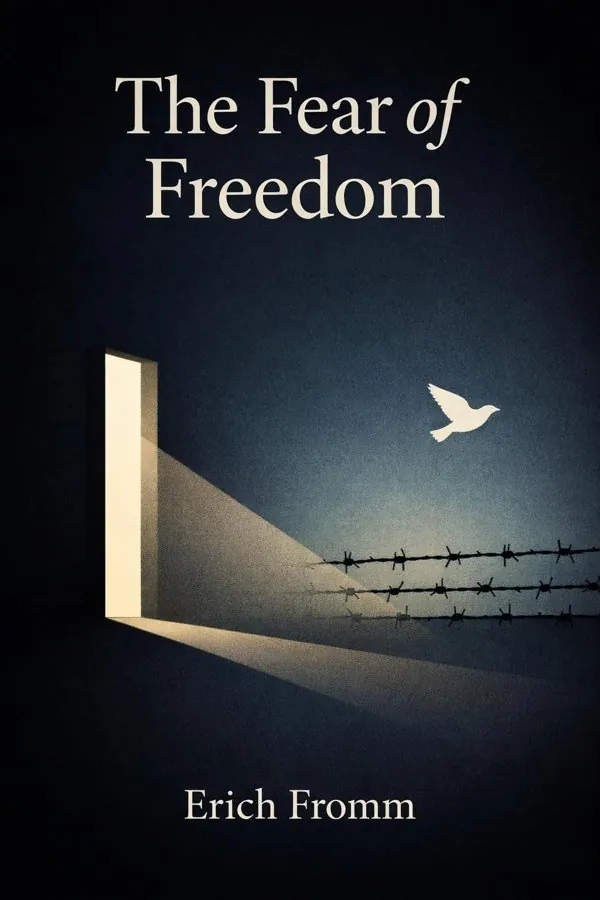
The Fear of Freedom: Summary & Key Insights
by Erich Fromm
 10 min9 chaptersAudio available
Key Takeaways from The Fear of Freedom
Freedom is often imagined as a gift, but Fromm shows that it emerged through loss as much as liberation.
The rise of individualism was one of modernity’s greatest achievements, but Fromm insists it came with a hidden emotional price.
A central insight of The Fear of Freedom is that the deepest threat posed by freedom is not chaos but isolation.
Fromm’s most famous contribution is his explanation of how people flee the burden of freedom.
Authoritarianism is not just a political system; for Fromm, it is a psychological orientation rooted in weakness and fear.
What Is The Fear of Freedom About?
The Fear of Freedom by Erich Fromm is a psychology book spanning 11 pages. Erich Fromm’s The Fear of Freedom is a landmark work of psychology and social philosophy that asks a disturbing question: why do people so often run away from the very freedom they claim to desire? Writing in the shadow of fascism and modern mass society, Fromm argues that freedom is not simply a political condition but a psychological burden. As traditional hierarchies weakened and individuals gained independence, they also became more isolated, uncertain, and anxious. Instead of using freedom creatively, many seek relief in obedience, conformity, or aggression. What makes this book enduring is the way it connects inner life with social structure. Fromm blends psychoanalysis, history, sociology, and ethics to show how economic systems, cultural expectations, and emotional needs shape human behavior. His analysis helps explain authoritarian movements, passive conformity, and the emotional costs of modern individualism. Few books examine so clearly why free societies can still produce fearful, dependent people. For anyone trying to understand modern anxiety, political extremism, or the struggle to become a fully autonomous self, this remains an essential and deeply relevant classic.
This FizzRead summary covers all 9 key chapters of The Fear of Freedom in approximately 10 minutes, distilling the most important ideas, arguments, and takeaways from Erich Fromm's work. Also available as an audio summary and Key Quotes Podcast.
The Fear of Freedom
Erich Fromm’s The Fear of Freedom is a landmark work of psychology and social philosophy that asks a disturbing question: why do people so often run away from the very freedom they claim to desire? Writing in the shadow of fascism and modern mass society, Fromm argues that freedom is not simply a political condition but a psychological burden. As traditional hierarchies weakened and individuals gained independence, they also became more isolated, uncertain, and anxious. Instead of using freedom creatively, many seek relief in obedience, conformity, or aggression. What makes this book enduring is the way it connects inner life with social structure. Fromm blends psychoanalysis, history, sociology, and ethics to show how economic systems, cultural expectations, and emotional needs shape human behavior. His analysis helps explain authoritarian movements, passive conformity, and the emotional costs of modern individualism. Few books examine so clearly why free societies can still produce fearful, dependent people. For anyone trying to understand modern anxiety, political extremism, or the struggle to become a fully autonomous self, this remains an essential and deeply relevant classic.
Who Should Read The Fear of Freedom?
This book is perfect for anyone interested in psychology and looking to gain actionable insights in a short read. Whether you're a student, professional, or lifelong learner, the key ideas from The Fear of Freedom by Erich Fromm will help you think differently.
- ✓Readers who enjoy psychology and want practical takeaways
- ✓Professionals looking to apply new ideas to their work and life
- ✓Anyone who wants the core insights of The Fear of Freedom in just 10 minutes
Want the full summary?
Get instant access to this book summary and 100K+ more with Fizz Moment.
Get Free SummaryAvailable on App Store • Free to download
Key Chapters
Freedom is often imagined as a gift, but Fromm shows that it emerged through loss as much as liberation. In premodern society, individuals were tightly embedded in fixed social structures: family, religion, village, class, and custom. People had less personal choice, but they also had a strong sense of belonging and identity. A person knew who he was because society had already defined his place. As medieval structures weakened, individuals gained room for movement, thought, and self-definition. Yet this process also dissolved old certainties. The result was not instant happiness but psychological instability. To be free from inherited authority meant also being free from inherited meaning.
Fromm’s point is crucial: negative freedom, being released from restraints, does not automatically produce inner strength. It can produce loneliness, doubt, and powerlessness. Imagine a young adult leaving a tightly structured home. The new independence may feel exhilarating at first, but without emotional resources, that freedom can quickly become overwhelming. Modern societies repeat this pattern on a larger scale. We praise independence, but often fail to prepare people for the responsibility and uncertainty that come with it.
This historical perspective helps explain why people may support rigid ideologies even in formally free societies. The longing is not always for oppression itself, but for certainty, order, and relief from isolation. Freedom requires more than legal rights; it requires a self strong enough to bear uncertainty. Actionable takeaway: when evaluating your own choices, ask not only “What am I free from?” but also “What am I free to become, build, and commit to?”
The rise of individualism was one of modernity’s greatest achievements, but Fromm insists it came with a hidden emotional price. The Renaissance elevated human capacity, creativity, and worldly accomplishment. The Reformation intensified personal responsibility by shifting the individual’s relationship to authority, conscience, and salvation. Together, these movements helped create the modern self: more autonomous, more self-aware, and more separate from collective identities. Yet separation is psychologically ambivalent. The more distinct the individual becomes, the more he must face life as an isolated being.
Fromm argues that modern people often celebrate individuality in theory while fearing its emotional consequences in practice. Real individuality demands inner discipline, self-trust, and the courage to act without constant external validation. Many people instead adopt a surface version of individuality, expressed through preferences, lifestyles, or opinions, while remaining deeply dependent on approval. A person may think of himself as independent because he chooses his clothes, career path, or political tribe, but if those choices are largely dictated by social pressure, then autonomy remains shallow.
This insight feels especially current in cultures built around branding and identity performance. Social media encourages endless self-expression, yet often rewards imitation and comparison more than authenticity. One can feel highly visible and deeply disconnected at the same time. Fromm’s lesson is that individualism is not the same as ego-display. It is the difficult process of becoming a person who can think, love, and work from an inner center.
Actionable takeaway: identify one belief, habit, or goal you maintain mainly to win approval, and test what it would mean to revise it according to your genuine convictions.
A central insight of The Fear of Freedom is that the deepest threat posed by freedom is not chaos but isolation. Human beings need connection, orientation, and significance. When traditional bonds weaken, individuals may gain independence but lose the emotional anchors that make life feel coherent. Fromm does not treat this as a private psychological problem alone. He argues that modern social arrangements can produce masses of people who are technically free yet inwardly insecure, detached, and powerless.
This is why freedom can become frightening. If I experience myself as a separate individual but lack purpose, solidarity, and confidence, then my freedom feels like abandonment. I must choose, decide, and take responsibility, but I do not feel equal to the task. Under these conditions, dependence becomes attractive. It promises release from uncertainty. This helps explain why highly developed societies can still produce intense anxiety, loneliness, and susceptibility to rigid movements or identities.
Consider modern work life. A person may enjoy mobility, flexible opportunities, and personal choice, yet still feel disposable, unseen, and disconnected from meaningful community. Or think of urban life, where one can be surrounded by millions and still feel emotionally anonymous. The problem is not freedom itself, but freedom without rootedness. Fromm’s idea challenges the simplistic belief that more choice always means more fulfillment.
The practical implication is that psychological resilience requires relationships and purposes that are not purely transactional. People need bonds that do not erase individuality but support it. Actionable takeaway: strengthen one form of non-instrumental connection this week, such as friendship, shared service, or creative collaboration, so your independence is supported by genuine belonging rather than isolation.
Fromm’s most famous contribution is his explanation of how people flee the burden of freedom. He argues that when individuals cannot bear isolation and uncertainty, they often resort to recurring escape mechanisms. These are not random flaws but patterned responses to psychological insecurity. Instead of developing mature autonomy, people seek relief by giving up selfhood, attacking the world, or blending into the crowd.
Fromm identifies three major routes: authoritarianism, destructiveness, and automaton conformity. Each offers a way to avoid the anxiety of being a free individual. The authoritarian person escapes by submitting to power or becoming powerful over others. The destructive person tries to eliminate what feels threatening. The conformist person dissolves individuality into socially approved roles. Though these mechanisms differ, they share the same function: they reduce the burden of freedom by weakening the self’s need to choose and stand alone.
These patterns appear far beyond political extremism. In personal relationships, someone may submit entirely to a controlling partner because dependence feels safer than autonomy. In workplaces, people may adopt institutional values uncritically to avoid moral responsibility. In culture, trends and opinions can spread not because they are deeply believed, but because joining them prevents exclusion. Fromm helps us see that many forms of obedience are emotionally motivated, not rationally chosen.
The power of this framework lies in its diagnostic clarity. When fear rises, people do not always seek truth; often they seek psychological relief. If we want stronger democracies and healthier individuals, we must understand those temptations. Actionable takeaway: in moments of stress, ask yourself whether your response is expanding your autonomy or merely helping you escape the discomfort of freedom.
When people cannot control life and cannot unite with it constructively, they may try to destroy what threatens or frustrates them. Fromm treats destructiveness as another escape from freedom. It is not simply cruelty for its own sake. More often, it emerges from impotence, humiliation, fear, or blocked vitality. If a person feels too weak to shape the world positively, he may seek relief by attacking it. Destruction creates an illusion of power where genuine agency is missing.
This insight explains why resentment can become so politically and personally explosive. A person who feels unseen or degraded may direct rage at scapegoats, institutions, or intimate partners. A group facing uncertainty may turn to fantasies of purging enemies. On a smaller scale, someone may sabotage a project, relationship, or opportunity because failure feels less threatening when self-inflicted. If I cannot master life, I can at least damage what reminds me of my weakness.
Fromm distinguishes destructiveness from healthy aggression. Healthy aggression protects life and serves growth; destructiveness negates life because the individual cannot bear his own helplessness. That distinction matters. Anger can defend dignity. But when anger becomes chronic hatred, contempt, or delight in harm, it often signals a deeper incapacity to live productively.
The practical value of this idea lies in early recognition. When individuals or communities become organized around blame, humiliation, and enemy-making, they are often expressing fear more than strength. The antidote is not passive tolerance of harm, but the rebuilding of agency, dignity, and meaningful participation. Actionable takeaway: when you feel the urge to lash out, pause and ask, “What power or purpose do I lack right now, and how can I build it constructively instead?”
The most common escape from freedom in modern democratic societies, according to Fromm, is not dramatic tyranny but quiet conformity. He calls this automaton conformity: the individual adopts the thoughts, preferences, and behaviors expected by society, then mistakes this adaptation for authentic selfhood. Outwardly, such a person appears normal, adjusted, and free. Inwardly, however, the self has become hollow. One does what “people like us” do, says what is acceptable, and wants what is socially rewarded.
This mechanism is especially dangerous because it feels harmless. The conformist does not experience himself as coerced. He experiences himself as willingly participating in ordinary life. Yet his opinions may be secondhand, his ambitions borrowed, and his emotions shaped by mass expectations. Because he resembles everyone around him, he also avoids the anxiety of standing alone. The price is subtle but enormous: spontaneity, creativity, and genuine conviction weaken.
Fromm’s diagnosis fits consumer and media culture with remarkable precision. People often select careers, lifestyles, and identities under the influence of trends, status systems, and invisible pressures. A person may pursue a prestigious job not from calling but from imitation. Another may adopt fashionable beliefs without reflection because dissent risks exclusion. Conformity can even disguise itself as uniqueness when marketed options allow people to “customize” themselves in prepackaged ways.
The remedy is not eccentricity for its own sake. True individuality is not rebellion against every norm. It is the capacity to think, feel, and act from one’s own integrated center while remaining connected to others. Actionable takeaway: choose one routine opinion or consumption habit and examine whether it expresses your values or merely your desire to belong.
Fromm argues that modern social life shapes character, not just behavior. The kind of economy and culture people live in helps form the kind of person they become. In capitalist mass society, individuals increasingly come to experience themselves as marketable entities. They must present themselves, package their personalities, and adapt to demand. Success depends less on deep character than on exchange value: how desirable, employable, impressive, or likable one appears to others.
This produces what Fromm elsewhere called the marketing orientation, and the seeds of that idea are present here. The self becomes something to sell. Confidence depends on acceptance by employers, peers, audiences, or institutions. Under these conditions, identity becomes unstable because it rests on external demand. If value is determined by market response, then a person may feel worthy only when approved, hired, followed, or admired. Freedom becomes distorted into self-management for survival.
This analysis helps explain the emotional volatility of modern life. If your identity is organized around performance, rejection feels annihilating. If your worth depends on visibility, invisibility becomes intolerable. Even relationships can become transactional, with people evaluating themselves and others according to status, usefulness, or appeal. The result is often chronic insecurity beneath polished competence.
Fromm does not deny the practical need to function in competitive systems. His point is that no person can remain psychologically healthy if he experiences himself only as a commodity. Human flourishing requires rooted values, productive work, love, and a sense of being rather than mere exchangeability. Actionable takeaway: invest time in one activity that has no branding, status, or performance function for you, so your identity is grounded in lived experience rather than market approval.
Fromm’s solution is not a return to old authorities and not a rejection of individuality. He argues for positive freedom: the ability to realize oneself actively and spontaneously through love, work, reason, and responsible participation in life. Negative freedom frees us from domination; positive freedom enables us to become fully alive. Without this second dimension, liberation remains incomplete and unstable. People who are merely cut loose from constraints are vulnerable to anxiety and escape mechanisms. People who develop productive capacities can bear freedom without fleeing it.
For Fromm, spontaneity is central. He does not mean impulsiveness, but living from one’s authentic powers rather than from compulsion or imitation. In productive love, one connects deeply with others without losing oneself. In productive work, one expresses capacities creatively rather than functioning as a mere instrument. In reason, one confronts reality honestly rather than hiding in dogma. Positive freedom therefore integrates individuality and connection. It allows a person to be separate without being isolated.
This vision is both psychological and ethical. Healthy societies should cultivate conditions in which people can develop inner strength, meaningful relationships, and active citizenship. Education, work, and community should help individuals become agents, not passive consumers of direction. The goal is not just personal comfort but human maturity.
Fromm’s humanism remains compelling because it rejects both atomized individualism and suffocating collectivism. He insists that genuine freedom is inseparable from the development of the whole person. Actionable takeaway: define one practice in your week, creative work, honest conversation, reflective study, or service, that helps you express your capacities rather than merely react to external pressures.
All Chapters in The Fear of Freedom
About the Author
Erich Fromm (1900–1980) was a German-American psychoanalyst, social psychologist, sociologist, and humanist philosopher whose work bridged the inner world of the individual and the structure of society. Born in Frankfurt, he studied sociology and psychoanalysis and was associated with the Frankfurt School, though he developed an independent voice grounded in humanism rather than orthodoxy. After leaving Nazi Germany, he lived and worked in the United States and Mexico, writing influential books on freedom, love, ethics, religion, and modern alienation. His best-known works include The Fear of Freedom, The Art of Loving, and Man for Himself. Fromm’s enduring contribution lies in showing how social systems shape personality and how genuine freedom depends on love, reason, responsibility, and the full development of human potential.
Get This Summary in Your Preferred Format
Read or listen to the The Fear of Freedom summary by Erich Fromm anytime, anywhere. FizzRead offers multiple formats so you can learn on your terms — all free.
Available formats: App · Audio · PDF · EPUB — All included free with FizzRead
Download The Fear of Freedom PDF and EPUB Summary
Key Quotes from The Fear of Freedom
“Freedom is often imagined as a gift, but Fromm shows that it emerged through loss as much as liberation.”
“The rise of individualism was one of modernity’s greatest achievements, but Fromm insists it came with a hidden emotional price.”
“A central insight of The Fear of Freedom is that the deepest threat posed by freedom is not chaos but isolation.”
“Fromm’s most famous contribution is his explanation of how people flee the burden of freedom.”
“Authoritarianism is not just a political system; for Fromm, it is a psychological orientation rooted in weakness and fear.”
Frequently Asked Questions about The Fear of Freedom
The Fear of Freedom by Erich Fromm is a psychology book that explores key ideas across 9 chapters. Erich Fromm’s The Fear of Freedom is a landmark work of psychology and social philosophy that asks a disturbing question: why do people so often run away from the very freedom they claim to desire? Writing in the shadow of fascism and modern mass society, Fromm argues that freedom is not simply a political condition but a psychological burden. As traditional hierarchies weakened and individuals gained independence, they also became more isolated, uncertain, and anxious. Instead of using freedom creatively, many seek relief in obedience, conformity, or aggression. What makes this book enduring is the way it connects inner life with social structure. Fromm blends psychoanalysis, history, sociology, and ethics to show how economic systems, cultural expectations, and emotional needs shape human behavior. His analysis helps explain authoritarian movements, passive conformity, and the emotional costs of modern individualism. Few books examine so clearly why free societies can still produce fearful, dependent people. For anyone trying to understand modern anxiety, political extremism, or the struggle to become a fully autonomous self, this remains an essential and deeply relevant classic.
More by Erich Fromm


You Might Also Like
The Body Keeps the Score
Bessel van der Kolk
10 min
Surrounded by Idiots
Thomas Erikson
10 min
Emotional Intelligence
Daniel Goleman
10 min
Attached
Amir Levine
10 min
Why Does He Do That
Lundy Bancroft
10 min
Women Who Run with the Wolves
Clarissa Pinkola Estés
10 minBrowse by Category
Ready to read The Fear of Freedom?
Get the full summary and 100K+ more books with Fizz Moment.