
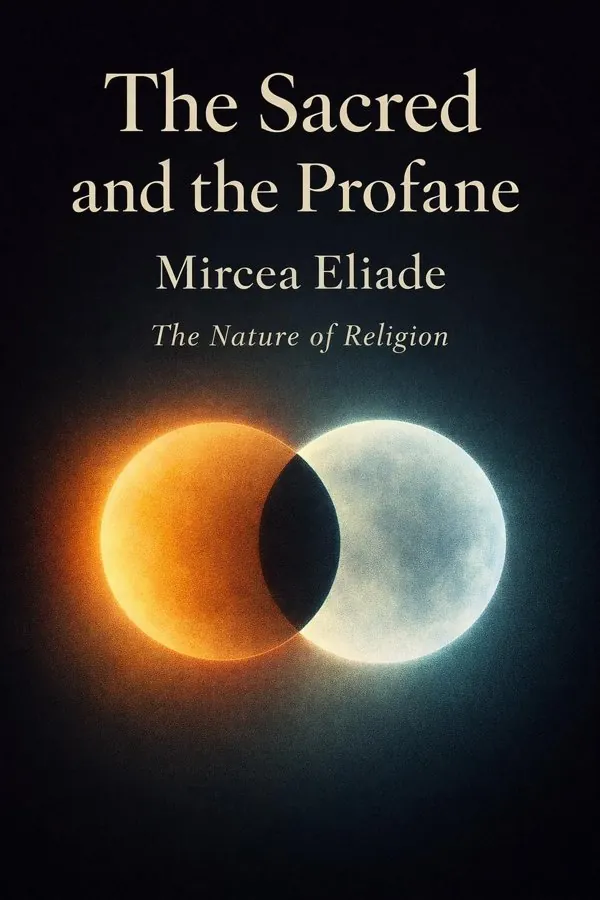
The Sacred and the Profane: The Nature of Religion: Summary & Key Insights
 10 min9 chaptersAudio available
What Is The Sacred and the Profane: The Nature of Religion About?
The Sacred and the Profane: The Nature of Religion by Mircea Eliade is a civilization book spanning 9 pages. In this classic work, Mircea Eliade examines the contrast between the sacred and the profane as two fundamental modes of human existence. Through a comparative study of myths, symbols, and rituals across cultures, Eliade reveals how the sacred shapes space, time, and human life. The book serves as a foundational introduction to the phenomenology of religion and remains a cornerstone in the study of religious experience.
This FizzRead summary covers all 9 key chapters of The Sacred and the Profane: The Nature of Religion in approximately 10 minutes, distilling the most important ideas, arguments, and takeaways from Mircea Eliade's work. Also available as an audio summary and Key Quotes Podcast.
The Sacred and the Profane: The Nature of Religion
In this classic work, Mircea Eliade examines the contrast between the sacred and the profane as two fundamental modes of human existence. Through a comparative study of myths, symbols, and rituals across cultures, Eliade reveals how the sacred shapes space, time, and human life. The book serves as a foundational introduction to the phenomenology of religion and remains a cornerstone in the study of religious experience.
Who Should Read The Sacred and the Profane: The Nature of Religion?
This book is perfect for anyone interested in civilization and looking to gain actionable insights in a short read. Whether you're a student, professional, or lifelong learner, the key ideas from The Sacred and the Profane: The Nature of Religion by Mircea Eliade will help you think differently.
- ✓Readers who enjoy civilization and want practical takeaways
- ✓Professionals looking to apply new ideas to their work and life
- ✓Anyone who wants the core insights of The Sacred and the Profane: The Nature of Religion in just 10 minutes
Want the full summary?
Get instant access to this book summary and 100K+ more with Fizz Moment.
Get Free SummaryAvailable on App Store • Free to download
Key Chapters
Every sacred experience begins with a rupture in ordinary space. The sacred reveals itself by making a certain place different from the rest of the world. For the religious man, not all spaces are equal—some are charged with an incomparable force, set apart from profane surroundings. When a hierophany occurs—when the divine manifests itself in a stone, a tree, or a temple—it founds a world. The place of revelation becomes a fixed point, the axis around which existence organizes itself.
Imagine archaic people erecting an altar where lightning struck the earth; that spot becomes the center of their universe, a place where heaven and earth meet. In this hierarchy of spaces lies the very principle of orientation. To dwell religiously is to live centered—to inhabit a cosmos structured by meaning. To live without such centers, as modern secular man does, is to wander in a homogenous, neutral space that lacks direction.
Temples, churches, and sacred mountains are material embodiments of cosmic order. Their construction imitates the creation of the world; every foundation stone re-enacts the primordial act of ordering chaos. The temple is not merely a building for worship—it is the world made visible, the model of the universe in miniature. By entering sacred space, the believer leaves behind profane confusion and enters the zone of absolute reality, where communication with the transcendent becomes possible.
When you step into such a space, you do not simply change your location—you change your mode of being. The sacred place is where existence becomes significant again, where orientation, purpose, and hierarchy are restored. This is why all cosmogonic myths and rituals begin at a center and why the sacred never ceases to reveal itself as the foundation of reality.
Humanity’s longing for a center is more than geographical; it is metaphysical. Wherever the sacred manifests itself fully, there is established a center of the world—an *axis mundi*—connecting the three cosmic levels of heaven, earth, and underworld. Every city, every temple, every altar is built in imitation of this cosmic axis. It is the line of communication uniting the human with the divine.
Ancient cosmologies are full of symbols of the center: the cosmic mountain rising at the world’s heart, the tree whose roots and branches touch the underworld and heavens alike, the pillar that holds the sky aloft. These images are not ornamental fantasies; they express an existential need to situate oneself in a meaningful cosmos. To dwell at the center is to be close to creation’s source, to live where the sacred breaks into the world of men.
For archaic peoples, founding a new settlement or building a house reproduced the creation of the world. The first stake driven into the ground symbolized the cosmic axis, turning an indeterminate space into an ordered cosmos. Through ritual repetition of this founding act, humanity continually regenerated its world. Even impermanence was thus domesticated by sacred orientation.
Modern man no longer perceives such centers. We live, so to speak, in a fragmented world, deprived of contact with any vertical axis. Yet subconsciously, traces of this desire persist—in our need for anchor points, homes, and sacred places of memory. The center is not lost; it sleeps beneath our conceptual habits, awaiting rediscovery in new forms of meaning and creative renewal.
+ 7 more chapters — available in the FizzRead app
All Chapters in The Sacred and the Profane: The Nature of Religion
About the Author
Mircea Eliade (1907–1986) was a Romanian historian of religions, philosopher, and writer. He served as a professor at the University of Chicago and is widely recognized for his influential research on myth, symbolism, and comparative spirituality. His work profoundly shaped modern religious studies.
Get This Summary in Your Preferred Format
Read or listen to the The Sacred and the Profane: The Nature of Religion summary by Mircea Eliade anytime, anywhere. FizzRead offers multiple formats so you can learn on your terms — all free.
Available formats: App · Audio · PDF · EPUB — All included free with FizzRead
Download The Sacred and the Profane: The Nature of Religion PDF and EPUB Summary
Key Quotes from The Sacred and the Profane: The Nature of Religion
“Every sacred experience begins with a rupture in ordinary space.”
“Humanity’s longing for a center is more than geographical; it is metaphysical.”
Frequently Asked Questions about The Sacred and the Profane: The Nature of Religion
The Sacred and the Profane: The Nature of Religion by Mircea Eliade is a civilization book that explores key ideas across 9 chapters. In this classic work, Mircea Eliade examines the contrast between the sacred and the profane as two fundamental modes of human existence. Through a comparative study of myths, symbols, and rituals across cultures, Eliade reveals how the sacred shapes space, time, and human life. The book serves as a foundational introduction to the phenomenology of religion and remains a cornerstone in the study of religious experience.
More by Mircea Eliade
You Might Also Like
The Structure of Scientific Revolutions
Thomas S. Kuhn
10 min
Genius
Harold Bloom
10 min
A Cultural History of the Medieval Age
Various Editors
10 min
A History of God: The 4,000-Year Quest of Judaism, Christianity and Islam
Karen Armstrong
10 min
A History of the World in 10½ Chapters
Julian Barnes
10 min
A Short History of Progress
Ronald Wright
10 minBrowse by Category
Ready to read The Sacred and the Profane: The Nature of Religion?
Get the full summary and 100K+ more books with Fizz Moment.