
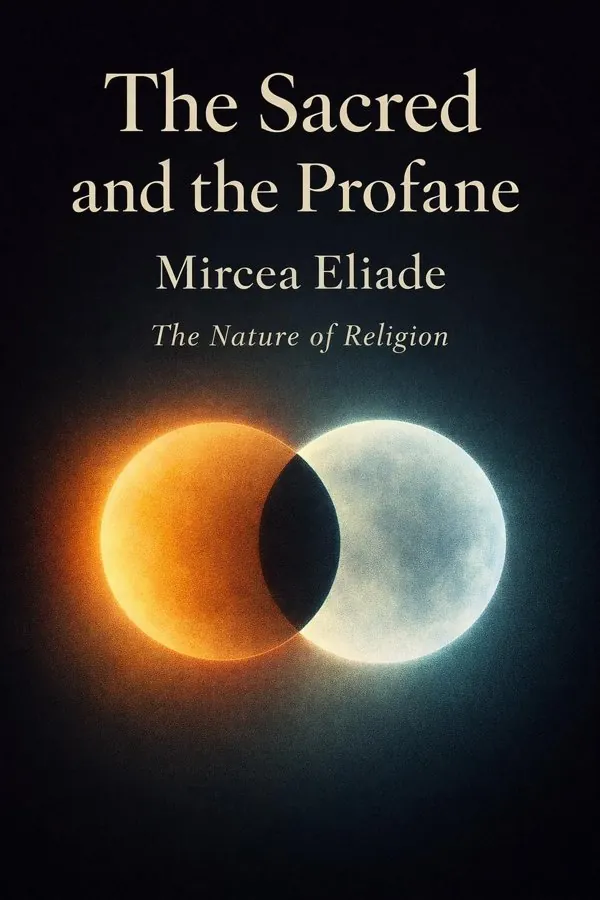
The Sacred and the Profane: Summary & Key Insights
 10 min9 chapters
Key Takeaways from The Sacred and the Profane
A room may be physically identical to another room, yet one can feel charged with presence while the other remains merely functional.
Not all time feels the same, and Eliade argues that religion takes this intuition seriously.
Facts tell us what happened; myths tell a culture what is ultimately real.
One reason rituals endure is that they do more than symbolize belief; they enact participation in a larger order.
A house is never just shelter in Eliade’s account.
What Is The Sacred and the Profane About?
The Sacred and the Profane by Mircea Eliade is a philosophy book published in 2001 spanning 5 pages. What makes a place feel holy, a ritual feel meaningful, or a moment feel larger than ordinary life? In The Sacred and the Profane, Mircea Eliade explores one of the deepest patterns in human experience: the distinction between everyday existence and encounters with what people perceive as sacred reality. Drawing on myths, rituals, symbols, architecture, and religious practices from cultures around the world, Eliade argues that traditional societies did not see the world as homogeneous or purely material. Instead, they experienced it as structured by sacred centers, sacred times, and sacred acts that gave life order and meaning. The book matters because it offers a powerful framework for understanding religion not merely as belief, but as a way of inhabiting reality. Eliade, one of the twentieth century’s most influential historians of religion, brings remarkable breadth to this study, connecting Indigenous traditions, ancient religions, and major world faiths. Even when readers disagree with his conclusions, his core insight remains compelling: human beings continually search for meaning by distinguishing the significant, the holy, and the real from the ordinary flow of life.
This FizzRead summary covers all 9 key chapters of The Sacred and the Profane in approximately 10 minutes, distilling the most important ideas, arguments, and takeaways from Mircea Eliade's work.
The Sacred and the Profane
What makes a place feel holy, a ritual feel meaningful, or a moment feel larger than ordinary life? In The Sacred and the Profane, Mircea Eliade explores one of the deepest patterns in human experience: the distinction between everyday existence and encounters with what people perceive as sacred reality. Drawing on myths, rituals, symbols, architecture, and religious practices from cultures around the world, Eliade argues that traditional societies did not see the world as homogeneous or purely material. Instead, they experienced it as structured by sacred centers, sacred times, and sacred acts that gave life order and meaning. The book matters because it offers a powerful framework for understanding religion not merely as belief, but as a way of inhabiting reality. Eliade, one of the twentieth century’s most influential historians of religion, brings remarkable breadth to this study, connecting Indigenous traditions, ancient religions, and major world faiths. Even when readers disagree with his conclusions, his core insight remains compelling: human beings continually search for meaning by distinguishing the significant, the holy, and the real from the ordinary flow of life.
Who Should Read The Sacred and the Profane?
This book is perfect for anyone interested in philosophy and looking to gain actionable insights in a short read. Whether you're a student, professional, or lifelong learner, the key ideas from The Sacred and the Profane by Mircea Eliade will help you think differently.
- ✓Readers who enjoy philosophy and want practical takeaways
- ✓Professionals looking to apply new ideas to their work and life
- ✓Anyone who wants the core insights of The Sacred and the Profane in just 10 minutes
Want the full summary?
Get instant access to this book summary and 100K+ more with Fizz Moment.
Get Free SummaryAvailable on App Store • Free to download
Key Chapters
A room may be physically identical to another room, yet one can feel charged with presence while the other remains merely functional. Eliade begins with this basic insight: for religious humanity, space is not uniform. Some places are qualitatively different because the sacred reveals itself there. A temple, shrine, mountain, altar, birthplace of a god, or even a tree can become a center where the divine discloses itself. Eliade calls this manifestation a hierophany, a showing of the sacred in the ordinary world.
This distinction matters because sacred space gives orientation. In a purely secular map, all points are measurable. In a religious world, however, one point becomes the center from which the world is organized. A sanctuary is not just a building; it is a fixed point in chaos. Ancient communities built cities, houses, and rituals around such centers because they believed true life begins where contact with ultimate reality is possible. The threshold of a holy site also becomes symbolically important: to cross it is to pass from ordinary life into a different mode of being.
You can see this pattern across cultures. Jerusalem, Mecca, Bodh Gaya, the Kaaba, a village shrine, or a family grave can function as orienting centers. Even modern people often preserve sacred corners in secular ways: memorials, ancestral homes, or spaces dedicated to silence and reflection. While Eliade writes about religion, his insight helps explain why human beings continue to mark certain spaces as inviolable.
Actionable takeaway: Identify the spaces in your life that create depth, clarity, or reverence, and treat them deliberately rather than as interchangeable locations.
Not all time feels the same, and Eliade argues that religion takes this intuition seriously. For modern secular consciousness, time is mostly linear: one moment passes into the next, never to return. For religious humanity, however, sacred time interrupts ordinary duration. Festivals, holy days, rites, and commemorations do not merely remember important events; they reactivate them. Through ritual, worshippers symbolically return to the original time when the gods acted, the cosmos was created, or salvation occurred.
This means sacred time is reversible and recoverable. The new year festival, for example, often represents a return to beginnings, a renewal of the world, and a chance to start life again. Religious calendars are not only systems of scheduling but structures of meaning. By entering sacred time, people step out of historical weariness and reconnect with foundational events that define their identity. Christmas, Passover, Ramadan, Easter, or seasonal rites in traditional societies all reflect this logic in different forms.
Eliade’s point is larger than institutional religion. Human beings seem to crave moments that break the monotony of chronological time and reconnect them to origins, values, and purpose. Birthdays, anniversaries, memorial days, and graduation ceremonies often carry this quasi-sacred structure. They are not valuable merely because they happen, but because they let us revisit who we are.
In practical terms, this idea suggests that meaningful repetition is not empty repetition. Ritualized time can restore attention, belonging, and renewal. A life without such rhythms easily becomes flat, fragmented, and exhausted.
Actionable takeaway: Create recurring practices, weekly or yearly, that reconnect you to your deepest commitments instead of letting time become only a sequence of deadlines.
Facts tell us what happened; myths tell a culture what is ultimately real. Eliade insists that myth should not be dismissed as mere fiction. In traditional societies, myth is a sacred story that recounts primordial events: how the world began, how death entered life, how fire was obtained, how marriage, hunting, agriculture, or kingship became possible. Myths matter because they provide models for human action. To act meaningfully is often to repeat what the gods, ancestors, or culture heroes did in the beginning.
This is one of Eliade’s boldest claims: reality itself becomes intelligible through archetypal stories. A ritual marriage echoes the first divine union; cultivation may reenact a cosmic act of creation; initiation repeats a foundational transformation. In this sense, myth is not entertainment but ontology, a way of locating human life in a sacred pattern. People know what they are doing because myth reveals the original form of that activity.
Modern readers may resist this framework, yet it remains surprisingly relevant. National origin stories, family legends, institutional founding myths, and personal narratives still shape identity and action. A company that tells itself it was founded to “change the world,” a nation that returns to stories of sacrifice, or a family that honors an ancestor’s courage is doing something structurally similar. The story establishes legitimacy, continuity, and meaning.
Eliade invites us to see that human beings do not live by data alone. We live by narratives that tell us what counts, what to imitate, and what kind of world we inhabit.
Actionable takeaway: Examine the stories you live by and ask whether they deepen your life, distort it, or need to be consciously rewritten.
One reason rituals endure is that they do more than symbolize belief; they enact participation in a larger order. Eliade argues that ritual often repeats a primordial event and thereby opens ordinary life to sacred reality. A sacrifice, initiation, pilgrimage, coronation, marriage, harvest rite, or funeral gains power because it is understood as patterned after an original sacred act. In religious consciousness, the ritual is effective not because it is emotionally moving, but because it reconnects participants to the source of meaning.
This is why ritual can seem both repetitive and indispensable. Repetition here is not redundancy. It is a disciplined return to origins. To rebuild a house, till the soil, or mark the new year may involve gestures, prayers, and formulas because these acts are treated as extensions of cosmic order. The rite protects human activity from becoming arbitrary. It situates work, suffering, and celebration within a meaningful universe.
Eliade’s analysis also helps explain why rituals persist even in secular settings. Graduation ceremonies, court oaths, military salutes, memorial services, and civic commemorations depend on scripted repetition. They tell participants that something more than personal preference is at stake. Ritual gives form to transition and binds individuals into a shared reality.
At a personal level, rituals stabilize attention. Morning silence, shared meals, seasonal observances, and intentional farewells can lend significance to life passages that otherwise feel chaotic. Eliade reminds us that ritual is a human technology of meaning, connecting time, action, memory, and identity.
Actionable takeaway: Choose one repeated practice in your life and turn it into a conscious ritual by linking it to a value, intention, or origin story you want to honor.
A house is never just shelter in Eliade’s account. For traditional humanity, dwelling is a sacred act because the home is often built as an image of the cosmos. The post, hearth, roof opening, threshold, and four directions may all carry symbolic significance. To inhabit a home is therefore to live in an ordered world, not merely to occupy private property. Building a house can even resemble founding a world: chaos is transformed into a meaningful center.
This idea links domestic life to larger religious patterns. The home often includes an axis, a center, or an opening to transcendence. Eliade connects this symbolism to temples, cities, and sacred mountains, all of which may represent an axis mundi, the world axis that joins heaven, earth, and the underworld. The central pillar of a house, a sacred fire, or even the arrangement of rooms can reflect this cosmic structure. In such a worldview, daily life unfolds within an environment already charged with spiritual significance.
Even modern people, who may not speak in cosmic terms, still invest homes with symbolic meaning. We orient family life around kitchen tables, mantels, photographs, altars, desks, and doorways. Housewarming rituals, memorial objects, and designated spaces for rest or prayer reveal that dwelling remains more than utility. We continue to seek rootedness, identity, and order through the spaces we inhabit.
Eliade’s insight is especially valuable today, when many people feel spatially uprooted. A home designed only for efficiency may fail to nourish the psyche. Meaningful dwelling requires intentionality.
Actionable takeaway: Arrange your living space around one symbolic center, such as a table, reading corner, or quiet place, that expresses the kind of life you want your home to support.
Growth often requires losing an old self before a new one can emerge. Eliade shows that initiation rites across cultures dramatize this truth through symbols of death, darkness, ordeal, and rebirth. Whether marking puberty, entry into adulthood, membership in a secret society, or religious conversion, initiation separates a person from ordinary life and leads them through a transformative process. The initiate symbolically dies to a former status and returns changed.
For Eliade, this structure reveals something profound about religious anthropology. To become fully human in many traditional societies is not automatic; it requires formation. The child or outsider must undergo instruction, testing, and symbolic suffering to gain access to sacred knowledge and social identity. Myths, masks, seclusion, bodily markings, and ritual trials all communicate that real life begins after one has passed through a threshold.
This pattern remains visible today, though often in diluted forms. Graduation, military training, recovery programs, monastic vows, professional licensing, and even demanding creative apprenticeships involve separation, discipline, and transformation. The symbolic language may be secularized, but the basic human need persists: important change must be marked, recognized, and integrated.
Eliade’s discussion also challenges a culture that celebrates freedom without formation. If identity is treated as effortless self-expression, the deeper work of becoming may be neglected. Initiation reminds us that maturity usually involves limits, guidance, trials, and the willingness to endure uncertainty.
Actionable takeaway: When entering a new stage of life, mark it intentionally with a practice of reflection, learning, and commitment rather than assuming change will happen automatically.
A stone can be geology, a river can be hydrology, and the moon can be astronomy, yet none of these descriptions exhaust human experience of them. Eliade argues that in religious consciousness, nature is not mute matter. It can reveal dimensions of the sacred. The sky suggests transcendence, the earth fertility, water renewal, the moon cyclical time, and the sun power and order. These meanings are not random projections for Eliade; they emerge from recurring symbolic structures through which humans encounter the world.
This does not mean every tree or mountain is automatically worshipped. Rather, certain natural forms become transparent to a deeper reality. A spring may signify purification, a cave gestation and return, a mountain nearness to heaven. Because these symbols are rooted in universal features of experience, they recur across civilizations. Eliade’s broader point is that traditional humans perceived the cosmos as meaningful and legible, not spiritually neutral.
Modernity often trains us to see nature primarily as resource, scenery, or scientific object. Eliade does not reject scientific explanation, but he insists that symbolic meaning addresses a different dimension of life. The persistence of pilgrimages to mountains, reverence for old trees, burial near water, or the use of light in ceremonies suggests that symbolic perception has not disappeared.
In practical life, recovering symbolic attention can deepen ecological responsibility. People protect what they experience as meaningful more readily than what they view as disposable material. A desacralized world is often easier to exploit.
Actionable takeaway: Spend time in one natural setting and ask not only what it is scientifically, but what human meanings and responses it evokes in you.
Even when people claim to live in a disenchanted world, Eliade suggests the sacred has not vanished; it has gone underground. Modern secular life often rejects explicit religious language, yet many of its habits preserve religious structures in disguised form. People still seek centers, celebrate beginnings, reenact myths of origin, honor heroes, mark thresholds, and treat certain spaces and dates as exceptional. The forms may change, but the longing for meaning persists.
Consider nationalism, political ceremonies, sports rituals, consumer holidays, celebrity culture, and memorial practices. A stadium can become a charged collective space; a founding constitution can function as a sacred text; a revolutionary event can be commemorated with liturgical seriousness. Similarly, personal life is full of quasi-sacred patterns: wedding vows, funerals, retirement ceremonies, pilgrimage-like travel, or obsessive returns to “life-changing” moments. Eliade does not say these are identical to religion, but he argues they reveal the endurance of sacred structure within supposedly profane existence.
This is one reason the book remains influential. It offers a vocabulary for analyzing not only temples and myths, but also modern experiences of intensity, belonging, and significance. If people cannot live entirely without sacred orientation, then secularization may transform religion more than eliminate it.
For readers today, this idea invites both sympathy and caution. We should ask what hidden sacreds govern our loyalties. Markets, ideologies, productivity, nation, identity, or technology can become ultimate concerns without being recognized as such.
Actionable takeaway: Identify the people, institutions, or practices you treat as unquestionable, and ask whether you have unintentionally made them sacred.
At the heart of Eliade’s book is a larger anthropological claim: the distinction between sacred and profane is one of the basic ways humans organize existence. The profane is everyday, ordinary, and often fragmented. The sacred is powerful, exemplary, real, and orienting. Religious people do not merely add beliefs onto neutral life; they inhabit a differently structured world. Their homes, calendars, stories, rites, and landscapes are arranged according to encounters with sacred reality.
This framework helps explain why religion has such resilience. It offers not only doctrines but a map of being. It tells people where they are, when they are, what actions matter, and how to align life with a larger order. That is why sacred symbols and practices can be existentially serious rather than merely decorative. They answer the need for orientation in a world that can otherwise appear chaotic or meaningless.
Of course, Eliade’s approach has been debated. Critics argue that he sometimes overgeneralizes religious experience or romanticizes traditional societies. Those criticisms are important. Yet the enduring power of his work lies in the scale of his question: what does it mean for human beings to experience reality as layered, charged, and meaningful rather than flat and homogeneous?
For contemporary readers, this idea becomes a mirror. Whether religious or not, we still divide life into what is trivial and what is ultimate. We still search for places, times, and commitments that make existence cohere.
Actionable takeaway: Clarify your own sacred-profane map by naming what, in your life, feels ultimate, non-negotiable, and meaning-giving.
All Chapters in The Sacred and the Profane
About the Author
Mircea Eliade was a Romanian historian of religion, philosopher, fiction writer, and one of the most influential scholars of religion in the twentieth century. Born in 1907 in Bucharest, he studied philosophy and later developed a lifelong interest in mythology, symbolism, and comparative religion. His work explored how traditional societies understand sacred time, sacred space, initiation, and myth. After leaving Europe during the upheavals of the mid-twentieth century, Eliade eventually joined the University of Chicago, where he became a central figure in the academic study of religion. His major books, including The Myth of the Eternal Return and The Sacred and the Profane, helped shape generations of scholarship. Though aspects of his method have been debated, his ability to synthesize religious patterns across cultures remains highly influential.
Get This Summary in Your Preferred Format
Read or listen to the The Sacred and the Profane summary by Mircea Eliade anytime, anywhere. FizzRead offers multiple formats so you can learn on your terms — all free.
Available formats: App · Audio · PDF · EPUB — All included free with FizzRead
Download The Sacred and the Profane PDF and EPUB Summary
Key Quotes from The Sacred and the Profane
“A room may be physically identical to another room, yet one can feel charged with presence while the other remains merely functional.”
“Not all time feels the same, and Eliade argues that religion takes this intuition seriously.”
“Facts tell us what happened; myths tell a culture what is ultimately real.”
“One reason rituals endure is that they do more than symbolize belief; they enact participation in a larger order.”
“A house is never just shelter in Eliade’s account.”
Frequently Asked Questions about The Sacred and the Profane
The Sacred and the Profane by Mircea Eliade is a philosophy book that explores key ideas across 9 chapters. What makes a place feel holy, a ritual feel meaningful, or a moment feel larger than ordinary life? In The Sacred and the Profane, Mircea Eliade explores one of the deepest patterns in human experience: the distinction between everyday existence and encounters with what people perceive as sacred reality. Drawing on myths, rituals, symbols, architecture, and religious practices from cultures around the world, Eliade argues that traditional societies did not see the world as homogeneous or purely material. Instead, they experienced it as structured by sacred centers, sacred times, and sacred acts that gave life order and meaning. The book matters because it offers a powerful framework for understanding religion not merely as belief, but as a way of inhabiting reality. Eliade, one of the twentieth century’s most influential historians of religion, brings remarkable breadth to this study, connecting Indigenous traditions, ancient religions, and major world faiths. Even when readers disagree with his conclusions, his core insight remains compelling: human beings continually search for meaning by distinguishing the significant, the holy, and the real from the ordinary flow of life.
More by Mircea Eliade
You Might Also Like
Browse by Category
Ready to read The Sacred and the Profane?
Get the full summary and 100K+ more books with Fizz Moment.