
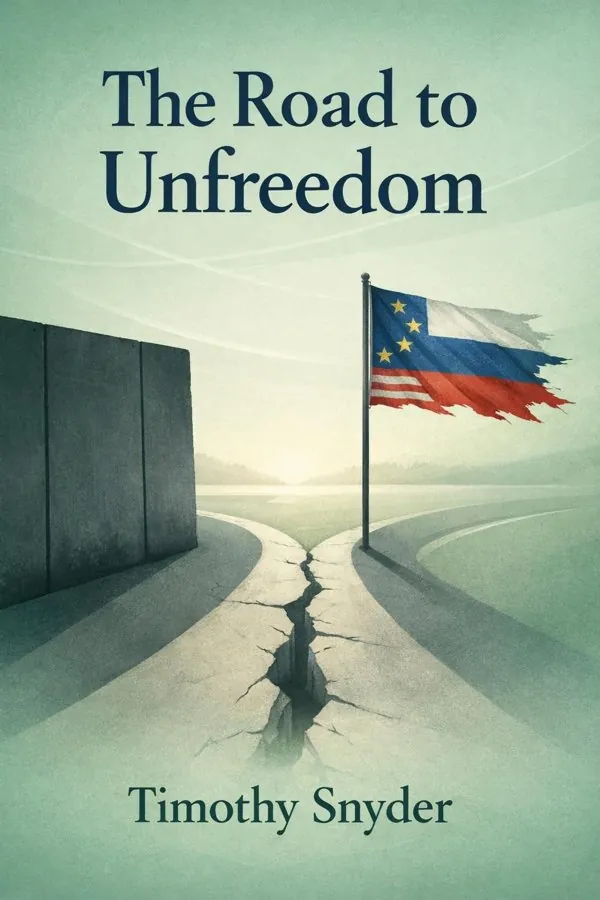
The Road to Unfreedom: Russia, Europe, America: Summary & Key Insights
 10 min11 chaptersAudio available
What Is The Road to Unfreedom: Russia, Europe, America About?
The Road to Unfreedom: Russia, Europe, America by Timothy Snyder is a politics book spanning 11 pages. In this work, historian Timothy Snyder examines the rise of authoritarianism and the erosion of democratic values in the 21st century. He traces the ideological roots of modern autocracy from Russia’s political philosophy of 'unfreedom' to its influence on Europe and the United States, exploring how disinformation, nationalism, and historical revisionism have reshaped global politics.
This FizzRead summary covers all 11 key chapters of The Road to Unfreedom: Russia, Europe, America in approximately 10 minutes, distilling the most important ideas, arguments, and takeaways from Timothy Snyder's work. Also available as an audio summary and Key Quotes Podcast.
The Road to Unfreedom: Russia, Europe, America
In this work, historian Timothy Snyder examines the rise of authoritarianism and the erosion of democratic values in the 21st century. He traces the ideological roots of modern autocracy from Russia’s political philosophy of 'unfreedom' to its influence on Europe and the United States, exploring how disinformation, nationalism, and historical revisionism have reshaped global politics.
Who Should Read The Road to Unfreedom: Russia, Europe, America?
This book is perfect for anyone interested in politics and looking to gain actionable insights in a short read. Whether you're a student, professional, or lifelong learner, the key ideas from The Road to Unfreedom: Russia, Europe, America by Timothy Snyder will help you think differently.
- ✓Readers who enjoy politics and want practical takeaways
- ✓Professionals looking to apply new ideas to their work and life
- ✓Anyone who wants the core insights of The Road to Unfreedom: Russia, Europe, America in just 10 minutes
Want the full summary?
Get instant access to this book summary and 100K+ more with Fizz Moment.
Get Free SummaryAvailable on App Store • Free to download
Key Chapters
After the Cold War ended, a peculiar triumphalism took hold of the Western imagination. The philosopher Francis Fukuyama declared the 'end of history'—the notion that liberal democracy had triumphed and that ideological struggle was finished. Politicians and citizens alike came to regard democratic capitalism not as an achievement that must be protected but as an automatic stage of human evolution. In this worldview, the future seemed prewritten: free markets would bring prosperity, prosperity would bring democracy, and democracy would bring peace.
But the politics of inevitability distorted the very understanding of history. It encouraged nations to see their present order as permanent and to neglect the structural forces—inequality, corruption, and information decay—that could destroy it. In post-Soviet Russia, this illusion was equally seductive. In the 1990s, the Russian elite embraced the idea that capitalist modernization would integrate them into the global democratic order. Yet when the promises of the market turned to oligarchy and collapse, inevitability morphed into disillusionment. People no longer believed in progress; they sought solace in a mythic past.
This faith in inevitability blinds societies to warning signs. It leads to what I describe as 'lazy fatalism'—the assumption that freedom and truth are natural states rather than political achievements. By the early 2000s, both Russia and the West had ceased to imagine alternate futures. When inevitability failed in Russia, Putin offered another path—not one of reform, but of regression dressed as glory. Thus the politics of eternity emerged from the ruins of inevitability.
In the new century, Vladimir Putin and his circle faced a stark choice. Having failed to deliver prosperity or democracy, they could seek legitimacy through truth or through myth. They chose myth. The ideology they constructed—what I call the politics of eternity—rejects the idea of progress and instead presents Russia as an eternal victim surrounded by enemies. Instead of forecasting a better future, this narrative glorifies the past, particularly the victory over Nazi Germany, as a timeless model of righteousness.
The politics of eternity functions by replacing problems with enemies. When Russia’s elites amass wealth while ordinary citizens suffer, the government blames foreign conspiracies and internal traitors. Elections become rituals of unity rather than instruments of choice. Media transforms from a space for debate into a battlefield of mythmaking. Putin’s regime, borrowing from fascist aesthetic traditions, fuses state power with a spiritual mission: to save civilization from Western decadence. This is not governance but perpetual mobilization—a loop of emotional politics that prevents reflection.
By embracing eternity, Russia freed itself from accountability. Facts mattered less than faith. History was rewritten to justify the present. In this worldview, truth becomes treasonous because it threatens unity. Such a mindset is not confined to Russia alone; it is a contagion that travels through images, slogans, and screens to any society willing to substitute feeling for fact.
+ 9 more chapters — available in the FizzRead app
All Chapters in The Road to Unfreedom: Russia, Europe, America
About the Author
Timothy Snyder is an American historian and professor at Yale University, specializing in the history of Central and Eastern Europe and the Holocaust. He is known for works such as 'Bloodlands' and 'On Tyranny', which explore the intersections of history, politics, and moral responsibility.
Get This Summary in Your Preferred Format
Read or listen to the The Road to Unfreedom: Russia, Europe, America summary by Timothy Snyder anytime, anywhere. FizzRead offers multiple formats so you can learn on your terms — all free.
Available formats: App · Audio · PDF · EPUB — All included free with FizzRead
Download The Road to Unfreedom: Russia, Europe, America PDF and EPUB Summary
Key Quotes from The Road to Unfreedom: Russia, Europe, America
“After the Cold War ended, a peculiar triumphalism took hold of the Western imagination.”
“In the new century, Vladimir Putin and his circle faced a stark choice.”
Frequently Asked Questions about The Road to Unfreedom: Russia, Europe, America
The Road to Unfreedom: Russia, Europe, America by Timothy Snyder is a politics book that explores key ideas across 11 chapters. In this work, historian Timothy Snyder examines the rise of authoritarianism and the erosion of democratic values in the 21st century. He traces the ideological roots of modern autocracy from Russia’s political philosophy of 'unfreedom' to its influence on Europe and the United States, exploring how disinformation, nationalism, and historical revisionism have reshaped global politics.
More by Timothy Snyder
You Might Also Like
Antifa: The Anti-Fascist Handbook
Mark Bray
10 min
Attack from Within: How Disinformation Is Sabotaging America
Barbara McQuade
10 min
Coercion, Capital, and European States, AD 990–1992
Charles Tilly
10 min
Digital Democracy: Concepts, Methodologies, Tools, and Applications
Various Authors
10 min
Fascism
Stanley G. Payne
10 min
Fire And Fury: Inside The Trump White House
Michael Wolff
10 minBrowse by Category
Ready to read The Road to Unfreedom: Russia, Europe, America?
Get the full summary and 100K+ more books with Fizz Moment.