
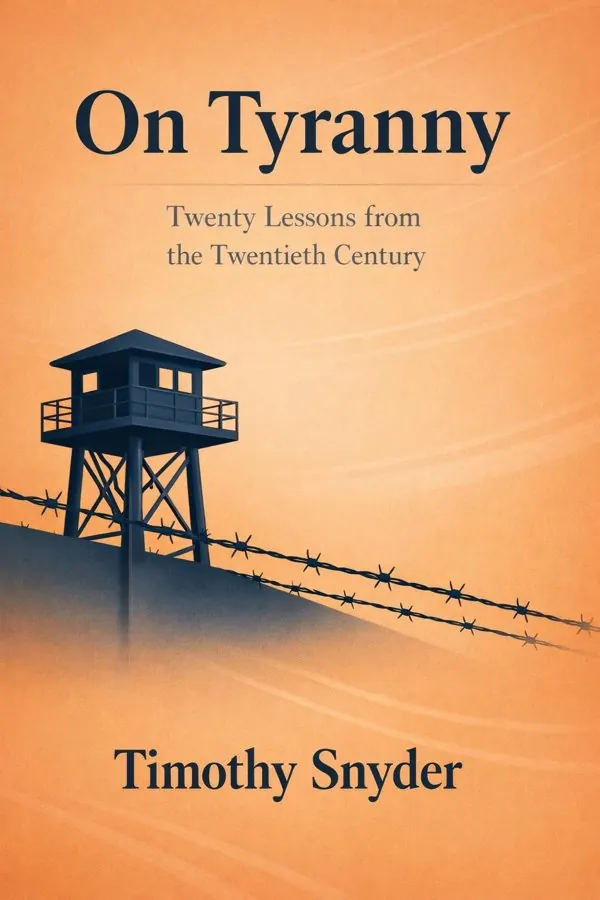
On Tyranny: Twenty Lessons from the Twentieth Century: Summary & Key Insights
 10 min9 chaptersAudio available
Key Takeaways from On Tyranny: Twenty Lessons from the Twentieth Century
One of the most dangerous political acts is often invisible: voluntary submission.
Institutions do not protect themselves.
The political world is shaped not only by laws and leaders but by what citizens allow to become normal.
Tyranny becomes easier when armed groups intimidate the public and when citizens are afraid to be visibly different.
If nothing is true, then no one can criticize power.
What Is On Tyranny: Twenty Lessons from the Twentieth Century About?
On Tyranny: Twenty Lessons from the Twentieth Century by Timothy Snyder is a politics book spanning 13 pages. Democracy rarely disappears all at once. More often, it erodes through habit, fear, silence, and the willingness of ordinary people to accept the unacceptable. In On Tyranny, historian Timothy Snyder distills the darkest political lessons of the twentieth century into twenty concise principles for resisting authoritarianism before it takes hold. Drawing on the histories of Nazi Germany, Soviet totalitarianism, communist Eastern Europe, and other failed democracies, Snyder shows that tyranny is not a distant historical phenomenon but a recurring human possibility. What makes this book so powerful is its urgency. Snyder does not write as an abstract theorist; he writes as a historian who has spent years studying how institutions collapse, how propaganda spreads, and how citizens either surrender or defend freedom. His lessons are practical, direct, and unsettling because they ask readers to examine their own responsibilities. The book argues that democratic life depends on personal courage, truthfulness, ethical professionalism, and civic participation. Brief but penetrating, On Tyranny matters because it turns history into instruction. It reminds us that freedom survives only when citizens actively protect it.
This FizzRead summary covers all 9 key chapters of On Tyranny: Twenty Lessons from the Twentieth Century in approximately 10 minutes, distilling the most important ideas, arguments, and takeaways from Timothy Snyder's work. Also available as an audio summary and Key Quotes Podcast.
On Tyranny: Twenty Lessons from the Twentieth Century
Democracy rarely disappears all at once. More often, it erodes through habit, fear, silence, and the willingness of ordinary people to accept the unacceptable. In On Tyranny, historian Timothy Snyder distills the darkest political lessons of the twentieth century into twenty concise principles for resisting authoritarianism before it takes hold. Drawing on the histories of Nazi Germany, Soviet totalitarianism, communist Eastern Europe, and other failed democracies, Snyder shows that tyranny is not a distant historical phenomenon but a recurring human possibility.
What makes this book so powerful is its urgency. Snyder does not write as an abstract theorist; he writes as a historian who has spent years studying how institutions collapse, how propaganda spreads, and how citizens either surrender or defend freedom. His lessons are practical, direct, and unsettling because they ask readers to examine their own responsibilities. The book argues that democratic life depends on personal courage, truthfulness, ethical professionalism, and civic participation. Brief but penetrating, On Tyranny matters because it turns history into instruction. It reminds us that freedom survives only when citizens actively protect it.
Who Should Read On Tyranny: Twenty Lessons from the Twentieth Century?
This book is perfect for anyone interested in politics and looking to gain actionable insights in a short read. Whether you're a student, professional, or lifelong learner, the key ideas from On Tyranny: Twenty Lessons from the Twentieth Century by Timothy Snyder will help you think differently.
- ✓Readers who enjoy politics and want practical takeaways
- ✓Professionals looking to apply new ideas to their work and life
- ✓Anyone who wants the core insights of On Tyranny: Twenty Lessons from the Twentieth Century in just 10 minutes
Want the full summary?
Get instant access to this book summary and 100K+ more with Fizz Moment.
Get Free SummaryAvailable on App Store • Free to download
Key Chapters
One of the most dangerous political acts is often invisible: voluntary submission. Snyder’s first lesson warns that authoritarian systems gain strength when citizens, businesses, journalists, and officials begin complying before coercion is even required. People anticipate what a new regime wants, then adjust themselves in advance. This creates the illusion of broad support and teaches would-be tyrants that they can push further. In the twentieth century, both Nazi and communist regimes benefited immensely from this kind of preemptive obedience. The machinery of oppression did not begin at full speed; it accelerated because so many people made small, fearful accommodations.
The lesson matters because modern authoritarianism may not announce itself with tanks in the street. It may arrive through social pressure, self-censorship, bureaucratic compliance, and a growing belief that resistance is futile. When institutions, universities, corporations, or individuals rush to appease power, they normalize extremism. A publisher that avoids controversial truths, a public servant who bends rules to please leaders, or a citizen who stays silent when rights are violated all become part of the same pattern.
Practically, this means noticing the moment when “adjusting” becomes surrender. Ask: Am I changing my conduct because a law requires it, or because I fear displeasing power? Support organizations and leaders who uphold rules consistently, even under pressure. If a new political climate encourages prejudice, dishonesty, or intimidation, refuse to participate reflexively. Small acts of noncompliance matter because they prevent larger systems of obedience from forming.
Actionable takeaway: When pressure rises, pause before conforming. Make every concession to power a conscious choice, not an automatic habit.
Institutions do not protect themselves. Courts, legislatures, universities, investigative journalism, professional associations, and civic organizations give democracy structure, but they remain alive only when people actively defend them. Snyder emphasizes that no institution is inherently immortal. The twentieth century shows that once institutions are weakened, politicized, or ridiculed into irrelevance, authoritarian leaders face fewer obstacles. A free press can be dismissed as treasonous. Courts can be packed or ignored. Elections can remain formally intact while becoming substantively meaningless.
What makes this lesson especially urgent is that institutions usually erode gradually. Citizens often assume someone else will defend them, or that established systems are too robust to fail. But history suggests otherwise. Democracies die when institutional legitimacy is stripped away and replaced with loyalty to a single leader or party. Defending institutions therefore requires more than vague respect; it requires participation, scrutiny, and sacrifice.
This lesson also includes vigilance against the one-party state. When one political force captures the machinery of elections, law enforcement, media narratives, and public administration, pluralism becomes hollow. Even if opposition formally exists, the conditions for meaningful competition disappear. Citizens must therefore care about procedural fairness, not just whether their preferred side wins.
In practical terms, subscribe to trustworthy journalism, vote in local and national elections, attend school board or town meetings, support legal defense organizations, and reject rhetoric that treats all constraints on executive power as illegitimate. Encourage institutional reform when needed, but distinguish reform from destruction.
Actionable takeaway: Choose one democratic institution you rely on—local news, courts, schools, elections—and support it materially, publicly, and consistently before it is too weak to defend itself.
The political world is shaped not only by laws and leaders but by what citizens allow to become normal. Snyder’s call to “take responsibility for the face of the world” asks readers to notice their surroundings and refuse participation in the visual and moral normalization of authoritarian culture. Symbols matter. Slogans matter. Public cruelty matters. If racist signs appear, if lies dominate public discourse, if intimidation becomes casual, then the environment itself begins teaching submission. Tyranny is easier to build when ugliness, fear, and exclusion become ordinary scenery.
This lesson extends into personal responsibility. It is tempting to blame “the system” while ignoring how daily choices reinforce it. Professionals also play a crucial role here. Snyder’s reminder to “remember professional ethics” points to lawyers who must defend due process, doctors who must protect human dignity, civil servants who must follow law rather than political whim, and journalists who must pursue truth rather than access. In the twentieth century, authoritarian regimes relied not only on fanatics but on educated professionals who abandoned ethical standards in the name of efficiency, patriotism, or careerism.
Today, responsibility may look simple but powerful: removing hateful propaganda rather than walking past it, correcting falsehoods in your workplace, insisting on lawful procedures, or refusing to misuse professional authority. A teacher who protects intellectual freedom, a judge who resists political pressure, or a business leader who refuses discriminatory practices all help preserve democratic norms.
The larger point is that public life is made visible through millions of choices. If decent people stop caring what the world looks like, others will gladly shape it in uglier ways.
Actionable takeaway: Protect your professional ethics and your public environment. Do not let intimidation, falsehood, or dehumanization become part of the everyday landscape without objection.
If nothing is true, then no one can criticize power. Snyder treats truth not as a philosophical luxury but as a civic necessity. His lessons “believe in truth” and “investigate” confront one of authoritarianism’s central strategies: overwhelming citizens with lies, conspiracy theories, emotional spectacle, and information chaos until people give up on the possibility of shared reality. The goal of propaganda is not always to persuade you of one falsehood; often it is to make you cynical, exhausted, and manipulable.
Twentieth-century regimes understood this well. Totalitarian systems did not merely censor; they replaced reality with ideological narratives. Modern technology can accelerate the same process. Endless feeds, manipulated images, partisan outrage, and algorithmic reinforcement create a public sphere where attention is fragmented and certainty is cheap. In such an environment, people become easier to govern through emotion rather than evidence.
Snyder’s response is active rather than passive. Believing in truth means valuing facts, accepting complexity, and resisting the temptation to treat all information as equally suspect. Investigating means reading beyond headlines, supporting serious reporting, learning who funds a media outlet, checking primary sources when possible, and refusing to share claims you have not verified. It also means reading books, because long-form thinking builds the patience that propaganda destroys.
In daily life, this might involve diversifying your news sources, following investigative journalists, learning basic media literacy, and discussing public issues with curiosity rather than tribal certainty. Truth survives where citizens take responsibility for finding it.
Actionable takeaway: Create a personal truth routine—verify before sharing, support reliable journalism, and spend more time with evidence than with outrage.
Authoritarianism prefers isolated individuals staring at screens, while democracy depends on embodied citizens meeting, organizing, and speaking in real places. Snyder’s lesson on “practice corporeal politics” is a reminder that freedom is not sustained by opinions alone. It is sustained by people who show up. Protests, local meetings, volunteer efforts, neighborhood conversations, religious gatherings, labor organizing, and civic associations all create networks of trust that power cannot easily monopolize. Physical presence matters because it transforms passive concern into visible solidarity.
This is why Snyder pairs public engagement with a deceptively simple lesson: “make eye contact and small talk.” Tyranny works by atomizing people, encouraging suspicion, and weakening ordinary social bonds. Casual human contact may seem politically insignificant, but it is the opposite. Communities become resilient when people know one another as neighbors rather than abstractions. A society of strangers is easier to frighten and divide; a society of relationships is harder to manipulate.
Contributing to good causes extends this idea. Independent organizations—charities, local media, libraries, civil rights groups, educational programs, mutual aid networks—create civic muscle. They give people places to belong outside partisan identity and strengthen democratic culture from below.
In practice, this might mean attending a town hall instead of only posting online, joining a civic group, donating regularly to a rights-based organization, introducing yourself to neighbors, or participating in local problem-solving efforts. None of these acts is glamorous, but together they form the everyday infrastructure of freedom.
Actionable takeaway: Replace some digital political attention with physical civic participation. Show up somewhere in person this month where democratic life is actually practiced.
A society becomes vulnerable when it assumes its problems are unique and its institutions too exceptional to fail. Snyder urges readers to “learn from peers in other countries” because authoritarian patterns repeat, even when local details differ. Citizens in one nation can learn from how others have resisted corruption, defended courts, rebuilt media independence, confronted propaganda, or mobilized nonviolent opposition. Comparative awareness punctures complacency. It reminds us that democratic decline follows recognizable scripts.
This lesson is closely tied to Snyder’s broader method: using twentieth-century history as a practical guide rather than as distant memory. Nazi Germany, Stalinist terror, communist Eastern Europe, and the failures of interwar democracies are not presented as identical to the present. Rather, they reveal mechanisms—fear, obedience, mythic nationalism, party capture, propaganda, emergency politics—that can appear in new forms. To learn historically is not to force false equivalences; it is to recognize recurring dangers before they are irreversible.
Cross-border learning also broadens moral imagination. When people in one country see how others defended voting rights, preserved civil society under repression, or documented state abuses, they gain strategies and courage. It also combats provincialism, a favorite condition of authoritarian politics. Leaders who want unchecked power often insist that criticism is unpatriotic and foreign examples irrelevant. Snyder argues the opposite: democratic citizens should be internationally curious.
Practical applications include reading foreign journalists, studying democratic backsliding in other nations, supporting international human rights institutions, and listening to dissidents and refugees who understand repression firsthand. Historical literacy and global awareness help citizens resist manipulation disguised as destiny.
Actionable takeaway: Study one foreign democracy and one historical case of democratic collapse. Compare them to your own society and ask what warning signs are already visible.
Authoritarian systems want access not only to public obedience but to private vulnerability. Although Snyder’s twenty lessons range widely, an underlying theme is that freedom requires personal spaces the state and political movements cannot easily colonize. Tyranny advances when surveillance expands, when citizens are blackmailed through secrets, and when individuals become so dependent on systems of power that they no longer have the independence to dissent. Defending privacy, dignity, and personal integrity is therefore political, not merely personal.
This includes courage in moments that feel small. The twentieth century teaches that dramatic acts of heroism are rare, but moral tests are constant. Will you sign the false statement? Repeat the dehumanizing joke? Ignore the abuse because it is inconvenient to object? Stay quiet when someone is targeted at work? Snyder’s framework suggests that free societies are preserved through habits of integrity long before constitutional crisis becomes obvious.
Personal courage also means understanding that not every duty can be delegated. Citizens often imagine that lawyers, judges, journalists, or politicians will handle threats to democracy. But when crises deepen, institutions depend on people with character. Someone must refuse the unlawful order. Someone must document what happened. Someone must testify, publish, organize, donate, or defend a neighbor.
Practically, this means strengthening your independence now: secure your digital privacy, know your rights, keep important records, cultivate friendships of trust, and think in advance about the values you will not betray. Ethical readiness matters because fear narrows judgment in real time.
Actionable takeaway: Decide which principles are non-negotiable for you, and build enough personal independence—financial, social, digital, and moral—to live by them under pressure.
One of Snyder’s most important contributions is redefining patriotism away from leader worship and toward constitutional responsibility. Authoritarian movements often claim a monopoly on national loyalty. They present themselves as the “real people,” while critics are cast as enemies, traitors, or outsiders. Snyder counters this by showing that genuine patriotism is not blind allegiance to rulers but care for the republic, its laws, its pluralism, and the dignity of fellow citizens. Loving a country means wanting it to be just, truthful, and free.
This distinction matters because authoritarian politics thrives on emotional shortcuts. It offers belonging, certainty, and identity while discouraging critical thought. Citizens are told that to question leadership is to weaken the nation. But twentieth-century history reveals the opposite: democracies are strongest when people can criticize power without being branded disloyal. A nation becomes fragile when patriotism is reduced to slogans, flags without principles, or mythic stories that erase injustice.
Snyder’s lessons collectively encourage a mature form of civic love. Defend institutions because they preserve liberty. Protect truth because without it public life decays. Honor professional ethics because law and medicine and education should serve people, not rulers. Stand out because conformity is not citizenship. Learn from other countries because national strength includes humility.
In practical terms, democratic patriotism may mean voting even when elections are imperfect, serving on juries, teaching history honestly, condemning abuses committed by one’s own side, and remembering that minority rights are not obstacles to national unity but measures of its decency.
Actionable takeaway: Practice patriotism as stewardship. Ask not how to prove loyalty to a leader, but how to strengthen the laws, norms, and freedoms that make self-government possible.
All Chapters in On Tyranny: Twenty Lessons from the Twentieth Century
About the Author
Timothy Snyder is an American historian, author, and professor recognized for his work on the political and moral history of Europe in the twentieth century. He has taught at Yale University and built an international reputation through books such as Bloodlands: Europe Between Hitler and Stalin and Black Earth: The Holocaust as History and Warning. His scholarship focuses especially on Central and Eastern Europe, totalitarianism, nationalism, mass violence, and the fragility of democratic institutions. Snyder is known for combining deep archival research with a strong interest in the civic relevance of history. In both his academic writing and public commentary, he explores how societies descend into oppression and what citizens can do to resist it. On Tyranny reflects that mission by translating historical insight into clear, practical lessons for modern democratic life.
Get This Summary in Your Preferred Format
Read or listen to the On Tyranny: Twenty Lessons from the Twentieth Century summary by Timothy Snyder anytime, anywhere. FizzRead offers multiple formats so you can learn on your terms — all free.
Available formats: App · Audio · PDF · EPUB — All included free with FizzRead
Download On Tyranny: Twenty Lessons from the Twentieth Century PDF and EPUB Summary
Key Quotes from On Tyranny: Twenty Lessons from the Twentieth Century
“One of the most dangerous political acts is often invisible: voluntary submission.”
“Courts, legislatures, universities, investigative journalism, professional associations, and civic organizations give democracy structure, but they remain alive only when people actively defend them.”
“The political world is shaped not only by laws and leaders but by what citizens allow to become normal.”
“Tyranny becomes easier when armed groups intimidate the public and when citizens are afraid to be visibly different.”
“If nothing is true, then no one can criticize power.”
Frequently Asked Questions about On Tyranny: Twenty Lessons from the Twentieth Century
On Tyranny: Twenty Lessons from the Twentieth Century by Timothy Snyder is a politics book that explores key ideas across 9 chapters. Democracy rarely disappears all at once. More often, it erodes through habit, fear, silence, and the willingness of ordinary people to accept the unacceptable. In On Tyranny, historian Timothy Snyder distills the darkest political lessons of the twentieth century into twenty concise principles for resisting authoritarianism before it takes hold. Drawing on the histories of Nazi Germany, Soviet totalitarianism, communist Eastern Europe, and other failed democracies, Snyder shows that tyranny is not a distant historical phenomenon but a recurring human possibility. What makes this book so powerful is its urgency. Snyder does not write as an abstract theorist; he writes as a historian who has spent years studying how institutions collapse, how propaganda spreads, and how citizens either surrender or defend freedom. His lessons are practical, direct, and unsettling because they ask readers to examine their own responsibilities. The book argues that democratic life depends on personal courage, truthfulness, ethical professionalism, and civic participation. Brief but penetrating, On Tyranny matters because it turns history into instruction. It reminds us that freedom survives only when citizens actively protect it.
More by Timothy Snyder

You Might Also Like
Antifa: The Anti-Fascist Handbook
Mark Bray
10 min
Attack from Within: How Disinformation Is Sabotaging America
Barbara McQuade
10 min
Coercion, Capital, and European States, AD 990–1992
Charles Tilly
10 min
Digital Democracy: Concepts, Methodologies, Tools, and Applications
Various Authors
10 min
Fascism
Stanley G. Payne
10 min
Fire And Fury: Inside The Trump White House
Michael Wolff
10 minBrowse by Category
Ready to read On Tyranny: Twenty Lessons from the Twentieth Century?
Get the full summary and 100K+ more books with Fizz Moment.