
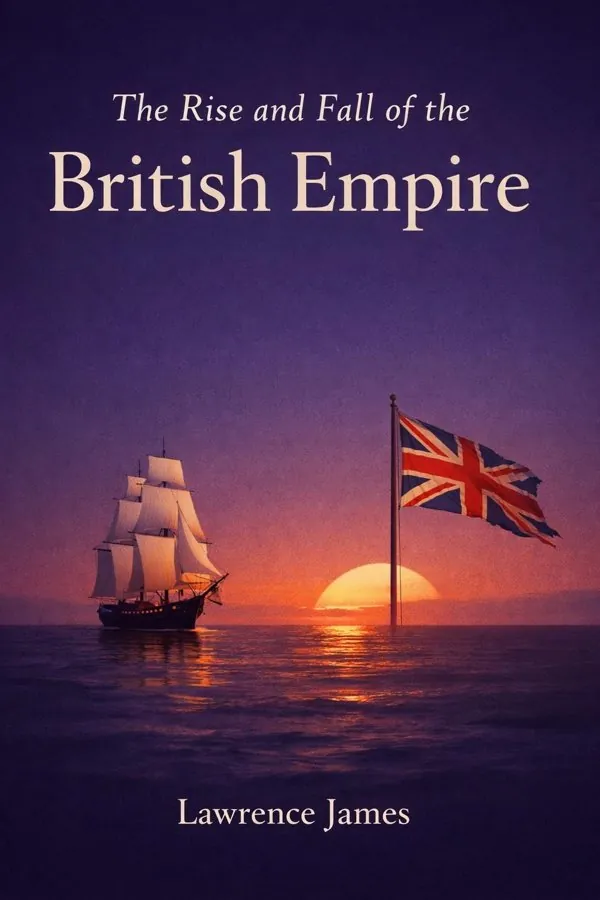
The Rise and Fall of the British Empire: Summary & Key Insights
 10 min12 chaptersAudio available
What Is The Rise and Fall of the British Empire About?
The Rise and Fall of the British Empire by Lawrence James is a world_history book spanning 12 pages. A comprehensive history of the British Empire from its origins in the 16th century to its decline in the 20th century, exploring the political, economic, and cultural forces that shaped its expansion and eventual dissolution. Lawrence James examines the motivations behind imperialism, the experiences of both colonizers and the colonized, and the enduring legacy of the empire in the modern world.
This FizzRead summary covers all 12 key chapters of The Rise and Fall of the British Empire in approximately 10 minutes, distilling the most important ideas, arguments, and takeaways from Lawrence James's work. Also available as an audio summary and Key Quotes Podcast.
The Rise and Fall of the British Empire
A comprehensive history of the British Empire from its origins in the 16th century to its decline in the 20th century, exploring the political, economic, and cultural forces that shaped its expansion and eventual dissolution. Lawrence James examines the motivations behind imperialism, the experiences of both colonizers and the colonized, and the enduring legacy of the empire in the modern world.
Who Should Read The Rise and Fall of the British Empire?
This book is perfect for anyone interested in world_history and looking to gain actionable insights in a short read. Whether you're a student, professional, or lifelong learner, the key ideas from The Rise and Fall of the British Empire by Lawrence James will help you think differently.
- ✓Readers who enjoy world_history and want practical takeaways
- ✓Professionals looking to apply new ideas to their work and life
- ✓Anyone who wants the core insights of The Rise and Fall of the British Empire in just 10 minutes
Want the full summary?
Get instant access to this book summary and 100K+ more with Fizz Moment.
Get Free SummaryAvailable on App Store • Free to download
Key Chapters
In the sixteenth and seventeenth centuries, England’s ventures overseas were motivated as much by curiosity and profit as by rivalry with larger European powers. I describe how the Elizabethan age nurtured a spirit of adventure among merchants and privateers, who sought new trade routes and colonies beyond the Atlantic. Figures like Sir Walter Raleigh and the navigators of the East India Company embodied a distinctly English blend of entrepreneurship and nationalism.
The empire’s beginnings were tentative—patchwork settlements in the Americas, trading outposts in India, and fragile footholds obtained more by negotiation than conquest. England’s maritime expansion was still dwarfed by the Spanish and Portuguese empires, yet its mercantile institutions and naval improvements laid the groundwork for later dominance. These early enterprises reveal how commerce and religion intertwined: Puritan colonies in New England pursued moral missions even as they embodied a capitalist ethos that would later define imperial economics.
The seventeenth century marked increasing coherence. The Navigation Acts underscored how trade and empire were bound in policy; they aimed to ensure that England’s commerce enriched the mother country rather than foreign rivals. Through these developments, the idea of a national destiny began to emerge—a belief that England’s maritime reach was divinely sanctioned and essential to its prosperity. In hindsight, these formative years established the empire’s defining formula: naval strength combined with commercial ambition, wrapped in a moralistic sense of purpose.
By the eighteenth century, Britain’s empire had acquired shape and confidence. This era witnessed the consolidation of imperial power through mercantilism and the Atlantic slave trade—two forces that entwined moral paradox with economic might. In my study, I examine how trade in human lives coexisted with Enlightenment ideals of liberty and reason. British wealth derived from plantations, from the sugar and tobacco economies fueled by slavery, and from the global networks that carried goods across oceans under the protection of the Royal Navy.
At home, empire became a matter of political identity. The military victories of the Seven Years’ War confirmed Britain’s supremacy over France, and the conquest of Canada and parts of India cemented its dominance. Naval power was the linchpin: it secured trade routes and imposed British presence across the seas. Yet, as I note, such triumphs came at a moral and administrative cost—the empire was becoming too complex to govern, and contradictions between freedom and domination were beginning to surface.
This century also saw the birth of imperial administration in its recognizable form. Governors, chartered companies, and colonial assemblies were tasked with managing territories, reflecting Britain’s pragmatic approach. Imperial ideology matured: Britons increasingly viewed their empire not as accidental but as an instrument of civilization. This would later evolve into the Victorian moral justification of empire, but its seeds lay firmly in the eighteenth century’s confident mercantilist expansion.
+ 10 more chapters — available in the FizzRead app
All Chapters in The Rise and Fall of the British Empire
About the Author
Lawrence James is a British historian and author known for his works on the British Empire and military history. Educated at the University of York, he has written several acclaimed books that combine scholarly research with accessible narrative, making complex historical subjects engaging for general readers.
Get This Summary in Your Preferred Format
Read or listen to the The Rise and Fall of the British Empire summary by Lawrence James anytime, anywhere. FizzRead offers multiple formats so you can learn on your terms — all free.
Available formats: App · Audio · PDF · EPUB — All included free with FizzRead
Download The Rise and Fall of the British Empire PDF and EPUB Summary
Key Quotes from The Rise and Fall of the British Empire
“In the sixteenth and seventeenth centuries, England’s ventures overseas were motivated as much by curiosity and profit as by rivalry with larger European powers.”
“By the eighteenth century, Britain’s empire had acquired shape and confidence.”
Frequently Asked Questions about The Rise and Fall of the British Empire
The Rise and Fall of the British Empire by Lawrence James is a world_history book that explores key ideas across 12 chapters. A comprehensive history of the British Empire from its origins in the 16th century to its decline in the 20th century, exploring the political, economic, and cultural forces that shaped its expansion and eventual dissolution. Lawrence James examines the motivations behind imperialism, the experiences of both colonizers and the colonized, and the enduring legacy of the empire in the modern world.
More by Lawrence James
You Might Also Like
The Age of Capital
Eric Hobsbawm
10 min
The Gulag Archipelago
Aleksandr Solzhenitsyn
10 min
Jerusalem: The Biography
Simon Sebag Montefiore
10 min
The Anglo-Saxons
James Campbell
10 min
The Boer War
Thomas Pakenham
10 min
The Industrial Revolutionaries: The Making of the Modern World 1776–1914
Gavin Weightman
10 minBrowse by Category
Ready to read The Rise and Fall of the British Empire?
Get the full summary and 100K+ more books with Fizz Moment.