
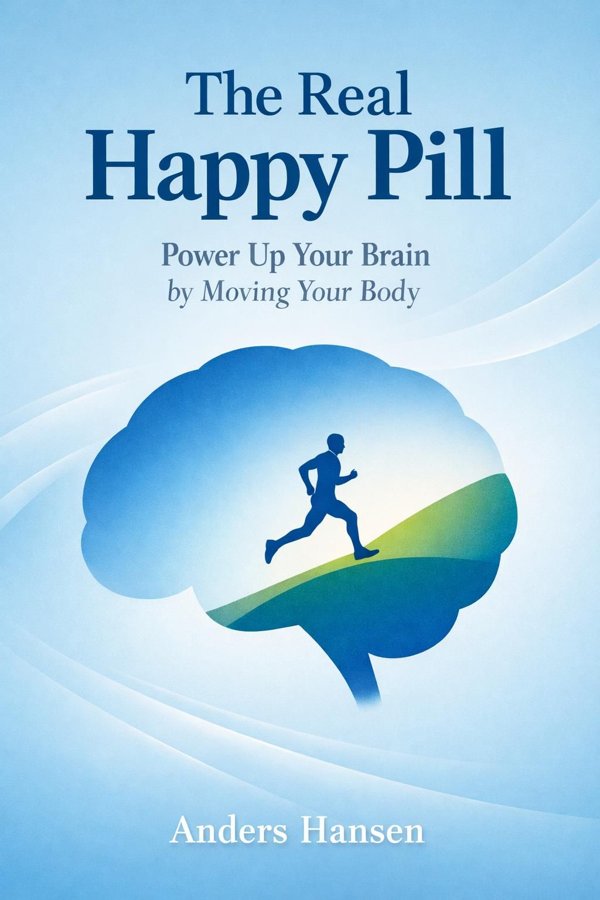
The Real Happy Pill: Power Up Your Brain by Moving Your Body: Summary & Key Insights
 10 min9 chapters
What Is The Real Happy Pill: Power Up Your Brain by Moving Your Body About?
The Real Happy Pill: Power Up Your Brain by Moving Your Body by Anders Hansen is a mental_health book spanning 9 pages. This book explores how physical exercise profoundly affects the brain, improving concentration, memory, creativity, and overall well-being. Psychiatrist Anders Hansen presents scientific research showing how movement can act as a natural antidepressant and cognitive enhancer, offering practical insights into how exercise can make us happier and more resilient.
This FizzRead summary covers all 9 key chapters of The Real Happy Pill: Power Up Your Brain by Moving Your Body in approximately 10 minutes, distilling the most important ideas, arguments, and takeaways from Anders Hansen's work.
The Real Happy Pill: Power Up Your Brain by Moving Your Body
This book explores how physical exercise profoundly affects the brain, improving concentration, memory, creativity, and overall well-being. Psychiatrist Anders Hansen presents scientific research showing how movement can act as a natural antidepressant and cognitive enhancer, offering practical insights into how exercise can make us happier and more resilient.
Who Should Read The Real Happy Pill: Power Up Your Brain by Moving Your Body?
This book is perfect for anyone interested in mental_health and looking to gain actionable insights in a short read. Whether you're a student, professional, or lifelong learner, the key ideas from The Real Happy Pill: Power Up Your Brain by Moving Your Body by Anders Hansen will help you think differently.
- ✓Readers who enjoy mental_health and want practical takeaways
- ✓Professionals looking to apply new ideas to their work and life
- ✓Anyone who wants the core insights of The Real Happy Pill: Power Up Your Brain by Moving Your Body in just 10 minutes
Want the full summary?
Get instant access to this book summary and 100K+ more with Fizz Moment.
Get Free SummaryAvailable on App Store • Free to download
Key Chapters
To understand why movement is fundamental to our brains, we must go back in time. Our ancestors did not evolve in front of screens or behind desks. They walked, ran, hunted, gathered, and constantly adapted to an environment that demanded action. The human brain is the result of this evolutionary pressure. It developed not in spite of movement, but because of it. To survive, our ancestors needed coordination, memory, focus, and planning—all tasks for a highly developed brain supported by physical activity.
Over hundreds of thousands of years, those who moved regularly had better chances at surviving and reproducing. Movement improved not only their muscles, but their ability to find food, avoid danger, and collaborate with others. Every step they took reinforced neural systems that controlled attention, emotional balance, and decision-making. That means that the brain’s chemistry evolved to reward us for moving. Pleasure signals, such as endorphin or dopamine release, made activity feel good—pushing us to keep going even when hunting was hard or weather was harsh.
When society modernized, survival stopped depending on physical effort. But our brains did not get that memo. We are still wired to need movement. Without it, the intricate system that once thrived on activity becomes imbalanced. The result? Higher stress, mood instability, attention lapses, and decreased motivation. Many of the mental health problems that now plague modern life are, in part, consequences of this mismatch between ancient biology and modern lifestyle.
Understanding that biology helps us reclaim movement not as an optional hobby but as an essential fuel for our mental systems. When we move, we are not simply burning calories. We are activating the brain systems that evolution designed to make us think and feel better. This view transforms exercise into something much more meaningful than fitness. It becomes a reconnection—with the very conditions that made us human.
The moment you begin to move, your brain starts to release chemicals that directly affect mood and cognition. Dopamine, serotonin, and endorphins are often called the brain’s happiness molecules, and movement is one of the most reliable triggers for their release. Dopamine gives you motivation and reward. Serotonin provides emotional balance. Endorphins create that well-known sense of calm euphoria often called the runner’s high.
When these substances rise, they change not only how you feel but also how you think. Exercise enhances the communication between brain cells in regions like the prefrontal cortex and hippocampus—the areas responsible for decision-making, memory, and learning. Neuroscientists have shown that after just a single workout, neurotransmitter levels adjust in a way that improves your ability to concentrate and handle emotional challenges. Over time, these chemical shifts become more stable. That’s why people who exercise regularly tend to report long-term improvements in mood and energy.
This biological cascade operates independently of willpower. You don’t have to force yourself to feel good; your brain chemistry does it for you. The so-called post-exercise glow is the brain’s reward signal for doing something beneficial. From a psychiatrist’s viewpoint, that’s incredibly powerful—because it provides an internal, side-effect-free alternative to pharmacological interventions. The brain is capable of producing its own antidepressants; movement simply unlocks that potential.
Think of each workout as a biochemical message to your brain: "Life is active and worth engaging in." That message rewrites your mental patterns from the inside out. The more often you move, the more fluent your brain becomes in its natural language of motivation and joy.
+ 7 more chapters — available in the FizzRead app
All Chapters in The Real Happy Pill: Power Up Your Brain by Moving Your Body
About the Author
Anders Hansen is a Swedish psychiatrist, lecturer, and author known for his accessible works on neuroscience and mental health. He has written several bestselling books that translate complex brain science into practical advice for everyday life.
Get This Summary in Your Preferred Format
Read or listen to the The Real Happy Pill: Power Up Your Brain by Moving Your Body summary by Anders Hansen anytime, anywhere. FizzRead offers multiple formats so you can learn on your terms — all free.
Available formats: App · Audio · PDF · EPUB — All included free with FizzRead
Download The Real Happy Pill: Power Up Your Brain by Moving Your Body PDF and EPUB Summary
Key Quotes from The Real Happy Pill: Power Up Your Brain by Moving Your Body
“To understand why movement is fundamental to our brains, we must go back in time.”
“The moment you begin to move, your brain starts to release chemicals that directly affect mood and cognition.”
Frequently Asked Questions about The Real Happy Pill: Power Up Your Brain by Moving Your Body
The Real Happy Pill: Power Up Your Brain by Moving Your Body by Anders Hansen is a mental_health book that explores key ideas across 9 chapters. This book explores how physical exercise profoundly affects the brain, improving concentration, memory, creativity, and overall well-being. Psychiatrist Anders Hansen presents scientific research showing how movement can act as a natural antidepressant and cognitive enhancer, offering practical insights into how exercise can make us happier and more resilient.
You Might Also Like

Big Feelings: How to Be Okay When Things Are Not Okay
Liz Fosslien, Mollie West Duffy
10 min
Creative Arts Therapies Handbook: Art, Music and Dance Therapy Practices for Wellbeing
Susan I. Buchalter
10 min
Emotional First Aid: Healing Rejection, Guilt, Failure, and Other Everyday Hurts
Guy Winch
10 min
Lost Connections: Why You're Depressed and How to Find Hope
Johann Hari
10 min
No Time to Panic: How to Stop Worrying and Embrace Life
Matt Gutman
10 min
Overcoming Mobbing: A Recovery Guide for Workplace Aggression and Bullying
Maureen Duffy, Len Sperry
10 minBrowse by Category
Ready to read The Real Happy Pill: Power Up Your Brain by Moving Your Body?
Get the full summary and 100K+ more books with Fizz Moment.