
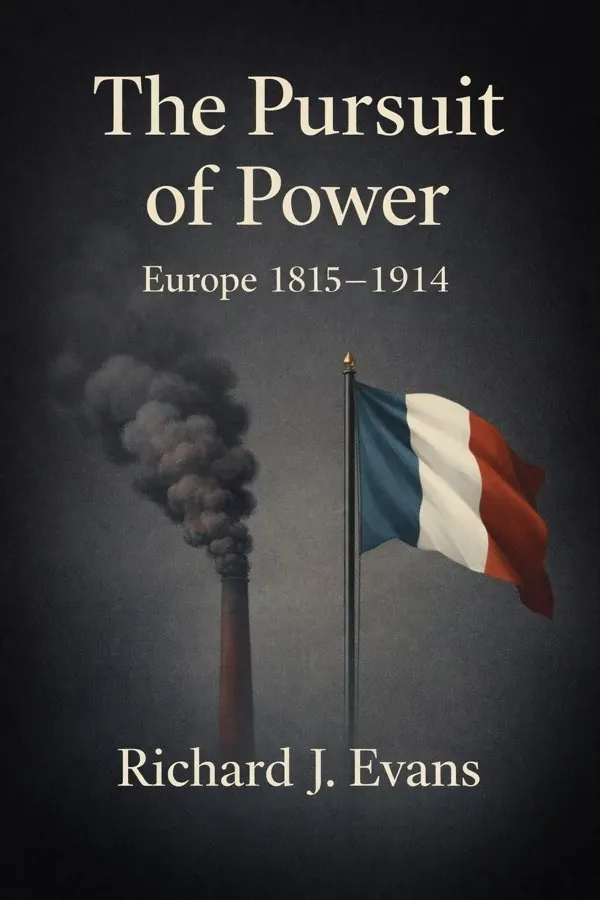
The Pursuit of Power: Europe 1815–1914: Summary & Key Insights
 10 min9 chaptersAudio available
Key Takeaways from The Pursuit of Power: Europe 1815–1914
Peace is often shaped less by idealism than by fear.
Conservatism is strongest when it presents itself as common sense.
Power in the nineteenth century increasingly came not from land alone but from coal, iron, steam, and machinery.
Sometimes a political order looks stable right before it starts collapsing.
Nations are not timeless facts; they are political projects built through stories, institutions, and struggle.
What Is The Pursuit of Power: Europe 1815–1914 About?
The Pursuit of Power: Europe 1815–1914 by Richard J. Evans is a world_history book spanning 8 pages. What made modern Europe: battlefield victory, diplomatic skill, industrial might, popular movements, or imperial conquest? In The Pursuit of Power, historian Richard J. Evans argues that all of these forces interacted across a turbulent century, reshaping Europe from the ruins of the Napoleonic Wars to the brink of World War I. This is not simply a political history of rulers and treaties. It is a broad, richly textured account of how states were rebuilt, economies transformed, empires expanded, and ordinary people drawn into public life through cities, factories, schools, newspapers, and elections. Evans shows how nationalism, liberalism, socialism, religion, science, and mass culture all helped create a new Europe while also deepening tensions within it. The book matters because it explains the foundations of the modern world: the rise of nation-states, the power of industry, the growth of democracy, and the deadly rivalries that made catastrophe possible in 1914. As one of Britain’s leading historians of modern Europe, Evans brings exceptional authority, clarity, and narrative energy to a century defined by ambition, upheaval, and relentless change.
This FizzRead summary covers all 9 key chapters of The Pursuit of Power: Europe 1815–1914 in approximately 10 minutes, distilling the most important ideas, arguments, and takeaways from Richard J. Evans's work. Also available as an audio summary and Key Quotes Podcast.
The Pursuit of Power: Europe 1815–1914
What made modern Europe: battlefield victory, diplomatic skill, industrial might, popular movements, or imperial conquest? In The Pursuit of Power, historian Richard J. Evans argues that all of these forces interacted across a turbulent century, reshaping Europe from the ruins of the Napoleonic Wars to the brink of World War I. This is not simply a political history of rulers and treaties. It is a broad, richly textured account of how states were rebuilt, economies transformed, empires expanded, and ordinary people drawn into public life through cities, factories, schools, newspapers, and elections. Evans shows how nationalism, liberalism, socialism, religion, science, and mass culture all helped create a new Europe while also deepening tensions within it. The book matters because it explains the foundations of the modern world: the rise of nation-states, the power of industry, the growth of democracy, and the deadly rivalries that made catastrophe possible in 1914. As one of Britain’s leading historians of modern Europe, Evans brings exceptional authority, clarity, and narrative energy to a century defined by ambition, upheaval, and relentless change.
Who Should Read The Pursuit of Power: Europe 1815–1914?
This book is perfect for anyone interested in world_history and looking to gain actionable insights in a short read. Whether you're a student, professional, or lifelong learner, the key ideas from The Pursuit of Power: Europe 1815–1914 by Richard J. Evans will help you think differently.
- ✓Readers who enjoy world_history and want practical takeaways
- ✓Professionals looking to apply new ideas to their work and life
- ✓Anyone who wants the core insights of The Pursuit of Power: Europe 1815–1914 in just 10 minutes
Want the full summary?
Get instant access to this book summary and 100K+ more with Fizz Moment.
Get Free SummaryAvailable on App Store • Free to download
Key Chapters
Peace is often shaped less by idealism than by fear. In 1815, Europe’s rulers emerged from the Napoleonic Wars determined not just to end conflict but to prevent another revolutionary upheaval from overturning the continent. The Congress of Vienna was their answer: a diplomatic effort to restore stability, rebuild legitimacy, and redraw borders in ways that would contain France and preserve a balance of power. Austria, Russia, Prussia, and Britain did not create a perfect order, but they established a framework that helped prevent a continent-wide war for decades.
Evans shows that Vienna was not merely a reactionary gathering of monarchs trying to turn back the clock. It was also an exercise in practical statecraft. Former dynasties were restored, territories reshuffled, and buffer zones created. The aim was equilibrium, not justice in the modern democratic sense. Small nations and popular aspirations were often ignored, but the system proved surprisingly durable.
A practical way to understand Vienna is to compare it with modern international summitry. Like later postwar settlements, it sought to combine punishment, restraint, and cooperation. Its success came from recognizing that stability depends on shared rules among powerful states, even when those rules are imperfect.
The deeper lesson is that political orders survive when they balance legitimacy with realism. If you want to understand how institutions endure after crisis, study what Vienna’s architects got right: they planned for the next conflict before it arrived. Actionable takeaway: when rebuilding after disruption, focus not only on immediate repair but on creating structures that can absorb future shocks.
Conservatism is strongest when it presents itself as common sense. In the decades after 1815, Austrian statesman Klemens von Metternich became the symbol of a Europe determined to suppress revolution, censor dissent, and preserve monarchical authority. Evans presents the so-called Age of Metternich as an era in which diplomacy and repression worked together. Governments feared that liberal constitutions, nationalist movements, and popular unrest would dissolve the fragile order created at Vienna.
Metternich’s system relied on alliances, surveillance, and intervention. Secret police monitored opponents, universities were watched for radical ideas, and newspapers faced censorship. When uprisings broke out in Italy, Germany, or elsewhere, conservative powers coordinated to crush them. Yet this system was never as secure as it looked. The need for constant repression revealed its weakness: a political order unable to inspire broad consent must rely on force and habit.
One useful application of this idea is in understanding how institutions resist change today. Organizations often claim to defend stability while actually defending privilege. Metternich’s Europe shows that suppressing demands for reform may delay upheaval, but it rarely removes the causes. New social classes, new ideas, and new economic realities kept undermining old assumptions.
Evans makes clear that conservatism in this period was not simply backward-looking; it was adaptive, intelligent, and often effective. But its success contained the seeds of future failure, because it blocked peaceful reform and intensified frustration.
Actionable takeaway: when evaluating any system that promises order, ask whether it earns loyalty through inclusion or merely enforces obedience through control.
Power in the nineteenth century increasingly came not from land alone but from coal, iron, steam, and machinery. Evans treats industrialization as one of the central engines of Europe’s transformation. Beginning unevenly in Britain and spreading gradually across the continent, the Industrial Revolution altered production, transport, labor, consumption, and class relations. It changed how people worked, where they lived, what they expected from life, and what states could do.
Factories expanded output, railways shrank distance, and new financial systems mobilized capital on a larger scale than ever before. Cities grew rapidly, often chaotically, as rural populations moved in search of wages. Industrialization generated enormous wealth, but it also produced overcrowding, pollution, dangerous working conditions, and stark inequality. A new middle class gained confidence through commerce and professional life, while an urban working class faced insecurity and exploitation.
Evans emphasizes that industrialization was not a single smooth process. Regions developed at different speeds. Some industries modernized rapidly, while others remained tied to older methods. States also played varied roles, from encouraging infrastructure to protecting domestic growth.
The practical lesson is that economic transformation always has social and political consequences. Technological progress can increase productivity while also destabilizing communities, creating winners and losers. You can see echoes of this today in debates over automation, global supply chains, and regional inequality.
The century’s industrial revolution teaches that growth alone does not guarantee cohesion. Societies need institutions, laws, and public investment to manage disruption. Actionable takeaway: whenever evaluating economic progress, look beyond output figures and ask how wealth, risk, and opportunity are being distributed across society.
Sometimes a political order looks stable right before it starts collapsing. The revolutions of 1848 erupted across much of Europe with astonishing speed, revealing how deeply dissatisfaction had spread beneath conservative rule. Economic hardship, food shortages, unemployment, demands for constitutional government, and nationalist aspirations all converged into a continent-wide wave of protest. Evans presents 1848 not as a single revolution but as a cluster of related crises that exposed the limits of post-1815 stability.
In France, monarchy fell and a republic returned. In the German states, liberals and nationalists gathered in Frankfurt to imagine a united constitutional nation. In the Habsburg lands, multiple peoples challenged imperial rule. In Italy, patriots sought liberation from foreign dominance and political fragmentation. Yet despite the drama, most of these revolutions failed in the short term. Divisions between liberals and radicals, urban workers and middle-class reformers, national groups and imperial authorities weakened the movements.
The importance of 1848 lies partly in its failure. It taught rulers how to recover control, but it also taught reformers that mass politics could not be ignored. Many of the demands raised in 1848, constitutions, civil rights, national self-determination, and political participation, would return later in more durable forms.
A practical application is to treat social unrest as diagnostic rather than accidental. Large uprisings often reveal underlying structural pressures that routine politics has failed to address. Even when revolts are defeated, the questions they raise can shape policy for generations.
Actionable takeaway: do not judge a movement only by its immediate outcome; ask which grievances, ideas, and networks survive after defeat and continue to reshape the future.
Nations are not timeless facts; they are political projects built through stories, institutions, and struggle. Evans shows that nationalism became one of the most powerful forces in nineteenth-century Europe because it offered people a language of belonging and a claim to sovereignty. It could inspire liberation, unite fragmented territories, and deepen public participation. But it could also exclude minorities, intensify rivalry, and sanctify war.
The unifications of Italy and Germany demonstrate nationalism’s double edge. In Italy, figures such as Cavour, Garibaldi, and Mazzini represented different paths toward unity: diplomacy, military action, and popular idealism. In Germany, Bismarck used war and statecraft to forge a powerful empire under Prussian leadership. These successes transformed Europe’s balance of power. At the same time, other national movements remained frustrated, especially within empires such as Austria-Hungary and the Ottoman realm, where many peoples competed for recognition.
Evans makes clear that nationalism worked through practical tools as much as emotion. Schools taught national history, armies disciplined citizens, censuses categorized populations, and monuments shaped memory. National identity became embedded in everyday life.
This matters today because nationalism still often presents itself as natural when it is, in fact, constructed and maintained. Understanding how it was made helps explain both its appeal and its dangers. It can mobilize solidarity, but it can also turn political disagreement into existential confrontation.
Actionable takeaway: whenever appeals to national identity dominate public life, ask who is being included, who is being excluded, and what institutions are being used to turn sentiment into power.
As Europe grew more powerful at home, it reached outward with increasing aggression abroad. Evans places imperialism at the center of nineteenth-century European history, not at its margins. Industrial growth, strategic rivalry, missionary zeal, racial ideology, and the search for markets and resources all contributed to a new era of overseas expansion. By the late nineteenth century, European powers were claiming vast territories in Africa and Asia, often with remarkable speed and brutality.
Imperialism was driven partly by prestige. Governments feared falling behind their rivals in the global race for influence. Colonies were seen as symbols of national greatness, whether or not they made economic sense. Public opinion, the press, and commercial lobbies often encouraged expansion, while military technologies made conquest easier. Yet empire was never only about flags and treaties. It involved coercion, extraction, cultural domination, and the reordering of local societies.
Evans also shows that imperialism fed back into Europe itself. Colonial competition sharpened tensions among the great powers, while imperial rule influenced domestic politics, popular culture, and ideas about race and civilization. Exhibitions, schoolbooks, and adventure literature normalized domination abroad.
A practical implication is that global power cannot be separated from domestic identity. States often justify expansion by telling flattering stories about themselves. Those stories can obscure violence and create dangerous illusions of entitlement.
The nineteenth-century imperial experience reminds us that power pursued without moral restraint becomes self-deceiving as well as destructive. Actionable takeaway: when nations describe expansion or intervention as civilizing, protective, or inevitable, examine the economic interests, political rivalries, and human costs hidden beneath the rhetoric.
Modern politics began when governments could no longer ignore ordinary people. Over the nineteenth century, Europe moved from elite rule toward mass participation, though unevenly and incompletely. Evans traces how expanded literacy, urbanization, associational life, organized parties, trade unions, and broader suffrage transformed political life. Politics was no longer confined to courts and cabinets; it became something enacted in newspapers, meetings, strikes, election campaigns, and public demonstrations.
This shift did not happen because elites suddenly embraced democracy. It emerged through pressure from below and adaptation from above. Liberal reformers pushed for constitutions and representation. Workers organized around wages, rights, and dignity. Socialist parties built disciplined networks that connected local grievances to larger ideological visions. Even conservative politicians learned to mobilize public opinion through nationalism, welfare measures, and electoral strategy.
Evans pays close attention to the institutions that made mass politics possible. Compulsory schooling created literate citizens. Railways and print media spread information. Bureaucracies tracked populations more systematically. As states expanded, citizens expected more from them: education, welfare, military protection, and social order.
A practical lesson here is that participation changes both society and government. When more people gain a political voice, institutions must adapt, but new forms of manipulation also emerge. Propaganda, party discipline, and symbolic politics become more powerful in mass democracies than in closed oligarchies.
The rise of mass politics teaches that inclusion is not a one-time achievement but a continuing struggle over representation, information, and power. Actionable takeaway: if you want to understand a political system, look not only at formal rights but at the media, organizations, and social conditions that determine whose voice is actually heard.
A society’s deepest revolutions often happen in how people think, believe, and imagine the world. Evans broadens political history by showing how the nineteenth century transformed European culture, knowledge, and moral authority. Scientific advances, secular ideas, biblical criticism, Darwinian debates, new artistic movements, and expanded education challenged inherited certainties. At the same time, religion remained a powerful force in public life, social organization, and personal identity.
This was not a simple story of faith declining and science triumphing. Instead, old and new worldviews coexisted and clashed. Churches adapted in some places, resisted in others, and often remained central to education, charity, and political mobilization. Meanwhile, literature, music, painting, and popular entertainment reflected social upheaval and helped shape national cultures. Urban life created new audiences and new anxieties, from morality and gender roles to crime and class conflict.
Evans’s treatment reminds us that modernization is cultural as well as economic. New ideas about progress, reason, race, sexuality, and the individual influenced law, education, medicine, and politics. Intellectual life did not float above society; it fed directly into public policy and social hierarchy.
The practical application is straightforward: when a society changes materially, its beliefs and symbols change too, but rarely all at once. Periods of rapid transition usually contain fierce disputes over truth, identity, and authority.
Actionable takeaway: to understand major political or social shifts, pay attention to changes in education, media, scientific prestige, and moral language, because these often reveal deeper transformations before laws and institutions fully catch up.
Great catastrophes are usually assembled piece by piece before they explode all at once. Evans ends his history by showing how the Europe that had achieved remarkable growth, state-building, and cultural confidence also became dangerously unstable by 1914. Industrial strength fed military power. Nationalism intensified diplomatic disputes. Alliances hardened into rival blocs. Imperial competition widened mistrust. Domestic politics encouraged governments to seek legitimacy through foreign policy and displays of strength.
The result was not an inevitable march to war, but a continent increasingly vulnerable to crisis. Germany’s rise disrupted the balance of power. France sought security and revenge after defeat in 1871. Russia pursued influence in the Balkans. Austria-Hungary struggled with internal national tensions. Britain worried about naval competition and imperial commitments. The Balkans in particular became a zone where local nationalism and great-power rivalry intersected with explosive force.
Evans’s larger point is that progress did not cancel danger. Europe’s sophistication, wealth, and institutions did not prevent leaders from embracing militarized thinking. On the contrary, modern administration, mass literacy, and industrial capacity made war more imaginable and more destructive.
There is a practical warning here for any era. Societies can mistake interconnectedness for security, or technological advancement for wisdom. Stability can erode when leaders rely on deterrence, prestige, and rigid commitments without leaving room for de-escalation.
Actionable takeaway: when evaluating geopolitical tension, watch for the combination of alliance rigidity, public nationalism, military planning, and political leaders who treat compromise as weakness. That mixture is often a sign that a system is becoming more brittle than it appears.
All Chapters in The Pursuit of Power: Europe 1815–1914
About the Author
Richard J. Evans is a leading British historian of modern Europe, widely recognized for his scholarship on Germany and the wider forces that shaped the modern continent. He served as Regius Professor of History at the University of Cambridge and has held major academic positions that reflect his standing in the field. Evans is especially known for his acclaimed trilogy on the Third Reich, as well as books on historiography, political culture, and the uses of history in public debate. His writing combines rigorous research with unusual clarity, making complex historical developments accessible to a broad readership. In The Pursuit of Power, he brings that same combination of authority and narrative skill to nineteenth-century Europe, tracing how diplomacy, industrialization, nationalism, and empire transformed the continent.
Get This Summary in Your Preferred Format
Read or listen to the The Pursuit of Power: Europe 1815–1914 summary by Richard J. Evans anytime, anywhere. FizzRead offers multiple formats so you can learn on your terms — all free.
Available formats: App · Audio · PDF · EPUB — All included free with FizzRead
Download The Pursuit of Power: Europe 1815–1914 PDF and EPUB Summary
Key Quotes from The Pursuit of Power: Europe 1815–1914
“Peace is often shaped less by idealism than by fear.”
“Conservatism is strongest when it presents itself as common sense.”
“Power in the nineteenth century increasingly came not from land alone but from coal, iron, steam, and machinery.”
“Sometimes a political order looks stable right before it starts collapsing.”
“Nations are not timeless facts; they are political projects built through stories, institutions, and struggle.”
Frequently Asked Questions about The Pursuit of Power: Europe 1815–1914
The Pursuit of Power: Europe 1815–1914 by Richard J. Evans is a world_history book that explores key ideas across 9 chapters. What made modern Europe: battlefield victory, diplomatic skill, industrial might, popular movements, or imperial conquest? In The Pursuit of Power, historian Richard J. Evans argues that all of these forces interacted across a turbulent century, reshaping Europe from the ruins of the Napoleonic Wars to the brink of World War I. This is not simply a political history of rulers and treaties. It is a broad, richly textured account of how states were rebuilt, economies transformed, empires expanded, and ordinary people drawn into public life through cities, factories, schools, newspapers, and elections. Evans shows how nationalism, liberalism, socialism, religion, science, and mass culture all helped create a new Europe while also deepening tensions within it. The book matters because it explains the foundations of the modern world: the rise of nation-states, the power of industry, the growth of democracy, and the deadly rivalries that made catastrophe possible in 1914. As one of Britain’s leading historians of modern Europe, Evans brings exceptional authority, clarity, and narrative energy to a century defined by ambition, upheaval, and relentless change.
You Might Also Like
The Age of Capital
Eric Hobsbawm
10 min
The Gulag Archipelago
Aleksandr Solzhenitsyn
10 min
Jerusalem: The Biography
Simon Sebag Montefiore
10 min
The Anglo-Saxons
James Campbell
10 min
The Boer War
Thomas Pakenham
10 min
The Industrial Revolutionaries: The Making of the Modern World 1776–1914
Gavin Weightman
10 minBrowse by Category
Ready to read The Pursuit of Power: Europe 1815–1914?
Get the full summary and 100K+ more books with Fizz Moment.