
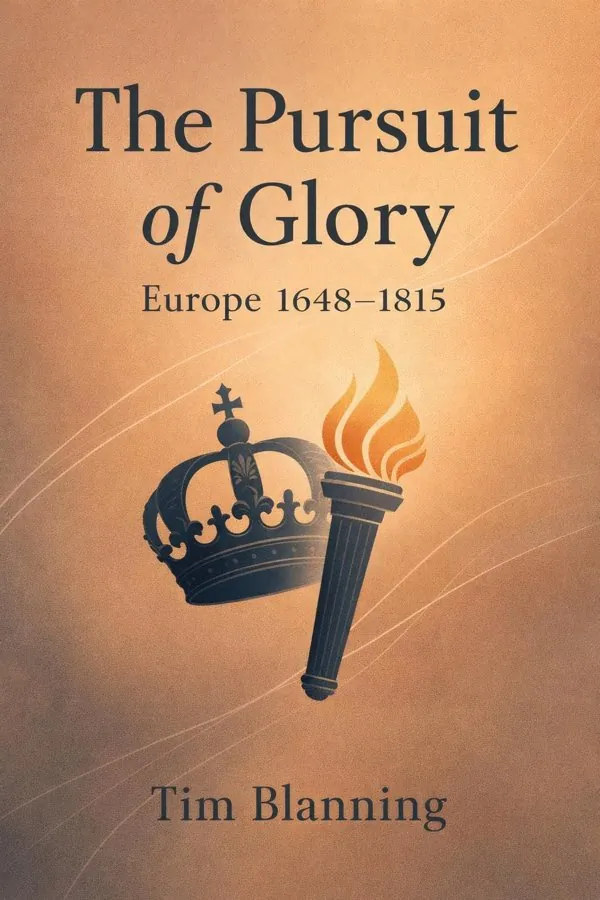
The Pursuit of Glory: Europe 1648–1815: Summary & Key Insights
by Tim Blanning
 10 min10 chaptersAudio available
Key Takeaways from The Pursuit of Glory: Europe 1648–1815
Great states are often born not in peace, but in crisis.
Money can transform society as profoundly as armies can.
Revolutions in thought do not automatically abolish inequalities in life.
History is not only made in parliaments and palaces; it is also made in streets, workshops, homes, and fields.
Ideas become revolutionary when they change what people believe is reasonable.
What Is The Pursuit of Glory: Europe 1648–1815 About?
The Pursuit of Glory: Europe 1648–1815 by Tim Blanning is a world_history book spanning 11 pages. Tim Blanning’s The Pursuit of Glory: Europe 1648–1815 is a sweeping, deeply intelligent history of a continent remade by war, commerce, culture, and ideas. Beginning in the shattered aftermath of the Thirty Years’ War and ending with Napoleon’s defeat at Waterloo and the Congress of Vienna, Blanning shows how Europe moved from dynastic rivalry and religious conflict toward a more modern world of centralized states, expanding markets, public opinion, and revolutionary politics. What makes this book especially valuable is its breadth: it is not only a political history of kings, ministers, and armies, but also a vivid account of artists, philosophers, merchants, peasants, city dwellers, and believers whose lives reveal how large historical changes were actually experienced. Blanning, one of Britain’s leading historians of early modern and modern Europe, writes with authority and range, connecting high politics to everyday life and intellectual movements to social transformation. The result is a masterful portrait of Europe in motion, explaining how the continent’s pursuit of power, prestige, prosperity, and cultural greatness shaped the modern age.
This FizzRead summary covers all 10 key chapters of The Pursuit of Glory: Europe 1648–1815 in approximately 10 minutes, distilling the most important ideas, arguments, and takeaways from Tim Blanning's work. Also available as an audio summary and Key Quotes Podcast.
The Pursuit of Glory: Europe 1648–1815
Tim Blanning’s The Pursuit of Glory: Europe 1648–1815 is a sweeping, deeply intelligent history of a continent remade by war, commerce, culture, and ideas. Beginning in the shattered aftermath of the Thirty Years’ War and ending with Napoleon’s defeat at Waterloo and the Congress of Vienna, Blanning shows how Europe moved from dynastic rivalry and religious conflict toward a more modern world of centralized states, expanding markets, public opinion, and revolutionary politics. What makes this book especially valuable is its breadth: it is not only a political history of kings, ministers, and armies, but also a vivid account of artists, philosophers, merchants, peasants, city dwellers, and believers whose lives reveal how large historical changes were actually experienced. Blanning, one of Britain’s leading historians of early modern and modern Europe, writes with authority and range, connecting high politics to everyday life and intellectual movements to social transformation. The result is a masterful portrait of Europe in motion, explaining how the continent’s pursuit of power, prestige, prosperity, and cultural greatness shaped the modern age.
Who Should Read The Pursuit of Glory: Europe 1648–1815?
This book is perfect for anyone interested in world_history and looking to gain actionable insights in a short read. Whether you're a student, professional, or lifelong learner, the key ideas from The Pursuit of Glory: Europe 1648–1815 by Tim Blanning will help you think differently.
- ✓Readers who enjoy world_history and want practical takeaways
- ✓Professionals looking to apply new ideas to their work and life
- ✓Anyone who wants the core insights of The Pursuit of Glory: Europe 1648–1815 in just 10 minutes
Want the full summary?
Get instant access to this book summary and 100K+ more with Fizz Moment.
Get Free SummaryAvailable on App Store • Free to download
Key Chapters
Great states are often born not in peace, but in crisis. Blanning begins with a Europe devastated by the Thirty Years’ War, where rulers learned that survival required stronger administration, more reliable taxation, and better control over armed force. The old medieval patchwork of overlapping loyalties had not vanished, but it was increasingly challenged by states determined to govern more effectively. In France, the Bourbon monarchy built a model of centralized authority that later generations would call absolutism, even if the reality remained limited by local privileges, noble influence, and logistical weakness. Elsewhere, rulers in Prussia, Austria, and Russia also expanded their reach, building bureaucracies and standing armies that gave them greater leverage over territory and subjects.
Blanning is careful not to present this as a simple triumph of centralized monarchy. States grew stronger, but they remained uneven, improvised, and dependent on negotiation. A king could issue decrees, yet tax collection still depended on local elites; an army could be enlarged, yet financing it could bankrupt the crown. The growth of state power was therefore a practical process of bargaining, coercion, and institutional learning.
A useful way to understand this is to think of modern governments and companies after a crisis. When systems fail, leaders reorganize chains of command, improve data collection, and centralize decision-making. Europe after 1648 underwent a comparable restructuring. The lesson is that institutions gain strength when they solve recurring problems more effectively than older arrangements. Actionable takeaway: when analyzing political change, look beyond rulers’ claims and ask which institutions actually gained the capacity to tax, administer, enforce, and survive.
Money can transform society as profoundly as armies can. In Blanning’s account, the seventeenth and eighteenth centuries saw Europe pulled into a widening web of commerce that linked ports, plantations, manufacturing regions, financial centers, and colonial outposts. Trade in sugar, tobacco, textiles, grain, slaves, and luxury goods generated enormous wealth for some regions and classes, while exposing others to volatility, exploitation, and imperial competition. Maritime powers such as Britain and the Dutch Republic turned commercial sophistication into geopolitical strength, using shipping, credit, insurance, and naval power to build systems of exchange that stretched far beyond Europe.
This economic expansion did more than enrich merchants. It altered consumption, encouraged urban growth, increased state revenues, and helped create new habits of calculation and speculation. Financial innovations such as public credit and stock markets allowed governments to fund war on an unprecedented scale. At the same time, commercial ambition deepened rivalries, making overseas empire and continental conflict part of the same story. Europe’s wars were increasingly tied to trade routes, colonies, and access to wealth-generating markets.
Blanning also shows that economic development was uneven. Prosperity in one region could coexist with poverty in another; rural life remained dominant even as commercial centers flourished. Yet the overall trend was unmistakable: commerce became a driving force in reshaping politics, class relations, and everyday expectations.
A modern parallel is globalization, where logistics, finance, and consumer demand reshape entire societies. Blanning reminds us that this process has deep historical roots. Actionable takeaway: to understand political power in any era, follow trade networks, fiscal systems, and patterns of consumption as closely as you follow battles and treaties.
History is not only made in parliaments and palaces; it is also made in streets, workshops, homes, and fields. Blanning gives sustained attention to demographic growth and urbanization, showing how Europe’s transformation was experienced in ordinary life. Between the late seventeenth and late eighteenth centuries, many regions saw population increases that placed pressure on food supplies, land use, employment, and social order. These changes could stimulate markets and labor mobility, but they could also produce hardship, migration, crowding, and unrest.
Cities became especially important as centers of administration, commerce, culture, and sociability. Capitals like Paris, London, Vienna, and Berlin were not merely large settlements; they were engines of political influence and cultural prestige. Smaller towns also mattered, linking rural producers to wider markets and creating spaces where new ideas, fashions, and social habits circulated. Coffeehouses, salons, print shops, theaters, and public promenades fostered forms of public life that were more connected and conversational than before.
At the same time, most Europeans still lived in the countryside, where harvest failure, taxation, seigneurial rights, and seasonal labor shaped existence. Blanning’s strength lies in balancing the rise of urban modernity with the persistence of rural constraints. Europe changed not by leaving the old world behind overnight, but by layering new forms of life atop old structures.
This idea has practical relevance today. Major transformations often begin in cities and communication hubs, but they only become historically decisive when they alter the wider social fabric. Actionable takeaway: when evaluating social change, look at demographic trends, migration, and everyday environments, because large political shifts are often rooted in changes in how ordinary people live, work, gather, and move.
Ideas become revolutionary when they change what people believe is reasonable. Blanning presents the Enlightenment not as a single doctrine, but as a broad and often contested intellectual movement that encouraged Europeans to question inherited authority and to trust reason, criticism, and inquiry. Philosophers, writers, scientists, and reformers debated religious toleration, legal reform, education, political legitimacy, commerce, and human progress. Thinkers such as Voltaire, Rousseau, Diderot, Montesquieu, Hume, and Kant did not agree on everything, but together they helped create a new climate of argument in which institutions had to justify themselves.
The spread of print was crucial. Books, journals, pamphlets, encyclopedias, and correspondence networks allowed ideas to travel far beyond universities and courts. Salons and learned societies gave intellectual life a social form. Even rulers paid attention. So-called enlightened monarchs selectively adopted reforms in administration, law, and education, not because they embraced democracy, but because rationalization could strengthen the state.
Blanning avoids turning the Enlightenment into a simple prelude to modern liberalism. It contained elitism, contradictions, and blind spots, especially regarding empire and social hierarchy. Still, its significance is enormous: it widened the space for criticism and made improvement seem possible rather than utopian.
A practical example is any modern policy debate shaped by data, rights-based arguments, and public criticism. The Enlightenment helped normalize the expectation that power should be examined rather than merely obeyed. Actionable takeaway: treat ideas as historical forces when they change standards of legitimacy; ask not only what people believed, but what they newly felt entitled to question.
Art does not merely decorate political life; it helps organize it. One of Blanning’s distinctive contributions is to treat culture as central rather than secondary. Music, architecture, painting, theater, literature, ceremony, and patronage were not luxuries floating above history. They were instruments through which rulers displayed glory, cities projected prestige, and elites affirmed their status. Courts competed not only in war and diplomacy but in magnificence. Palaces, operas, academies, and festivals signaled legitimacy and refinement, helping turn cultural achievement into political capital.
This cultural flourishing reached beyond the court. The eighteenth century saw expanding publics for books, concerts, exhibitions, and theater. The careers of composers such as Mozart and Haydn, for example, illuminate a world in transition: artists still depended on patrons, yet they increasingly addressed broader audiences and commercial markets. The same was true in literature and visual art, where the growth of print and urban sociability allowed cultural influence to circulate more widely.
Blanning also shows that culture could challenge authority as well as support it. Satire, criticism, and new literary forms helped expose hypocrisy, generate sympathy, and shape public opinion. Taste itself became socially meaningful, distinguishing groups while also giving ambitious outsiders new ways to claim refinement.
The practical lesson is visible in modern branding, soft power, and media ecosystems. Nations, companies, and leaders still compete through symbols, narratives, and prestige as much as through force. Actionable takeaway: when assessing power, pay attention to who controls cultural institutions, public rituals, and the means of shaping admiration, because influence often depends on what people find impressive, beautiful, and legitimate.
Modernization did not simply push religion aside. Blanning argues that religion remained a potent force throughout this period, even as its role changed. After the confessional violence of the sixteenth and seventeenth centuries, European rulers increasingly sought stability, discipline, and coexistence rather than endless religious war. Yet faith continued to shape law, education, morality, collective identity, and personal life. Catholic and Protestant institutions remained powerful, and religious revival could be as historically important as skepticism.
At the same time, the Enlightenment and state-building altered the religious landscape. Churches faced criticism, reform, and greater supervision by governments. Some rulers curtailed monastic orders, redirected church wealth, or sought to make religion more useful to the state. Movements of piety, revival, and evangelical activism also emerged, showing that rational critique did not eliminate spiritual hunger. In many regions, religion became less dominant in diplomacy while remaining deeply influential in society.
Blanning’s balanced view is helpful because it resists a simplistic secularization story. Europe did not move neatly from faith to reason. Instead, belief, doubt, reform, and institutional adaptation interacted in complex ways. This helps explain why revolutionary attacks on the church later proved so powerful and so destabilizing: religion still mattered enough to be worth contesting.
The contemporary application is straightforward. Even in highly modern societies, institutions of belief continue to shape values, identity, and political behavior. Actionable takeaway: do not mistake reduced religious monopoly for religious irrelevance; ask how faith is being reorganized, politicized, or redirected rather than assuming it has vanished.
War was both a destroyer and a builder of Europe. Blanning demonstrates that from Louis XIV’s campaigns to the Seven Years’ War and the Napoleonic conflicts, warfare drove administrative reform, fiscal innovation, diplomatic realignment, and social mobilization. Maintaining standing armies required barracks, supply systems, officer corps, arsenals, and taxation on a scale earlier rulers could scarcely imagine. In this sense, warfare accelerated state formation by forcing rulers to become better organizers.
But war also exposed limits. Campaigns consumed resources, provoked resistance, deepened debt, and revealed the fragility of even the most ambitious monarchies. The military revolution was not simply about bigger armies and better weapons; it was about the entire machinery needed to sustain violence across long distances. Blanning shows how military competition turned Europe into a system in which no major power could ignore the actions of the others. Diplomacy, alliance-making, and strategic calculation became permanent features of political life.
The French Revolutionary and Napoleonic wars transformed this pattern further by combining mass mobilization with ideological energy. Armies were no longer only dynastic tools; they increasingly claimed to represent nations and causes. This shift altered the relationship between state and society and helped usher in modern forms of warfare.
A practical analogy is competitive escalation in business or technology sectors, where rivals innovate under pressure but may also overextend themselves. Actionable takeaway: to understand institutional growth, examine the pressures that forced it. In Europe’s case, war rewarded states that could mobilize money, manpower, logistics, and legitimacy more effectively than their competitors.
When a political order loses its moral credibility, reform can turn rapidly into revolution. Blanning treats the late eighteenth century not as an abrupt break from the past, but as the culmination of long-building tensions involving fiscal crisis, social inequality, intellectual critique, and state weakness. The French Revolution shattered the old regime in dramatic fashion, abolishing feudal privileges, redefining sovereignty, and unleashing forces that transformed not only France but all of Europe. Ideas that had circulated in salons and books now entered law, administration, military service, and mass politics.
Napoleon inherited and redirected this revolutionary energy. He was both consolidator and conqueror: codifying laws, rationalizing administration, and promoting careers based more on talent than birth, while also building an empire through relentless war. Wherever French influence spread, old institutions were challenged. Feudal structures weakened, legal systems were revised, and political expectations shifted, even among those who resisted French rule. In this sense, Napoleon was not merely a military phenomenon but a vehicle of deep institutional change.
Blanning also emphasizes the costs. Revolution and empire produced repression, censorship, conscription, and immense bloodshed. Liberation and domination often traveled together. Yet after 1815 Europe could not simply return to 1648. The language of rights, nation, citizenship, and reform had entered the political bloodstream.
This pattern is useful beyond history. Large disruptions often destroy old constraints while creating new forms of control. Actionable takeaway: when judging transformative leaders or movements, separate their emancipatory effects from their coercive methods, and ask what structural changes outlasted the drama.
The end of a great conflict is never only about peace; it is about deciding what kind of stability should replace chaos. Blanning ends with the fall of Napoleon and the Congress of Vienna, where Europe’s leading statesmen attempted to construct a durable settlement after decades of revolutionary and imperial turmoil. Their goal was not simply restoration in the narrow sense. It was the reestablishment of balance, legitimacy, and diplomatic cooperation strong enough to prevent another continent-wide catastrophe.
The settlement recognized that Europe had changed. Some territorial rearrangements and administrative reforms introduced during the Napoleonic period remained. At the same time, conservative powers sought to contain revolutionary contagion by strengthening monarchies and preserving order. Vienna therefore combined pragmatism with reaction. It was less a return to the old world than an effort to domesticate the new one.
Blanning shows why this matters. The Congress of Vienna helped create a framework for great-power diplomacy that proved more resilient than many critics admit. Though hardly just or democratic by modern standards, it reflected a sophisticated understanding that stability requires negotiation, restraint, and acceptance of mutual limits. Its architects knew that victory alone does not guarantee peace; institutions and shared rules matter.
The modern application is immediate. Post-conflict reconstruction, whether after war or organizational crisis, succeeds only when it balances justice, realism, and long-term incentives. Actionable takeaway: when thinking about durable settlements, ask not who won, but whether the resulting order gives major actors enough reason to preserve peace rather than gamble on renewed conflict.
All Chapters in The Pursuit of Glory: Europe 1648–1815
About the Author
Tim Blanning, born Timothy Charles William Blanning, is a British historian and Professor Emeritus of Modern European History at the University of Cambridge. He is one of the leading English-language scholars of eighteenth- and nineteenth-century Europe, known for writing history that combines political analysis with deep attention to culture, ideas, and institutions. His work often explores the relationship between power and prestige, showing how monarchy, war, religion, music, and public life shaped the European experience. In addition to The Pursuit of Glory, Blanning has written influential books on the French Revolution, the Enlightenment, Frederick the Great, and the cultural world of Europe. He is widely admired for his ability to synthesize complex historical material into clear, elegant narratives without sacrificing nuance or scholarly depth.
Get This Summary in Your Preferred Format
Read or listen to the The Pursuit of Glory: Europe 1648–1815 summary by Tim Blanning anytime, anywhere. FizzRead offers multiple formats so you can learn on your terms — all free.
Available formats: App · Audio · PDF · EPUB — All included free with FizzRead
Download The Pursuit of Glory: Europe 1648–1815 PDF and EPUB Summary
Key Quotes from The Pursuit of Glory: Europe 1648–1815
“Great states are often born not in peace, but in crisis.”
“Money can transform society as profoundly as armies can.”
“Revolutions in thought do not automatically abolish inequalities in life.”
“History is not only made in parliaments and palaces; it is also made in streets, workshops, homes, and fields.”
“Ideas become revolutionary when they change what people believe is reasonable.”
Frequently Asked Questions about The Pursuit of Glory: Europe 1648–1815
The Pursuit of Glory: Europe 1648–1815 by Tim Blanning is a world_history book that explores key ideas across 10 chapters. Tim Blanning’s The Pursuit of Glory: Europe 1648–1815 is a sweeping, deeply intelligent history of a continent remade by war, commerce, culture, and ideas. Beginning in the shattered aftermath of the Thirty Years’ War and ending with Napoleon’s defeat at Waterloo and the Congress of Vienna, Blanning shows how Europe moved from dynastic rivalry and religious conflict toward a more modern world of centralized states, expanding markets, public opinion, and revolutionary politics. What makes this book especially valuable is its breadth: it is not only a political history of kings, ministers, and armies, but also a vivid account of artists, philosophers, merchants, peasants, city dwellers, and believers whose lives reveal how large historical changes were actually experienced. Blanning, one of Britain’s leading historians of early modern and modern Europe, writes with authority and range, connecting high politics to everyday life and intellectual movements to social transformation. The result is a masterful portrait of Europe in motion, explaining how the continent’s pursuit of power, prestige, prosperity, and cultural greatness shaped the modern age.
You Might Also Like
The Age of Capital
Eric Hobsbawm
10 min
The Gulag Archipelago
Aleksandr Solzhenitsyn
10 min
Jerusalem: The Biography
Simon Sebag Montefiore
10 min
The Anglo-Saxons
James Campbell
10 min
The Boer War
Thomas Pakenham
10 min
The Industrial Revolutionaries: The Making of the Modern World 1776–1914
Gavin Weightman
10 minBrowse by Category
Ready to read The Pursuit of Glory: Europe 1648–1815?
Get the full summary and 100K+ more books with Fizz Moment.